Latest Posts

Rate the dress: Embellished stripes and flora

There was a whole range of opinions on Margaret’s pink cloak over fur surcoat with blue skirt over gold frock  while holding red book against red and dark blue checked curtain, ranging from “elegant and royal” to “meh” to “great big pink curtain” (with Mrs C then suggesting that I should make it out of some pink curtains in her stash) to “very sexy medieval surcoat”.  Mostly though you thought there were a lot of colours (this could be good or bad) and that it was a pity the cloak hid so much.   With everything going on Margaret came in at a respectable 7.1 out of 10

This week, I’ve gone for less colours, though there is still lots going on, and no wraps to hide the dress details.

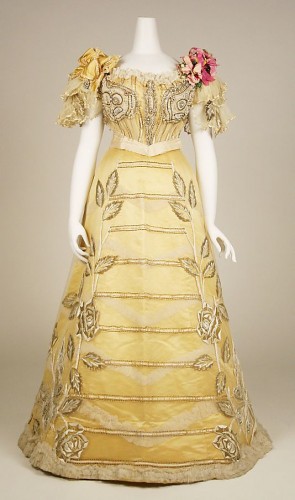
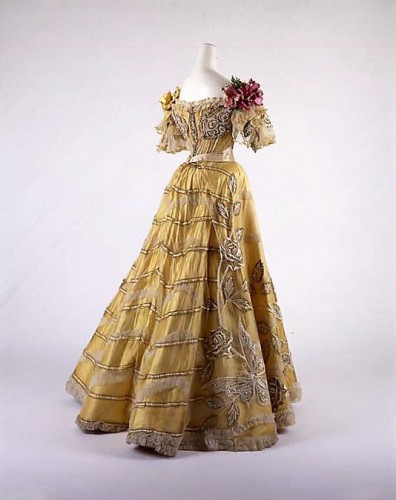
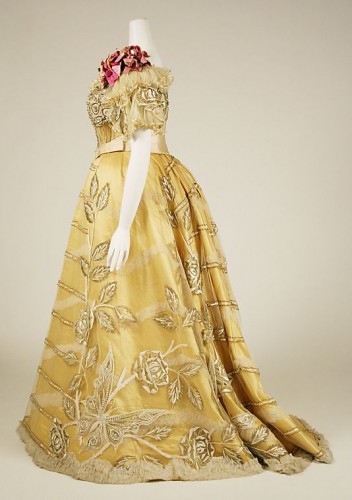
This week’s Rate the Dress theme is ‘All the Challenges‘.    I don’t see this  yellow (what shade depends on which photo you believe) evening dress from the Metropolitan Museum of Art  having much to do with peasants or the seaside (unless, perhaps it was worn to a ball at a seaside resort), but all the other challenge are covered!


Dress, Evening Duval and Eagan (American), ca. 1889, silk Met

Dress, Evening Duval and Eagan (American), ca. 1889, silk Metropolitan Museum of Art

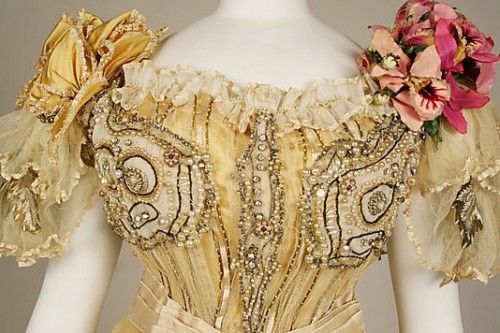
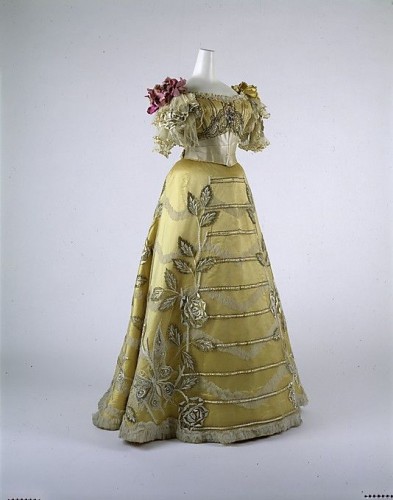
It features stripes, flora in the form of  the roses on the skirt and the corsage on the shoulder (and a corsage is essentially an accessory), fauna in the butterflies on the skirt hem and the echo of butterflies bodice decorations, plus pretty much every possible form of embellishment – lace, beading, ribbon, ruching, ribbon embroidery, bows, flowers!   If you really want to stretch it, in some photos the sash is rather like a swiss waist, and corset inspired, like undergarments on the outside (OK, I’m stretching it!).

Dress, Evening Duval and Eagan (American), ca. 1889, Metropolitan Museum of Art

Dress, Evening Duval and Eagan (American), ca. 1889, Metropolitan Museum of Art


Detail of silk evening dress, Duval and Eagan (American), ca. 1889 Metropolitan Museum of Art

Detail of silk evening dress, Duval and Eagan (American), ca. 1889 Metropolitan Museum of Art

Dress, Evening Duval and Eagan (American), ca. 1889, Metropolitan Museum of Art

Dress, Evening Duval and Eagan (American), ca. 1889, Metropolitan Museum of Art

Dress, Evening Duval and Eagan, silk, ca. 1889, Metropolitan Museum of Art

Dress, Evening Duval and Eagan, silk, ca. 1889, Metropolitan Museum of Art

What do you think?  Is the dress inventive and elegant, Victorian whimsy and maximalism at its best, or is it, well, just trying to do a little too much?

Rate the Dress on a Scale of 1 to 10


Panier Along #3: Assembling the Panier Bag bottoms

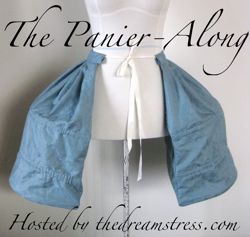
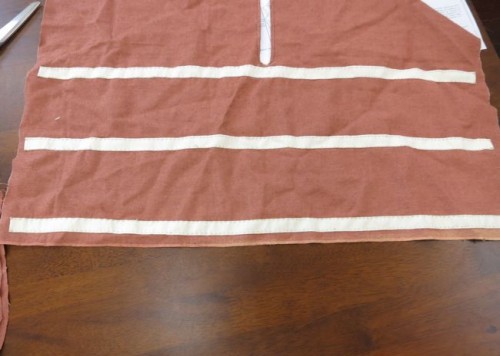
The Panier-Along When I last left you in the Panier-Along we were all sewing on our hoop channels on the panier outside.  Here are mine all hand-sewn on with linen thread:

The panier outsides with the hoop channels sewn on

The panier outsides with the hoop channels sewn on

Today, we’re going to assemble our panier bags, which is the point where your paniers really start to look like something. First, mark the centre point of the bottom of your panier outside piece (straight down from the pocket slit), and the centre point of the panier bottom piece.

Marking the centre points of the panier bottom and panier outside pieces

Marking the centre points of the panier bottom and panier outside pieces

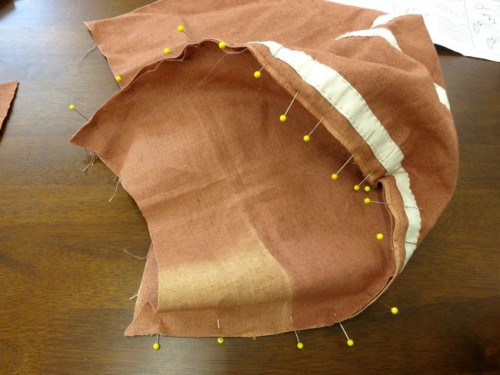
Matching these points, pin the bottom edge of the panier outside piece and the large outside curve of the panier bottom piece together:

Panier outside pinned to panier bottom

Panier outside pinned to panier bottom

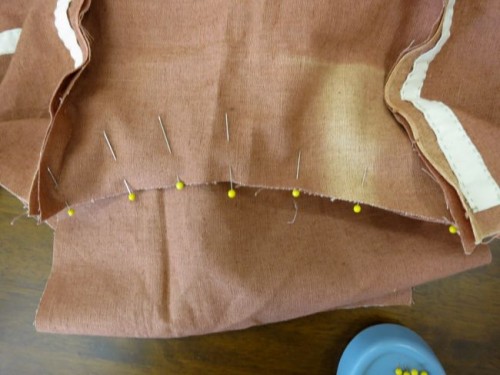
Sew that curve 1/2″ from the edge, just below your first hoop channel.  Start your line of stitching 1/2″ from the short vertical edge, at the same point where the hoop channel starts:

Start your sewing 1/2" from the edge

Start your sewing 1/2″ from the edge

With the bottom completely sewn on

With the bottom completely sewn on

There is your bottom sewn on!  Time to sew on the panier inside piece. Pin the bottom edge of the panier inside piece to the shallow curve of the panier bottom piece.

The panier inside pinned to the panier bottom

The panier inside pinned to the panier bottom

Beginning at the point where you began sewing the large outside panier bottom piece curve to the panier side piece , sew (by hand or machine) the panier bottom piece to the panier inside piece.

Sewing from the point of the panier side to panier bottom seam

Sewing from the point of the panier side to panier bottom seam

Sewing the curve

Sewing the curve

When you get to the far corner, stop your stitching just where it meets the line of stitching from the panier bottom large curve and the panier side piece.

The stitching ending where it meets the other panier bottom to panier side point

The stitching ending where it meets the other panier bottom to panier side point

I’m going to stop here, because the next two steps have optional components, where you have to make decisions about how you want your paniers to look, and what is best for your particular fabric, and this post would take too long to discuss them.  I’ll be back with that discussion tomorrow. Hope your paniers are going well!

Striped Inspiration

I was planning to do inspiration posts for each Historical Sew Fortnightly Challenge in the fortnight running up to the challenge, but I realise that defeats the whole purpose of posting the challenges weeks ahead and giving people time to plan for the challenge.  Instead I’ve decided to do inspiration posts when I announce the next challenge (a full 16 weeks ahead). Of course, first I have to catch up on all the challenges that are already up!

So, over the next few weeks expect lots of pretty, pretty historical eye candy inspiration posts.

Today I’m starting with some gorgeous stripes to get you inspired for the upcoming Historical Sew Fortnightly challenge: Stripes (#6),  mostly because I already had the post written!

I think the important thing to remember about the Stripes challenge is that there are many ways to interpret stripes.  Some people have bowed out of the challenge because they don’t like stripes, but I think that’s just silly.  Stripes don’t need to be bold, big, black and white stripes.  They can be as subtle as the tiny self-striped silk in the sleeves and bodice of my 1813 Kashmiri dress, as simple as a striped ’20s Chanel sailor top.  They can be created with striped fabric, or by applying trim to create a striped effect.

The ancient Egyptians may not have gone in for patterned fabric, but their neighbors did.  This mural shows Caananites in brightly patterned, including striped, tunics bringing tribute to Egypt.
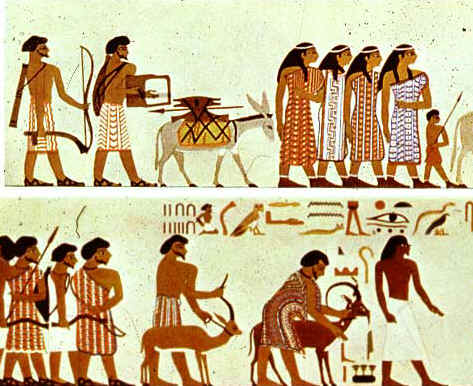
Men bearing tribute

Skipping ahead a millennia,  Parmigianino’s rosy cheeked young woman has both a fascinating striped headdress and what I think is a striped partlet -gorgeous and exotic.
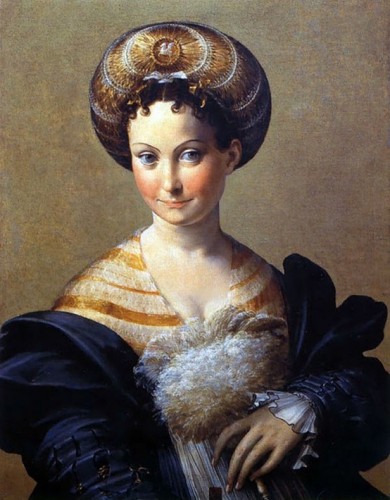
Parmigianino- A Turkish Slave (aka, Portrait of a Young Woman) (ca. 1533)

Parmigianino- A Turkish Slave (aka, Portrait of a Young Woman) ca. 1533

Now, how about some fabulous 17th century stripes going every-which way (and isn’t her dog just darling?)?

Or some sweet fancy dress stripes from the early 18th century?

ca. 1720 Henrietta Hobart, The Hon. Mrs Howard, later Countess of Suffolk, in a masquerade dress, attributed to Thomas Gibson, Blickling Hall - Blickling, North Norfolk UK

ca. 1720 Henrietta Hobart, The Hon. Mrs Howard, later Countess of Suffolk, in a masquerade dress, attributed to Thomas Gibson, Blickling Hall – Blickling, North Norfolk UK

Rococo stripes are often paired with flowers arranged in the classic serpentine line, lending them an air of femininity and frivolity:
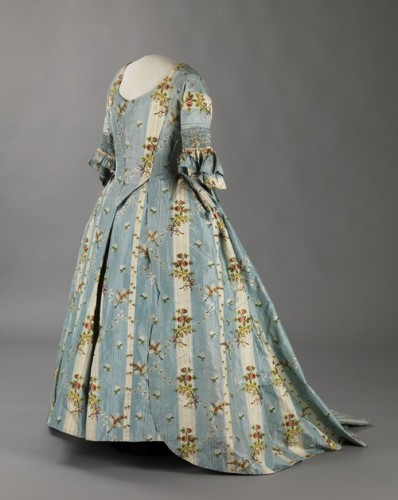
Robe a la francaise, ca. 1770’s, Digitalt Museum

Robe a la francaise, ca. 1770’s, Digitalt Museum

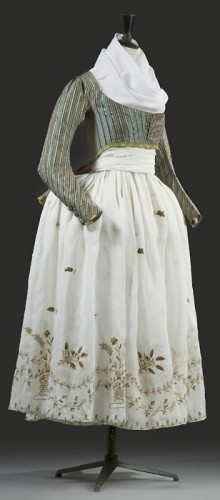
At the end of the 18th century the serpentine line of rococo gave way to the stripes and white severity of Neoclassicism – this charming jacket is a midpoint between the two:

“Macaroni” jacket and embroidered skirt, late 18th century, KCI

Striped jacket and embroidered skirt, late 18th century, Metropolitan Museum of Art

Another version of the Neoclassical stripe is seen on this late 18th century fashionista:
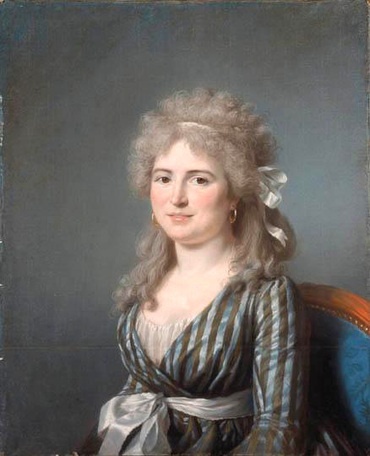
Portrait of a Portrait of Mme J L Germain , Marie-Gabrielle Capet, 1780s

Portrait of a Portrait of Mme J L Germain , Marie-Gabrielle Capet, 1780s

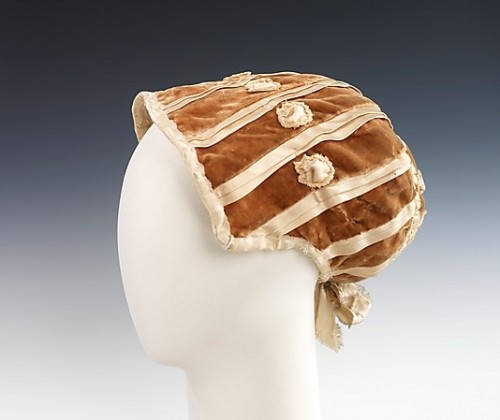
Of course, not every striped item has to be a full frock.  This bonnet with its trim stripes is just adorable:

Bonnet, Evening, ca. 1802, American, silk, Metropolitan Museum of Art

Bonnet, Evening, ca. 1802, American, silk, Metropolitan Museum of Art

Neoclassical stripes were soften with lace and trimmings as the 19th century progressed, but they are still quite bold and severe and striking in this frock:
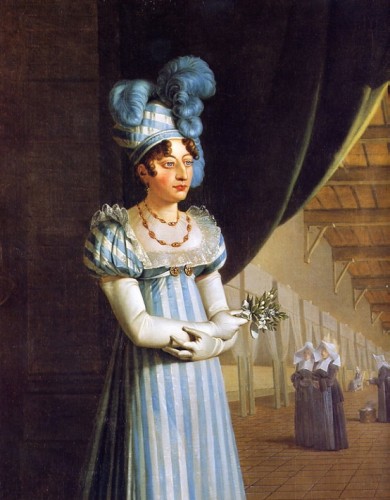
The Duchesse d'Angoulême and the Hospital at Toulouse by Joseph Roques, 1815 or later

The Duchesse d’Angoulême and the Hospital at Toulouse by Joseph Roques, 1815 or later

I love the use of horizontal stripes in the mid-19th century.  It really emphasizes the width of the hoopskirts.

Morning dress, 1860-65, silk, American, Metropolitan Museum of Art

Morning dress, 1860-65, silk, American, Metropolitan Museum of Art

And look how beautiful the arrangement of stripes on this bodice is:
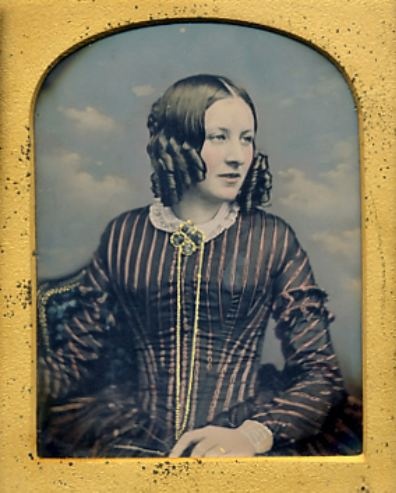
ca 1850’s hand-tinted daguerreotype portrait of a young woman posed in front of a cloud backdrop

ca 1850’s hand-tinted daguerreotype portrait of a young woman posed in front of a cloud backdrop

The Victorians knew how to do stripes, using them to full effect in 1880s bustles.  This frock manages to be both striking and subtle in its use of stripes:
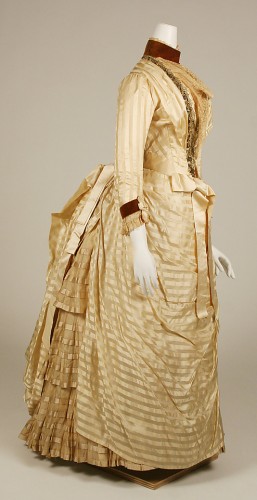
Dress, ca. 1886, American, silk, metallic thread, beads, Metropolitan Museum of Art

Dress, ca. 1886, American, silk, metallic thread, beads, Metropolitan Museum of Art

If that’s a little too subtle for you, perhaps this one is bold enough:

Evening Dress, Jacques Doucet, 1890s, The Mint Museum

Evening Dress, Jacques Doucet, 1890s, The Mint Museum


For something a bit simpler, this teens jacket could easily be used in modern life, and the lavender dress cleverly creates its own stripes through the use of trim:

Day and sport dresses, 1916, US, the Delineator

Day and sport dresses, 1916, US, the Delineator

These 20s swimsuits use very modern and restrained stripes – the tops could be worn as simple singlets today.
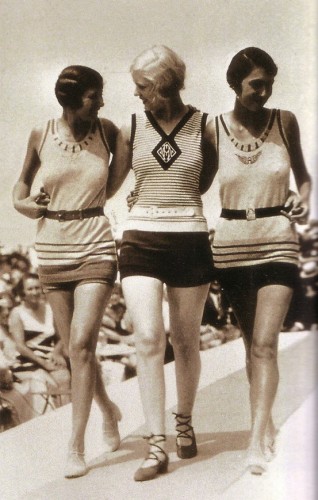
Swimsuits, 1928

Swimsuits, 1928

What’s not to love about Hattie Carnegie’s amazing use of stripes in this ’30s ensemble.  Tres chic!
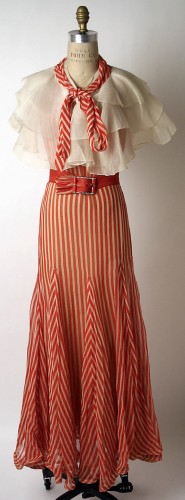
Striped evening ensemble (dress, belt, cape, slip) by Norman Norell for Hattie Carnegie, Inc., American, 1932, Metropolitan Museum of Art

Striped evening ensemble (dress, belt, cape, slip) by Norman Norell for Hattie Carnegie, Inc., American, 1932, Metropolitan Museum of Art

Finally, something from the very last year of eligibility.  These sandals are just fabulous, and I think they could be replicated with strips of suede and a pair of modern sandals with the right heel.

If that wasn’t enough striped inspiration for you, I have a whole pinterest page of striped loveliness to spark your imagination (just remember that the post 1938 stuff is not eligible for the HSF).