Latest Posts

Panier-Along #2: Pocket slits and hoop channels

The Panier-Along

Welcome back to the Panier-Along (look, there is a button!  And it links to a Panier-Along page!).  Yesterday we cut out our panier pattern pieces – today let’s start sewing!

The first sewing step it an optional one.  Some historical paniers have slits at the top so that you can use the paniers as pockets (since wearing paniers and pockets can get a bit tricky).  If you don’t want pocket slits, you can skip this step and move halfway down the post to the next step.

First, mark a line 6″ down from the centre top of your 25″ wide panier outside piece.  This will be your slit to reach through.
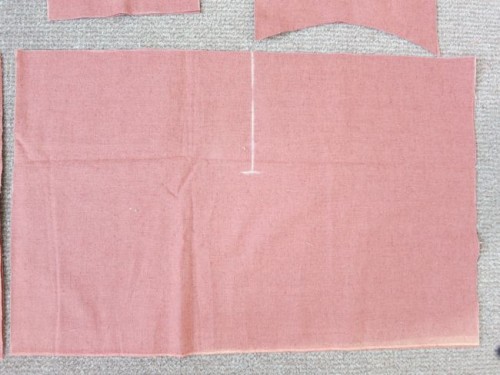
Measuring down 6" from the centre top

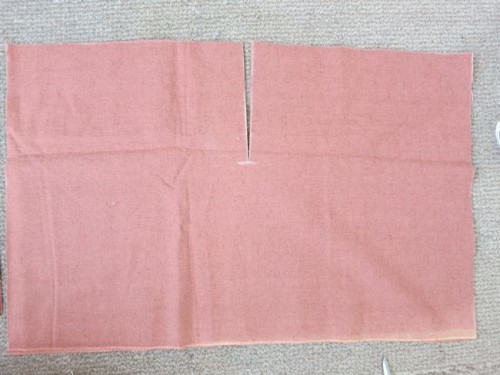
Cut down this line:

Cutting down the panier pocket slit

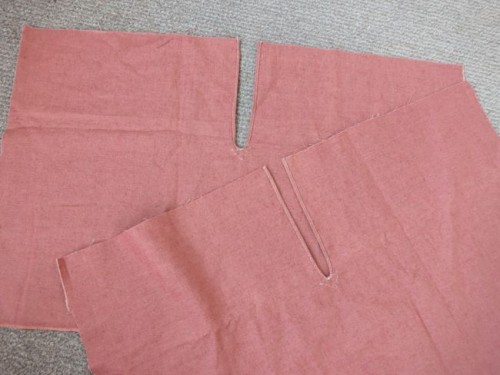
Now, you need to finish the raw edges of the pocket slits.  My way of finishing pocket slits is based on historical examples, but if this method is too complicated you could just widen your slits a little so that they form narrow U shapes and bind the edges with bias tape.

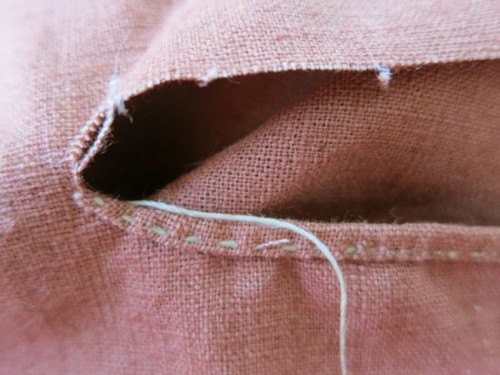
To do it historically,  make a narrow hem down one side of the slit, tapering to nothing at the bottom of the slit.  I’ve done it by hand, but this can be done by machine as well.

Hemming the slit

A detail of the bottom:

A detail of the bottom

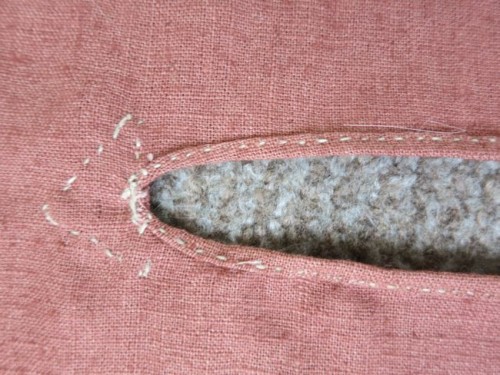
Do the same to the other side of the slit, and sew back and forth a couple of times at the bottom of the slit to strengthen it:

The bottom of the slit

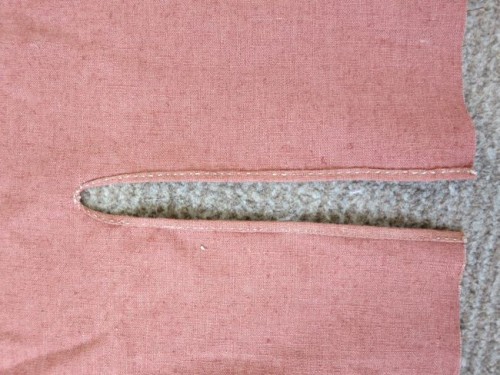
Your finished slit will look like this:

Front:
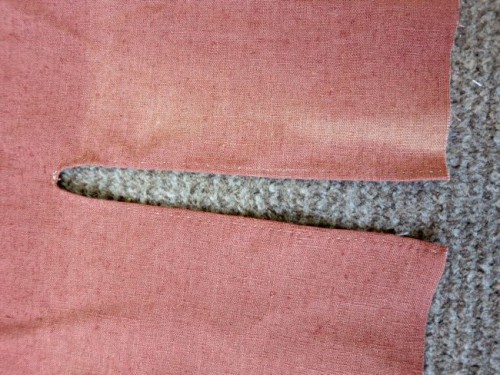
From the right side:

Back:

Finished slit from the back

Then do the same to your other slit.

Now we need to re-inforce the bottom of the slit so that it doesn’t rip with wear and use.  First, cut a 1 1/4″ square from your scrap fabric:

A little square to reinforce the bottom of the slit

Fold the square in half diagonally, forming a triangle:
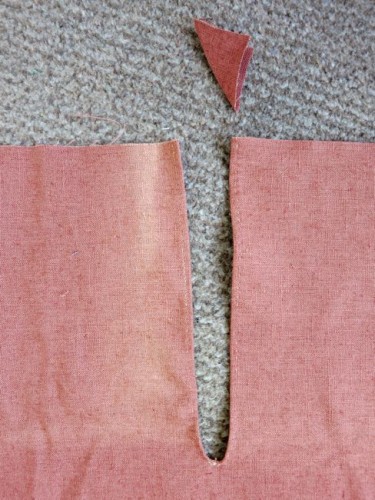
The square, folded in half diagonally

Press the raw edges of the triangle under it, and place the folded edge of the triangle along the bottom of your slit.  Sew it in place.  (and I’ll show you how-unbeautiful mine looks, so that you don’t feel bad about how yours looks, however it comes out).
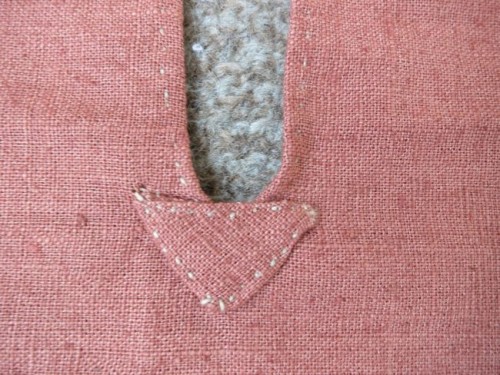
The sewn-down triangle

The sewn-down triangle from the back

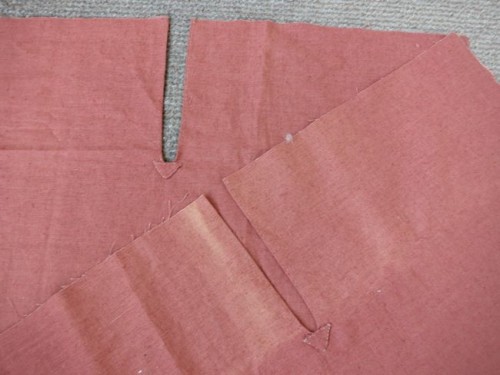
Do the same thing to the other slit:
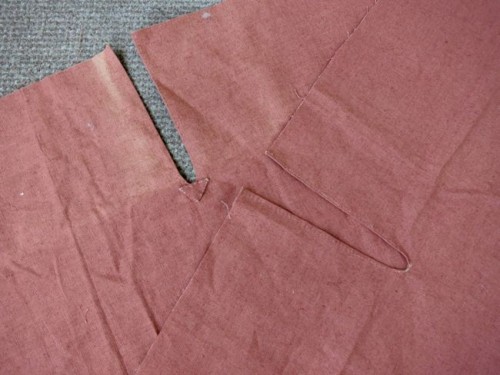
One with triangle, one without

Both slits with reinforced triangles

Both with reinforcing triangles

Yay!  You now have two strong, historically accurate, functional pocket slits.  Or not, if you chose to skip this step.

Right, now let’s get to the sewing that isn’t optional: your hoop channels.

On the backs of the panier side pieces (the 25″ wide ones) mark points at  half an inch from the hem, 4 1/2″ from the hem, and 8 1/2″ from the hem.
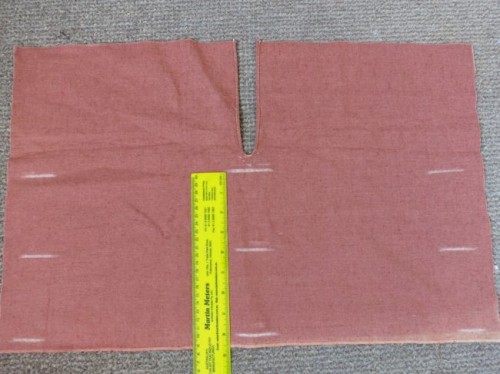
Marking the hoop lines

Draw lines with chalk across your piece, connecting these points from edge to edge.  These will be the lines that your hoops will run along.
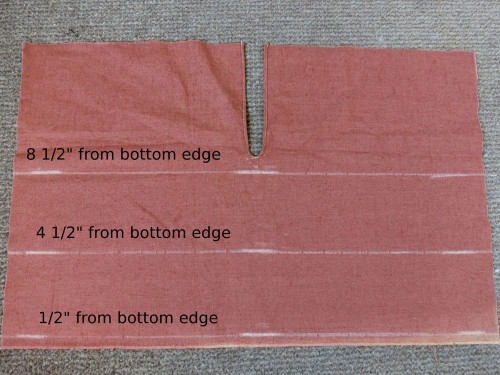
Panier hoop lines2

Using your twill tape, or strips of fabric with their edges turned under (making sure that either is wide enough to sew down and snugly slip your hooping/cane etc through, lay the a 26″ length of tape with it’s bottom edge along the top line and pin it down:
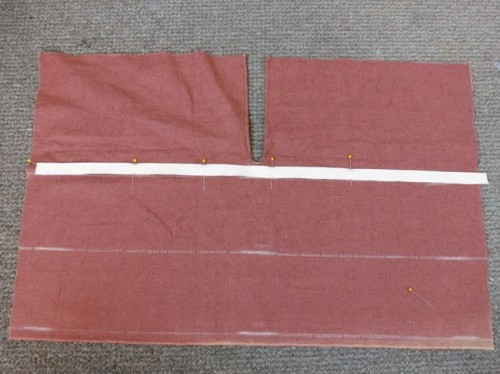
Pinning down your first tape

Turn the edges of the tape under at each end so that they are 1/2″ away from the cut edges:
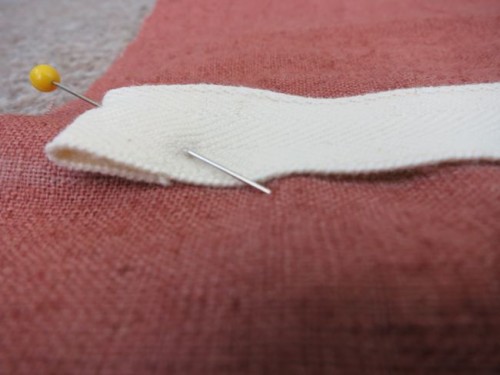
The turned under tape

Sew your tape down along the line by hand or machine, taking care to make sure the ends are well tacked down:
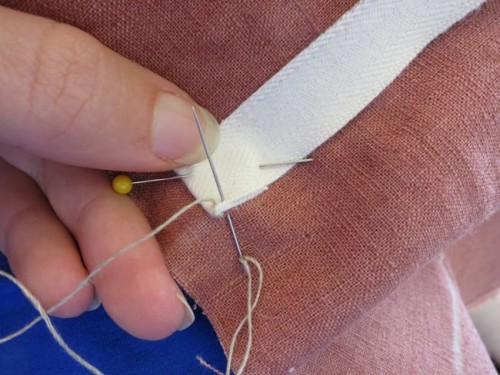
Tacking down the ends securely

I like to do a bit of a Hudson Bay start and sew in a few inches on the top and bottom of the tape and then double check that my hooping fits in snugly, without being too tight and hard to insert:
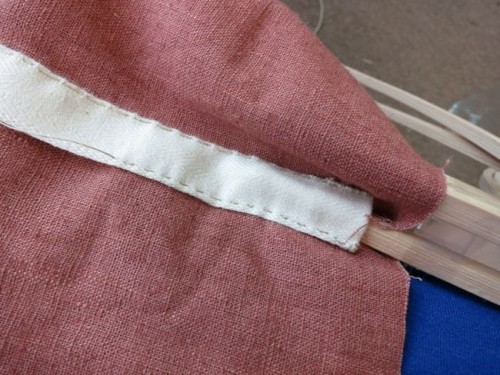
Checking my hooping insertion

If that is all in order, continue sewing your entire length of tape on:
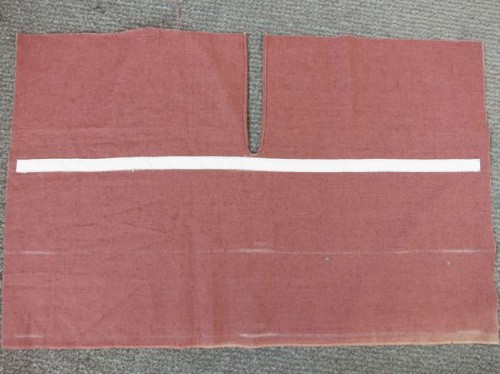
Tape one sewn down

Repeat with the middle tape, making sure the bottom edge of the tape is along the top of your chalk line:
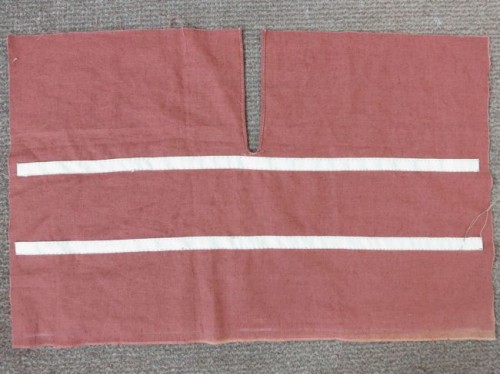
Second length of hoop tape sewn down

Do the same with the bottom length of tape, making sure to leave a 1/2″ seam allowance below it.  And then do the same thing for the other panier side piece!

Detail of the sewn-down hoop tapes

Tomorrow I’m going to take a little break from the Panier-Along, and post some pretty, pretty inspiration for an upcoming Historical Sew-Fortnightly challenge, and then I’ll be back on Saturday with your next step.
Panier Along #1: Pattern pieces

Yay!  Hello!  Welcome to the Panier-Along!  Over the next two weeks I’ll be walking you through making 1770sish paniers.

To start with, check out the Materials List.

Now that you have all your materials sorted, let’s get the pattern figured out, and your fabric cut.

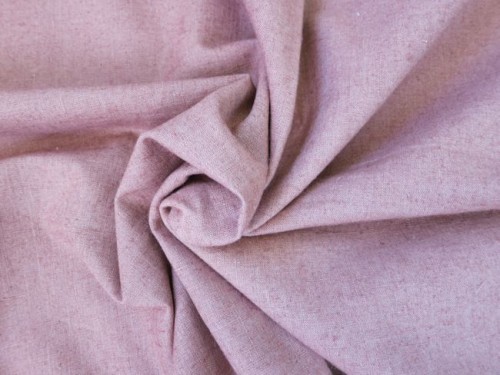
I’m using a lovely heavyweight linen in a sort of pinky-terracotta that was in my stash. It’s got some light fading, but is really ideal in terms of weight and the tightness of the weave: it will support the boning well without being too thick to pleat.

I know I said I’d be machine sewing, but linen is such a pleasure to hand-sew that I have changed my mind, and will be hand sewing it.

Pinky-terracota linen

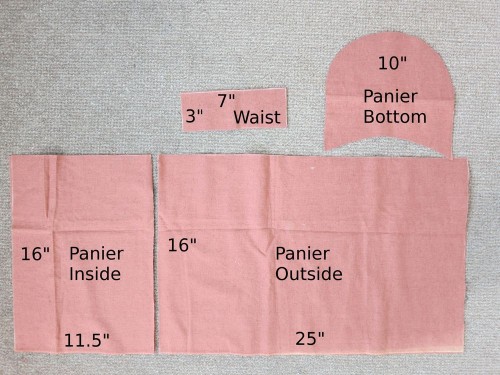
The pattern pieces for the paniers look like this:

Panier pattern2

There are two of each (one for each side of the paniers), and they are laid out as I cut them from my 45″ wide  fabric.  The rectangles are pretty self explanatory, but here is how to draft the panier bottom:

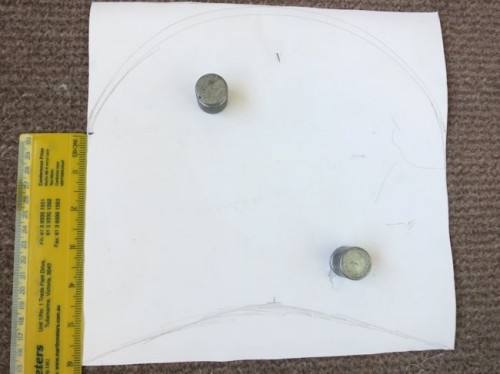
Start with a 10″ pattern piece.  Measure up 6″ from the bottom left corner and make a mark.  Measure up 6″ from the corresponding corner, and make another mark on the right side.

10" square for the pattern piece

Then measure down 1/4″ from the centre top, and make a mark.

The 10" pattern piece for the panier bottom

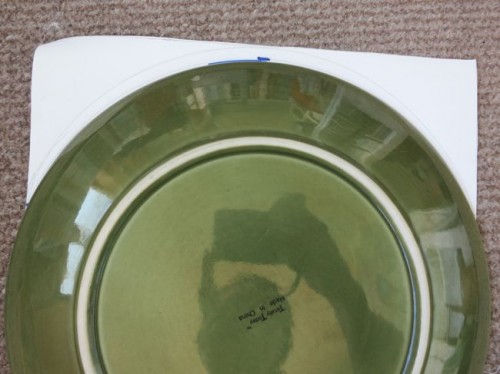
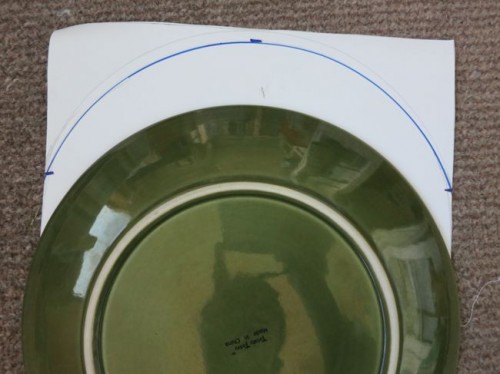
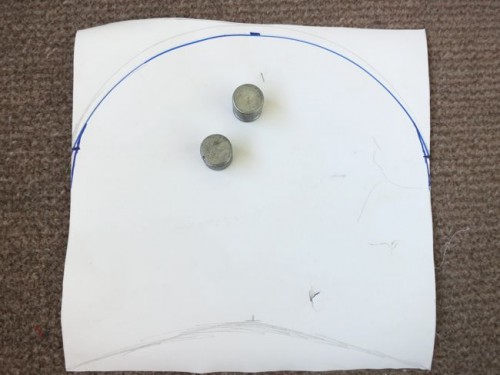
Now, using a large plate (10 1/2″ across) draw a curve that connects the three points.

Drawing a curve with the plate

The curve

That curve will be the outside curve of your panier.  You may wish to smooth down the edges where the curve meets the square so the transition is a little smoother.

With the edges smoothed a bit

Measure along the curve from the bottom left point to the bottom right point, just to make sure it is the right length around.  It should be 25″ along the whole curve, just like your panier side piece.

Now, measure up 1 1/2″ from the centre bottom of the square.  Sketch a curve from the bottom left corner up to the point, and down to the bottom right corner.

The bottom curve of the bottom panier piece

This curve will fit around your hips, helping the paniers to stay closer to your body.

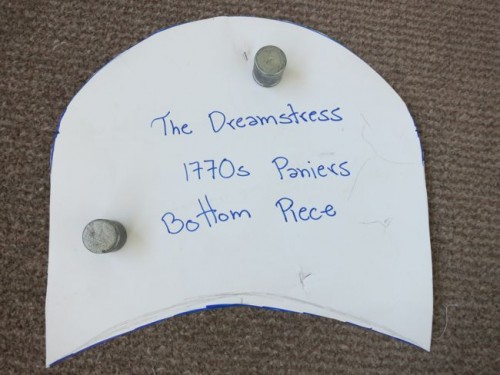
Now, cut out your pattern piece and label it so you know what it is.

1770s panier bottom piece

OK, hard part done!  Now you can cut out all your fabrics.

First, cut your side pieces, the piece that will have the boning inserted along it, two 25″ x 16″ rectangles.

Then cut your back piece, which will sit against your body.  They are two 11.5″ x 16″ rectangles

Cutting the two large rectangles

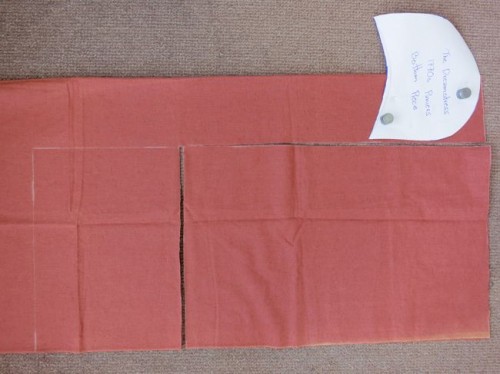
Then cut your bottom piece.  I did this by unfolding my lengthwise fabric fold, and refolding it horizontally, so it fits two curved bottom pieces.

Cutting the bottom pieces

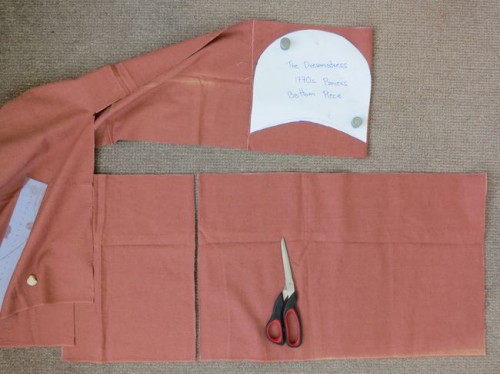
Finally, cut the last two pieces, 3″ x 7″ rectangles which will form the channel that you slip the waist tape through.  Now you should have all these pieces:

Panier pattern 2

How easy was that?  Tomorrow I’ll show you how to cut and finish the slit for your pockets (this is an optional step), and the day after that how to measure and sew the boning channels.

Rate the Dress: Margaret of Anjou in Romantic pink

Silly me!  Forgot to tally up last week’s votes on Pierre Balmain’s 50’s ostrich feather and diamantes frock.  As it turns out, you either like ostrich feathers, or you don’t, so the votes were quite divided, balancing out at 7.5 out of 10, which was a rating that absolutely no-one gave the dress.  Such is the Rate the Dress though!

This fortnight’s theme in the Historical Sew Fortnightly is Under It All – making undergarments, and starting tomorrow I’ll be leading a Panier-Along as I teach how to make paniers.  However, showing you undergarments to rate isn’t that interesting, and I didn’t just want to show dresses worn over paniers.  Maybe I’ll do one of those next week!

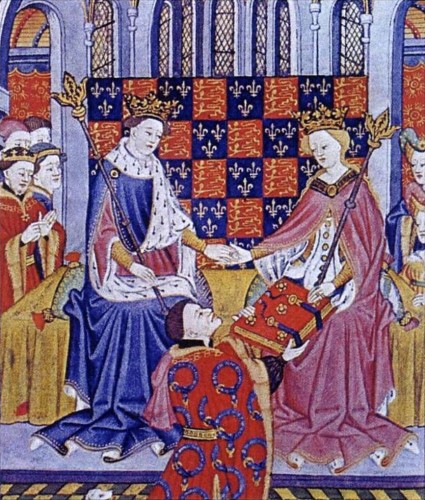
Instead, I’ve gone for something random: Margaret of Anjou  being presented with the Book of Romance in a ca. 1445 illumination.

John Talbot, 1st Earl of Shrewsbury, presents the Book of Romances (Shrewsbury Book) to Margaret of Anjou, wife of King Henry VI, circa 1445 by the Talbot Master

John Talbot, 1st Earl of Shrewsbury, presents the Book of Romances (Shrewsbury Book) to Margaret of Anjou, wife of King Henry VI, circa 1445 by the Talbot Master

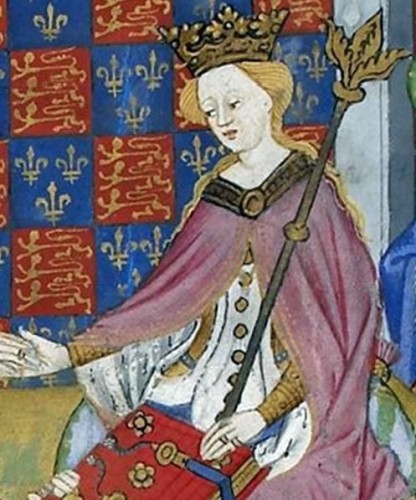
Want to see that in detail?

The young, beautiful Margaret, in the years before the disastrous War of the Roses, and while her husband still had some grasp of reality, is shown wearing an ermine-trimmed mantle of dusky pink over a dress of golden yellow with a surcoat (is that what those things are called) of blue with gold buttons.  There is some fascinating detailing around the edges of the cloak, and in the collar and sleeves.

What do you think?  Pretty, pretty medieval princess, or a bit too layer-y?  Are her crown and scepter just a trifle over the top, and is it a pity that her frock clashes so with the book?

Rate the Dress on a Scale of 1 to 10