Mr Dreamy can rarely be convinced to wear vintage styles, but I still like collecting vintage mens patterns, partly because they are useful for clients, partly because I want to teach classes on vintage menswear, and partly out of a hope that someday he will convert and become as enamored of vintage fashions as I am.
A lot of my vintage men’s patterns are from the 1970s, because the 70s was a great period for men’s patterns – incredibly well written and drafted, and easy to alter to other periods. I do have some earlier patterns though, so I’ll focus on those today.
Like Butterick 3999, the only menwear pattern that I inherited from my Grandma. I can just imagine Grandpa wearing this shirt. I don’t think he played golf though.
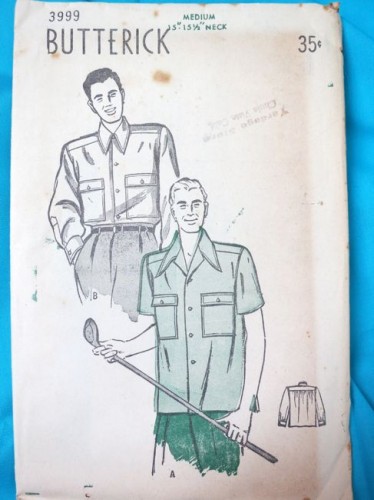
Butterick 3999 – ’50s sports shirt

Butterick 3999 – sports shirt with convertible collar
Academy 2174 is the (slightly earlier, or well behind the times) New Zealand version of the sports shirt. I love how dapper the men are, in a sort of really ugly Clark Gable way.
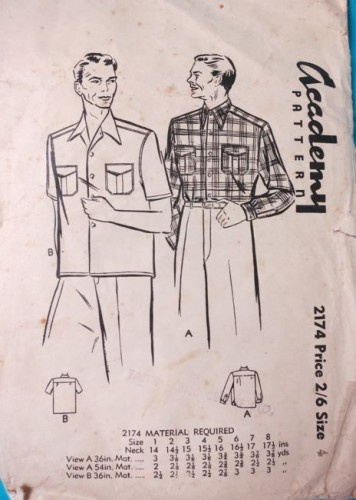
Academy 2174 – Sports shirt with long or short sleeves
Keeping things casual is Weigel’s 1590, with beach shorts, summer shirt, and bathers. Yep, that pattern is never going to entice Mr D!
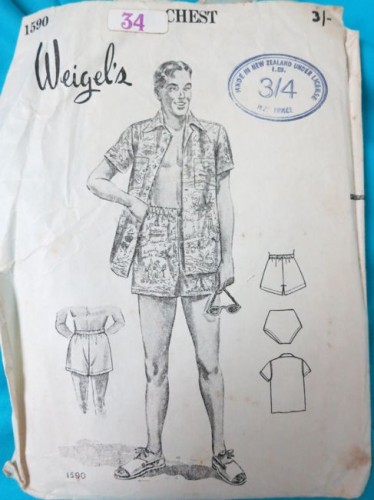
Weigels 1590 – beach shorts, shirt and bathers
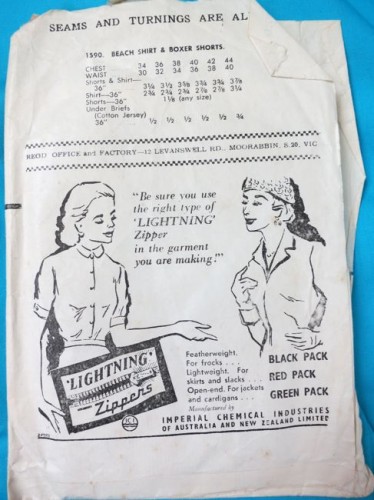
Weigels 1590 – beach shorts, shirt and bathers
If that is too much skin to show, how about Academy 4601, with its men’s track suit? I wonder if this pattern is in any way linked to the popularity of running in New Zealand in the ’50s and ’60s, when NZ was top of the world in running?
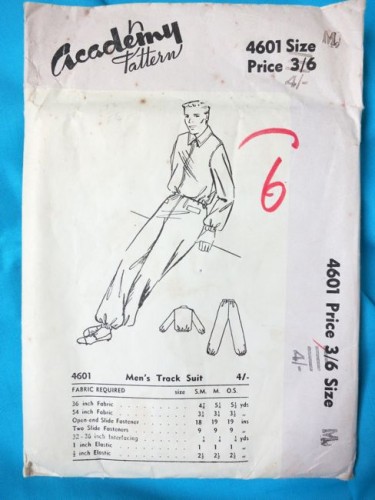
Academy 4601- Men’s track suit
If the beach and running aren’t your thing, how about the woods? Simplicity 3074 offers both what it blandly describes as a ‘men’s jacket’ (I’d call it a bomber jacket) and a lumberjack jacket!
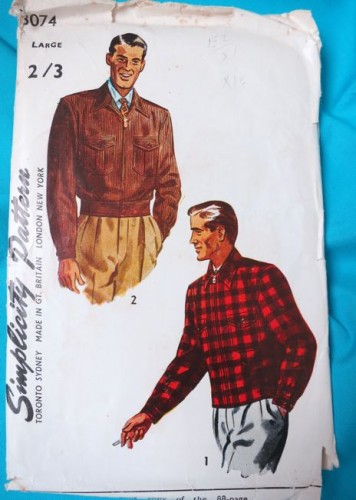
Simplicity 3074 – bomber jacket and lumberjack jacket
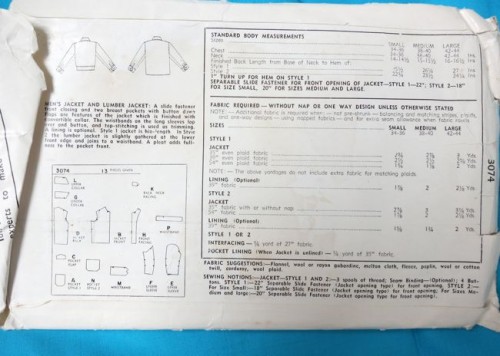
Simplicity 3074 – bomber jacket and lumberjack jacket
I also have a more formal men’s jacket pattern from the ’50s, in the form of Simplicity 4107, which also has the option of a snazzy vest.
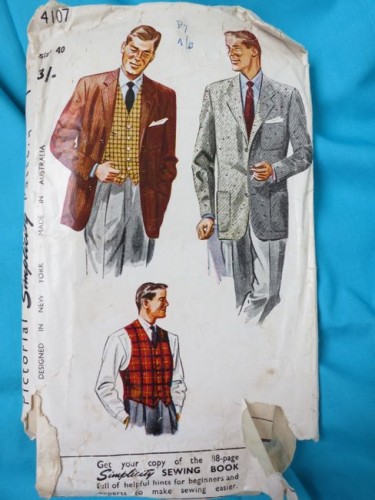
Simplicity 4107 – ’50s mens jacket and vest
Oh, and it’s a ‘Father and Son Fashion’, so you can make your boy one to match!
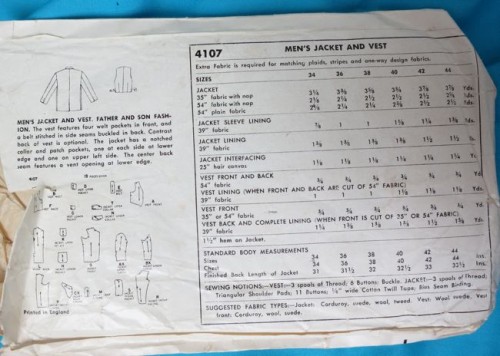
Simplicity 4107 – ’50s mens jacket and vest
The rest of my ’40s & ’50s mens patterns are all sleepwear. I suspect that many women found sewing most menswear daunting, so left that up to the professionals, but felt pyjamas were within their skill set, hence the abundance of pyjama patterns (tangent: When did we stop spelling them pyjamas? I’ve always spelled them pyjamas, and only recently discovered via a google search for pyjama inspiration that pretty much no-one else does. The world lost a bit of piquancy when it replaced that ‘y’ with a bland a. Bring back the y!)
I love Home Journal 9744, mostly because the handsome fellow on the cover with his turkish towel reminds me off a cross between Inspector Poirot and Nick Charles. You just know that someone has been murdered just off the edge of the pattern, and he’s off to solve the mystery!
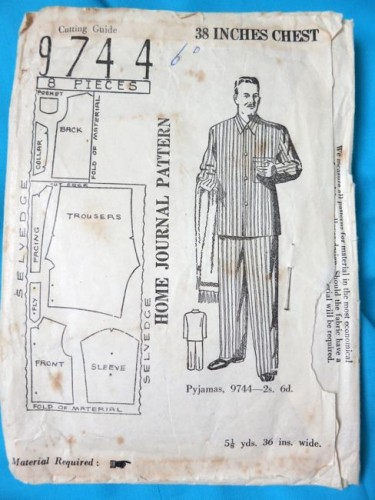
Home Journal 9744 – mens pyjamas
The models on Academy 2042 aren’t nearly as worldly, nor are their towels as posh. The toothbrush is a nice touch though!

Academy 2042 – boys pajamas (or pyjamas)
A fun little quirk of this pattern is that no-where on the pattern envelope, or in the directions, does it use the word pajamas or pyjamas – the directions refer to ‘top’ and ‘trousers’ and the envelope is completely silent as to what is being sewn. The pattern pieces themselves are unmarked. That’s one was to avoid the question!