Latest Posts

There is just something about red shoes

I just love red shoes.  They are like happiness for your feet.

Amazingly, I’ve owned very few red shoes, because the modern ones just aren’t as pretty as my historical ideals.

Want to see some of the ones I lust after?

This pair is darling, but so practical.  If a modern shoe company came out with a replica, I would buy them in a heartbeat!
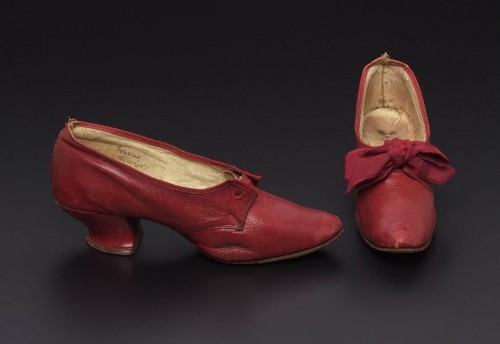
Red leather shoes, American, end of 19th century, Museum of FIne Arts Boston,51.1997

This pair may not be quite as practical, but, oh, that fabric!

Shoes, 1732—59, British, silk, leather, metal, Metropolitan Museum of Art

And just imagine how gorgeous these shoes would have looked when worn, with the little tassel swaying jauntily with each step.  Darling!

Slippers, 1790—1810, European, leather, silk, metal, Metropolitan Museum of Art

Actually, now that I think of it, that tassel and buckle is something I could do myself.  I must make it happen!

I like the juxtaposition of the tasseled pair and this much more recent pair.  I’d wear either in a heartbeat.
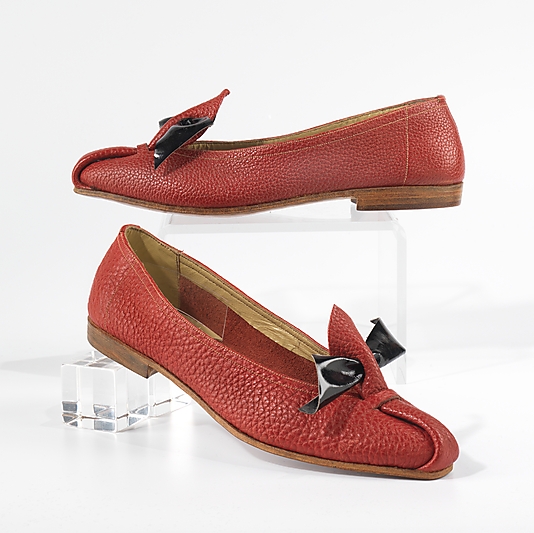
Shoes, Albion, 1956, Italian, leather, Metropolitan Museum of Art

Speaking of red and black shoes, the next pair is more red than black, but I think we can agree they deserve to be featured.  They are embroidered in strawberries after all!
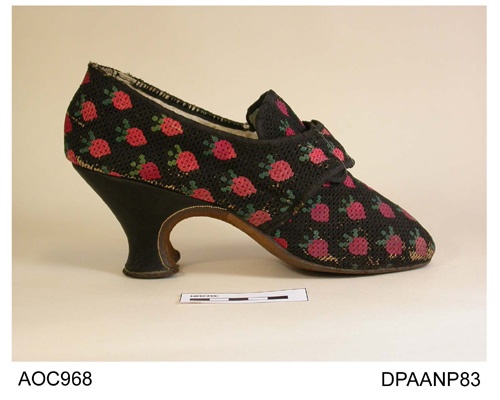
Shoes with strawberries, 1760-1770, Hampshire City Council Museum

Speaking of patterns, was I ever not going to like a shoe in red and gold with a Greek key variant?

Shoes, French, leather, 1920-28, Paris, Musee international de la Chaussure

The shape of the next shoe doesn’t make my heart flutter, but the overall effect does.  Red stripes!  Happiness!

Shoes, 1845—60, French (probably), cotton, silk, Metropolitan Museum of Art

I’ve shown these sandals before in my Regency sandal post, but they are too fantastic not to post again:
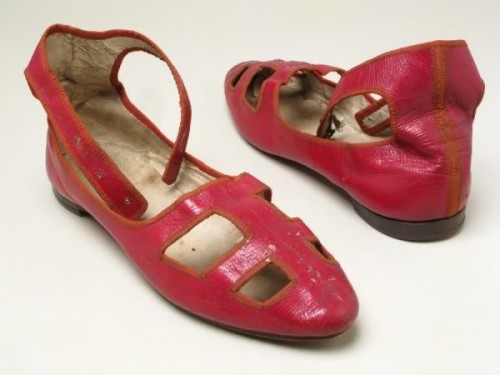
Sandals, 1800-1825, leather, Manchester City Galleries

My late 1930s wardrobe is much sadder for not including these shoes:

Shoes, Delman, 1937—39, American, leather, silk, Metropolitan Museum of Art

And finally, for the most fabulously ridiculous pair of red shoes ever:
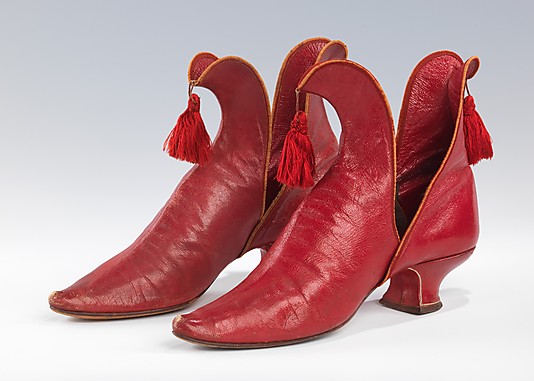
Slippers, Rosenbloom’s, ca. 1892, American, leather, Metropolitan Museum of Art

Do you like red shoes?  Or do you subscribe to the idea that they are ‘common’?  Which is your favourite?


Rate the Dress: Worth IV does Zig-zags

Last week Fidelo summed up your reaction to the purple, orange and green 1870s frock perfectly: “This  should not work. It really should not work at all. The fact that it does is genius.”  And because it was genius, you gave it a rating of 9.3  out of 10, which is pretty much as close as we’re ever going to get to perfect!

This week, I’m presenting a very different dress from a very different era, but I feel it has some of the same elements that made last week’s dress so successful: unusual choice of colour or pattern, clever construction, a balance of structure and femininity, and just a wee bit of cheek.

Evening dress, silk, House of Worth, Roger Worth, ca. 1938, Metropolitan Museum of Art

This dress is also a fun one to present, because it’s by Roger Worth, the great-grandson of CF Worth, and one of the last designers of the House of Worth (the last was his brother Maurice).  You haven’t much cared for the second and third generations of Worths, but what about the fourth?  Did Roger manage to return to his great-grandfather’s greatness?

On a side note, one has to wonder about the Worth family.  They are the world’s greatest couturiers, handing down the family tradition from the stately Charles Frederick to the clever Gaston and artistic Jean-Phillipe, followed by the romantic Jean-Charles and the enterprising Jacques, and what does Jacques choose to name his heirs, who must carry on the glamorous tradition of fashion?  Roger and Maurice.  No wonder the House of Worth shut!

Right, so Roger might not be the most evocative name, but how do his fashions fare?  Does his zig-zagged extravaganza dazzle you?

Rate the Dress on a Scale of 1 to 10 (whole or .5 ratings only, I’ll ignore any more specific fractions)

Tutorial: a simple, sweet little drawstring gift bag

Last week I shared the tutorial for making the simple zippered cushion cover that I use to teach zip insertion in my Absolute Beginners class.  This week I thought I’d share an even easier tutorial – one for the simple drawstring bag that is the very first thing that I teach my Absolute Beginner students to sew.

I love these bags, and have been making them for almost as long as I could sew.  My mother doesn’t like wrapping presents, so I made her dozens of them in lovely festive fabric, and she just pops her presents in them – easy-peasy, looks gorgeous, and totally green and recyclable, because she’s still using the ones I made her 10 years ago!

These days I make little ones to keep my pearl necklaces in, middle sized ones to hold the accessories to each of my historical outfits, and bigger ones for sorting socks and undies when I travel.

This tutorial makes a  a 15cm (6″) wide x  22cm (8 3/4″) long bag – perfect for a chunky pearl necklace, or a mobile phone.

To make a different sized bag your piece of fabric should be the width you want + 3cm (1 1/4″), and the length you want + 12cm (4 3/4″).  Your ribbon length should be the width of your bag x2 + 30cm (11 3/4″).

For this tutorial you will need:

  • One piece of fabric 18cm (7″) wide x 52cm (20 1/2″)
  • Two lengths of 1 – 1.4cm (3/8 – 1/2″) wide ribbon, each 60cm (23 1/2″) long
All stitching in this tutorial is done with a standard (2.4-2.6) stitch length.

Step 1: The side seams

  • Start with your long, narrow length of fabric.  Fold it in half widthwise, and measure down 4cm (1 1/2″) from the cut ends.  Make a mark.  Measure down another 2cm (3/4″) and make another mark.  Finish all four edges with zig-zag stitches if desired (I decided not to for this bag).

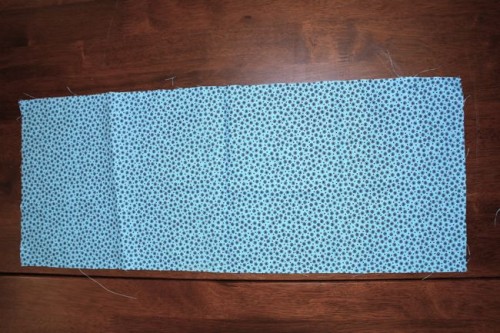
    Your length of fabric

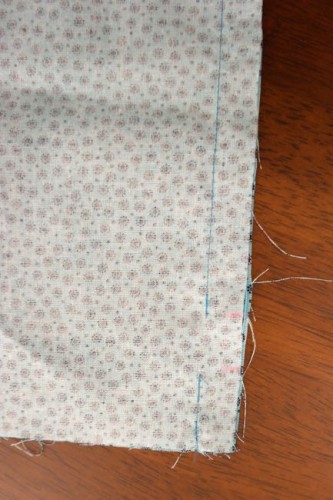
    The fabric folded in half, with pink markings from the top end

  • Using a standard stitch length (2.4-2.6) and a 1.5cm (5/8″) seam allowance, start at the top on one side of your folded fabric and backstitch.  Stitch down to the first mark, and backstitch again.  Leaving the 2cm space between the marks open, backstitch below the 2nd mark, and stitch down to the bottom of the fabric, backstitching at the end.  The space between the marks will be where you thread your ribbon.    Repeat on the other edge of your folded fabric.

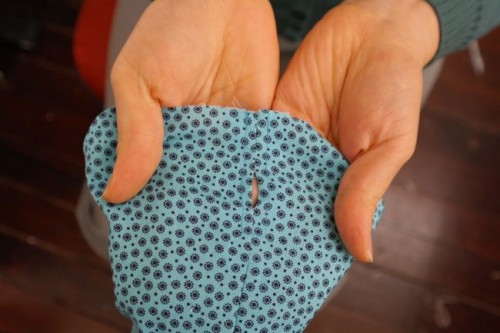
    The stitched side seam, with a gap left open for threading your ribbon

Step 2: Securing the ribbon holes.

  • Press the two side seams that you just sewed open, so that the threading gap is nicely visible.  Starting at the top (raw) edge of your bag and sewing through the outer fabric and the seam allowance so that you are sewing the seam allowance open, topstitch  7mm (1/4″) from the side seam down to just past the gap in the seam.  Lower your needle, lift your foot, turn your fabric 90 degrees, sew across the bottom of the gap, turn your fabric again, and sew back up to the top of the fabric.  Backstitch again.

    Lifting the foot to turn the fabric and sew across the bottom of the threading gap

  •  Repeat for the other side.  Both of your threading gaps should now be nicely sewn open, so that it is easy to slip ribbon through them.

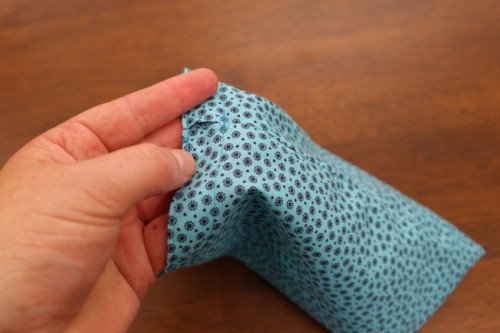
    The topstitched threading gap from the outside of the bag

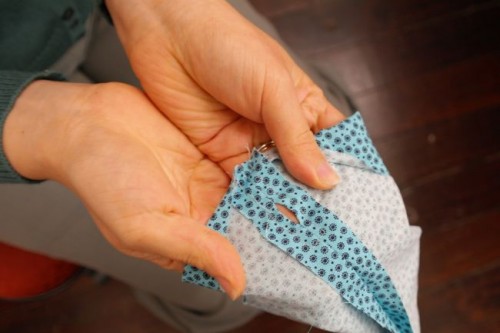
    Topstitched threading gap from the inside of the bag

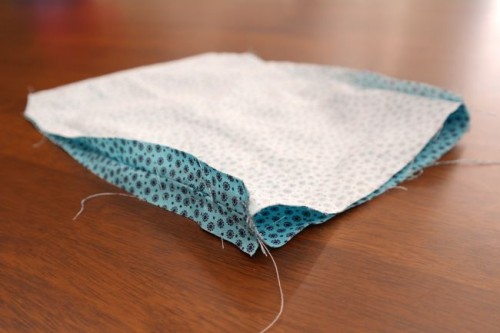
    The bag so far

Step 3: Creating your threading channel for the ribbon.

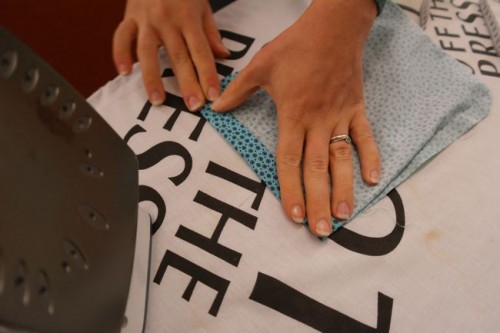
  • Turn the top edge of your fabric over 1cm (3/8″) and press.

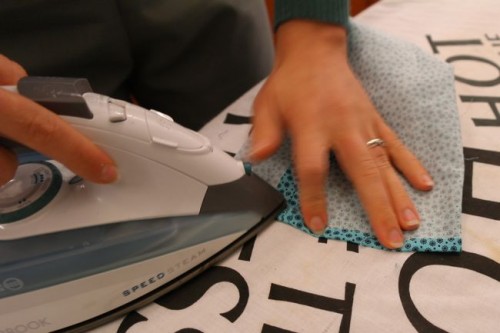
    Pressing the first 1cm fold

  • Turn the top edge again, this time 2.5cm (1″), so that the raw edge is completely enclosed, press.

Pressing the second, 2.5cm, fold

Step 3:  Sewing your threading channel for the ribbon.

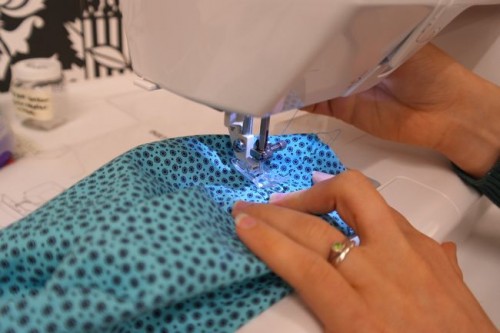
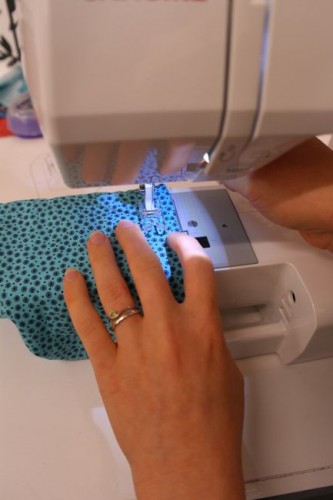
  • Using your sewing machine with the box off (free-arm sewing), slip your bag over the sewing machine arm and topstitch a line of stitching 2cm (7/8″) from the top edge of the bag around the entire top of the bag so the line of thread overlaps, backstitching as you begin and end.

    Sewing the first line of stitching for the threading channel, 2cm from the top edge of the bag

  • Topstitch another line of stitching around the entire bag, 3mm (1/8″) from the top edge of the bag, backstitching at beginning and end.  You’ve now created an enclosed channel that your ribbon can run through.

    Sewing the second line of topstiching for your threading channel

    Your two lines of topstitching and the channel for the ribbon to run through

Step 4: Threading your ribbon

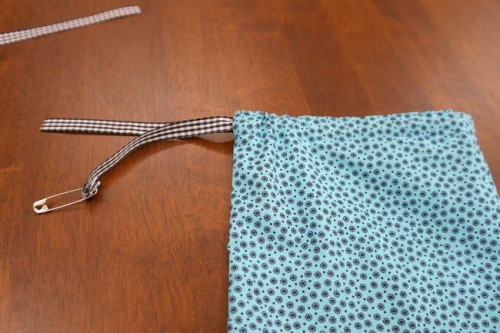
  • Take one length of your ribbon, fold the end over a cm or so, and pin a safety pin through it.  Insert the safety pin into one threading gap, and use it to thread the ribbon through the threading channel.  Thread it past the gap in the channel, all the way back to the gap you inserted it in to.  Tie the ends of the ribbon together.

    The first length of ribbon inserted through, ready to be tied off

  • Using a safety pin, insert the other length of ribbon into the second  threading gap, and thread it all the way around and back out in the same gap, in the same way you did it with the first ribbon.  Tie off the end.

    Inserting the second length of ribbon

    The second length of ribbon brought back out its original threading gap

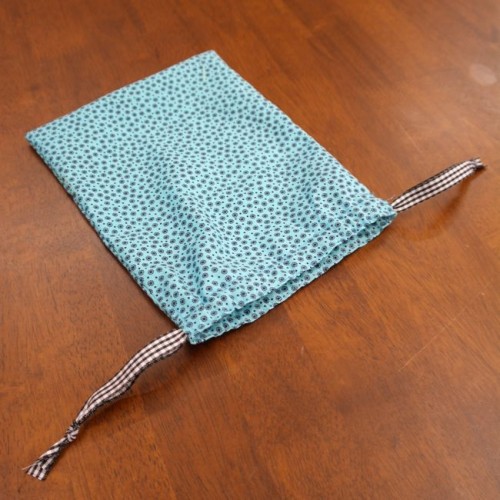
    Both lengths of ribbon tied off

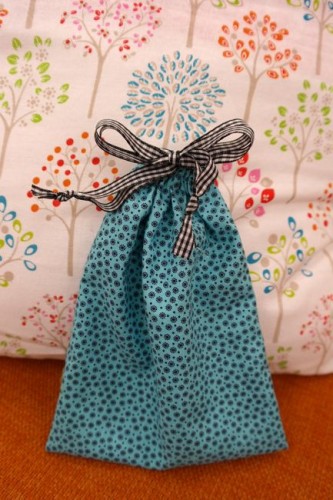
Ta da! Your bag is done. Tug on both lengths of ribbon at the same time  to pull the bag closed, and tie off in a bow.

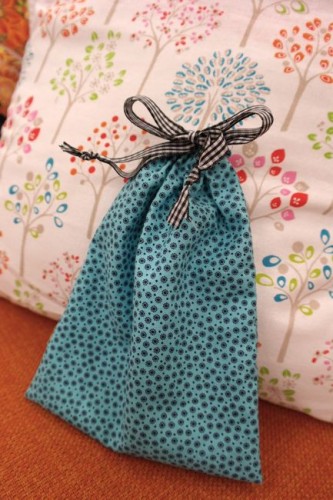
Your finished bag