Latest Posts

The Turkish tea robe at the Honolulu Museum of Art

A bit back I showed you a taster of the lovely textiles that I was lucky enough to see in the textile store at the Honolulu Museum of Art, and promised to show more images and tell you about them.

Today, let’s look at an intriguing garment made in Turkey:
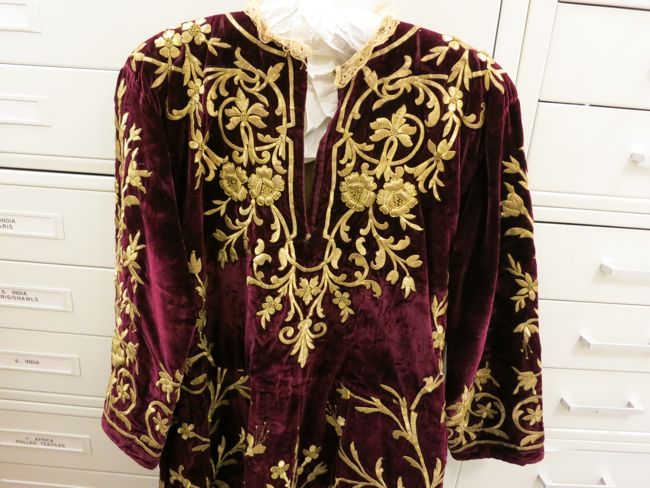
Robe, late 19th century, Turkish, Honolulu Museum of Art

This garment is a robe of silk velvet in a rich burgundy red, heavily ornamented with scrolling florals in gold.  The gold is still bright and untarnished, indicating that it is real gold, probably made by  rolling or wrapping thread in tissue-thin gold leaf.

The ornamentation is made in the most intriguing way.  First, paper models in the desired shapes were cut out.  Then, gold thread was wrapped around the paper shapes, completely covering the paper.  Then, the gold-wrapped shapes were sewed down to the garment.
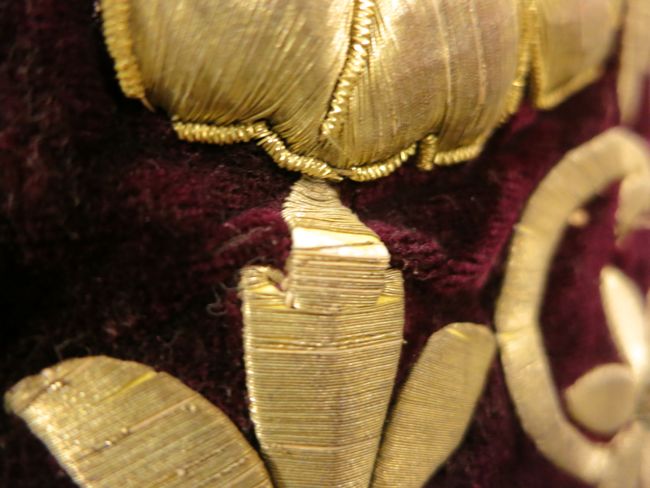
Detail of the gold-wrapped shapes

Some of the larger flowers must have been padded before wrapping, and are further highlighted by outlines in coiled gold wire, with details are picked out with knots coiled gold.

Gold detailing on the robe

The overall effect is of elaborate, sumptuous satin-stitch embroidery: the work of an incredibly skilled embroiderer.  However, gold thread cannot be applied in a satin stitch as pulling the thread through the fabric would rip the gold covering off, so instead gold thread is applied through couching, where the thread is coiled on top of the fabric and stitched over to hold it on.  The technique used on this garment, where thread is wrapped around shapes, gives the same effect as satin stitch, but wouldn’t require the skill or time of either satin stitch or couching.  It’s a very novel and time saving technique.
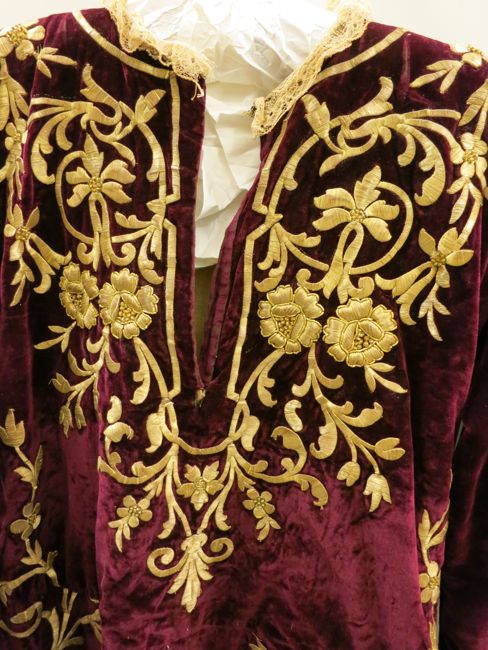
The elaborate gold ornamentation

The only information about this robe on the storage label was that it was made in Turkey, but based on the techniques and the materials used I suspect it is late 19th century, or even early 20th, and that it was either made for the export or tourist markets.  It has been very slightly altered: A frill of lace has been tacked around the collar, hiding the original line of beadwork that ornamented the collar.

The lace frill and the original beading

Based on this and mentions I have read of Turkish tea robes, I suspect this was worn as a tea gown by a woman in the West.  What exactly its use would have been in Turkey (or, the Ottoman Empire, as it was at the time) I do not know.

I hope you’ve enjoyed a little peek at this garment.  If you know more about what it would have been, or about the wrapping technique used, please do share!

Rate the Dress: Maria Anna does geometry

Last week you were surprisingly positive about the black and gold Regency frock.  Many of you noticed the bee/bug resemblence, and you actually approved of it!  The dress rated an 8.1 out of 10.

This week, I thought it was high time I posted a full portrait, where you could consider the dress and the way it fits the wearer’s looks and personality.  This is Maria Anna of Spain, who was considered as a potential bride to Charles I of England, and was instead married to her cousin Ferdinand III.

Maria Anna of Spain with her son Ferdinand, 1634, unknown Austrian Artist

Maria Anna was everything you could want in a 17th century princess: pretty, without being so attractive as to cause jealousy or tempt a king into an unwise match; even tempered and happy, more than capable of balancing her gloomy husband’s moods; a competent ruler when called upon to serve as her husbands regent, but not tempted by more power, like her sister Anne of Austria.  Also unlike Anne, she had no problem producing the raft of heirs that was the ultimate mark of success for a royal consort, and it was this that proved her undoing.  Maria Anna died in childbirth only two years after this portrait was completed, and her most notable legacy was her contribution to the horribly inbred and inter-married Hapsburgs.

Today though, we are not concerned with Maria Anna’s character or history.  Let us look, instead, at her dress.  As a Spanish princess, it’s not surprising that Maria’s dress is still very stiff and formal: more 16th century than 17th century.  Within the confines of conservative Spanish royal fashion Maria Anna has found space for something unexpected: unusual and elaborate geometric patterning.

What do you think?  Do the lines and checks and squares lift the dress from ordinary to fabulous, or does the trim and design only add to the impression of stiffness and formality?

Rate the Dress on a Scale of 1 to 10


Does thread have a shelf life?

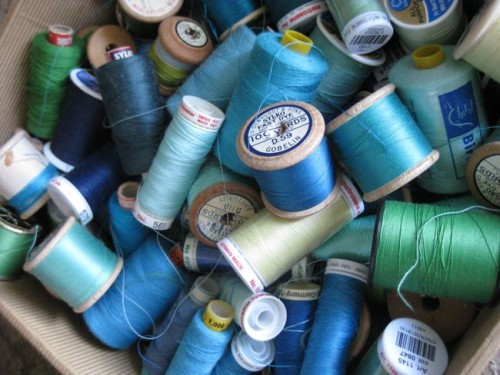
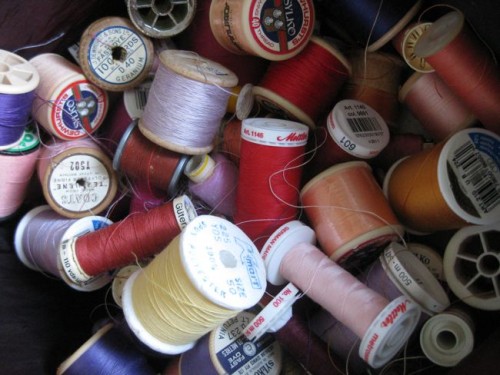
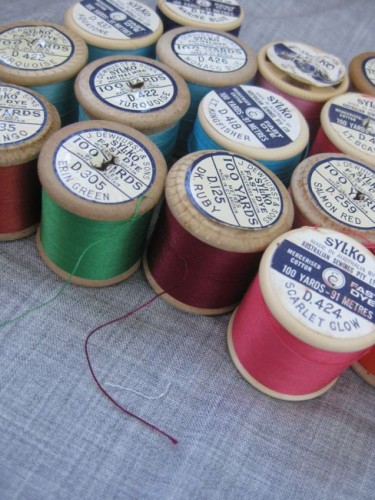
As many of you may know, I love using vintage fabrics, and vintage threads.  I inherited hundreds of threads from Grandma and Nana, and buy old thread at op-shops whenever I see it.

I estimate that 90% of my sewing is done with vintage thread, and  I’ve never had a problem with it. No breakages in the machine, no breakages in clothes I wear (including ones I made over a decade ago, and still wear), no funny pulls or tension issues.

Yet over, and over on the internet I hear ‘never use old thread’, ‘thread has a shelf life’, ‘vintage thread just isn’t strong enough and doesn’t work right’, ‘old threads are thicker’.

I use new thread for commissions and when sewing with students, so I’ve been able to compare new with old on the same machines, and even on different projects in the same fabrics.  I’ve tested and tested, and just can’t find any substantial evidence that using old thread gives a substandard result compared to new thread.

I do match thread to fabric — I use my vintage cotton threads for vintage cotton and rayon fabrics, my slightly less old cotton thread for slightly less old cotton and rayon fabrics, and only use new poly/polymix thread for synthetic fabrics and knits and the occasional silk chiffon.  Polyester thread is certainly stronger for its width compared to cotton thread, but my new cottons are no stronger or thinner than my old ones.

It can’t be that it’s just that my vintage threads were stored properly, as they come from so many different sources.  I’ve got Grandma’s 20-60 year old threads, which spent their life in San Diego, Great-Aunt’s 20-35 year old threads, from Idaho and Hawaii, Nana’s 20-60 year old threads, from New Zealand, plus all the ones I pick up in op-shops around New Zealand.

I keep my thread sorted by colour, not source, so except for knowing the brands that are definitely NZ and not US threads, and the general age of different brands and spools, I have no record of where they came from after the fact.  Still, my thread fail rate is less than 1/100 spools.

“But wait”, says the anti-vintage thread brigade, “vintage thread can’t possible be good – I’ve had so many vintage garments that were coming apart at the seams!”

Guys.  C’mon!  Thread that has been sewn into a garment that has been worn/washed/drycleaned is NOT the same as old-but-unused thread on a spool.

You can’t say 30 year old thread on a spool is going to break because 30 year old thread sewn into a dress 30 years ago and worn and washed 60 times, and left dirty for 20 years before it was drycleaned and worn and washed again, broke.  In 60 years time the seams of the garments I’ve been sewing with vintage thread, and have been wearing and sweating in and washing, may be falling apart.  But I suspect the stuff I’m sewing with brand-new Gutterman may be as well.  For now, even the stuff I sewed with 30-year-old-at-the-time thread 20 years ago, that has been worn and washed 80+ times since, is still going strong.  And for me that’s pretty good evidence that vintage thread is fine to sew with!

Whenever I’ve had problems with thread breaking it’s happened as it ran through the machine: in hundreds of garments sewn with vintage thread I’ve never had one that started breaking after a couple/dozen wears.

The final  reason given for not using vintage thread is that it creates more lint than modern thread.

First, this not entirely true  – some vintage threads may create more lint than modern threads, but a good quality vintage thread still creates less lint than a cheap modern thread.

To really check, I did a test where I cleaned my machine completely, and sewed only with vintage thread for a month, cleaned, and checked the lint accumulation, and then sewed only with brand new Mettler or Gutterman, and cleaned and checked the lint accumulation, and the difference was negligible.  Did it again – same result.  If anything, there was less lint from the vintage thread month.  (I know.  I am such a mad sewentist!  I can’t ever accept the things that sewing books say without testing).  I’d have to do thing a couple hundred more times to really get a totally accurate answer, but for now I’m comfortable that the difference isn’t a problem – especially for modern sewing machines, with fairly limited expected lifespans.

Second, even if your vintage thread is creating more lint, it’s not an issue.  Simply clean your machine regularly, which  you should be doing anyway.

Have I missed something?  Is the rule about not using old threads based on a few people who inherited entire thread collections that were stored in damp places and had terrible experiences with those (because thread that gets damp does need to be thrown out)? Or do I just have the miracle vintage thread collection?

Have you heard the ‘don’t use vintage thread’ rule?  Do you use vintage thread?  Have you ever experienced a problem with it?