Latest Posts

Visiting Kalaupapa: Day 2

Spending the night at Kalaupapa is amazing. I grew up in a very rural location, and our house now is set well off the road, and is very quiet, but neither of these begins to compare to the tranquility of Kalaupapa.  Unless there is an activity which everyone is attending the entire town goes to bed early.  There is no distant traffic, no early flights at the airport, no murmur of late night businesses and parties: just the wind and the waves.

You sleep deep, and wake early, to the sunshine spilling across the pali, highlighting each ravine in the cliff-face, and bathing the whole peninsula in a reflected glow.
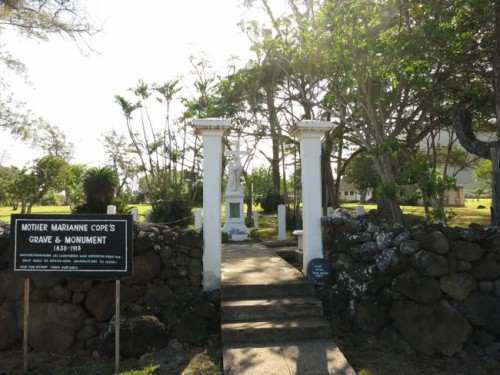
Mother Marianne Cope’s memorial, Kalaupapa township

After breakfast and devotions (we were doubly lucky to be there on the Baha’i feast of Might – like Sabbath), we headed out into the sunshine, walking through the tiny township, past the gravesite of Mother Marianne Cope, who came with her nuns  to Moloka’i from upstate New York  in the 1880s to help Father Damien.

Fifty other religious orders had turned down Hawai’i’s plea for help from a group of nuns, for fear of catching the disease.  Marianne promised her nuns that none of her order who served in Hawai’i would contract leprosy: a reasonable promise to make in the light of modern medical knowledge, but a giant leap of faith in the face of 19th century attitudes towards leprosy, especially as Father Damien was dying of the disease.  Her promise held true, the faith and assistance of her and her comrades was unflinching and invaluable, and in October Mother Marianne will be made Saint Marianne of Moloka’i: the second Catholic saint to come from the tiny corner of our tiny island.

Beyond her grave are more lighthearted reminders of Kalaupapa’s legacy.  First, a garage adorned with license plates from all over the US, the legacy of all the people that have come to work there, and all the cars that have ended their life in Kalaupapa.  The barge only comes to Kalaupapa once a year (its annual visit is a memorable event), so that is your only chance to get a car in, and no car ever goes out.  Because the county is so small and sparsely populated, and has such a unique set of laws, the driving and licensing rules in Kalaupapa are quite loose compared to the rest of to the state of Hawaii.  Legally blind patients have been allowed to drive, and for a while there was a car on the peninsula that only drove in reverse.
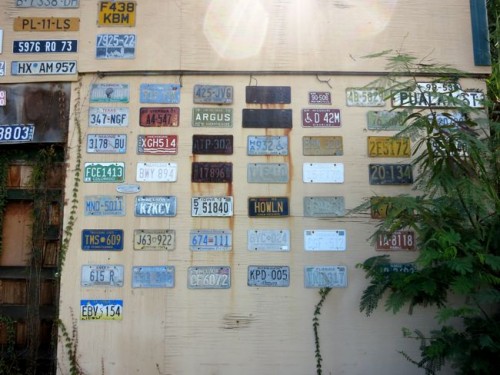
A wall of license plates, Kalaupapa township

Regular cars aren’t the only thing that end their life in Kalaupapa.  Old schoolbuses have been brought to the peninsula to serve as tour buses, and as we hiked down the pali we could see the big yellow bus whizzing around the roads, carrying the tour group on seats that I probably sat on as a schoolkid.
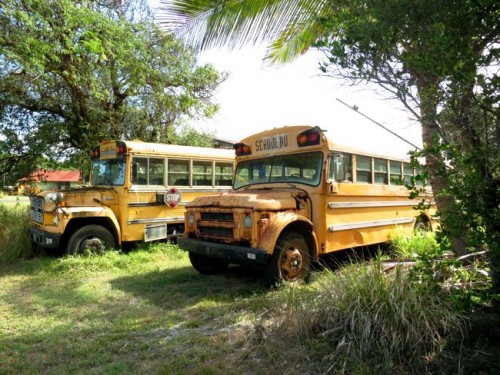
End of the road for the big yellow buses, Kalaupapa township

For all the fun stories, reminders of Kalaupapa’s past are never far away.  Every turn of the road brings a new graveyard, snuggled against the pali or spread out by the sea.

Graveyards by the sea, Kalaupapa Peninsula

In the newer graveyards the Hawaiian on the old gravestones has given way to English, and the last names show how ruthlessly democratic the disease was, striking all races and walks of life.  The gravestones are much fancier than in cemeteries in other parts of Hawai’i, lending an odd grandeur to the regularity of death on the peninsula (one former patient talked of the constant ringing of churchbells, day after day).

For all the grandness of the memorials, nature is fighting back, breaking down the stones and re-claiming the edges of the cemetaries.

Nature reclaiming the land, Kalaupapa peninsula

For the historians and archeologists at Kalaupapa, and for those who have family buried there, honouring the history is a delicate balance between conservation, nature, and restoration.  A gravestone lying broken on the ground will continue to disintegrate, a stone wall fallen into disrepair will turn into a jumble of stones, no matter how carefully you monitor the placement of the stones.  Is it better to rebuild the wall, to re-erect the gravestone, and fill in the missing pieces, in order to preserve the bits that are left?

Banyan tree and gravesite, Kalaupapa peninsula

These questions plague those in the history and museum fields everywhere, but in few places is the question more poignant than at Kalaupapa.  What is the best way to honour the history, and to memorialise the people who lived there?
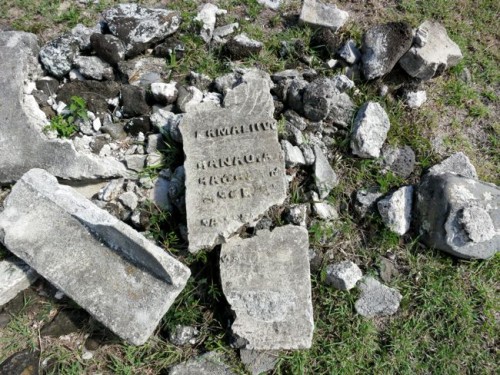
Broken gravestone, Kalaupapa Peninsula
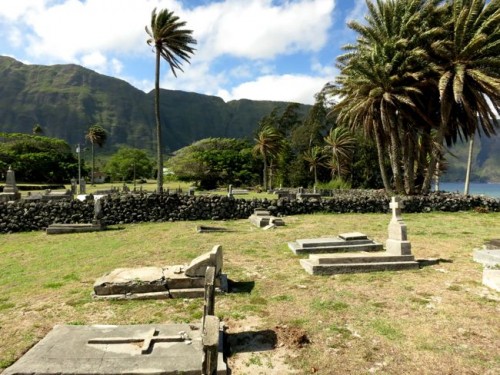
Gravesites, stone walls, and date palm trees

The same questions of history and memory have had to be tackled by the National Park Service and the Board of Health in administering and making laws for what must be the most unique national park in the US.  How do they make the park accessible to visitors, while respecting the former patients who still make the park their home?  It’s a question that affects every aspect of life.  At the moment, 100 visitors a day are allowed on the peninsula, but only as an invited guest of a resident or as part of an official tour.  Only former patients are allowed to own businesses on the peninsula, so the tours are run by former patients.  There are only 13 former patients left, 7 of whom live on the peninsula full-time.  What will happen when they are all gone?  That’s still to be decided.

Other discussions and rules are less obvious.  Because there are so many archeological sites and gravesites on the peninsula, no digging is allowed, so anyone who wants to have a garden has to create a raised bed with fresh dirt.  There is also an ongoing discussion about what to do about housing.  In past decades, when a patient passed away and their house would no longer be used the houses were burnt down, as caring for them took too much in the way of resources.  Now the remaining houses that don’t belong to patients are used by the  NPS and the State to house employees, leading to another discussion about the houses.  Should they be kept as they are, with 1950s kitchens and simple rooms, as living pieces of history, or updated to make them more modern and comfortable for the people who live there? (having been in them, seen ’50s plantation style houses in Hawaii vs. very un-tropical modern remakes, I am a massive supporter of the ‘leave them as they are’ camp).

The beach, with little waves lapping to shore, Kalaupapa Peninsula

There are also discussions about how the visitors who come to Kalaupapa get to use the peninsula.  One rule that surprised me (until I thought about it) prohibits surfing.  Why?  Kalaupapa is said to have the best surf on Moloka’i: so coveted were the waves that in ancient times only the chiefs were allowed to surf on them.  Residents were afraid that Kalaupapa would become a surf destination, and the history would be lost beneath the commerce, so surfing is not allowed.  Hunting, on the other hand, is not just allowed but encouraged, because the peninsula is over-run by introduced axis deer, goats and pigs, all of which cause havoc to the natural environment.  Kalaupapa has become a little bit of a hunting destination (though you still have to be an invited guest), but without it their would be a major environmental disaster.
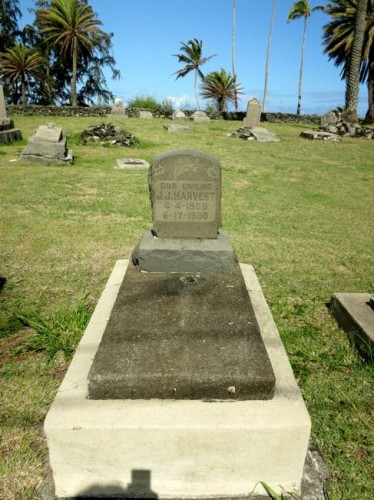
Darling JJ, two months old

Finally, there is the rule that kept me from visiting Kalaupapa as a child: no visitors under 16.  I had thought this was simply to prevent children from gawking and unthinkingly saying hurtful things, but the real reason is far, far more tragic.  Throughout most of the 20th century patients at Kalaupapa who had children had their infants taken away from them at birth (patients were not even allowed to hold their child once, so some hid their pregnancy and the birth to get a little time with their child), and adopted away.  In an attempt to prevent the stigma of the disease from following the child, their birth certificate would be altered to give a different place of birth, and they would be adopted to families on the US Mainland, to further separate them from their history.  The authorities had the best intentions with this practice; they wanted to protect the child from contracting leprosy, and from the stigma associated with it, but the reality of what happened is heartbreaking.  For patients who had their children taken away, seeing other family’s children was just too hard a reminder, so no children are allowed on the peninsula.
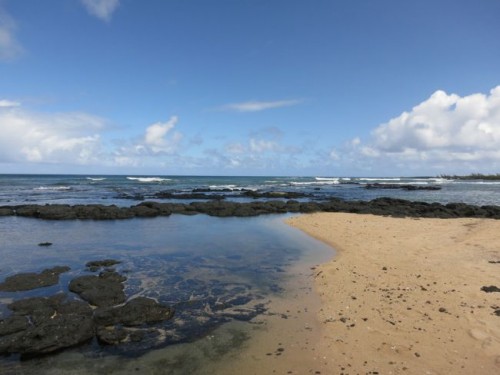
Rock pools and shallows, Kalaupapa peninsula

I’m sorry.  I’ve made you cry.  I’ve made me cry too.  Let’s look at some beautiful images of the coast, take a deep breath, and move on to something happier.
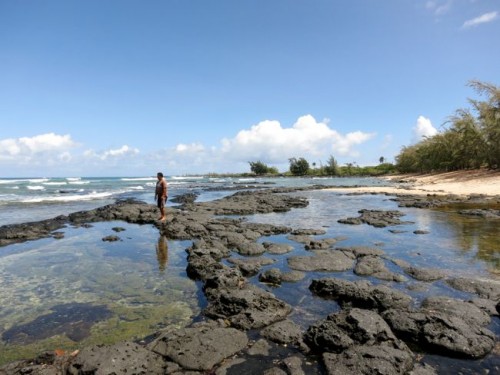
My host taking in the view, Kalaupapa Peninsula

How about the other things that Kalaupapa is protecting, in addition to it’s history?  The deserted beaches provide the perfect place for the endangered Hawaiian Monk Seal to rest and breed, and so, for the first time in my life, I was lucky enough to see them.
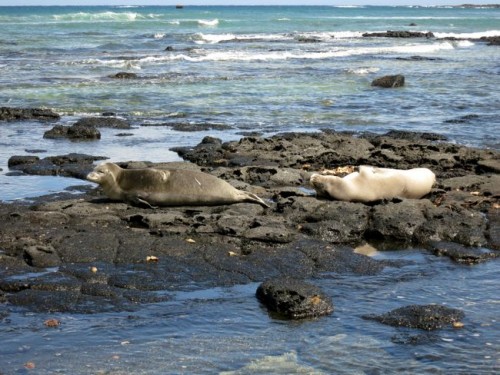
Hawaiian monk seals, juvenile and mother

Sitting on the rocks along the coast, watching the mother and her almost grown pup (the darker one) as they sunned themselves and occasionally turned their heads to check up out, in the absolute peace of Kalaupapa, was amazing.  Only the tragedy of the past has made this place safe enough for these rare animals, so another piece of good has come out of what happened.
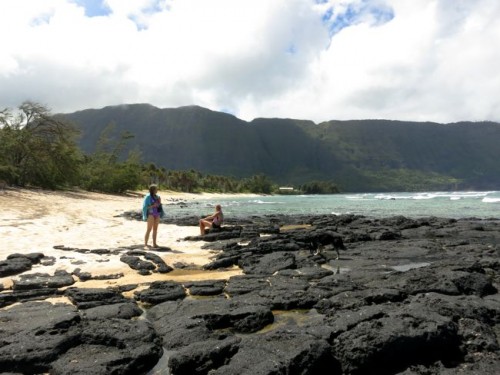
Mum, our hostess, and the dog keep a safe distance from the monk seals

After a morning by the coast, contemplating the memorials, chatting with our hosts, watching the monk seals and the waves, it was time to head back up the pali, to home.  We took one last look at the beach, the township, and the view of the trail heading up the cliff, gave our hosts a hug, and we were on our way, with lots and lots of water.

The pali trail, winding its way up the cliff
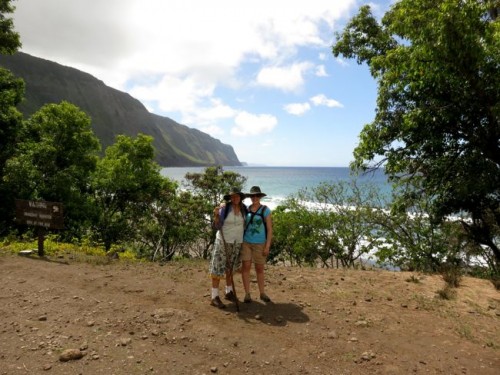
On our way back up the trail

We were silent starting the hike, each thinking of all the things we had seen, and heard, and experienced.  Then Mum said that she felt so moved she needed to sing, and so we started the hike on a melody, singing “There is an ocean, an ocean, an ocean of light, where the rays of the sun and the raindrops unite…”
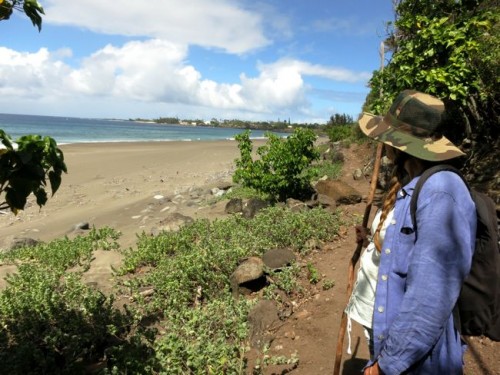
Last look at Kalaupapa

After a while we fell silent again, and began the hike to nothing but the sound of the wind sighing across the peninsula, and the endless woosh of un-surfed waves.
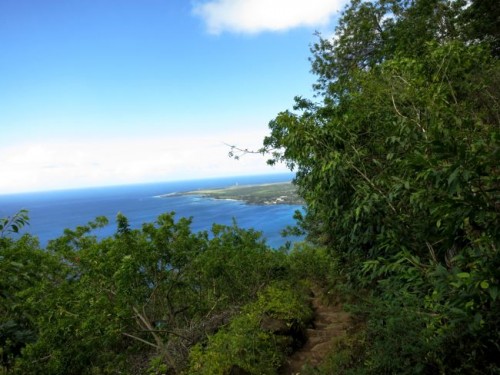
Last glimpse of the peninsula
Visiting Kalaupapa – Day 1

Yesterday I told you the history of Kalaupapa Peninsula, and I promised to tell you of my trip down to the Peninsula today.  As I tried to write this post, and select images to go with it, I realised I could never get all the words into one post, much less the images.  So this is part 1 of 2 of my trip – day 1.

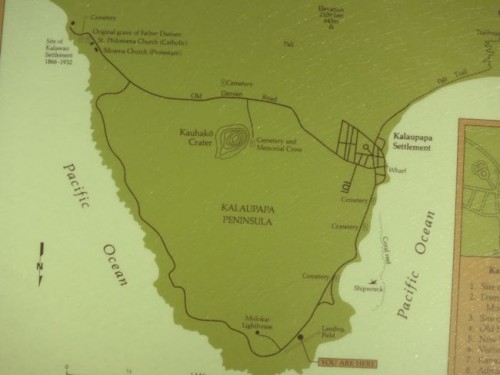
Map of Kalaupapa peninsula

All my life, Kalaupapa was there: just over the mountain, just down the pali (cliff), visible from the lookout, as unreachable and unattainable as Paris, for all it was so many thousands of miles closer.  I couldn’t visit it as a child under 16, and as an adult I couldn’t visit it without an invitation from someone who lived and worked down on the peninsula, or as part of a tour.  I didn’t know anyone who worked at Kalaupapa, and I didn’t want to visit it as a tourist.

Every trip home to Hawaii I thought of giving in, paying for a tour, and going down just to see that bit of my history, but the time never seemed right.  Then this visit, once I had arrived on Moloka’i, my mother mentioned, quite casually, that the new archeologist down at Kalaupapa and her husband were Baha’is, and friends of my parents, and it might be possible for us to go down and visit them.

And, as it turned out, it was.  On my very last weekend on Moloka’i, Mary Jane (the archeologist) secured permits for Mum and I.  Dad stayed home to take care of the farm and watch out for the ducklings that were due to hatch, and Mum and I headed down the Pali trail.

The start of the trail at the top of the pali

I should let you know at this point that one of the many things that Mum and I have in common is a phobia of heights.  Tackling the hike was quite an undertaking for us (I fully expected to spend the entire walk alternating between chanting prayers and simple ‘not going to die’ pleas under my breath), so visiting Kalaupapa was a commitment in many ways.

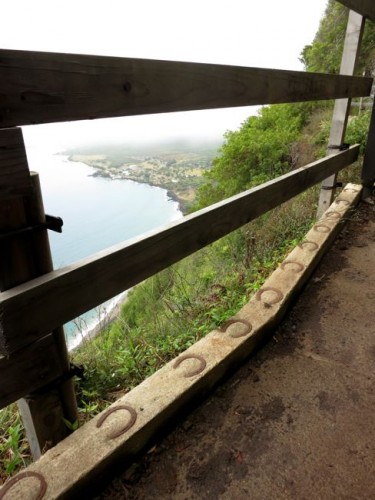
Descending the trail, protected by blessed guardrails

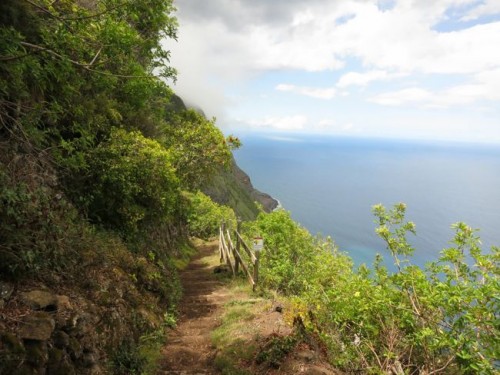
As it happens, the trail isn’t as bad as I had thought it would be.  Lush vegetation hides the worst of the dropoff views, and the scariest parts have been upgraded with bridges and protected with guardrails.

Good-luck mule shoes pressed into the cement supporting the guardrail

At least we were hiking though.  The alternative way to get down the trail is to take a mule.  In earlier times mail and supplies were taken down to the settlement via mule, and the tradition has been kept alive by the Moloka’i Mule Ride, which conveys people down to Kalaupapa for the tour.  We passed the day’s tour as they were coming back up, and I did not envy them one iota.

Red lehua blossoms overhang the trail

The trail wends its way down the cliff-face via 26 switchbacks, each marked with a plaque, so that you can count your way up and down (and possibly to help you identify where you are if someone gets hurt and you need to go for help).  In addition to spectacular views, the trail is marked by stunning examples of native vegetation, from the red lehua flower (the Hawaiian cousin of pohutakawa), to the endangered native Hawaiian hibiscus,  to the extremely rare  Alula, which has less than 65 extent species.

Alula growing along the Kalaupapa pali trail

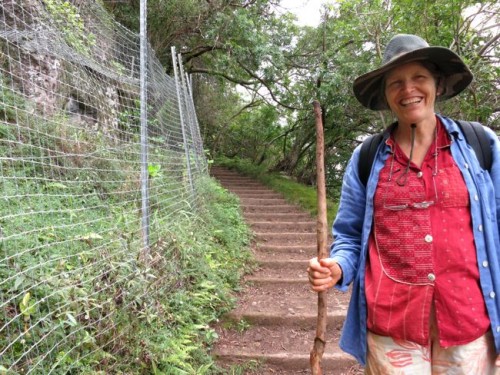
Seeing an alula was a privilege in itself.  The one along the trail was just about to flower, and was protected from invasive foragers like goats and deer by fencing.  You can see it in the fenced area just parallel to Mum’s glasses in this picture:

Alula protected by fencing along the Kalaupapa pali trail

As we descended the trail, the mist blew away from the peninsula, and it got hotter and hotter as the cool upland forest gave way to more open coastal forest.  By the 26th switchback we were extremely hot, and extremely grateful when the endless steps gave way to more level ground that wound through the last gentle incline which dropped up to the sea.

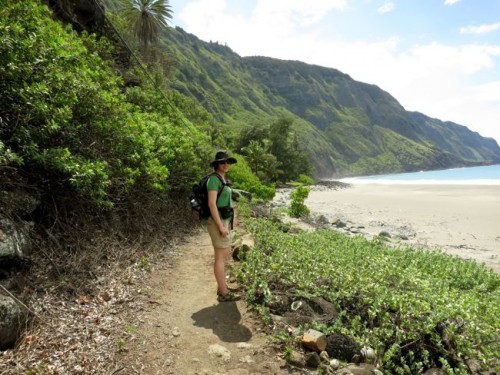
Open lowland forests at the foot of the Kalaupapa pali trail

As we had descended the trail the sound of the ocean crashing against the cliffface had grown louder and louder, from a faint whisper at the top, through a dull roar, and finally, at the bottom, we turned away from the cliff and came out at a long black sand beach, with the characteristic swish of waves carrying tons of sand with each rise and fall of the water.  Behind us were the cliffs, stretching out along the northwest shore of the island, and the pali trail, rising to the uplands.  In front of us was Kalaupapa.

Trails end and the stretching black sand beach of Kalaupapa

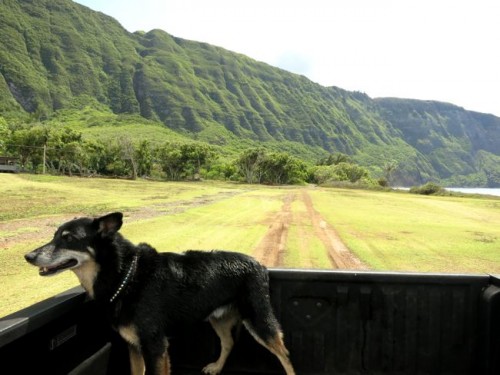
We were collected at the trail’s end by Mary Jane, lovely and welcoming, ready to show us the world she is helping to understand and protect.  I got to experience the classic Hawaiian (and especially Kalaupapan) mode of transport: ‘catching air’ in the back of a truck, with prerequisite dog.

Catching air with the pali rising in the background, and wires tumbling down the pali

Riding in the back of a truck may be the best way to see all the amazing views that Kalaupapa has to offer.  In the image above you can just see the modern view that amazed me most.  Enlarge the picture, and you should just be able to see the electricity and phone cables coming straight down the pali at the point of the deepest cleft.  They go down at an almost vertical angle!  There must have been some pretty impressive moments with a helicopter to make that happen.

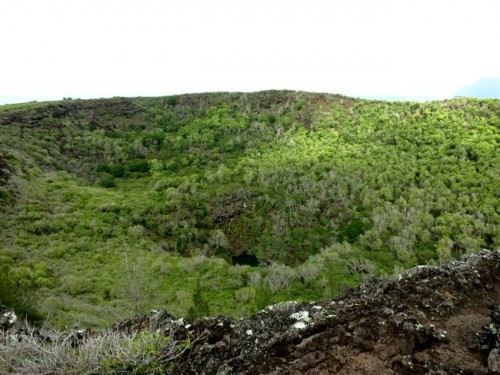
Kauhakö Crater, Kalaupapa peninsula

Everything at Kalaupapa is amazing, from the natural beauty, to the ancient history, through to the 19th and early 20th century events that it is most famous for, to the modern engineering that has tried to connect it to the outside world.  First, we went to see some of the natural beauty.  Kauhakö (that should actually be a straight line over the O, but I can’t figure out how to do that in WordPress) Crater is what remains of the low shield volcano that formed the peninsula: a low rising hill punctuated by a deep crater.  At the floor of the crater is a tiny lake, at 800 feet deep, it’s probably deeper than it is wide.  On the day I visited it was a deep, olive green, but on other days it glows blue, or dark brown, or a range of other hues.

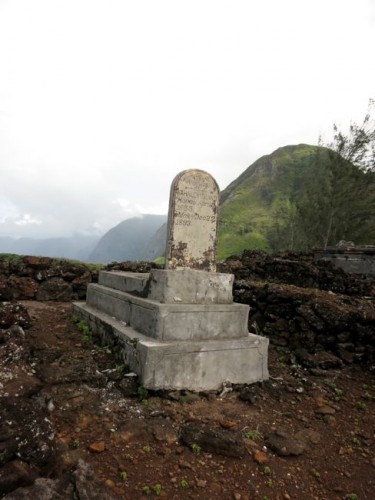
On the hill around the crater are example of the two most common human artifacts on the peninsula: stone walls and gravesites.  Everywhere you look in Kalaupapa are stones arranged to form walls, or piled in piers to mark the thousands who were sent there  not to live, but to die.

Memorial stone for Kahalekumano, born April 1 1855, died Dec 22, 1893, on the edge of Kauhakö Crater.

Beyond the tragedy of the story they tell, and their abundance, two things struck me about the gravestones that are so prevalent at Kalaupapa.  First, so many of them are in Hawaiian.  The Hawaiian language lingered as the predominant spoken language much longer at Kalaupapa than in other places in Hawaii, so many, many gravestones bear the legend ‘He Kiahoomanao‘ (this is the memorial marker) no (of) ______, hanau (born) _______, make (died) _______.  Second, for all that so many of the gravestones are in Hawaiian, and Hawaiian’s were the most succeptible to leprosy, its clear from the names on the gravestones that people of every ethnicity, and every walk of life, caught the dread disease and were exiled to Kalaupapa.

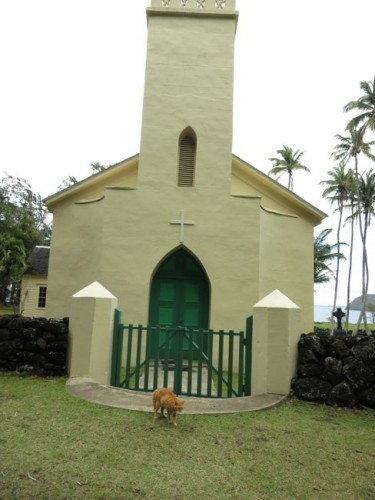
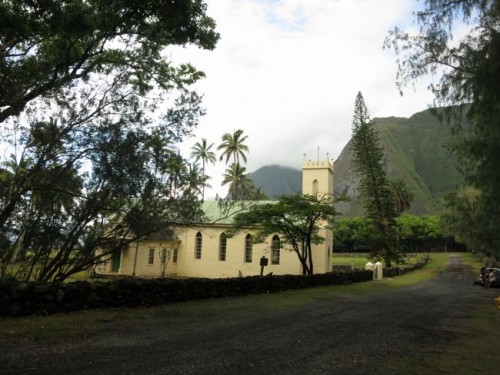
St Philomena Catholic Church, Kalawao

From the crater we headed down and around the curve of the pali, to Kalawao, the original site of the place of exile for Hansen’s Disease patients.  While the Kalaupapa township side of the peninsula had been warm and dry, the problems with Kalawao were immediately evident.  It lies in perpetual coolness and mist, all but abandoned save for one orange cat which has appointed itself the guardian of Damien’s church, waiting daily in front of it to greet the tour group.

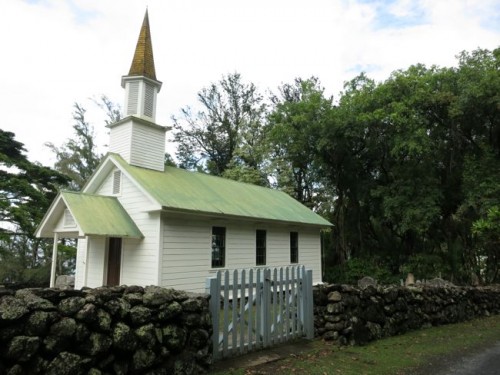
Siloama Church, Kalawao

After stone walls and gravesites, Kalaupapa is marked by churches.  Religion had a profound impact on the early patients, providing them with care and succor, and sometimes even hope.  Kalaupapa is the second least populous county in the US, but it surely must have the most houses of worship per capita.

The pali rising behind St Philomena’s

The churches at Kalawao are no longer active today though: the settlement at Kalawao was abandoned in the 1930s, with all the patients moving to the warmer end of the peninsula.  The population of the peninusla has dwindled on a yearly basis since then, and all the buildings but the church were allowed to fall into disrepair, the jungle slowly taking over the old boys home, the leprosarium, the houses and cottages that would have surrounded the churches.  Nothing remains but the stone walls and the gravesites.

Mum and I at the furthermost point of Kalawao

From Kalawao, we turn away from the pali, heading down and around the curve of the peninsula.  We stop at the rocky shore where patients were unloaded, left to fend for themselves without provisions or a word of comfort.

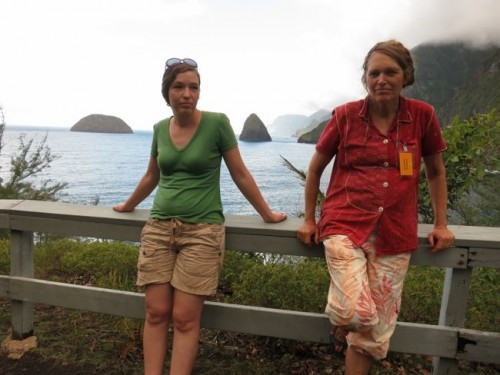
Mary Jane and Mum at the remains of the old landing site

In a place desperate with sadness, with longing for life, this is perhaps the saddest point: the place where one life ended, before patients had a chance to realise they might be able to make another, very different, life.

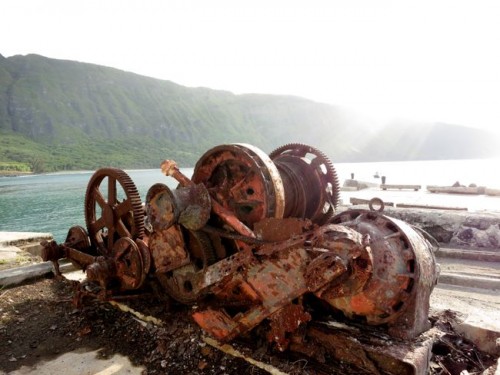
Old shipping gears, Kalaupapa warf, with the pali behind

The amazing, wonderful thing about Kalaupapa is that after the first few dreadful years, there was life, and joy, and the full breadth of human experience.  Visitors to 19th and early 20th century Kalaupapa came expecting a place of utter desolation and despair, and found instead the resilience of the human spirit.  Robert Louis Stevenson talked of the beautiful things he had seen in the world, and especially of the girls of Kalaupapa being ‘not the least beautiful among them’ by far, and how the young boys in the boys home were like boys everywhere: eternally picking up one amusement and fad after another, one day enjoying jacks, the next all learning to play the ukulele, then abandoning those for ballgames.  Jack London found himself laughing himself silly at the Fourth of July races at Kalaupapa, feeling that one oughtn’t to laugh in such a place, but unable to resist the infectious joy of the crowd.

Mum and our hosts on the Kalaupapa wharf in the last of the afternoon sun

Kalaupapa today is a balance of the sadness that every person brought with them, the sadness of all those gravesites, the unutterable longing for life that you hear in every wave, in every breath of wind, and the peace and joy that people found, despite it all.  The township of Kalaupapa is both exquisitely charming: a picture postcard of what small-town Hawaii might have been in the ’40s & ’50s, and slightly desolate, with too many empty rooms and abandoned lots.  The whole peninsula is too full of the memories of lives with broken ends: all those people who were forced to leave their homes in the 1860s to make way for the patients, all the patients who were forced to leave their homes to come to Kalaupapa, all the children born there, who were taken away to protect them from catching leprosy.

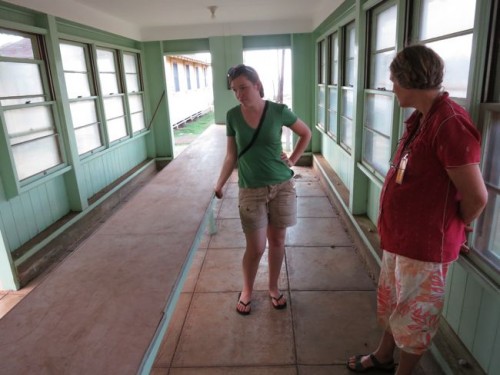
The long room, Kalaupapa

The whole peninsula aches with longing, perhaps most of all in the long room: a long, narrow building with five doors, two at each end, and one in the middle.  The room is divided along its entire length by a table, but in the early 20th century it was also divided by a heavy fence running the length of each room.  On one side, the patients came in, on the other, their visiting families.  They could see each other, but never touch each other.

The long room is freshly painted, but a layer of dust lies on all the ledges.  It’s both cared for, and abandoned: a rather heavy metaphor, but there it is.

Kalaupapa

The following post is probably the longest post I have ever written, and certainly the hardest.  I find it very difficult to talk and write about the things that are closest to me.

This is a story that needs to be told, but I didn’t know where to start.  I guess I’ll start where the story usually starts for me, and hope I can tell it properly from there.

When people hear I am from Moloka’i, Hawai’i, they have one of two reactions. Either they say “Moloka’i? Which one is that?” or they say “Moloka’i!?! Really!?! The one with the leper colony?”

And it’s true. My island is known first and foremost because of its unusual and tragic history: because Kalaupapa peninsula was used as a place to banish patients suffering from Hansen’s Disease (to use its proper, medical, name), a place to isolate them from society for fear they would spread their affliction to the rest of the population.

Moloka’i lies in the middle of the Hawaiian archipelago, middle in age and middle in size. The island is shaped like a dolphin: curving its flippers out on the dry western end, its mouth on the wetter side of the island marked by the valley of Halawa. Along the stomach of the dolphin lie deep valleys and steep cliffs plummeting over 3,000 feet into the sea. Spread out at the base of these cliffs is Kalaupapa peninsula: a flat stretch of land punctuated by the rise of Kauhako crater, a small shield volcano which erupted long after the rest of the island had been formed, creating the peninsula.

Molokai

Kalaupapa peninsula from the top of the pali (cliff) trail

In ancient times and the 19th century the only access to the peninsula was via a steep, treacherous trail up the cliff-face, or by sea. In the 1840s and ’50s the entire peninsula planted in sweet potatoes which were shipped off to California to feed hungry gold miners. When the gold rush boom died off the farmers began to move away from the peninsula. At the same time, Hawai’i experienced a health crisis.  The population of the kingdom had already been devastated by outbreaks of smallpox, influenza and other infectious diseases that the Polynesians had no natural immunity against.  Now a new threat loomed: leprosy.

In the 19th century leprosy was a poorly misunderstood disease, and the stigma against it was enormous. When the disease began to spread among Hawaiians, the country went into panic mode. Beginning in 1864 Kalaupapa peninsula was cleared of all its former residents and in 1866 islanders diagnosed with leprosy were sent on a one-way trip to the peninsula: never to return to their former lives, and never to see their family and friends again.

The peninsula in the sun, from halfway up the pali trail

Tragically, what 19th century doctors didn’t know is that leprosy, despite its terrible historical reputation, is not an easy disease to catch. Between 93-95% of the world’s population is naturally immune to Hansen’s disease (yes, that means they can’t catch it under any circumstances). Even the 5-7% who are susceptible to the disease are only likely to catch it after extended exposure. Unfortunately the stigma against leprosy means that people are reluctant to seek treatment, increasing the chances of spreading it to family members. And particularly unfortunately for Hawaii, Pacific Islanders are one of the ethnic groups most susceptible to leprosy. Even so, it’s quite likely that many of those who were sent to Kalaupapa peninsula did not actually have Hansen’s disease: there was no actual diagnostic test, and skin cancer, eczema, syphilis (at the time, leprosy was thought by some doctors to be a form of syphilis) and a number of other skin ailments could be easily mistaken for the dreaded disease.

When Kalaupapa was first made a leper colony the Kingdom of Hawaii was in such a panic over the disease that little provisions were made for the sufferers: no houses were built, no hospital was established, no doctors or medical supplies were sent to assist the patients. Instead, they were deposited at Kalawao, a cold, damp settlement tucked at the base of the cliffs.  They were sent without food as it was hoped they would grow their own supplies, but most were too ill, and the cold climate and lack of sun conspired against those who tried, or medical supplies.

The view from Kalawao settlement back over the steep valleys of the north shore

The suffering of the earliest patients at Kalawao was immense: written accounts from the period tell of patients dying of pneumonia and starvation, begging for poi (fermented taro, the staple of the Hawaiian diet) with their last breath. The settlement was completely lawless, and stronger patients took advantage of weaker patients. Children and the elderly (the youngest patient sent to Kalawao was 6, the oldest 104) and those in advanced stages of the disease had no hope of survival.  Their only hope was that a family member would make the ultimate sacrifice, and would go into exile with them as a ‘kokua’ or helper.

Just getting to the peninsula could be a hazard.  In one notorious instance a storm came up as the boat carrying a new load of patients approached the rocky landing at Kalawao, and the boat was unable to dock.  The captain panicked, and, unwilling to carry the patients back to Honolulu, ordered them to be thrown over the side, forcing them to swim to the rocky shore in the heavy seas.  Not everyone made it.

The rocky shores around the boat landing site at Kalawao

Devastated by the situation on the peninsula, and facing public outcry over situations like the one above, the government sought desperately to improve life for the patients, but the fear of leprosy was so great that it was almost impossible to convince anyone to work on the peninsula to support the patients there.  Finally the Catholic church found four priests who volunteered to serve in the colony in rotation, to limit their chances of catching the dread disease.  On May 10, 1873 the first priest, Father Damien, arrived at the settlement, and, at his own request, stayed there permanently.
Father Damien with the Kalawao Girls Choir, at Kalaupapa, Moloka’i, circa 1870s, via Wikimedia Commons

Damien was more than a priest: he built houses, bandaged wounds, grew food, and dug seemingly endless graves.  His presence helped to create a community, and inspired others who came to serve and help.  A dozen years after he arrived he contracted leprosy himself, and in 1889 he passed away from its effects.

Father Damien’s funeral, Moloka’i, 1889, via Wikimedia Commons

Damien’s legacy made the peninsula a much more pleasant place to live, with churches, hospitals, homes for children who were sent to the peninsula without their parents, and entertainment facilities.  In 1907 Jack London visited the peninsula, and wrote an article in defense of its civility, describing races and fun, the prosperous residents, the humane treatment, and the relative safety of exposure to leprosy.
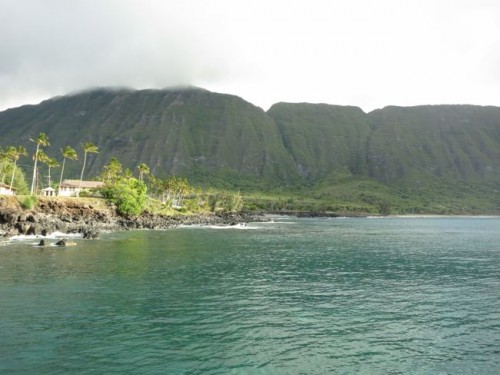
The steep pali rises from the peninsula, cutting it off from the world

Still, for all these amenities, for all its beauty, the peninsula was a place of exile, a prison.

It would remain a prison for most of the 20th century, with those suffering from Hansen’s disease being sent there well into the 1940s, even after the introduction of effective drugs for treating the disease.  Only in 1969 were patients allowed to move away from peninsula, and by then, many of the remaining patients had spent almost their entire life on the peninsula, and did not want to leave.  After some discussion, most of the patients stayed in the prison that had become their home.  Some moved away, some ventured out for visits, some never left at all.  At their request, the peninsula will become a national park once the last patient passes away.  When I was born there were over 75 patients: now there are 13, seven of whom live permanently at Kalaupapa.

As well as a national park, Kalaupapa will always be a memorial, and its now a sacred site: Father Damien was made Saint Damien of Moloka’i, and the first nun to serve at Kalaupapa, Mother Marianne, will become Saint Marianne this October.

Father Damien & patients in front of St Philomena Church, Kalawao, 1880s

For me, and for every child growing up on Moloka’i, the story of Kalaupapa and Kalawao was as much a part of my childhood mythology and history as Disney’s Cinderella is for most other children.  We knew the story of Father Damien, visited the churches he built on the ‘topside’ portion of the island, took annual school field trips to the lookout at the top of the pali, with its views out over the peninsula, and knew more about Hansen’s disease than any other 10 year olds in the US.

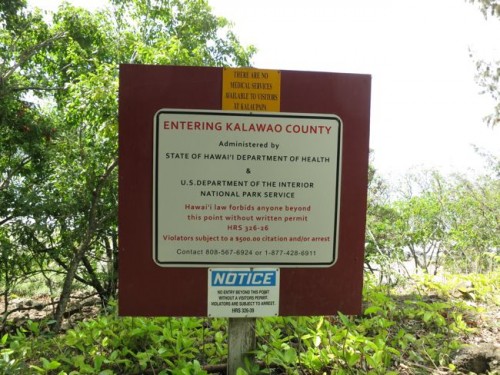
But for all I grew up with the story, I never got to visit the peninsula.  Kalaupapa used to keep people in: now it keeps people out.  Access is still incredibly difficult: by air, by sea, or by that same trail up the steep cliff-face.  And even with a boat, a plane ticket or really good knees, you can’t just visit Kalaupapa.  Children younger than 16 are not allowed to visit the peninsula, and even adults can only visit either as part of an official tour or with an invitation from a resident of the peninsula.  I couldn’t afford the first, and an opportunity for the second never arose.

Entry signs at the bottom of the pali trail

Until this trip.  During my last visit home I was privilege enough to have the opportunity to go down to Kalaupapa, and even stay the night.  It was an experience that is almost indescribable, but I’ll try my best to tell you about it tomorrow.

For now, if you want to know more, the National Park service has an excellent website, particularly the page with quotes from patients.