Latest Posts

Elise’s gift: the white cape-stole

Last week I showed you the most exciting of the garments that Elise gave me.  This week I’m being mean and showing you the simplest, least-exciting garment.
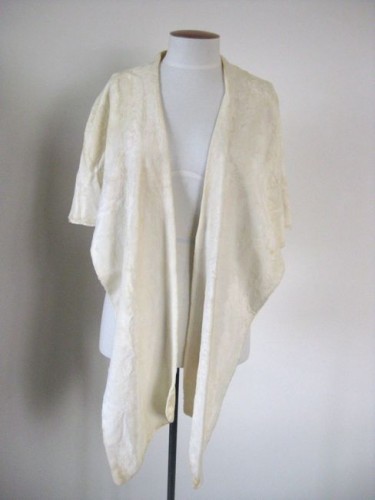
Little white cape-stole

Well, it may be simple, but sometimes the simplest things are the best.  I think this little cape-stole is adorable.
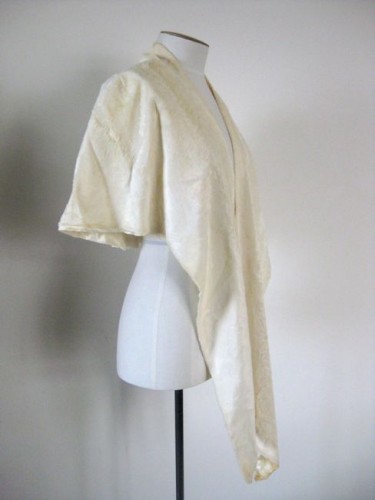
Adorable

The cape is very cleverly made.  It’s made from two pieces of fabric, with part of the back extending further, and the other part curving up around the neck.  The extension is gathered to the neck-part to add back fullness:
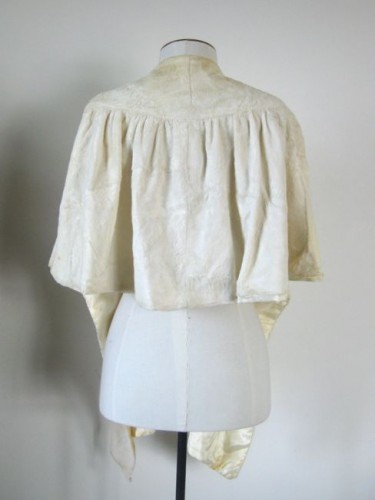
The gathered back of the cape-stole

The lining is cut in exactly the same shape as the outside, and also gathered at the upper back seam.

Cunning back gathers in the lining

I think it is late ’30s, but I’m not entirely sure.  It’s such a classic style it could really be from any timeperiod.
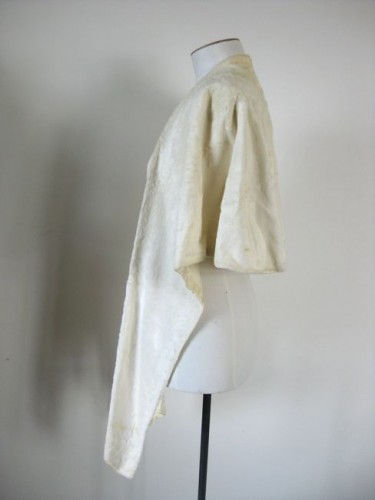
Lovely draping and fullness

While it is charming and dressy, I suspect this would have been a very cheap garment when it was made.  It’s made from a very short pile fabric which  is somewhere between a faux fur and a synthetic velvet, and lined in an inexpensive synthetic taffeta lining.  Synthetic fabrics were considerably cheaper than their natural fibre alternatives throughout the 30s and 40s.  The pile of the faux fur is quite sparse and thin – indicating that the fabric was a particularly cheap, low quality synthetic.
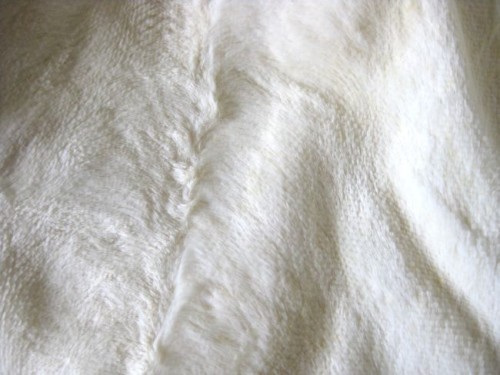
The short pile synthetic faux fur. You can see how sparse it is.

Both the outside and lining fabric have foxing: an acid reaction that creates yellow spots.
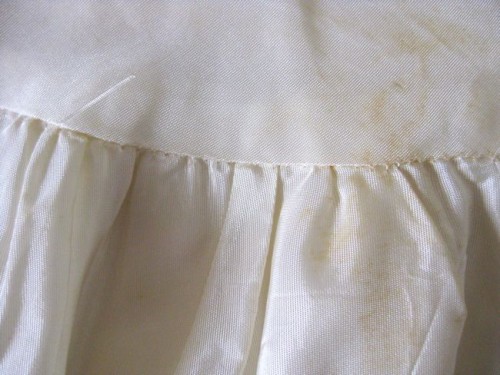
Foxing stains on the lining

Based on this, you might be thinking that I find this garment a bit disappointing, especially after something like the assuit tunic.  And you’d be very wrong.  While I love and appreciate the luxury of expensive, exotic, high society textiles like last week’s tunic gown, it’s simple, inexpensive garments like this that really have my heart.
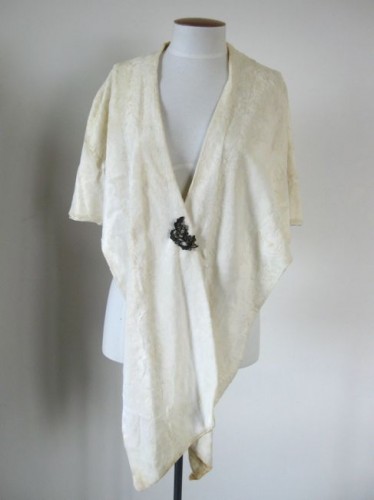
The cape stole pinned with a brooch inherited from Nana

This garment must have been so special to the person who owned and wore it.  Perhaps it was a young girl’s first proper dress up wrap – worn to her first dances.  Or the garment of a farm wife, who had few occasions to wear evening clothes, and could little afford to buy a pricey wrap she didn’t need.

Their story isn’t as glamorous as that of the Houston socialite, but it is, in it’s own way, much sweeter.
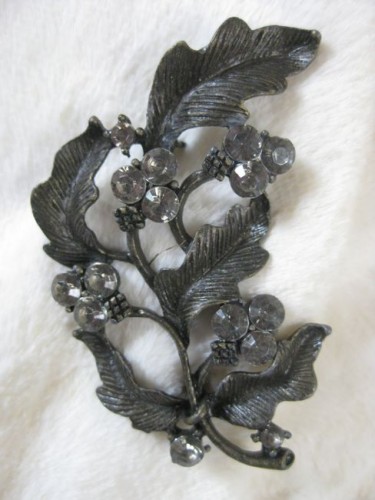
Nana's mistletoe brooch - another sweet and simple piece
 

Terminology: What is calamanco?

Calamanco (also spelled callimanco, calimanco, and kalamink) is a thin fabric of worsted wool yarn which could come in a number of weaves: plain, satin, damasked, and was even brocaded in floral, striped and checked designs.  The surface was glazed or calendered (pressed through hot rollers).

References to calamanco go back to the late 16th century, but calamanco’s heyday was from the end of the 17th century to the end of the 18th century.  It was a popular fabric for women’s gowns and petticoats and men’s waistcoats, though it was gradually replaced by cotton and linen calico as a dress fabric.

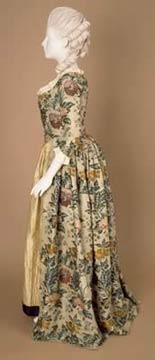
Open gown with a petticoat of quilted silk, lined with calamanco, mid-late 18th century, Liverpool Museum

Daniel Defoe mentions a petticoat of black calamanco in 1720, and they remained popular among the rural populace until the early 19th century.  He also describes the wardrobe of the ‘poorest countryman’ in England and notes his ‘waistcoat of calimanco from Norwich.’

At least in the beginning of the century, calamanco wasn’t confined to the common man’s waistcoat.  The Tatler in 1709 describes the wardrobe of the ‘Dapper’.

The habit of a Dapper when he is at home, is light broadcloth, with calamanca or red waistcoat and breeches and it is remarkable that their wigs seldom hide the collar of their coats.

Since the Dapper is also described at being most at home in the country, we can assume that the Tattler is describing more of a casual country gentleman than the type of man that we envision as a modern day dapper.

Most calamanco was produced in Norwich in England, and exported from there throughout England, and to the Colonies.

Unfortunately, because calamanco was often used for simple petticoats and working clothes, there aren’t very many extant garments.  The Norfolk Museum has at least two pieces, a blue brocade calamanco from ca. 1765, and a striped piece from between 1750-1800, but alas, does not have images of them online.  Meg Andrews has a striped petticoat that she describes as being similar to the ones at the Norfolk Museum, but it’s not entirely clear if her petticoat is also calamanco.   The Manchester Galleries have a petticoat with a calamanco hem, but their photograph doesn’t show that part of the petticoat.

Most extent calamanco pieces are either quilts, or the linings of quilted silk petticoats, where the cheaper calamanco fabric would provide warmth beneath the more fashionable silk exterior.

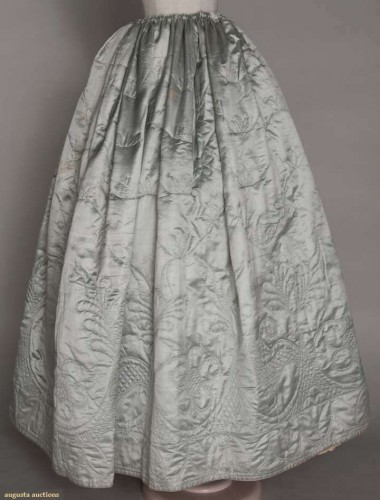
Quilted petticoat, 1770-1780s, silk satin with cream calamanco lining, Augusta Auctions

As the century progressed, not only did calamanco become less and less fashionable, even among the working classes, its definition became less and less defined.    The glazed surface was such a common characteristic of calamanco fabrics that ‘calamanco’ eventually referred to a range of wool and wool blend fabrics with glazed surfaces.  These fabrics were often used in quilts, particularly in North America.

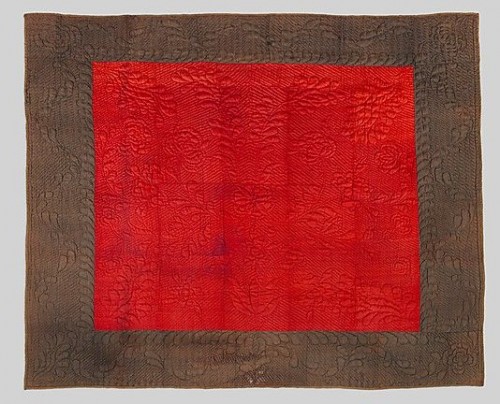
Calamanco quilt, New England, 1775-1800, Wool, Metropolitan Museum of Art

Apparently, because calamanco was so often striped, striped tabby cats were sometimes called calamanco cats, though this may also have been a confused regional variant based on the similarities between the words ‘calico’ and ‘calimanco’ and the term for a  calico cat.  Construction finishes with plaster and timber alternating were also called calamanco-work.

For a bit of a history of the use of calamanco in quilts check out  this article.

Sources:

Andrews, Meg.  Norwich Woollens or Stuffs.  Retrieved from  http://www.meg-andrews.com/articles/norwich-woollens/

Buck, Anne.  Dress in 18th Century England, B.T. Batsford Ltd: London.  1979

Cunnington, C. Willet and Cunnington, Phyllis.  Handbook of English Costume in the 18th Century.  Faber and Faber Ltsd: London.  1957

The Cymbidium Orchid corset for Madame Ornata

I’ve been working on a corset based on the 1890s corded corset pattern for Madame Ornata.

She asked me to make a BRIGHT green corset for a Victorian Poison Ivy costume.  There were lots of complications (it’s complicated) and ended up going with an 18th century take on the idea for the costume party.

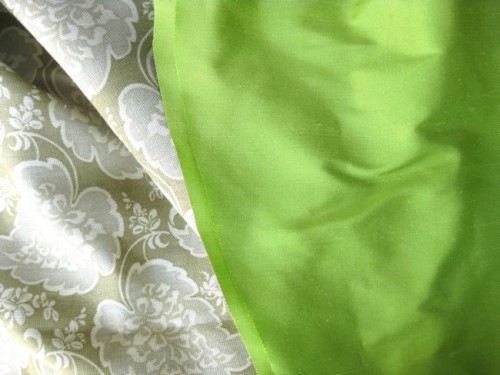
The brief for the corset was BRIGHT green.  Unfortunately we just couldn’t find anything in visits to every fabric store in Wellington.  We did pick up a cute ivy-leaf patterned green quilting fabric for the lining.

And then Madame O found the outer fabric on her own.  And it was BRIGHT green.  Did I tell you it was BRIGHT?

Leafy quilting fabric, BRIGHT green silk

Yeah.  It made the lining fabric look dull and brown.

So I had a mad rummage through my fabric stash.

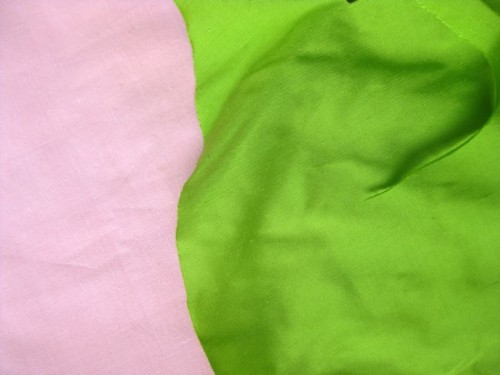
I found a flowered pink cotton that was rather sweet.

Flowered pink cotton, BRIGHT green silk

Too sweet in fact.  It just couldn’t stand up to the green silk.

Finally, I found a mid-pink quilting cotton.

Pink quilting cotton, BRIGHT green silk

I’m not even sure why I own this fabric.  I have no idea when I acquired it.   It isn’t a ‘me’ colour.  It isn’t the type of fabric I sew with.  And I have three or so metres of it!

But it was perfect for the green – bold enough to stand up to it, but without distracting from the green.

The pink and the green of the fabric together really reminded me of a green cymbidium orchid.  So this became the Cymbidium Orchid/Poison Ivy Corset.

The first thing with the corded corset is, well, the cording.

People have been telling me that cording would be easier/work better/be more historically accurate (not for this period)/smell better etc. if I sewed the channels first, and then pulled the cords through.

A bust piece with sewn then corded channels up the top, cord sewn in in one step at the bottom

It isn’t.  It’s two steps instead of one.  If you sew the channels tight enough to really hold the cording it is incredibly hard to pull through.  And no matter how tight you sew the channels, the sew-and-then-pull-through method just doesn’t provide nearly as much support as sewn in cording.  I’m not a convert.

Look how loose the three at the top are compared the lower ones

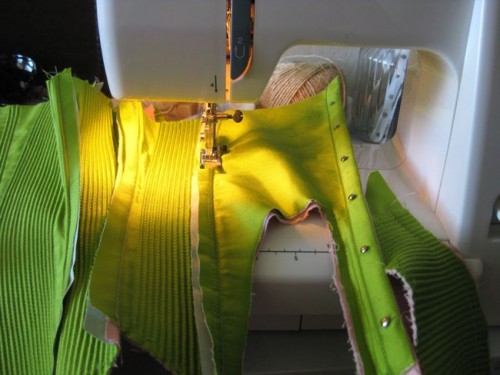
With all the pieces corded, I sewed them together, wrong sides together, and then stitched down the seam selvedges, which would be covered with bias strips.

Pieces sewn together, sewing down the selvedges

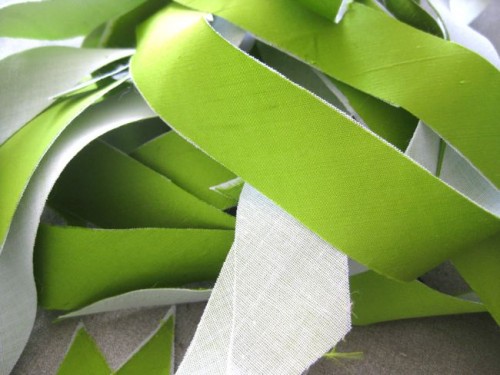
Along with lots and lots of cording, this corset takes lots and lots of bias strips.

Bias strip bonanza

Because the silk outer fabric is so lightweight, I bonded it to fusible interfacing so that the fabric would be strong enough to support the boning channels.

Bias strips fused on to interfacing

It would have really been smart if I had thought to bond the silk fabric to the interfacing BEFORE I cut the bias strips.  And if I had noticed the obvious directionality of the silk and turned all my strips the same way.

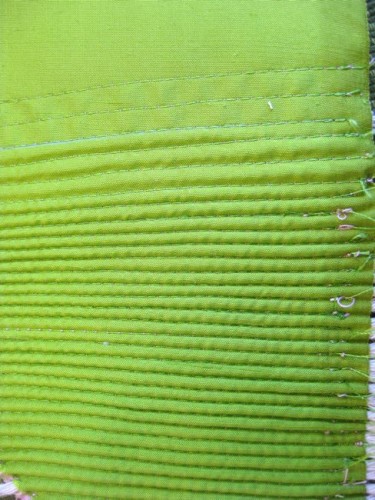
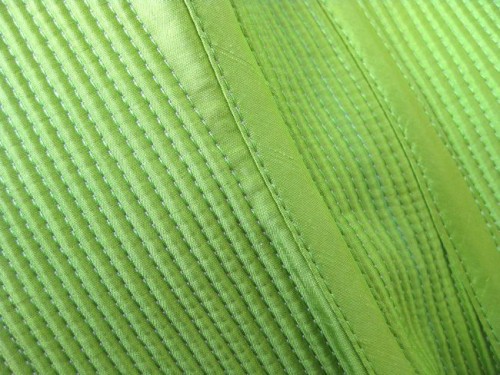
The final challenge with this corset was the thread colours.  Obviously the outer and lining fabric are very different colours.  And BRIGHT green is really hard to find as a thread colour.  I ended up having to use a rayon embroidery thread in bright green for the top thread.  Gorgeous, but not very strong.

Green thread on the outer, and a sewn-down bias channel

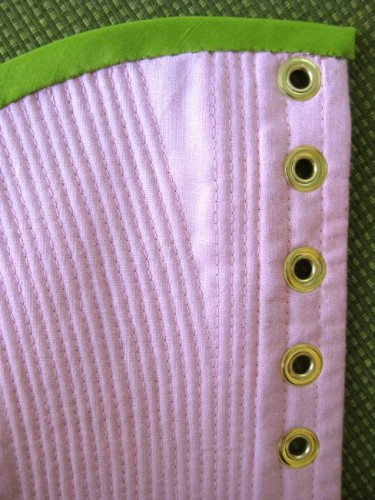
For strength, and because I didn’t want the contrast on the lining, I used a pink polyester thread for the bottom thread.

Pink on pink lining stitching

And, for a final touch I used brass eyelets.  Green and gold are so fabulous  (well, maybe not on yesterday’s Rate the Dress according to some of you).

Gold eyelets on green and pink

So that’s the corset’s beginnings and a few sneak peeks to titillate you.  On Saturday I’ll show you finished photos.