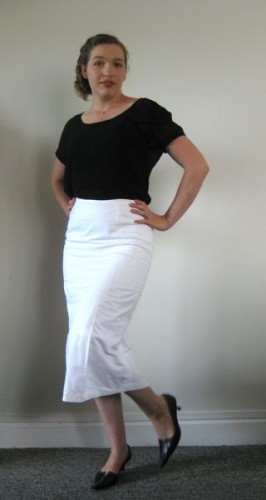
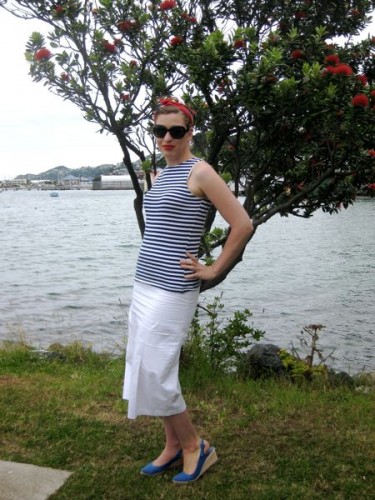
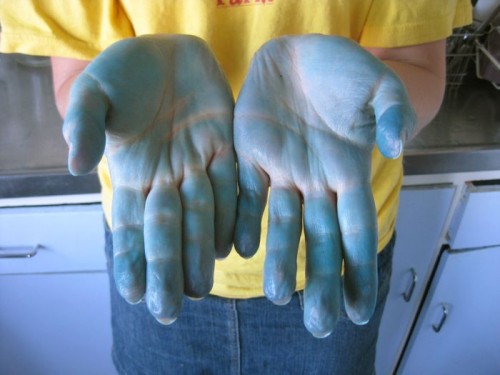
A reader has just finished her own hand-quilted 18th century petticoat (massive kudos and envy here!) and wants to know what to wear under it.
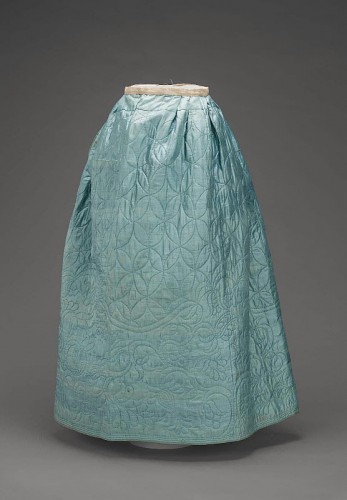
Quilted petticoat, silk, 18th century, Museum of Fine Arts, Boston
Based on my research: anything from large formal hoops to nothing but a shift and perhaps another petticoat, but bumrolls and small panniers were probably the most common, at least for the relatively well-to-do in the later 18th century.
When I get around to making a proper silk hand-quilted one myself I plan to pleat my petticoat with an even hem, but extra pleating at the sides, so it could be worn with small panniers and a bumroll, or without, as we see in this petticoat:
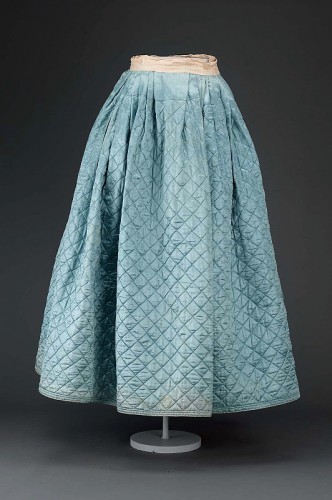
Lozenge quilted petticoat, 1750s, American, MFAB
Quilted petticoats were informal winter (well, cold-weather) wear ubiquitous across England, and common in France and America as well. Buck calls them “the undress of the country gentlewoman” (p. 72), though some extent petticoats seem to have been worn with more formal gowns.
As they were generally informal, I found few mentions of quilted petticoats over wide hoops in the later 18th century, though Robert Dodsley’s 1775 poem The Fable of Ixion: To Chlorinda mentions one as he describes how a goddess tricks an misguided suitor by dressing a cloud as a simulacrum of herself:
This cloud which came to her stark naked,
She dreÅ¿s’d as fine as hands cou’d make it.
From her own wardrobe out she brought
Whate’er was dainty, wove or wrought.
A smock which Pallas spun and gave her
Once on a time to gain her favour;
A gown that ha’n’t on earth its fellow,
Of finest blue and lin’d with yellow,
Fit for a Goddess to appear in,
And not a pin the worse for wearing.
A quilted petticoat beside,
With whalebone hoop six fathom wide.
With these she deck’d the cloud d’ye see?
As like herself, as like cou’d be:
So like, that cou’d not I or you know
Which was the cloud, and which was Juno.
I very much doubt that real 18th century ladies were wearing hoops six fathoms wide, but the the indication is still that the quilted petticoat is worn over a wide hoop.
Certainly wide hoops were worn under quilted petticoats earlier in the 18th century. Van Aken’s ca. 1720 An English Family at Tea shows the clear outline of hoops under the mistress of the houses’ white quilted petticoat and black gown. Two decades later Devis’s Mr and Mrs Atherton shows Mrs Atherton in fashionable undress of the 1740s: stiff stays and a white satin ‘nightgown’ (not worn in bed!) worn over a quilted petticoat. The style was not confined to England either. Gravelot’s The Judicious Lover of 1743-5 also depicts a quilted petticoat supported by wide hoops.
On a slightly less formal note, many women probably wore quilted petticoats over small panniers. Certainly Nelly’s skirts appear moderately wide, but not-quite hoop-width at the sides in her Reynold’s portrait:
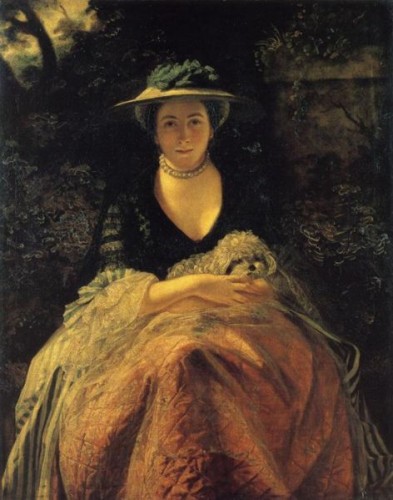
Nelly O'Brien by Sir Joshua Reynolds, circa 1762-4, the Wallace Collection, London
The shining silk skirts and beautifully worked petticoat of the matriarch of the Sharpe family also seem quite wide in the hips:

The Sharp Family by Johann Zoffany, 1779-81, National Portrait Gallery London
Later in the 18th century, when the emphasis moved toward the back of the outfit, it appears that panniers and bum rolls could be worn under quilted petticoats. Certainly the observant fashionista in No Resisting Temptation has augmented her natural form, both side and rear, in some way, though her dress is less formal than her naughty companions.
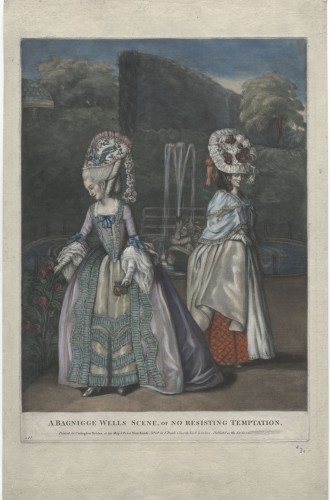
A Bagnigge Wells scene, or, No resisting temptation, Printed for Carington Bowles, 1776, Lewis Walpole Library, Yale
An example of a semi-formal robe worn with large panniers and a quilted petticoat in the later 18th century:
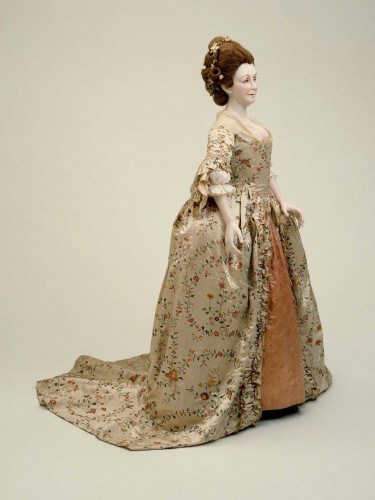
Woman's gown and petticoat (petticoat) English, about 1780, MFAB
On a more informal note, the pretty young things in polonaised dresses playing at bowls in Miss Tipapin going for all nine are either wearing no supports under their petticoats and pinned-up dresses, or ones small enough that they can still frolic and compete in.
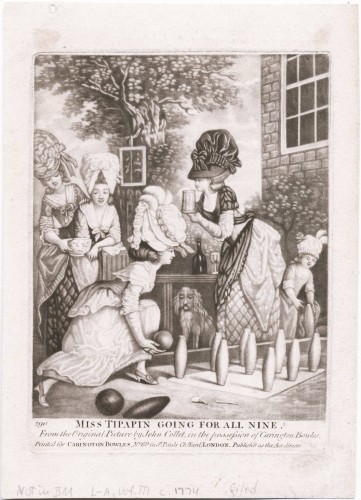
Miss Tipapin going for all nine from the original picture by John Collet, in the possession of Carington Bowles. 1778. Lewis Walpole Library Yale
Quilted petticoats may have also served in place of panniers or bumrolls. Certainly Buck indicates that they were worn instead of hoops (p, 43), and my experience is that they significantly augment the width of your skirt.
Moving down the rungs in society, the poor market sellers in their quilted petticoats in The Abusive Fruitwoman and The Enraged Macaroni (which sadly, the Library of Congress have not yet digitised in their own collection) do not appear to have any extra width or padding under their petticoat, and certainly it would have been impractical in their line of work.
In addition, there are numerous mentions of runaway slaves in America wearing quilted petticoats, and it is very doubtful that they would have been wearing them with any elaborate under-supports.
What really strikes me with all of these images and mentions is that quilted petticoats are not confined to one level of society or another in any way. The Bagnigge Wells visiting ton sport them, as do the fishwives in the London Markets, and buxom country maids, and the lowly apprentice’s innocent sweetheart. Neither does the quilted petticoat carry any implications of character or lack thereof: the country parson’s wife wears one in her modesty and thrift, as does the cobbler’s wife in her unseemly obsession with fashion, and the dirty, ragged Nan on the dockside.
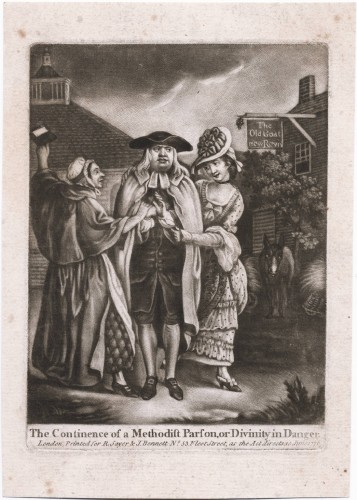
The continence of a Methodist parson, or, Divinity in danger, 1776, Lewis Walpole Library Yale
Useful links:
Quilted Petticoats at the 18th Century Notebook
Brocade Goddess’s exquisitely constructed 18th century petticoat
A costuming student makes a hand-quilted petticoat
Sources:
- Baumgarten, Linda and Watson, John with Florine Carr. Costume Close-Up: Clothing Construction and Pattern 1750-1790, Williamsburg: The Colonial Williamsburg Foundation. 1999
- Buck, Anne. Dress in 18th Century England. B.T. Batsford Ltd: London. 1979
- Burnston, Sharon-Anne. Fitting and Proper