Do you love historical shoes? I LOVE historical shoes. After all, they combine two of my favourite things: shoes and historical fashions.
For this week’s terminology post, let’s look at a a historical shoe term: the Cromwell buckle & shoe and its stylistic relatives.
Basically, a Cromwell buckle is an ornamental buckle of metal (often cut steel, and sometimes nickel or pewter) on the front of a shoe. In addition to the sparkly cut steel the buckle might be ornamented with paste jewels. A Cromwell shoe is obviously the shoe worn with the decorative buckle. Cromwell shoes are generally somewhat 18th century inspired, and usually have medium to high heels.
A variant of the Cromwell shoe is the Moliere shoe, which sported a slightly lower heel, and a slightly turned-up toe (though it seems likely that which you chose to call your shoe depended more on the date and your location than the actual style). Notoriously, Moliere shoes were worn by the first known victim of Joshep Vacher: the French Jack the Ripper.
Another variant of the trend was ‘Colonial’ shoes, which had the buckle and a tongued vamp.
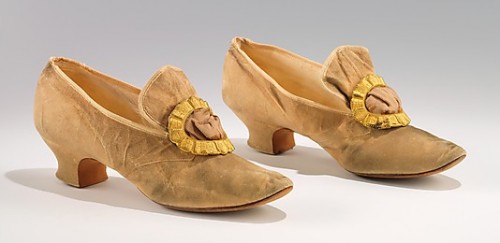
Shoes ('Colonial' Pumps), Evening, Steigerwalt, worn to Yale Junior Promenade, 1890, Met
Not all shoes with Cromwell buckles were strictly Cromwell shoes. Shoe designers did try sticking them on other styles, with mixed results.

Boots with Cromwell buckles, 1860-69, American, wool, Met Museum
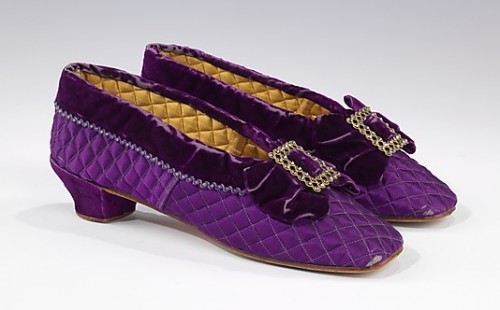
Boudoir slippers with Cromwell buckles, E.D. Burt & Co. Fine Shoes, 1865-85, Met
All the terms had their roots in 17th & 18th century historical examples: Cromwell & Moliere as the polar opposites of the mid-17th century, and Colonial as a generic term for early America.

Pair of men's shoes of the type that inspired the Cromwell variants, probably Italian, about 1650—1700, MFAB
Cromwell shoes could be very historically inspired, or somewhat freer in their interpretation. The Powerhouse Museum in Australia has a pair of ca. 1890 extremely 18th century inspired shoes to be worn with Cromwell buckles, but alas, without the buckle.
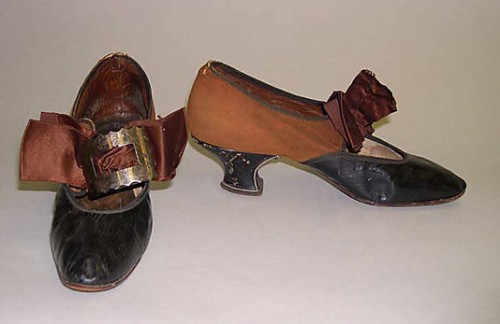
Shoes with Cromwell buckle over bow, American, 1887, Leather, silk, CI46.27.10ab Met
The term arose in the late 1860s and was used until the 1930s, with its biggest period of popularity from the 1890s to the 1920s.
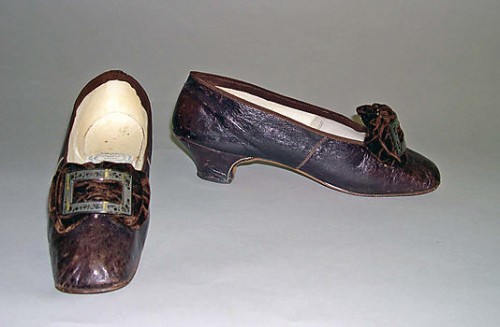
Shoes with Cromwell buckles, ca. 1867, Belgian, leather, silver, cotton, CI62.35.11ab, Met
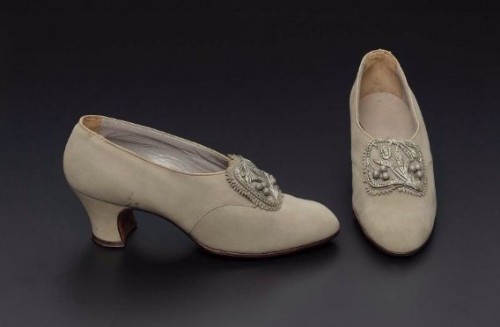
A pair of woman's pumps, Bob, Inc. New York, USA, about 1914, Suede, leather, metal, 51.2628a-b, MFAB
The application use, and type of shoe the buckles were applied to varied greatly. A 1903 fashion articles extolled the merits of practical ‘hygenic’ short skirts, and declared that the shoe to wear with them were equally practical “well-cut, laced-up, serviceable-looking black Cromwell shoes or one with three straps over the ankle to button.”
Practical could be elegant too, as extolled in a 1905 write-up for a “ladies glace kid Cromwell shoe with one strap and moveable ornamental buckle. It is in every way a dainty and at the same time serviceable production”
They also had less serviceable uses, as in the 1900s they were also advertised specifically as dancing shoes, where they cost more than wedding shoes.

Advertisement for Cromwell Shoes, Auckland Evening Post, Volume LXX, Issue 32, 7 August 1905, Page 7
Cromwell shoes weren’t just for adults. In 1910 NZ papers advertised Cromwell shoes for children in buck, kid, and patent leather. While they don’t make it clear if the children are boys are girls, later 1914 ads specifically describe Cromwell shoes for boys.
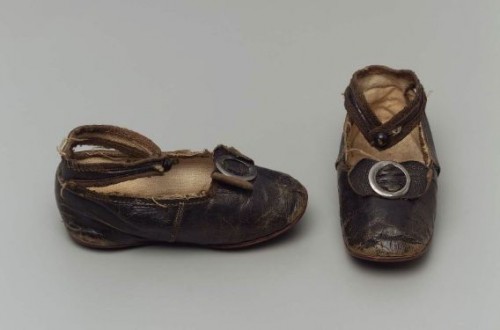
An early example of a child's Cromwell shoe "First pair of shoes worn by little Neddy," American, 19th c, MFAB
After the 1914 ad, mentions of Cromwell shoes disappear from NZ newspapers for 20 years. They reappear briefly in 1933, and then are gone. Despite this odd gap, there are numerous examples of 1920s shoes that are clearly 18th century inspired, and sport what would have been called Cromwell buckles in earlier decades.

Shoes (Pumps), Evening Nancy Haggerty (American), 1918—22, American, silk, metal, glass, 1979.416.8ab, Met

Shoes (Pumps), Evening Pietro Yantorny (Italian, 1874—1936), 1925—30, Met

Shoes (Colonial Pumps), Evening Pietro Yantorny, 1925—30, 2009.300.1593a, b, Met
Sources:
O’Hara, Georgina, The Encyclopedia of Fashion: From 1840 to the 1980s. London: Thames and Hudson Ltd. 1986
The Metropolitan Museum of Art
Side note: have you seen American Duchesses first prototype photos for her early 20th century Astoria shoe? Swoon!