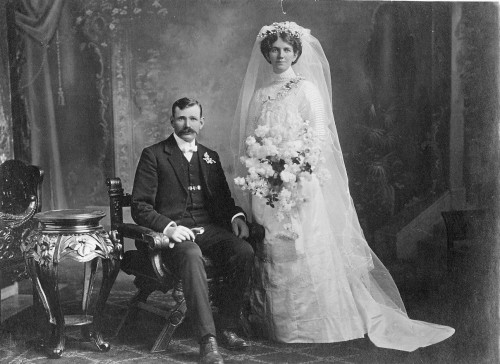
Want to recreate one of the gorgeous 1911 wedding dresses we have looked at? Unless you are brave and foolish (e.g. me) you’ll want a pattern. Here are some that might help:

The Sense & Sensibility 1910s tea gown pattern
The S&S 1910s tea gown pattern generally receives excellent reviews and is very similar in cut to many of the wedding dresses we’ve seen. The sleeves appear to be a bit shorter than most examples, but it shouldn’t be too hard to lengthen them or to add lace undersleeves. You could also lengthen the skirt to form a train if desired. The one slightly tricky thing will be filling the neckline, as its much too low for a daytime wedding. The easy way to fix this? With a guimpe! (Note to self – do a guimpe tutorial). This is perfectly historical, as I’ve found quite a few 19teens wedding descriptions that make note of the guimpe, and there are examples of 1910s wedding dresses that were worn with guimpes for the wedding, and without for evening wear after.
Sense & Sensibility also offers the 1912 kimono dress pattern:
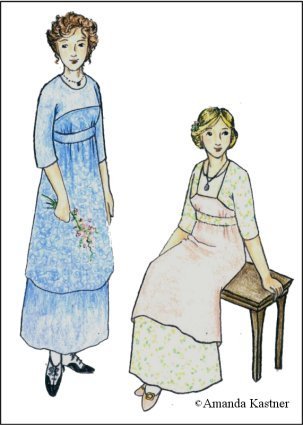
1912 Kimono dress pattern
Note how similar the blue version is to Elizabeth Boyd’s wedding dress. Just make it in luscious midweight silk satin over a lace bodice, add tucks in the skirt and pintucks on the sleeves and a collar.
Want something with a fuller blouse? Also from Sense and Sensibility is the 1914 afternoon dress pattern.

Sense & Sensibility 1914 afternoon dress pattern
Yes, it’s a few years later than our ideal year, but the pattern is quite simple, and does match the shape and silhouette of some extent 1911 gowns, so isn’t entirely out of the question. And wouldn’t it be perfect for this dress from the I Do exhibition.
Slightly less well known are Promenade Patterns, which offer this trained 1912 Dinner & Theatre gown:
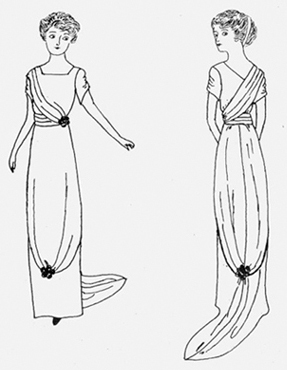
Promenade Patterns, 1912 gown for dinner & theatre
Once again it needs a guimpe, but couldn’t you just imagine it in satin with a lace and tulle overlay? Swoon!
They also offer a pattern very similar to the S&S tea gown pattern, but with a closed tunic:
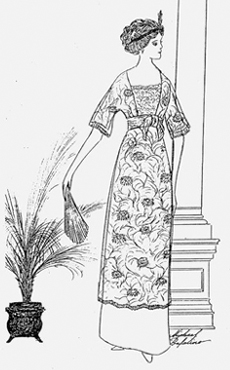
Promenade Patterns 1910-14 Dinner/Ball gown
If the previous patterns have been too ‘teens, and you want a less ‘modern’ wedding dress, you could adapt Promenade Patterns 1905 summer gown to fit a later date:

Promenade Patterns, 1905 Summer Gown
To update this dress 5 or 6 years, reduce the skirt gores slightly, reduce the blousing in the bodice, change the sleeves to long slim lace sleeves under mid-length straight sleeves and remove the bodice ruffle.
Or just go with Past Pattern’s 1910-11 Misses panel dress:
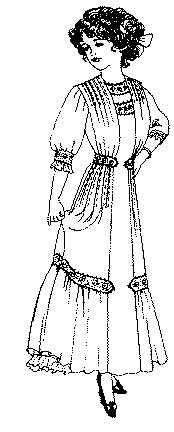
Past Pattern #4971- Misses' Panel Dress- Circa 1910-1911
The original 1910 pattern even suggested it be made up in marquisette! You could also easily work lace into the bodice, and there are lots of places to trim with Irish crochet buttons.
Past Patterns also has their version of the ubiquitous tea-gown pattern:
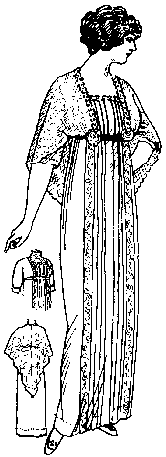
Past Patterns #8109: Tea Gown with Two-Piece Skirt: 1911 - 1914
This one is comes with a lace cape, and an option for a high neck – very helpful for a wedding dress! It is, however, a style usually seen later than 1911.
Not quite so worried about historical accuracy? And used to working with modern patterns? You could try to find a copy of Simpliciy 9716, their ‘Edwardian’ wedding gown.

Simplicity 9716 - Edwardian wedding dress
It does have the high neck and options for long sleeves already built in, but you’d need to make extensive adjustments if you wanted it to be accurate (change the sleeves from set-in to kimono, the neckline from sweetheart to round, square, or crossover, and the back fastenings from zip to hooks or buttons at the very least). Probably much easier to stick with the more historical patterns!
There you go! Lots of options! Just pick the one that matches your inspiration image best, and go with it!
Anyone made a dress from any of these patterns and want to show it off?