Latest Posts

Rate the Wedding Dress: 1860s cotton ruffles

Last week you LOVED the 1950’s  festive party frock.  I’ve never seen so many 10/10 in one post!  Alas, just enough of you were party poopers to make our frock miss out on a perfect belle of the ball rating, but it still managed a very popular 9.3 out of 10.

Since I’m focusing on wedding dresses this week on the blog, what better way to celebrate it than by rating a wedding dress?  Not one from 1911 though – we’ve done quite a few frocks from that era lately, and the focus on 1911 dresses might taint your vote.  So instead I’ve picked an 1860s froock.

This dress from the Met is the epitome of wedding dresses.  It’s WHITE, it’s BIG, it’s RUFFLY.  It’s even got a faux-pannier effect (do you remember being little and drawing wedding dresses and they always had split fronts with panniered poofs?) If ever a 1940s costume designer wanted inspiration for an 1860s wedding dress, it would have been their holy grail.

Wedding dress, French, 1864, Metropolitan Museum of Art

It’s not all typical bridal froth though.  The dress has almost no train, no lace, and it is made of cotton, rather than silk, mixing complete bridal over-the-top ness with a form of restraint in materials and design.

How do you feel about the dress, its puffs, its ruffles, its girth, the combination of design maximalism and bridal minimalism?  Too much, too little? And any chance that you would wear it as your wedding dress?

Rate the Dress on a scale of 1 to 10
A wedding dress of 1911

Tara wrote me last week with a fascinating query.  She’s trying to recreate her great-grandmother’s wedding dress, but all she has is a tantalizingly brief  description:

the bride looked charming in a gown of silk marquisette trimmed with Oriental lace and Irish crochet buttons over cream satin with lace coat to match.  She wore the bridal veil and orange blossoms and carried pink carnations.

As Tara says, not a lot to go on.  She want to know what the dress might have looked like, patterns that could use as a guide to making it, and what silk marquisette and Oriental lace (or their modern equivalent) are.  I thought this would make fun series of posts, so over the next week I’ll try to answer, with lots of pretty pictures!

For starters, let’s do what all brides do when they plan their wedding: look at inspiration images in wedding magazines!

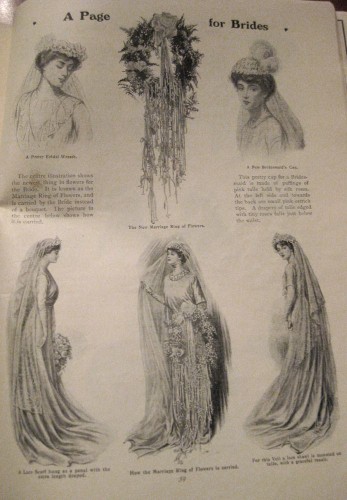
There weren’t any proper wedding magazines in 1911, but the Women’s Own Magazine did do ‘A Page for Brides.’  I’ve already blogged about the bridal headpieces they suggest.  Here’s the rest:

A Page for Brides, Women's Home Magazine, 1911

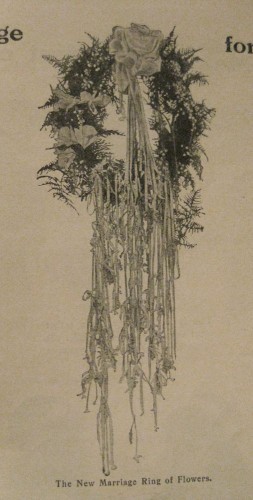
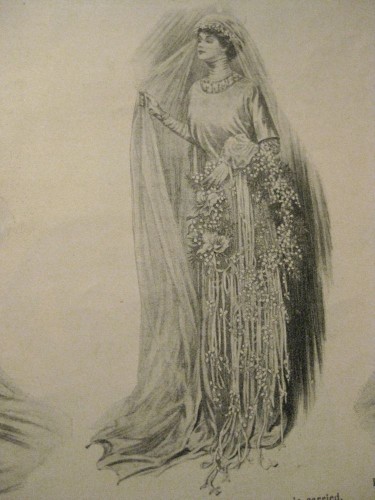
The new trend for 1911: wedding wreaths instead of bouquets

And how to carry your wreath - just in case you couldn't figure that out for yourself!

And for your bridesmaids, have them wear their own mini-veils!

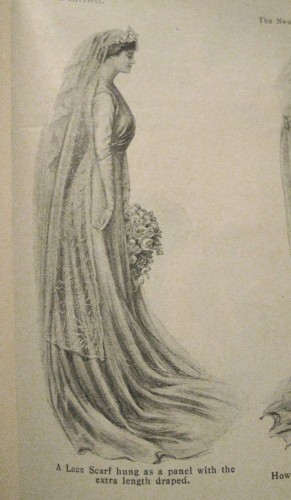
A suggestion for your veil

Another veil trend

If the suggestions in Women’s Own Magazine don’t do it for you, perhaps these ones will:

Two ways of arranging the bridal veil. In one, silver leaves and pearl "blossoms" hold the filmy lace in position on the hair. In the second, lace forms a dainty cap, adorned with bridal flowers, a clear tulle veil being thrown over the whole

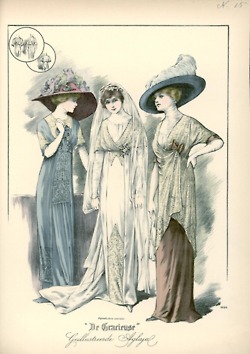
With the accessories sorted, the bride of 1911 can move on to deciding on the most important thing: her dress!  Die Gracieuse has a few charming suggestions:

A wedding dress from De Gracieuse, 1910

Wedding dress, De Gracieuse, 1910

Wedding dress, Die Gracieuse, 1911

And this is cheating just a little, but I found some fantastic images from 1912 and 13:

An exquisite example of a wedding gown in peau de soie interwoven with silver leaves and true-lovers' knots. The train is veiled with tulle and lace to match that composing the upper part of the corsage, 1912

Bride, 1913, Demoiselles

And finally, the perfect bridesmaid: one young enough not to argue with you!  And in an utterly adorable frock:

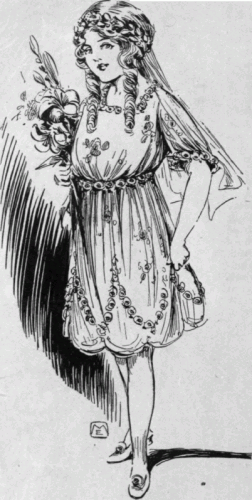
Child bridesmaid's frock in cream and pink chiffon, garlanded with tiny pink roses. A chiffon veil is held in place by a chaplet of the flowers and leaves

Shell’s dress – some very special fastenings

As much as I love the design of Shell’s dress, and all I have put into it, the most special touch, and the one that takes it from a gorgeous dress, to a spectacular, absolutely one-of-a-kind gown, isn’t my work.

It was my idea though.

Madame Ornata is a mutual friend of Shell’s and mine, and was very involved with the wedding.  She’s an incredibly talented seamstress and a truly gifted embroiderer, but was very busy in the run-up to the wedding, and with such a short timeframe it wasn’t practical for her to be part of the dressmaking, and the simple silhouette didn’t suit embroidered embellishments.

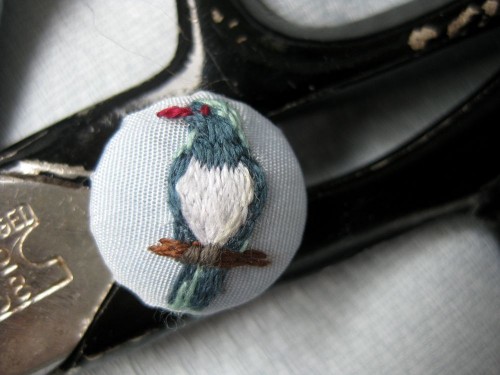
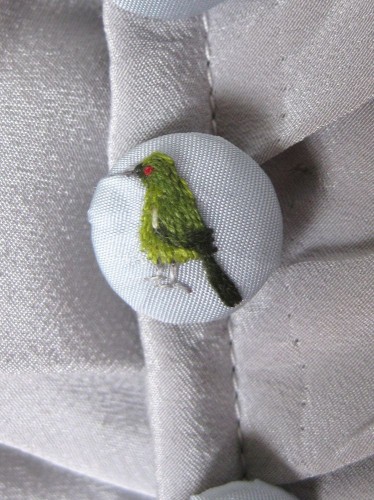
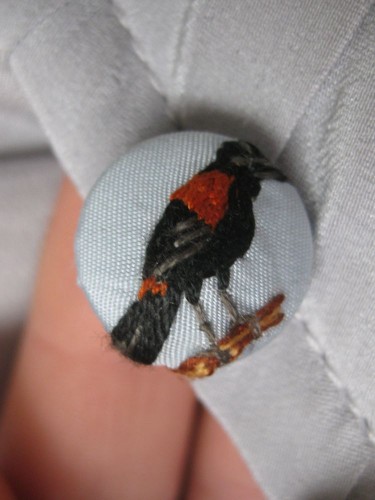
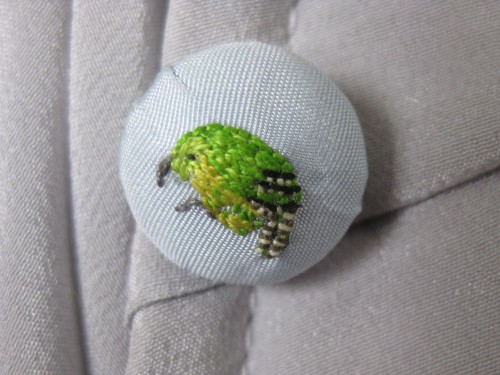
When native birds became the loose theme for the wedding, I had a brainstorm.  Maybe Madame O would be willing to embroider simple little bird motifs on the buttons up the back of the dress!

Now the buttons are very small – 9/16″ – so I really thought that if she could do anything more elaborate than the little double curves that kids draw to represent birds in the sky it would be really impressive.

Yeah.  Prepare to have your socks knocked off.

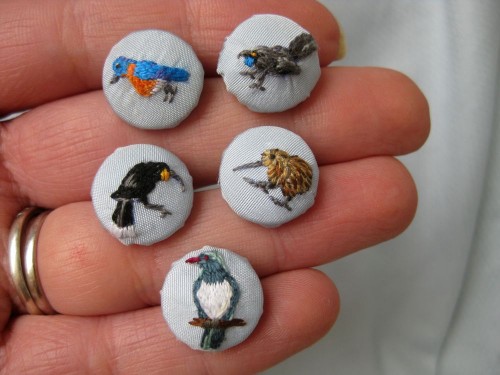
These are what she did:

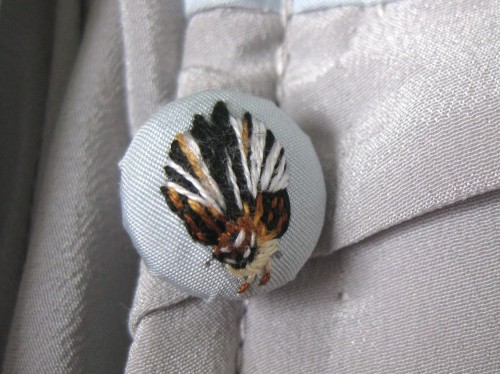
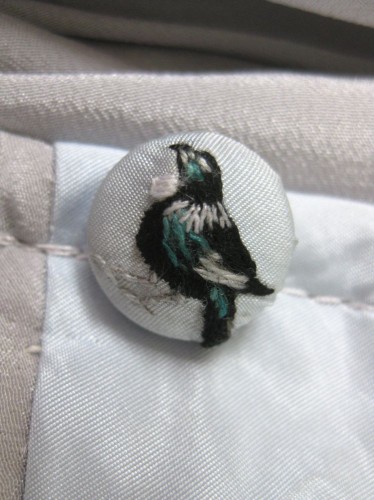
A bevy of beautiful bird buttons

Perfect representations of New Zealand native birds, all worked in just over half an inch of fabric!

Here are some of the birds she did:

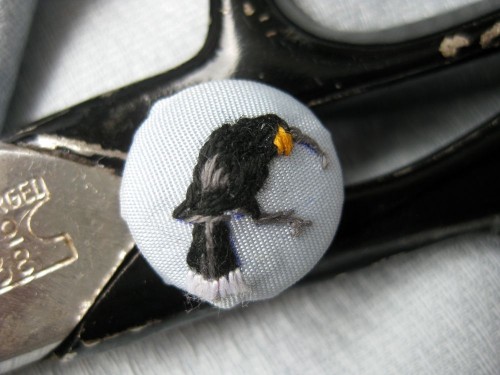
A female huia - our one extinct inclusion

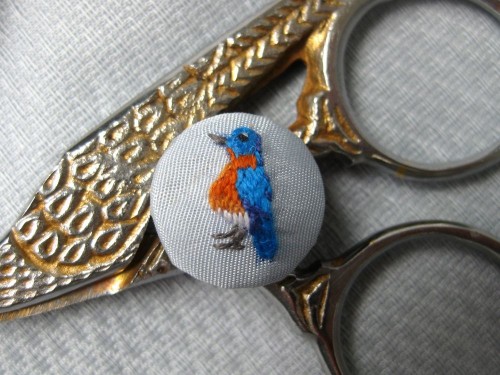
A Missouri bluebird - a reminder of Shell's origins

A kereru (wood pigeon) to match the dress

A kōkako, a relative of the huia and the saddlback

A takahe - thought to be extinct until they were rediscovered in 1948

A bellbird - unassuming except for their exquisite song

A tieke (saddleback)

A kakapo - 5-9lbs of roly-poly flightless parrot

A piwakawaka (fantail) - a common but enchanting native

A tui - common, cheeky, iconic imitators, called 'parsons birds' by early settlers

And finally, of course:

A little brown kiwi!

Aren’t they gorgeous?  Aren’t they adorable?  Isn’t Madame O amazing?!?

The best part of these is that Richard, Shell’s fiancee, got very interested and involved in them.  I think he may love Shell’s dress even more than she does!

I’ll show you a bit more of the buttons when I blog about the dress fastening in a few days.