Latest Posts

Why loving your body doesn’t have to equal revealing your body

This is a follow-up post to my post on the phrase ‘real bodies.’

I’ve noticed a big trend lately for loving your body = revealing your body.

You see it in shows like “How to Look Good Naked”, where women who hide their body under baggie clothes learn to celebrate it by doing a ‘boudoir’ photoshoot that is displayed on large screens in public places.  It’s a big part of the burlesque community, where you celebrate yourself by taking your clothes off.

And these are fine, and there is something great to be said for anything that helps women to feel comfortable with who they are, but I’m not entirely comfortable with their message, both for personal reasons, and in a wider societal context.

Personally, I’m quite a private person.  I don’t really tell people what’s going on with my life.  I hold new people at a distance until I really assess my character.  I hide my privacy in real life, and on the blog, with ‘public’ stories.  It’s amazing how people think they know you if you mention that you just had a dreadful cold, hate fringe and tell them what a merkin is.  😉

Along with being private, I’m private about my body.  I feel funny showing you fitting photos where I reveal my stomach.  I almost always wear surf shorts over a swimsuit.  I wear tunics over pants, not leggings, and avoid tight jersey clothes.  This isn’t about not liking my body (well, mostly), this is about feeling that my body is mine.  It’s private.  It’s like my private thoughts and feelings:  I only want to share them with people I really know, and like (and of course I like you guys, but who knows who else is on the internet 😉 ).

So that’s my personal reason for preferring to dress a bit more modestly.

In a wider societal context, I see the trend to promote loving your body through showing it off as part of a bigger emphasis on sexualising women: on our worth being based on how alluring, and available, we make our bodies.  Once again, it bases our perception of worth around our bodies on how other people view them.

I can see this movement having real value when it helps a woman who has never seen herself as alluring and desirable to feel that way, and to experience that about herself.  At the same time, I think its very important not to focus on ‘sexy’, on ‘alluring and desirable’ as the most important attributes of a woman.  We’re so much more than that, and any movement that can’t get that across, and can’t celebrate all those other things, is selling us short.  Because I want all women to feel that they can love themselves, even without being sexy.

I’m not advocating dressing like a Quaker from 1840: sometimes focusing on dressing non-sexually and modestly can put just as much emphasis on it as taking everything off.  Both are about how the outside world sees you: not how you feel about yourself.  I’m advocating taking control of your own body, and celebrating what it is, in any way that makes you feel comfortable.

So I’m going to wear  things that make me happy.  Skirts that end below the knees (though I got quite brave in Oz and bought two dresses that end above the knees).  Necklines that dip quite low, because I don’t have enough bosom to feel sexualized and ‘revealing’ in decollete.  Surf shorts over my one-piece swimsuits.  And I’m wearing them for me.  Because they make me love my body.

And those are my thoughts on dress and revealing your body.

I have a hard time writing posts like this, because they are very revealing about me.  They break my privacy barrier.  But while I don’t think that the only way for women to celebrate themselves is through sexualising their image, I do think that it is important to learn to celebrate yourself by trusting the world and showing them who you really are.  So this is me taking off my metaphorical privacy sarong.  Please ignore the mental cellulite.
PorcelainToy’s ‘Monsters’ Music Video – my screen debut as a costumer!

Exciting news!  The launch of PorcelainToy’s ‘Monsters’ music video was on Sunday, and the film is now available online.

Here it is, my screen debut as a costumer!  What do you think?  Can you tell the difference between my dress and the original?  Is it the right mix of pathos and cheesy (just like the original White Zombie)?  And isn’t Elizabeth de la Ray as Madge/Madeline  gorgeous?

Porcelaintoy ‘Monsters’ from Rater/Coder on Vimeo.

The launch night was lots of fun.  It was held at the newly refurbished Roxy Cinema (my neighborhood cinema!) with a dress code of black and white 1930s Gothic.

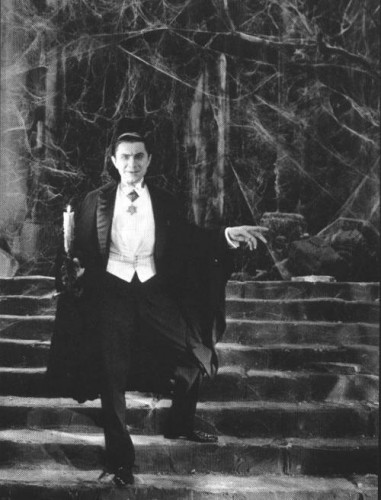
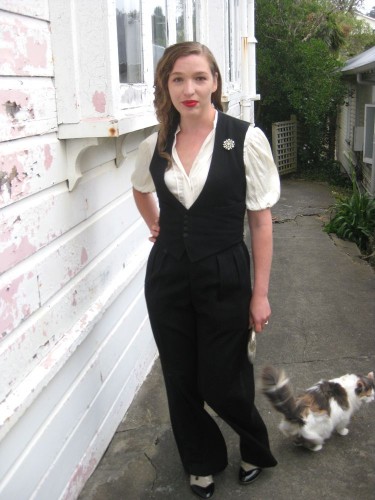
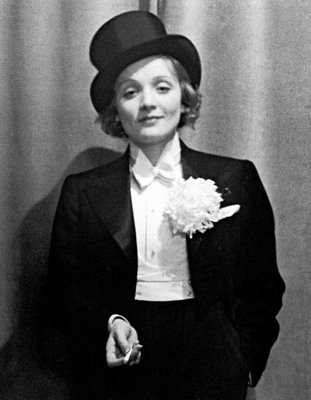
I wore vintage dress trousers (probably 1940s) and took in Mr D’s vintage dress waistcoat (probably 1930s, with 1950s alterations) to fit me.  Alas, nothing would make his vintage tails fit, so I added a late 1930s evening cape as a wrap, and a diamante brooch.  I was aiming for  “Marlene Dietrich as vampire” look.

Marlene Dietrich in a tuxedo

+

Bela Lugosi in Dracula

=

My 30s/40s formalwear trousers and waistcoat

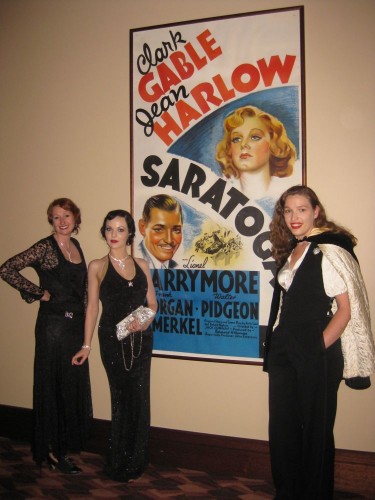
Claire of The Vanity Case, Elizabeth de la Ray, and me in my evening cape at the Roxy

Well, hopefully!  I think I need a white tie waistcoat, and a top hat to really make it work 😉


Terminology: What is a picot hem?

If you crochet or knit you are probably familiar with a picot hem, or a picot edge – a series of looped threads along the edge of your knitting or crocheting, which can be used for functional or decorative purposes.  A ‘picot’ is a single one of these loops)

If you are a really dedicated crafter, you might even know the same term from tatting (which is characterised by its use of picots), or know that some types of lace commonly use picots.

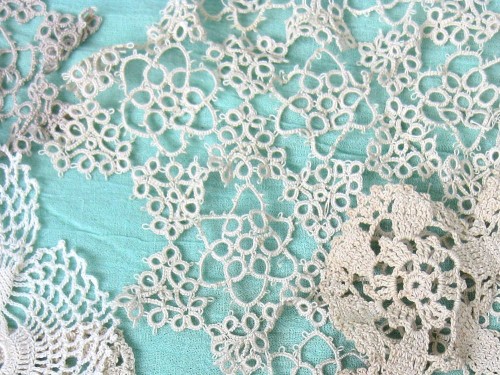
Lots of little picots on a tatted table mat

Picot edges are less well known in sewing these days, but you should, because  1) they are awesome, and 2) they are a common sewing technique in the 1920s and 30s, worked both by machine, and by hand.

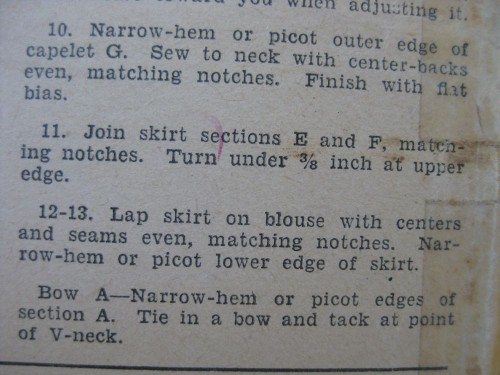
A 1930s pattern from my collection with picot edges

Note instruction 13

In sewing, a picot edge is a rolled hem with a zig zag stitch sewn over the hem to hold it.  It is usually worked on very fine, lightweight fabrics such as chiffon.

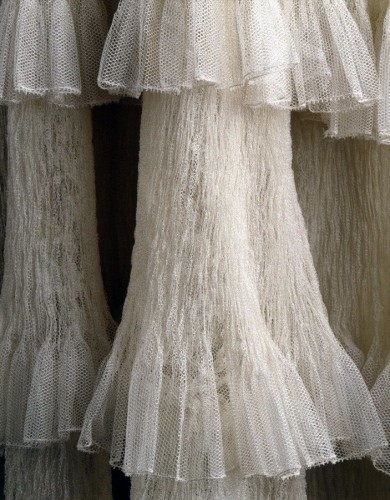
Chanel dress with picot edging, Metropolitan Museum of Art

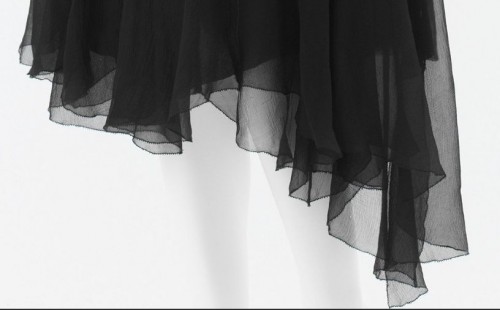
When I first saw a picot edge, I thought it must have been a very simple, cheap, low quality finish, such as overlocked hems on modern clothes.  However when I interned at the Met I got to see Chanel dresses with picot hems – you can’t get much posher than that!

Picot hems on a chiffon Chanel dress ca 1925, Metropolitan Museum of Art

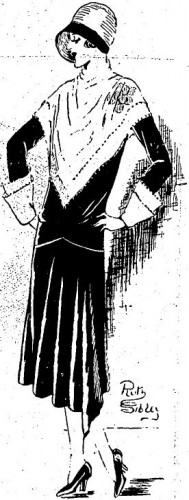
The use of picot edging for this type of hem seems to have arisen in the 1910s, with numerous retailers advertising picot edged scarves and collars.

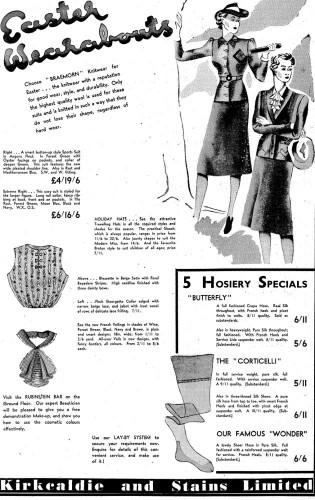
"A new and charming expression of the handkerchief vogue. In navy satin and pearl grey georgette with picot edges and a dainty design on the shoulder embroidered in yellow and orange."Evening Post, October 1928

It wasn’t just for dresses though.  A 1935 advertisement extols the merits of  ‘bungalow curtains‘ (how modern!) with picot edges.

The technique was so common and popular in the 20s and 30s that the name picot was even applied to straw woven in small loops.

"A picot straw model in beige, with turn-up brim, a side-rever, and, jutting out from this, two bright green lacquered feathers." Evening Post, 18 August 1934

You can also see usages where picot refers to a zig-zagged or looped seam join – not an edge at all.

Stockings with picot seams, Evening Post, 3 April 1939

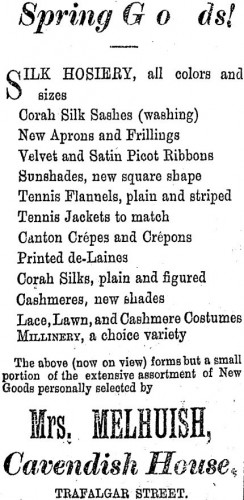
The earliest uses of picot (at least that I can find) are not for lace or crocheting, or knitting or hemming or straw at all, but for ribbon.  Numerous advertisements from the 1880s market different types of picot ribbon, referring to ribbon finished on the edges with little loops.

Advertisement for picot ribbons in the Colonist, 19 October 1886

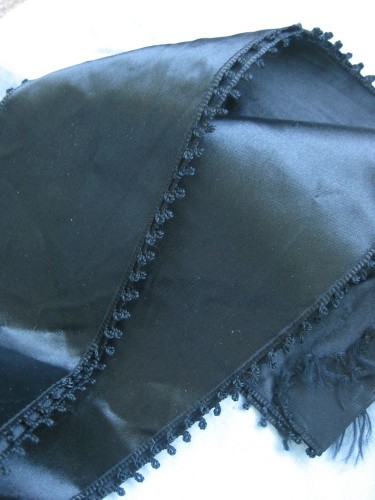
You can still buy picot edged ribbon, and it’s still sold under that name.

Vintage picot edged ribbon from my collection

I’ll add picot edging to my list of tutorials to-do, and hopefully it won’t be too long before I get to it!