A while ago someone asked me about Regency sandals. Why do we see so many in fashion plates, but so few extent pairs?
Well, I suspect the ratio is quite similar to most items seen in fashion plates vs. extent items. Fashion plates (and fashion magazines today) always show the most avant -garde and extreme fashion, and few ladies ever reached that level of modish dress.
In addition, contemporary sources seem to indicate that wearing sandals was rather noteworthy, and maybe just a little bit scandalous, so there probably was a lot more talking about them than actually owning and wearing them.
We can see the scandalousness conotations of sandals illustrated in the famous Boilly image of a rakish Incroyable meeting his female counterpart, the Merveilleuse. In her transparent dress even the radical Incroyable mistakes her for a prostitute and offers her money, while she shows a modesty not apparent in her attire and makes the sign of a cross with her fingers to indicate her shock and virtue.

Louis Leopold Boilly, Incroyable et Merveilleuse in Paris, 1797
While they are hard to find, there must have been a few naughty woman, as there are some extent pairs of Regency sandals, just not very many. And a few pairs of almost sandals. And then some that are probably not actually Regency sandals at all.
Here is a darling pink pair from the Met:

Shoes, 1806-15, E. Pattison (British, 1800—1850), Met Museum, 2001.576ab
And a white satin-over leather pair from the Bata Shoe Museum (image from Dawn Luckham and the Regency Society of America boards):
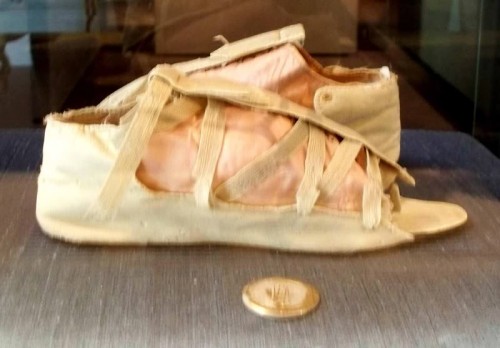
Silk and leather sandals, 1795-1805, Bata Shoe Museum
And a red leather pair from the Manchester City Galleries:
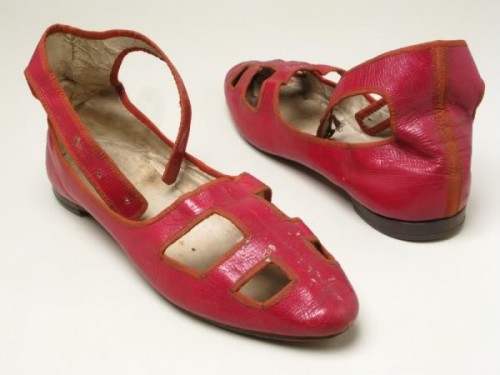
Red leather sandals, 1800-1825, Mancherster City Galleries
A lot of Regency sandals are really more like slippers with elaborate lacing patterns.
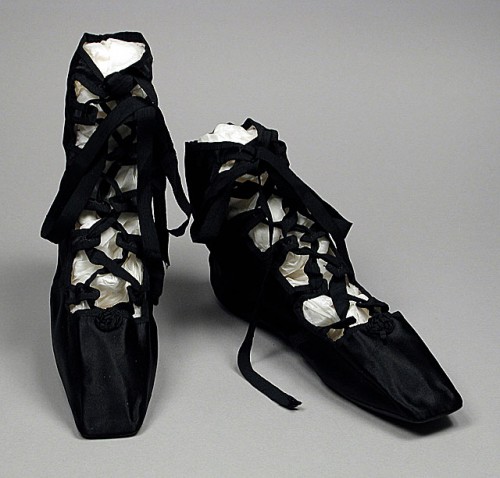
Pair of 'Grecian Sandals' in a shoe bag, circa 1818, England, LACMA
This pair of slipper-sandals from the MFA Boston is quite cunning, if barely sandal-like:
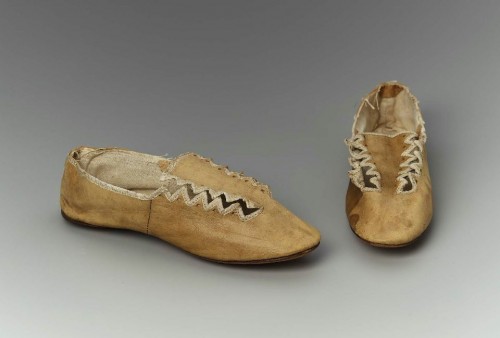
Sandal slippers, 1810-15, MFA Boston, 99.664.37a-b
This gorgeously detailed pair is slightly more sandal like:
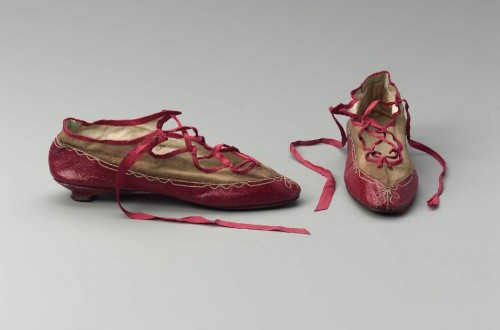
Sandals, ca 1805-10 France (worn in America), MFA Boston
This fashion plate shows a similar laced slipper. Was it the proper woman’s alternative to the sandal?

Morning dress, London, Sept 1798
In the category of not actually Regency sandals at all, Te Papa has a pair that are listed as ca 1800, but I have inspected them in person myself, and suspect they are actually early 20th century Scottish dancing shoes, which is probably why they aren’t included in their online catalogue!