Latest Posts

Rate the dress: Lace and fur in 1910

Well, you have had two weeks now of vivid red Rate the Dresses.  You liked the rose-red of Charles I’s outfit better than the tomato red of the 1860s dress, but other than the colour Charles’ 1610s outfit didn’t fare too well.  You rated it a paltry 4.7 out of 10, and dubbed it a representation of the ugliest period in fashion ever, but I daresay it would have come off worse had it not been red.

Popular as it may be, I can’t show you red outfits for every Rate the Dress.  It would get monotonous, and I think it gives them an unfair advantage.  Personally, I’m a huge fan of neutrals, partly because I feel a neutral frock really has to work for approval: if it isn’t right, you notice, where a bright colour can hide shoddy design.

Shoddy design is, of course, a matter of taste and time.  It had never occurred to me that this was a fashion no-no, but in Flora Klickmann’s Flower Patch books, she complains about the “innappropriate, vulgar, inartistic fashion of trimming frail transparent dress material with fur.”

Ouch!

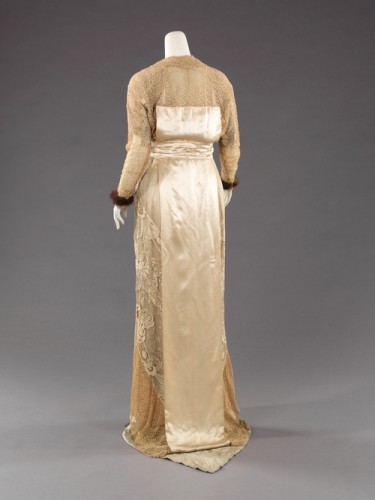
What about you, dear readers?  Do you also think that combining fur and fragile chiffon and lace is a fashion faux pas?  Let’s test it with a frock by noted Parisian designer, Jacques Doucet.  The frock is held in the    Metropolitan Museum of Art.

Evening dress, silk, fur & linen, Jacques Doucet, 1910, Met

Evening dress, Jacques Doucet, ca. 1910, Met

Evening dress, Jacques Doucet, ca. 1910, Met

Doucet’s dress combines lavish amounts of silk satin, lashings of draped lace, elaborately embroidered chiffon, and just a touch of fur on the cuffs, all over a linen underlay.

Too much? Too many fabrics?  Does the neutral colour scheme hold it all together, or just make it boring?  And what about those bits of fur?

 Rate the Dress on a Scale of 1 to 10.

Marine minutiae

A friend and I took a walk along the seashore.  At first we looked beautiful scenery, the rocks and rippling waves, the swirl of clouds in the sky.
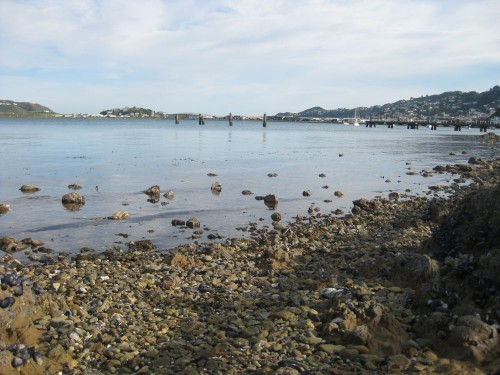
Sea and sky and rocks

Then we looked down, and found a world of life, tiny and vibrant, hidden amongst the scenery.

It started with a crab, no bigger than my thumbnail:
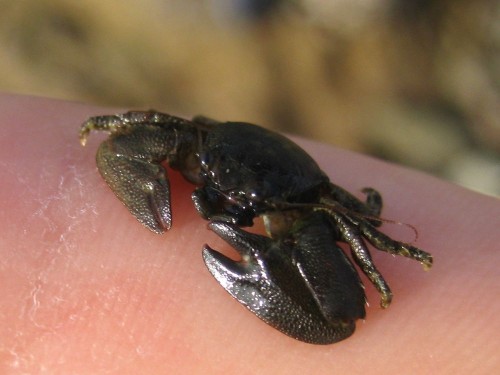
Itty-bitty crabbie

I saw him run across a rock, and we picked him up to marvel at his tiny eyes, the curling antennae, the olive-black carapace both smooth and bumpy at the same time.

There were more crabs on the rocks, glistening in the late afternoon sun, trying to blend their greens and blues to the golden rocks, and running sideways for safety when they felt they had been spotted.
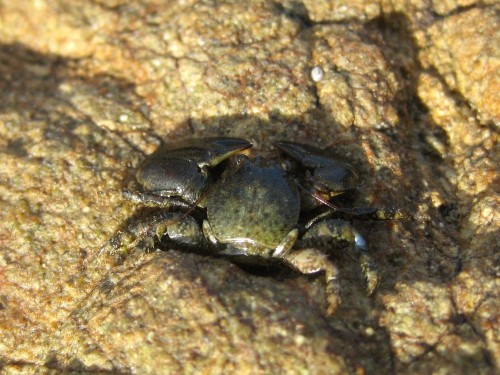
Big claws, and muscled legs

There was other life on the rocks, also practicing camouflage, but unlike the crabs unable to flee, so protected by their hard shells.
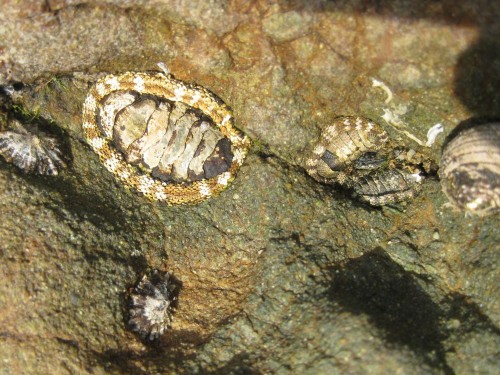
Shells and prehistoric snake-limpet thingees

I don’t know what the prehistoric looking armoured thingees with little snakes wrapped around their edges are.  Oddly enough googling “rehistoric looking armoured thingees with little snakes wrapped around their edges” doesn’t bring up anything useful.  I do like that the first result references Terry Pratchett though.  I realised I left off the ‘P’ by accident, but if you google it with the ‘p’ your results aren’t any better (though I am intrigued by the page that offers “Fun things to do near Uckfied”).
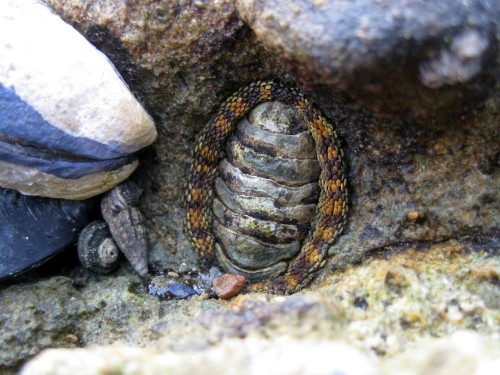
What are you, oh armoured snake thingee?
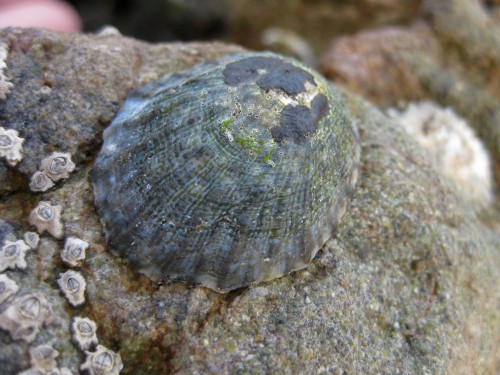
This is a limpet. That one I do know.

After inspecting all the life on the rocks we began to wonder what lived in the water.  I took off my shoes and socks and waded into the shallows.

The water was full of seaweed and algae, and tiny little barnacles, but with a closer look you also noticed the dozens of shells, all hiding some snail creature that slowly crawled up and over the rocks, living out its little shell-creature life.

Little crawling sea shells

Little sea snails in a pretty shells - look at the one climbing up the rock toward me
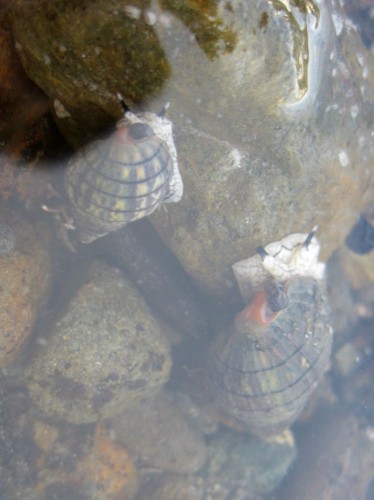
Two sea snails, antennae alert, traverse a rock

We crouched together, my friend and I, immersed in the world of the sea snails, watching them traverse the seafloor, their persistence dislodging pebbles twice their size as they pursued the path they had set.
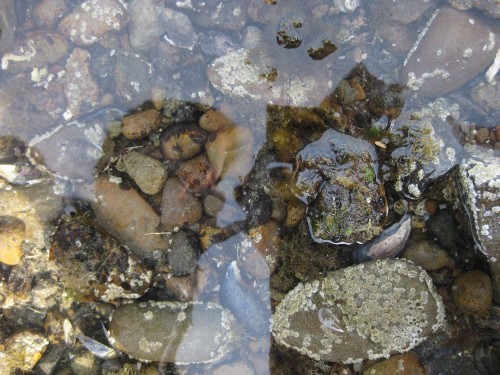
Our reflections above the sea world

We thought about the sea snails, and their awareness.  Did they sense us there, our feet causing ripples in the water, our bodies casting shadows, and occasional click as the camera snapped a shot?  What if we had picked one up, tried to get it to crawl across our hand?  What would a sea snail, in its sea snail consciousness, have made of us?  How much could it comprehend the road passing by, just metres from the beach, the cafe and the apartments across the road?

Sea snails living where air and water meet with each swell of tide

Are we, in our own way, just sea snails?  Trying to understand a universe that is as foreign and incomprehensible to us as the road and cafe is to the denizens of the shallows?  Trying our best to explain, with science and religion, but really no more able to express what is really going on than the snail can express the concept of the espressos they serve in the cafe?

Speaking of things that try to grasp their reality, I wonder what the crab who bumped into my foot on his travels thought of it.
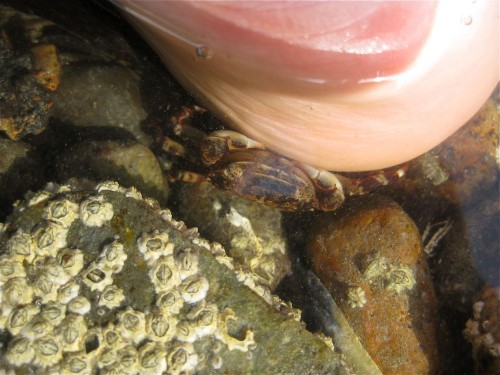
Little crab at the edge of the foot

I was crouched in the shallows, watching the shells, when I felt a tickling on my heel.  I joked to my friend that the water was so crawling with life that some of it was crawling on me, and then I felt the tickling again, and realised it was true.  We looked down and saw the little creature making his way around the curve of my foot, trying to hide under the arch.

To my great credit, I did not squeal and scream and jump out of the water and shake my foot off.  Instead I snapped the photo above, and then gently moved my foot to let the crab go on his way.
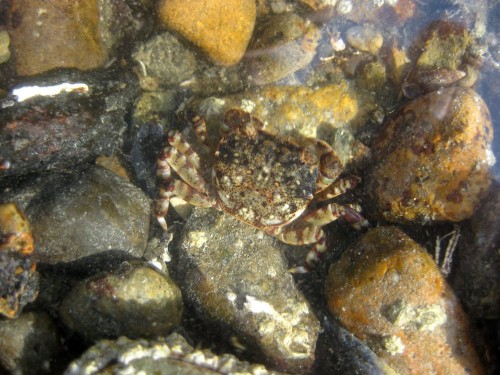
Crab sans foot

In addition to crabs in their usual crab-carapaces, and the shells with their natural inhabitants, we watched long enough to espy a hermit crab, his shell moving across the ocean floor at a most un-snail like pace.
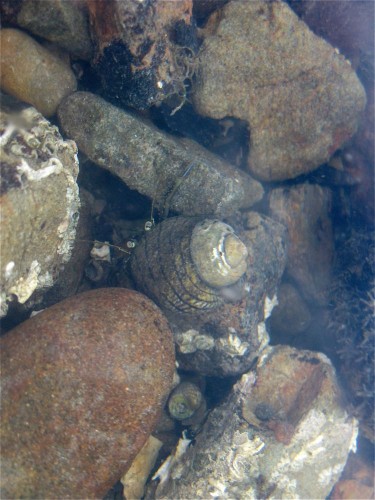
The hermit peers out from his borrowed home

What does the hermit crab think of the previous owner of his house?  Does he appreciate the wonder of a creature that makes and carries its own home on its back?

I do.

Sewing a set of ill-begotten stays

Some time ago, I decided I needed another pair of stays, and started on a set.  And they’ve been nothing but trouble since then.  They are almost making #4 on  the list of evil things.

First there was the fabric.  I bought a bunch of linen with a gilded finish in a fabric sale, because it was soooo pretty, and I’m a magpie.

Linen is a great fabric for stays, right?  And who doesn’t want a pair of gilded stays?

Linen is not a great fabric for stays if it warps.  And gilded linen is an even worse choice if the minute  you iron it, the gilded finish comes off, leaving you with plain, boring, ecru linen.

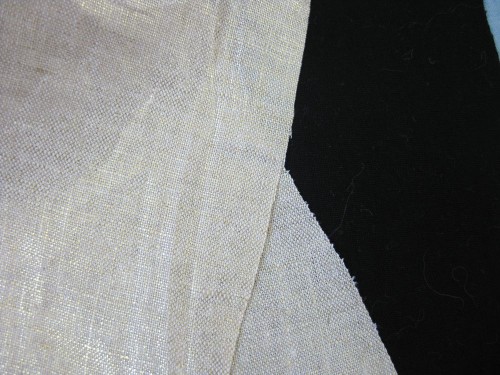
But I didn’t even get far enough into the stays to find these things out before it gave me problems, because it turns out that gilded linen is actually really, really hard to match for a lining.  So I finally settled for black, because it was really the only thing I had that didn’t look hideous with it.

Gilded linen and black lining

And, of course, the day after I cut out all the black lining pieces, I was at an op shop and found the perfect tightly woven blue cotton fabric for the lining.  And it was only $2, so of course I bought it.  And then went home, and glared at my black lining pieces, and then sighed, and re-cut the lining out of the blue.

Much prettier, but what a hassle!

So now I have an extra black lining cut for stays, and being the sort of person I am I don’t want to just toss it, so now I have to make yet another pair of stays.  Out of the same pattern.  And I wanted to try a different pattern next time.  Grumble-grumble boo.

The pattern, now that I’ve mentioned it, is the same one that I used for my are-they-or-aren’t-they 1750s  red cotton and linen stays.

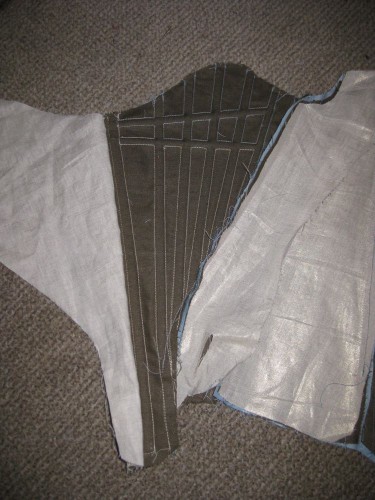
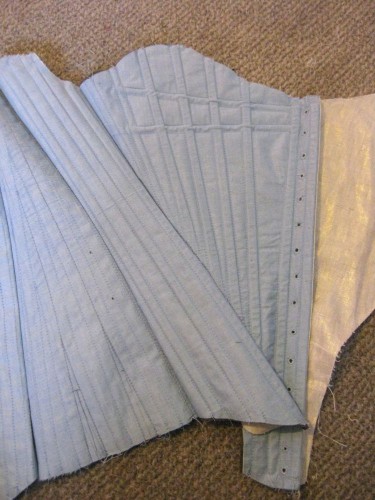
I’m trying a new way of sewing the stays, where I sew the boning channels through the lining and the support fabric (a lovely non-warpy but not pretty-coloured brown linen), and sew the pieces wrong-sides together with the seam allowances facing out, and then put the gilded linen outer pieces over each pattern piece to cover the seam allowances.  It’s quite similar to what I did with Ninon’s bodice.

Inner brown linen with boning channels, and gilded linen cover

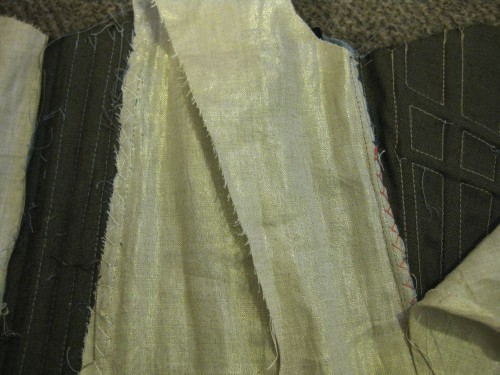
You can see above how the gilded linen pieces are sewn with the seams at one edge, and then will be folded back over their pattern piece, and the edge folded under to cover the raw seam allowances.

The raw seam allowances sewn down to keep them flat and nice under the gilded linen

I’m sure I read about this as a historically accurate type of stay construction, but these stays have been so evil that now I am convinced that I made it up in some horrible nightmare that convinced my mind I had read it, and now all this effort has been for naught.

Well, mostly naught, because they will still be wearable, if not historical.  Sort of.  We’ll see.

I’m also trying a new boning layout, also based on a source that I can no longer recall or find.  I know I looked at pictures and stays and patterns to draw it, but between drawing out the boning layout and sewing it the pictures and stays and sources have all disappeared.

Typical of these stays.

Where did you come from, oh mysterious boning layout?

You can see in the photo above the other ill-thought out, misbegotten, evil thing about these stays.  They lace front and back.  That means twice as many eyelet holes to do by hand.  What was I thinking!

I’ve realised something writing this post.  The more evil something is, the more I use italics.  Mr Carpenter was right!  Italics are evil!  Or at least a sign of it.