Latest Posts

Cording is evil (#3)

Cording is evil.

After pintucks, and the Briar Rose Corset, cording makes #3 evilness.

I’m making an 1890s corded corset.  It’s based on a pattern in Jill Salen’s Corsets: Historical Patterns and Techniques.

The pattern is kinda weird and insane.  Look at my pattern pieces:
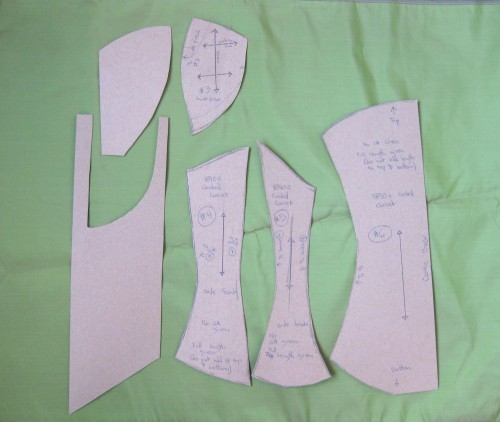
1890s corded corset pattern

Starting from the centre back on the right, it looks totally normal.  Basic princess seam, basic side back princess seam, basic side front princess seam, and then you have your….what the heck is that!?!

The front piece with bust insets

That, dear readers, is the front piece, with a set in bust.

The problem with the set in bust is that 1) it gets set into a 3.5cm opening in the front piece (and I don’t know if you have ever measured one breast, but mine isn’t 3.5cm across!), 2) the original corset was sized for someone very short, with a very large cup size, so needed a lot of resizing, 3), resizing bust cups is horrible and tricky and 4)  once you have figured out all the fitting issues, actually setting in a double bust inset isn’t easy.

This is what the set in bust looks like when it is done. Weird aye?

But before I get to the setting in the bust bit, I had to sew the aforementioned evil cording.

But first I should tell you about fabric.

I’m using a gorgeous black silk satin recycled from an obi for the outer of my corset, a dark pink vintage cotton for my lining, and obi lining cotton for the interior support.
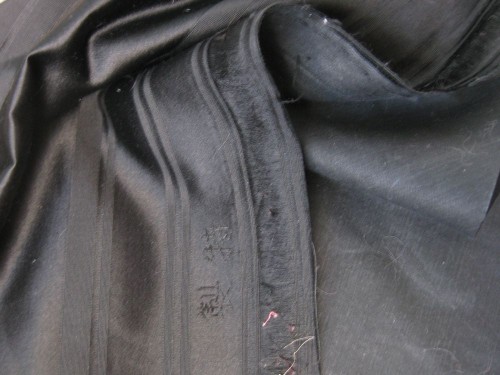
The recycled obi silk satin - such amazing quality silk!
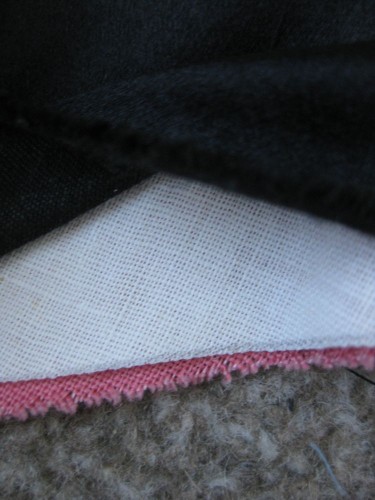
The interior cotton, and the dark pink lining

I sewed my cording between the black silk and the stiff obi cotton.

Basically every single piece of the corset excepting the front piece is fully corded.  That’s a LOT of cording.  My corset is corrugated.
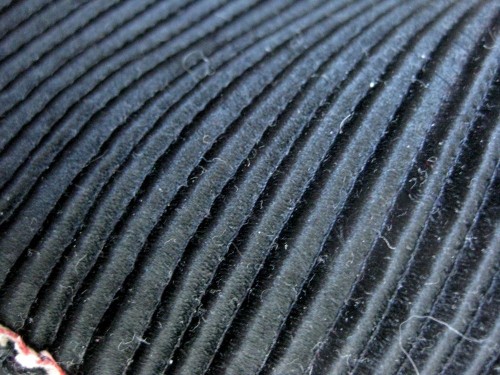
Corrugated corseting

To sew the cording, I marked the centre cording line in each pattern piece with chalk, and then sewed a line of stitching along that line.  Then I used the zipper foot to sew a cord snuggly up against the line of stitching to start my cording.
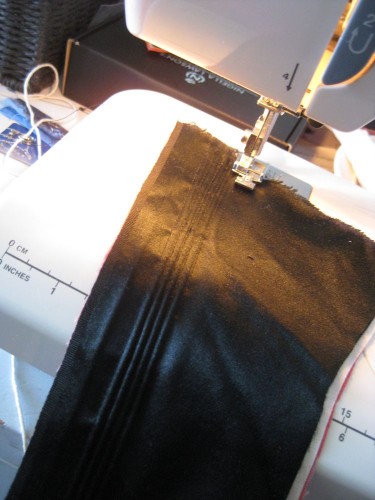
Sewing down a line of cording with the zipper foot

Additional lines of cording get smashed up against the started cording line.  I would maneuver the fabric with my left hand, and use my right index fingernail to push the cord up against the stitching and press in a crease to sew along, keeping the cording nice and tight and even.
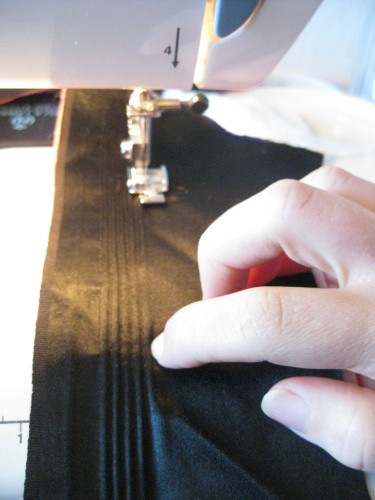
Pushing the cord up against its fellows with my fingernail

And every three cording lines or so I would sigh and come up with a new creative not-actually-a-swear word and wonder why I did this to myself.

But for all that evilness, the corset is almost done, so I’ll show you more progress pictures in just a day or two!

The 18th century man’s jacket: finishing details

With all the patterning, construction and fitting of the 18th century jacket done, I could now do the finishing touches.

Or more accurately, I could send out a panicked call to a few friends who owed me favours, and get them to do a bunch of the finishing touches for me.  This was the week before the Grandeur & Frivolity talk, and I was a just a little overwhelmed and busy.

I sewed the neckband on myself, and did all the buttonholes too.

The collar and buttonholes

They are machine done for now, but I will probably do them over by hand at some point.  You’ll notice that they aren’t actually opened: this seems to be the case on most 18th century jackets (at least for all but the top few buttonholes).

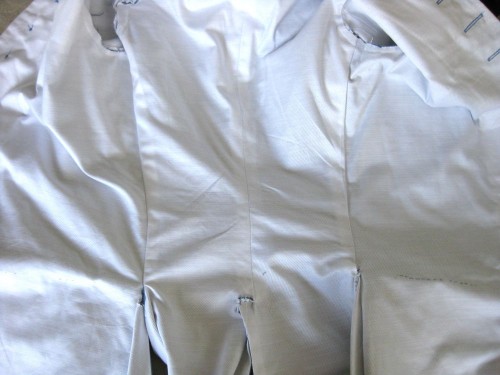
The reverse of the unopened buttonholes

Darling Shell sewed on all the buttons.  She didn’t hide the threads between the layers as I probably would have done, but I’m not sure which is historical.  Anyone seen a actual 18th c jacket and how the buttons were sewn on?  And am I the only one insane enough to be interested in stuff like exactly what is the proper historical way to sew on buttons?

The back of the buttons

Shell sewed all the buttons down the front, and the ones on the top of the pleats.  That’s a lot of buttons.

Buttons at the top of the pleat openings.

I tacked down the pleats from the back so that they hung properly.  There is still some raw fabric showing, and I’m not sure how to finish that nicely.  Is this how it’s supposed to be done?  Did I cut the jacket properly?  What is the correct way to finish the top of jacket pleats? Lauren I’m looking at you!

My messy-raw, tops of the pleats

Finally, the false pocket flaps got sewed on.  I was so busy at this point I really can’t remember who did the sewing.  Was it me or someone else!?!

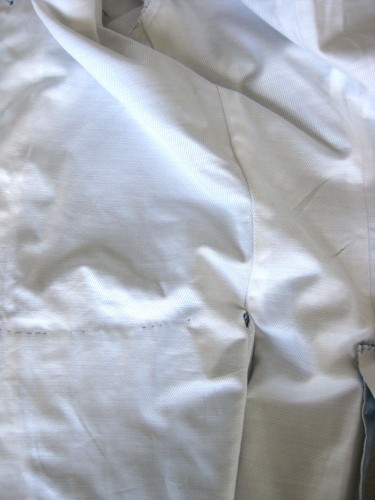
I didn’t measure the flap positions: I just eyed where they went, pinned the flaps on and basted them on.  You can see the basting stitches show through the lining.

The stitching line for the pockets (and another look at sewn-down pleats tops)

I may go back and make these real pockets in the future, but for now the faux pocket flaps do the job.

Whether or not to make real pockets is still up in the air, but the one thing I definitely do want to do is to bind the edges of the armholes so that they aren’t raw.

Must be finished prettily!

First I want to try the jacket on a few more men, to make sure that it will fit a range of models if the amazing Daniil isn’t available.


Rate the Dress: Mourning in 1872-4

Despite the fact that most of you thought Marie Christine looked like a “blinged-out sheep” with “an 18th century mullet” the essential loveliness of her pink dress (and a general weakness for diamonds on the part of some voters) brought her in at a respectable 6.5 out of 10.  How to improve the rating?  More flowers, less jewellery, and no rat-tail curls!

This week I’ve tried to move as far as possible from frilly pink status frocks while still staying very feminine and detail-oriented.  You can’t get much further from pink party dress than a Victorian mourning dress.

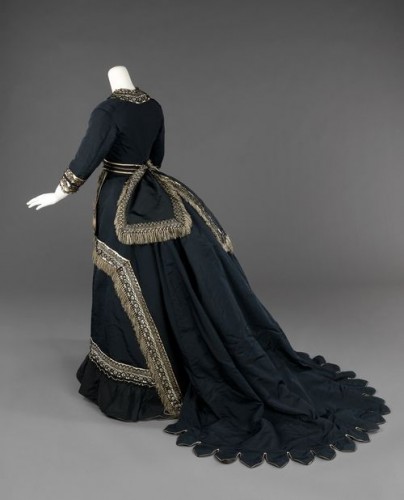
Admittedly, this 1872-4ish mourning dress from the Met is still clearly a status garment, demonstrating that the wearer could afford specialized mourning clothes and completely impractical garments that they couldn’t do any real work in.

Silk mourning dress, 1872-4, American, Metropolitan Museum of Art

Silk mourning dress, rear view, 1872-4, American, Metropolitan Museum of Art

Impractical is one thing, but as long as a garment isn’t ridiculously confining by the standards of its time, we are more worried about looks.

What do you think?  Is this frock an elegant way to navigate the social requirements of mourning without being a compete dowd, or did our early-bustle period fashionista let grief go to her head, and loose all sense of taste along with her personal loss?

Rate the Dress on a scale of 1 to 10