Latest Posts

On Fasting: some answered questions

Tomorrow is the last day of the Baha’i fast.

For nineteen days, Baha’is all over the world have been abstaining from food and drink between dawn and sunset.  And, for nineteen days, random people all over the world who have never encountered someone who fasted before have asked lots of questions, frequently starting with “why the heck would you do that!?!”

These are the questions I often get, and my answers to them.

I have no idea what kind of photos to use, so pretty ones of NZ would have to do

1. Why the heck would you do that?

First, because participating in the fast is part of my faith.  As part of being a Baha’i, we are asked to act in a certain way, and uphold certain principals.  I firmly believe that everything that God requires of us has a specific purpose, and is absolutely necessary.  Sometimes we, as people, can understand the purpose, but sometimes the laws of God don’t immediately makes sense, and we just have to trust that they are right.  That’s faith.

The fast is something I can completely understand and accept without any leaps of faith.  Fasting may seem odd, archaic even, in a society that is centred around abundance and instant gratification, but I think it reveals so much that needs adjusting in our societies dominant mindset.

For me, fasting is an escape from our society: a reminder that the fetters of conspicuous consumption, of luxury induced apathy, can, and should, be broken.   It reminds me not to be dependent on material happiness.

Fasting allows me to break all the habits and routines I get into.  Eating can be such a habit, and when you remove it you also start to assess all of your other habits: the time you waste on the internet and watching TV, how easy it is to fall into being discourteous to the people you interact with on a daily basis, the things you do that aren’t actually important to you.  I find myself re-focusing on the important things, cleaning my house, and cleaning my life.  My whole life become physically and spiritually refreshed.  No amount of money can buy that.
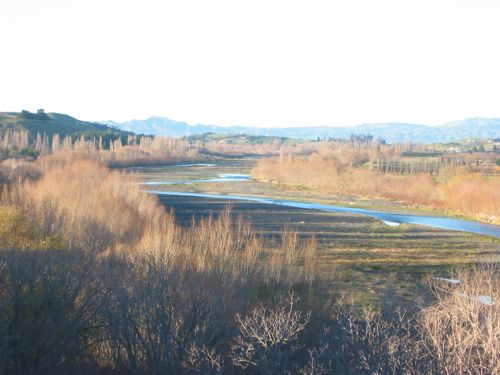
Hawkes Bay NZ, 2003

2. Is it hard?

Yes, and no.  After the first day, it really isn’t hard not to eat and drink for 12+ hours.  I do get a bit fuzzy and peckish around the 4pm mark.  For me, the hard part is the lack of sleep: getting up before dawn is early .  Sometimes I would rather skip breakfast than wake up at that time!

The other hard part is habit.  If I garden while fasting I find myself picking berries and lettuce leaves to pop in my mouth without thinking.  When I cook, I dip spoons to taste, and have to stop with the spoon halfway to my mouth.  I realise how much I really eat without intending to.

Cows eat grass, Waipoua, Northland, NZ, 2003

3. Isn’t it bad for you?

No.  There are also health checks on the fast: you shouldn’t do it if you are under 15, or over 70, or pregnant, menstruating, doing heavy labour, traveling, or ill.  It’s very sensible.

I have a check up with my doctor and a discussion about the fast every year before I do it.  Some years, due to health reasons, I have to do a modified fast where I drink during the day, and sometimes have a bit of fruit.

There are no specific instructions of what you should do if your health prevents you from fasting, but I still feel you should follow the spirit of the fast as much as your health permits.

Pretty ponds, Hawke's Bay, NZ, 2003

4. Are you glad it is over?

Yes, and no.  It will be nice not to have to wake up early, and it will be nice to eat, but I’ll also miss the specialness, and I’ll miss the comradeship: the dinners with other Baha’is to break the fast in the evening, and the jokes about food and weight loss.  It’s a wonderful time of year, but it wouldn’t be so special if it didn’t come for just this 19 days.

Swans on the pretty pond, Hawke's Bay, NZ, 2003

Friday Review: Bryan Gaskin Fabrics in Palmerston North

John Cleese famously dubbed Palmerston North the ‘suicide capitol of NZ’ and advised that a visit to the city would inspired anyone to be able to do the deed.

If you are a fabric and textile enthusiast there are only two reasons that a visit to Palmy would only inspire you to end your existence.  You might do it if you were completely overcome with fabric fabulosity and couldn’t stand the wonderfulness anymore.  Or perhaps you might need to permanently alter your social standing if you spent so much money on fabric that you decide it would be easier to kill yourself than to face your significant other when they see the bills.

One of the main reasons for all the fabric fabulousness in Palmy is Bryan Gaskin Fabrics, 402 Main Street, Palmerston North (just off The Square)

The Good:

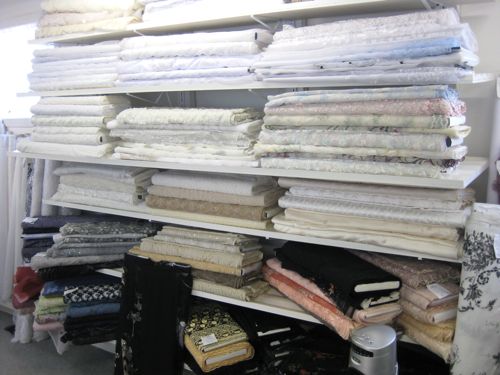
BGF’s stocks…well…everything.  They focus on bridal and evening fabrics, so the selection of laces, beaded fabric, and silks of every variety is spectacular.

A rainbow of fabulousness

Being bridal specialists, they have a lot of white, but their stock comes in every other colour too.

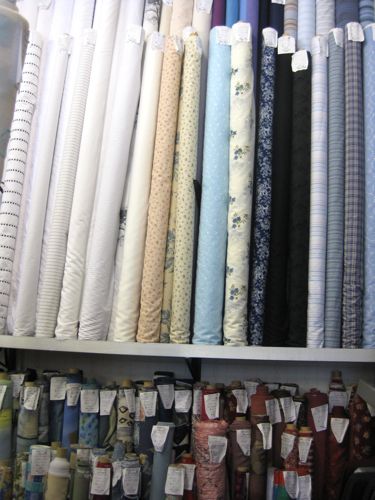
And a whole selection of pale

Of course, I’m notorious for loving white and pales, so I drooled over the whole selection.

Bridal laces. Yum!

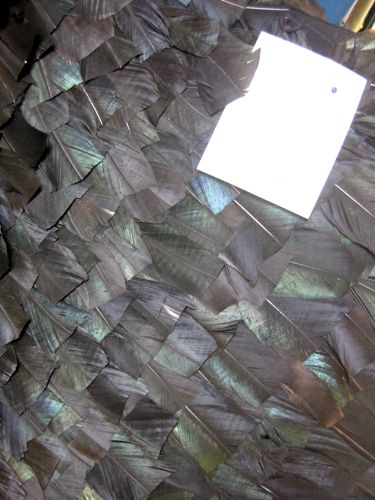
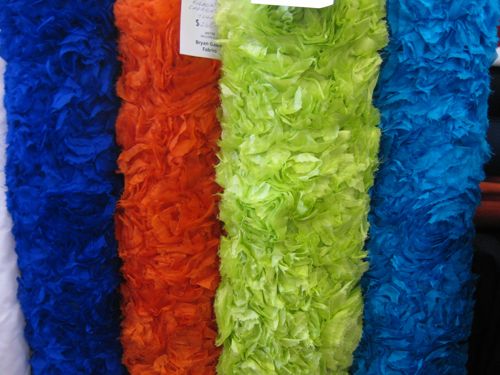
They also stock some extremely specialist and hard to find fabrics, like feathered fabrics…

Indian feathered fabric on silk. If only I had a spare $400 a metre to spend...

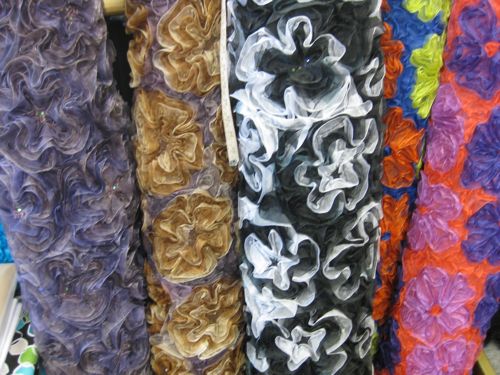
And pleated and ruffled fabrics…

Wouldn't a skirt of those pleats be amazing?

And the most amazing rhinestones and pearled motifs…

This is over a foot and a half across. What would you do with it?

And gold and other lace trims…

Real metallic lace!

And more lace…

Lots and lots of lace

Yep.  Pretty much everything you would ever need to make endless fancy, fancy, delicious dresses.

Mmmm...fancy, fancy dresses!

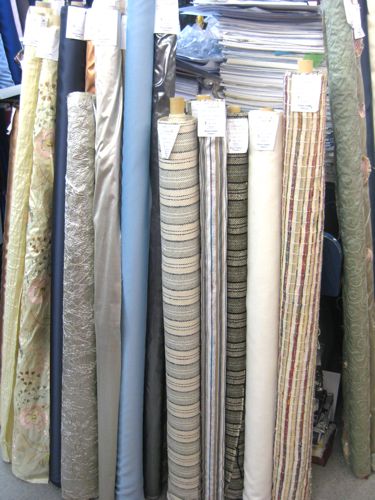
Of course, as much as we want to, we can’t live in pretty princess dresses forever.  Sometimes you need fabric for things that are just a bit more casual, and BGF’s have that as well.

There is the really practical:

Lovely cottons and linens and wool

And the somewhat practical, and utterly adorable:

Cherries are a retro cliche, but they are so cute!

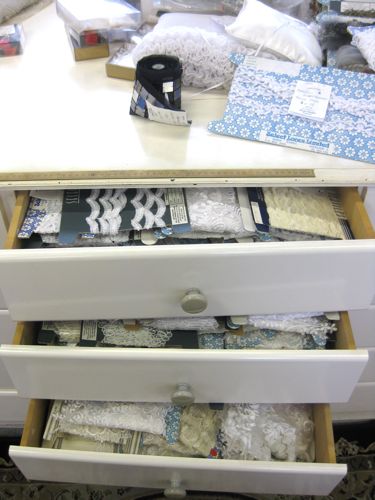
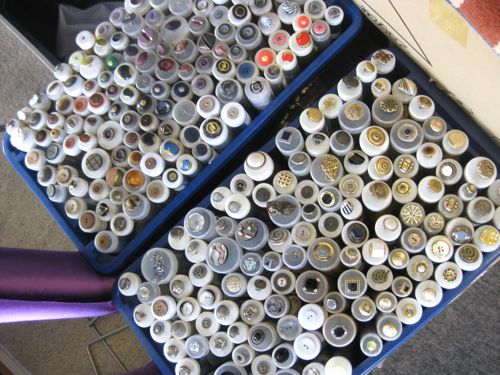
Beyond fabric, they carry a selection of basic notions and buttons and bits:

Buttons

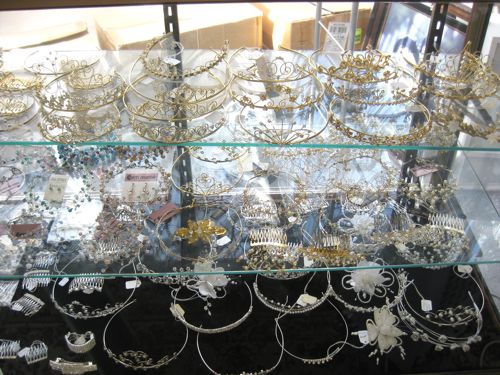
And a less basic selection of all the the sparkly bits that brides love to deck themselves out in:

Tiara's and necklaces and other bride-y things

The Bad:

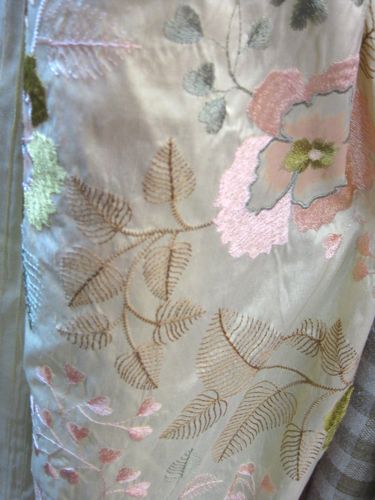
They are all the way up in Palmy!  And the prices are not exactly low (well, neither is the merchandise)  and I didn’t get the impression that that they have a lot of sales.

Boo. I'm going to have to save a lot of pennies to afford this drool-worthy embroidered silk

The Ugly:

Ummmm.....

Well, maybe not precicely  ugly, but certainly only suitable for very specific purposes.

Interesting...

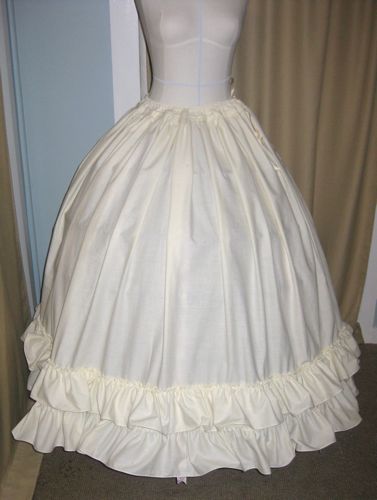
Tutorial: How to make a drawstring petticoat to go over a crinoline

My hoopskirt tutorial has been getting a lot of use, and I have had a request to do a tutorial on making the petticoat that goes over the hoopskirt, so here goes.

This tutorial will make a full petticoat gathered to a 45″ drawstring waistband with two layers of 6″ ruffles at the hem.   The petticoat has a circumference of approximately 150″ at the hem, and is up to 45″ long.

For your petticoat you will need:

  • 7 yards (6.25m)  of 45″ wide fabric (60″ if you want your petticoat to be longer or can be bothered hemming)
  • 2.5 yards of 3/4″ wide  cotton waist tape
  • 10 yards of cotton cord for cord gathering

Apologies in advance for the quality of the photographs with this tutorial – I guessed at what I would need as I made the petticoat, and then wrote the tutorial, and my guesses were hopelessly off, so I need to go back and make another petticoat and photo-document the process properly.

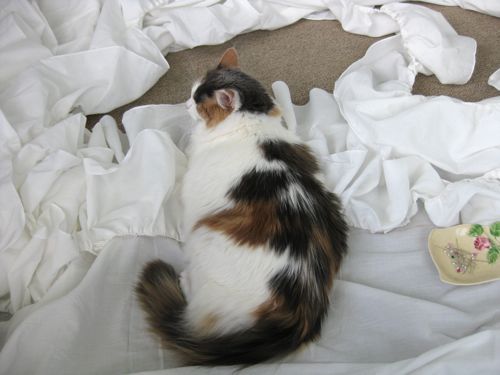
At least I got a hopelessly adorable photo of Felicity reminding me how much more important she is than a tutorial

Step 1: The Hem Ruffles

Cut 14 7″ wide strips from the ends of your length of fabric.  Each strip will be 45″ long (unless, of course, you bought 60″ fabric, in which case you only need to cut 10 7″ wide strips).  I find it easiest to fold the fabric in half lengthwise and cut two at a time, cutting from both ends of the fabric at the same time.

Divide your strips into two piles of 7 strips (or 5 for 60″ long).

Sew each pile of strips end to end to form two 300″ long strips.

Sew the loose ends of each strip together to form a loop.

Narrow hem each loop (I use my roll hem foot for this)

Narrow roll hemming (doesn't the white thread look be-yew-ti-ful on cream!)

Gather each ruffle loop into 155″ using my tutorial for corded gathering.  DO NOT tie off and sew down the ends of cord, as you may need to shorten/lengthen the ruffles later on when you attach them to the hem of the petticoat.

The tiny hemmed and cord-gathered ruffle

Step 2: The Waistband

Cut another 5″ strip off one end of the remaining fabric.  It will be 45″ long and 5″ wide.  This will be your waistband.

Fold it in half lengthwise and and iron in the crease, then set aside for Step 7

Step 3: The Petticoat Body

Take your remaining fabric (it should measure about 150″ long) and, with wrong sides together, sew the raw edges together.

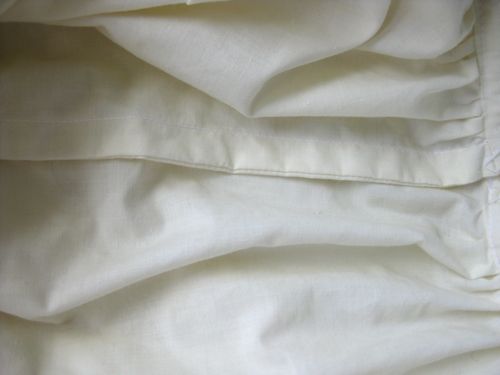
Finish the raw edges using either a french seam or a flat felled seam.

My large and ugly, but serviceable, french seams

Step 4: Hemming

As you are using the entire width of the 45″ fabric, both your hem and top edge are already finished.  How easy is that!

If you are using 60″ wide fabric, or are quite short, you can hem the fabric shorter, or you can just fold it over at the top edge so that there is an extra ruffle on the inside, at your waist, which will help to give you extra ‘poof’ and bell shape around your waist – not at all a bad thing with a crinoline petticoat!

If you finish your petticoat, put it on over your hoopskirt, and find it is too long, don’t dismay – you can just shorten it with one or more grow tucks.  Grow tucks are perfectly period accurate, help the petticoat to hold its shape at the hem, and can be taken out later.

Step 5: Attaching the ruffles

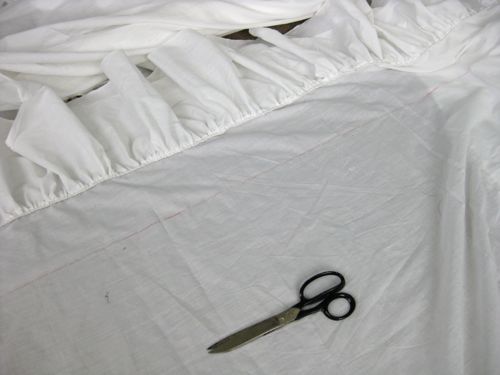
Lay your petticoat body out, and measure up 5″ and 10″ from the bottom edge/hem.  Mark a line at 5″ and 10″ from the bottom all the way around the petticoat.

The line marked at 10" from the hem using tailors chalk

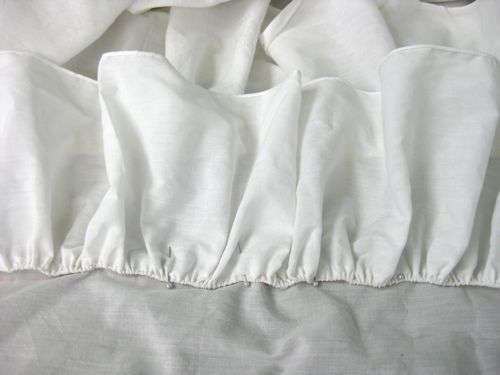
Take your first ruffle, and carefully pin it to the line which is 5″ from the bottom.  Adjust the gather of the ruffle as needed.  Sew the ruffle down, with your stitch line falling just under the stitch line for the gathering cord.

Pinning down the first ruffle. Note the cord gathering

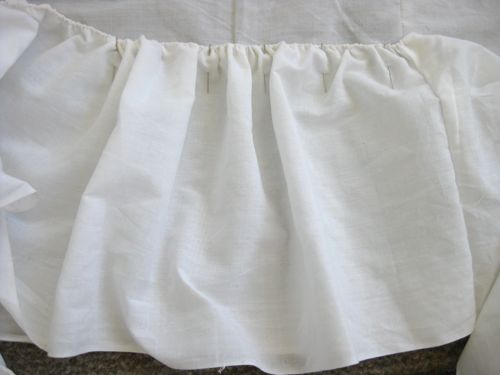
Pin the second ruffle at the 10″ mark, adjust as needed, and sew as with the first ruffle.

Pinning the second ruffle to the 10" line

Step 6: Gathering the Petticoat

Take your petticoat body and fold down any extra length at the top edge of the petticoat, so that it measures exactly the length you want (this length will depend both on your height, and the width of your hoopskirt, but 42″-45″ is a good average length).

Cord gather the top edge of the petticoat body, either laying the cord inside the fold of the extra length, or just folding over a scant 1/2″ of fabric to hold the cord.  Gather the petticoat top until it measures 45″.  Do not tie off the cords yet.

Step 7: Attaching the Waistband:

Take your 45″ long waistband strip, and, wrong sides together, pin it to your 45″ long gathered top of the petticoat body.  Sew the petticoat body and waistband together with a 1/2″ seam allowance.

Flip the waistband up from the petticoat, so that the all the raw edges, and the cord gathering, are all pointing up from the petticoat body.  Press, being careful not to press out the centre fold line you pressed in in step 2.

Fold down the top raw edge of the waistband 1/2″ toward the wrong side of the fabric, so that it is pointing toward the other raw edges.  Press.

Flip the petticoat out to the right side, fold the waistband down over the all the raw edges and cording, using the centre fold line you pressed in during step 2.  Both raw edges of the waistband, and top edge of the petticoat with the cording, should now all hidden inside the waistband.

Press the whole thing one more time, and then top stitch the loose edge of the waistband down onto the right side of the petticoat.

The petticoat body sewed to the waistband

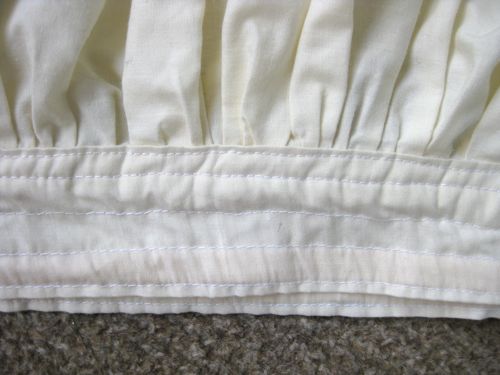
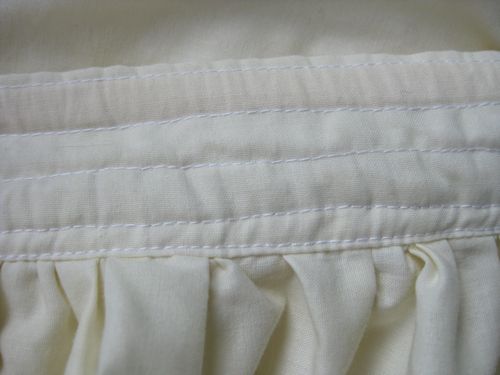
Stitch a line 1/8 from the top edge of the waistband, just to keep everything neat and tidy.  Stitch another line 1/2″ from the bottom stitching line of the waistband, to keep all the raw edges out of your gathering channel.

See the stitch a tiny distance from the top edge, and another just at the bottom? Ignore all the other ones that managed to come out dreadfully wobbly.

Step 8: Finishing touches:

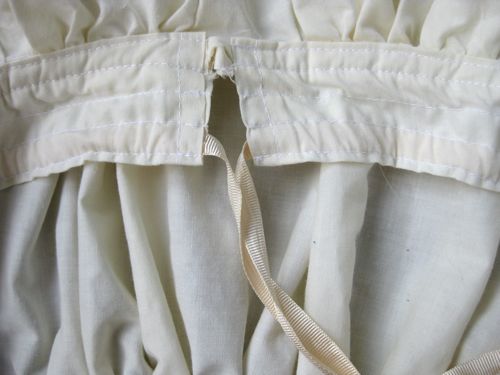
Thread your waist ribbon through the channel left in the waistband (I use a large safety pin for this), and ta-da, you are done!

My (narrower) grosgrain ribbon threaded through the waistband

Put your petticoat over your hoopskirt, and enjoy the smooth line it provides for your skirt to lie over.  And, of course, the more petticoats you make and wear, the better your outer skirt looks!

Petticoats make hoopskirts pretty

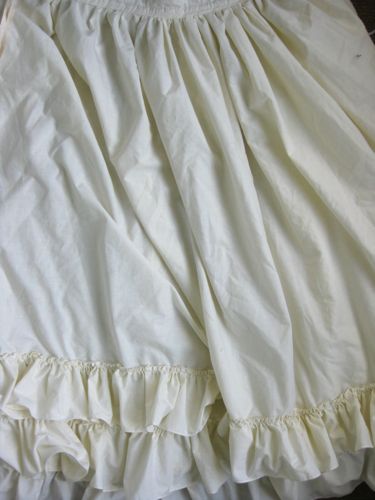
The whole petticoat laid out flat