Latest Posts

Carolyn’s dress: the sparkly bits

The whole bodice and belt of Carolyn’s dress will be beaded, and the belt is fastening with a vintage buckle, so I got to have lots of fun picking up sparkly pogey bait to show to Carolyn so she could decide what would go on the dress.

First, we picked buckles.  The two best ones I could find were these:
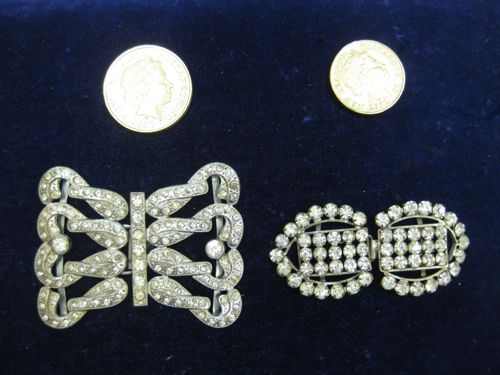
Shown with NZ $1 and $2 coins for scale

Carolyn, having excellent taste, of course picked this one:

I love how the curves of the buckle echo the curves in the dress

A few of the diamantes need to be replaced, but that is easily fixable.

With the most important thing selected, we moved on to beads.

A spread of bead possibilities

Each bead will be centred on one of these beautiful, pearlised pailletes:

I love how shiny and subtle they are at the same time

The colours of the beads will range from silver beads on the design around the bust and on the sash, through to silver greys and clear glass beads.

Cut metal beads
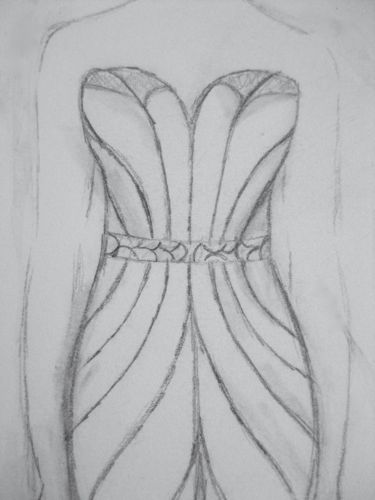
The design around the bust will be in silver

The silver grey and pale grey glass beads will help to accentuate the curving lines on the bodice:

Vintage glass beads ranging from dark grey to clear

Clear beads will add extra sparkle:

Vintage clear glass beads

We had originally considered including dark gunmetal beads, but Carolyn decided that they were too stark, and might just look like flyspecks:
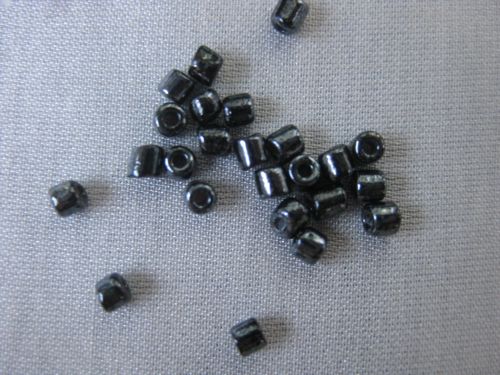
Gunmetal grey beads are a no-go

I loved the idea of gunmetal on a wedding dress, but I think that aesthetically, Carolyn is absolutely right.

We also vetoed some vintage pearl beads, because the colour was too yellow, and the shape was too different from the other beads:

Pretty pearl beads, but not for this dress

Thats OK, I think these might be perfect on the other wedding dress I am working on.  Or I could just put them in my stash and admire them every once and a while!

I’ve already started using all these delicious beads on the dress, so I’ll show you images of that on Wednesday

Carolyn’s dress: the bodice

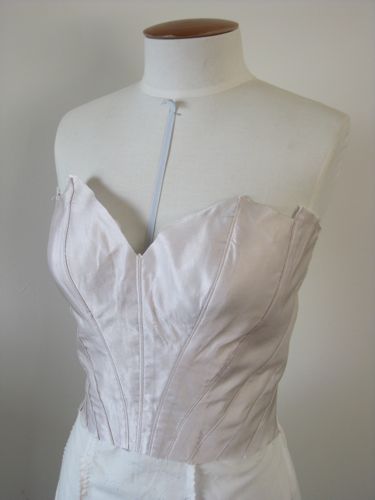
Rather than showing you a finished project today (even though I do have quite a few to share), I thought I’d keep you updated with the project that is currently consuming all my time: Carolyn’s wedding dress.

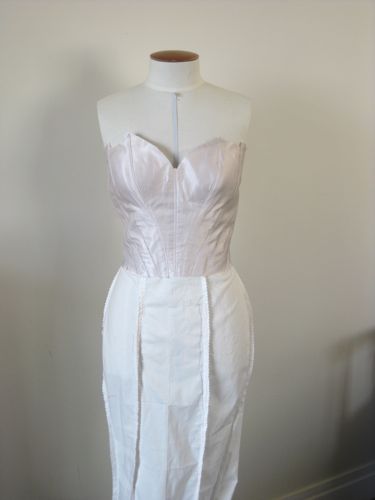
I’ve got the bodice all done (well, except for thousands of beads and piping trim and a corset back), and now I’m working on the skirt.

Mmmm...those curves!

I’m extremely pleased with how the bodice has come out, and I am totally in love with the fabric.

It is the most indescribably gorgeous colour.  It’s white, but it has depth and dimensionality and a subtle, luminous glow.  And the colour name is ‘vintage’.  Swoon!

Pretty, pretty, pretty

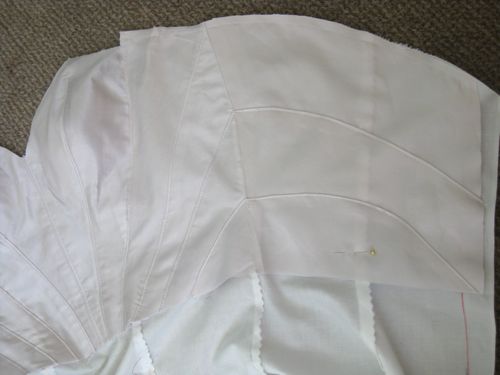
It also shows the seaming beautifully, which makes it perfect for this dress, but does mean that I have to be extremely precise with my sewing.

Perfectly precise seaming

I want to buy every bit of the fabric that is left in my stash just to have it.

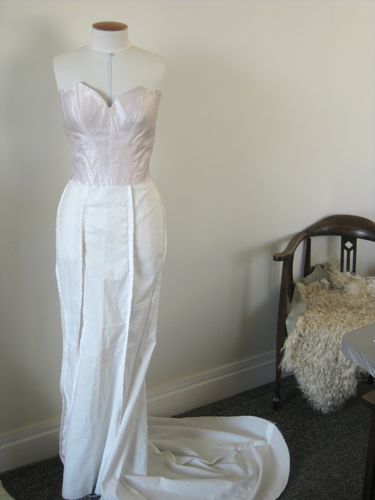
Now, time for the skirt.

The skirt is time consuming, but pretty easy, and very meditative.  It’s just one strip after the other all the way down.  And then ostrich feathers!

The train will have ostrich feathers

The ostrich feathers have been held up slightly by the earthquake.  I ordered them just before it, and the postal and courier companies are all running slow because the air and transport systems have been prioritised for relief work (as they should be!).  They should be here by next week though.


Friday Review: Jill Salen’s 1900 Ribbon Corset

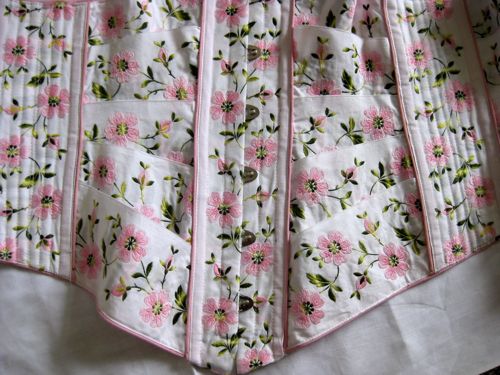
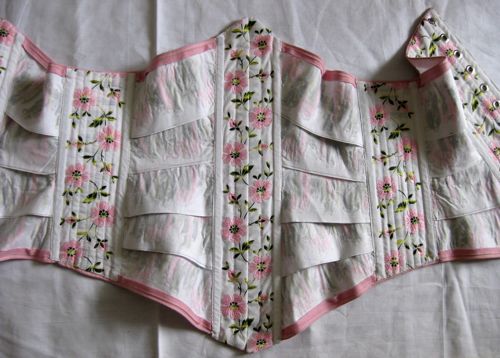
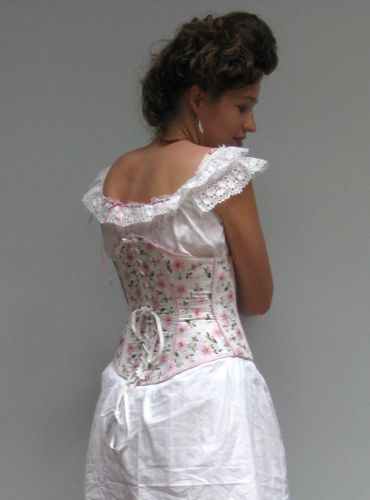
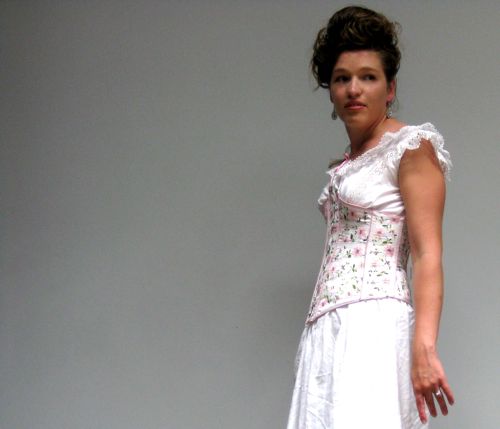
This is a review of the fit, comfort, and wearability of the 1900 ribbon corset pattern from Jill Salen’s Corsets: Historical Patterns and Techniques, and of the pattern itself.

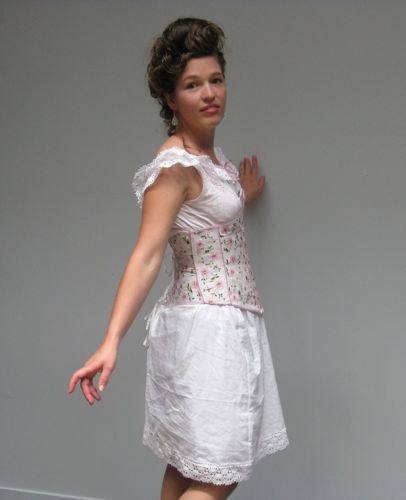
Obviously, this is my favourite photo of me in it!

First, the pattern:

The pattern, when you first confront it, looks ridiculously hard and completely incomprehensible.  This is true of all ribbon corset patterns in my experience.  As soon as you put a prototype together and figure out how it works, the logic of it all comes together in your mind (or at least it did in my mind!) and the whole thing makes perfect sense.

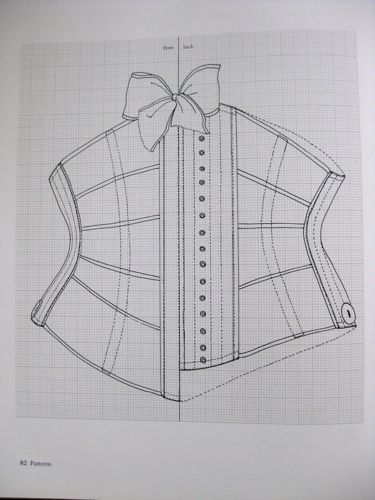
There are some very interesting things about this pattern.  Because the side, back, and front pieces are perfectly straight, the seams that meet them are very curved, to give the corset its curving and shape.  The front and back seams are particularly curved.  I’m not used to sewing two very curved seams at the centre front and back, modern seamstresses are generally taught to keep both of these seams perfectly straight, so it did take a little mind-readjustment.

Note the straight back and side pieces, and how the curve is in the seam next to the centre back

Flaws/problems in the pattern.

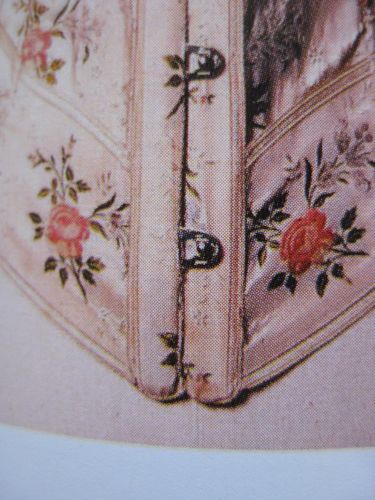
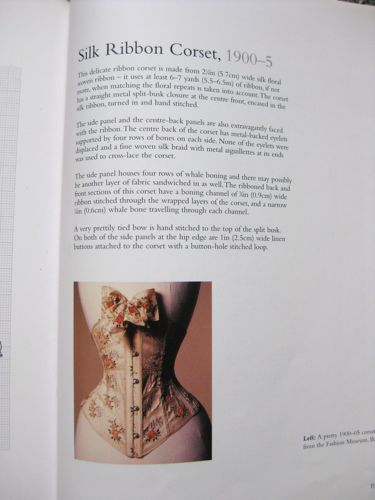
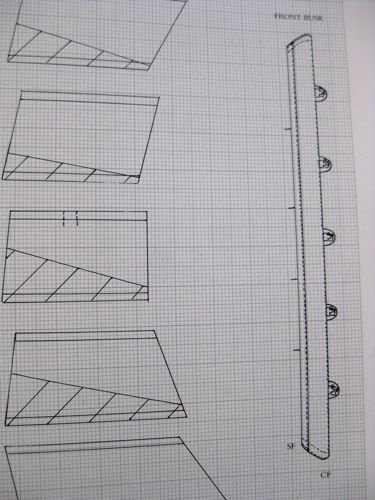
  1. The busk ends: Jill Salen has drawn the busk pieces with pointed tops and bottoms, following the deep points of the corset.  I got all worked up trying to find a way to cut/sand the tips of my busk pieces into matching points, and then I took a really close look at the image of the original corset, and realised that it has normal, slightly rounded busk ends, just like modern busks.  So ignore the busks in the drawing, they aren’t accurate.

    The corset and busk ends as drawn by Salen

  2. Normal, curved busk ends

  3. The bust/waist/hip ratio: In the image of the original corset, it is shown on a mannequin with extreme, Camille Clifford style, curves.  I did an exact replica of the originals measurements, based on the pattern, for my first prototype, and it just doesn’t have that kind of curves.  Yes, it has a 21″ waist, but the hips and bust to go with it are only 30″/32″ respectively.  When I sized up the pattern to fit me, if it fits my bust and hips properly it doesn’t reduce my waist at all, and I’m not a curvy girl.  So I can only assume that either 1) the corset, as it is shown on the mannequin, is clipped in back to make it look curvier, or 2) Salen has nicely, but irritatingly, pre-altered the pattern to suit a modern figure.  I expect the first is more likely.  Luckily it is very easy to alter the pattern (just make your side, front, and back seams curvier!), so a more extreme figure is easy to achieve.

    Yowzers, look at those curves!

  4. Matching of seam measures: Some of the simple, straight, ribbon seams/overlaps that are supposed to match up don’t.  They are simply different lengths.  It only the difference of 1/4 of an inch in the book, but this turns out to be quite a lot once you size the pattern up!  So I definitely recommend making a prototype out of strips of cheap fabric before you cut into your ribbon.

    If you cut those pieces out and glue them together, they don't match!

  5. Pattern shapes: When you assemble the horizontal ribbons for side front and side back panels it quickly becomes clear that some of the ribbon pieces actually have should actually be cut in curve ( or V < shape at their ends, rather than the simple slope angles that the pattern shows.  This is another flaw/problem that will become apparent during your mock-up prototype.  Use the prototype to determine if you need to add a bit of ( to the end of a / to make sure that your corset doesn’t come out too small.

    Some of these pieces should have curves rather than slants. Also, check out that pointy, pointy busk end. Grrrrr.

  6. Horizontal seaming?:  Salen’s descriptions and pattern don’t make it at all clear if each piece of horizontal ribbon should be sewed to each other along the horizontal edges to make solid side front and side back pieces.  I did a bit of sleuthing on the internet and looked at every single ribbon corset I could find.  Whenever it was possible to tell if the ribbons were sewn together or not, they weren’t, so I assumed that this one would be the same, and didn’t.  I don’t know if that is how the original is constructed, but I do know that it is how other ribbon corsets were constructed, and that it works.  The extra bones on the side front and side back pieces (which I didn’t bother to include on my corset, as it was sturdy and shaping enough without them), would hold these pieces together a great deal more than with most ribbon corsets, and makes it possible that the side front and side back ribbon pieces are actually sewn into solid pieces.

    I've decided not to sew the ribbons together, and to omit the extra bones

  7. Lining: Salen describes the front, back, and side vertical patterns as being lined in the same ribbon as the outside.  However, she doesn’t mention how the horizontal side-front and side-back panels are finished, and if they are lined, and there were no images to refer to.  It’s entirely possible that the original ribbon used was woven tightly enough to not need a lining.  Unfortunately, the design in my ribbon had lots of loose threads on the back, and these would need a lining for protection.  I looked at cutting strips of a plain fabric, folding both edges, and sewing them down to the ribbon, but was afraid this would make it too bulky.  I finally did something that I am sure isn’t historically accurate, and used iron on interfacing to line and cover the back of each piece of ribbon.  Naughty me!  I’m making this corset again and trying the fabric lining option with a thin, crisp, silk taffeta to see if that is a more elegant, but equally suitable, lining option.  I’ll keep you updated.  Of course, if you use a plain and sturdy ribbon than lining won’t be a problem at all.

    Naughty me. Interfacing in a corset!

Great things about the pattern:

  1. Resizing: The pattern is super easy to resize to practically any waist measurement.  Just figure out how much you need to add to the total circumference of the waist, divide that by 4, and add 1/4 of the total to both the front and back set of horizontal ribbons, being careful to keep the end angles the same.  Easy peasy!  Vertical alterations are a little trickier. If you are a lot taller than the original wearer, I recommend simply using a wider ribbon (which is what I did), to increase vertical height.

    A little bit of vertical resizing gave me that gorgeous curve that supports my back

  2. Alterations: In addition to sizing the pattern up and down with the same hip/waist/bust proportions, it is very easy to alter any of these proportions to suit a figure with more or less hips, bust, or all-round curves.  Just reduce or add to the curves at front, back, and sides.  All in all, this is one of the easiest patterns I have ever worked with in terms of resizing and alterations.

    I want my corset to look like the one in the photo curve wise!

  3. Easy: as mentioned above, it looks tricky, but as soon as you figure it out, the corset is super easy to put together, very logical, and very quick to make.  Oh, and it fits a lot of figures without any alteration.  You can’t ask for more than that!

Wearing the corset:

Is fabulous.  Really.  It’s so comfortable, adapts and fits to so many body shapes, is so light, and so un-restrictive.  It won’t be quite as comfortable and unrestrictive once I adapt the pattern to encourage serious curves, but even so I suspect this is going to be one of the most comfortable corsets going for the effect it give.

I could wear this all day. Really.

The one drawback to the corset is that it is an underbust corset, so unless your bust is exceptionally well formed and your chemise gives it enough support and shape for you to feel comfortable without anything else, you are going to want to wear a bra or historical bust supporter/enhancer with it.  This, unfortunately, tends to decrease comfort levels.  And you have to go to the trouble of making another piece.  All of this is making me think that I really want to develop a ribbon corset pattern which has a bust built in.  No, it won’t be entirely historical, but I can guarantee it will be pretty!

Weird squishy bust stuff going on here

The overall verdict:

The pattern has some issues with clarity, but once you work through those, it is super easy, super pretty, and well worth the effort.