I left you a few days ago with Marie Leszczyńska and her many, many portraits featuring the fleur de lys.
Maria may not be remembered as a trendsetter in the same way that her husbands most famous mistress, Madame de Pompadour is, but she had an effect of her own. Her infatuation with the fleur de lys robes was such that her daughter, Elisabeth of France, was also portrayed in them in two occasions.
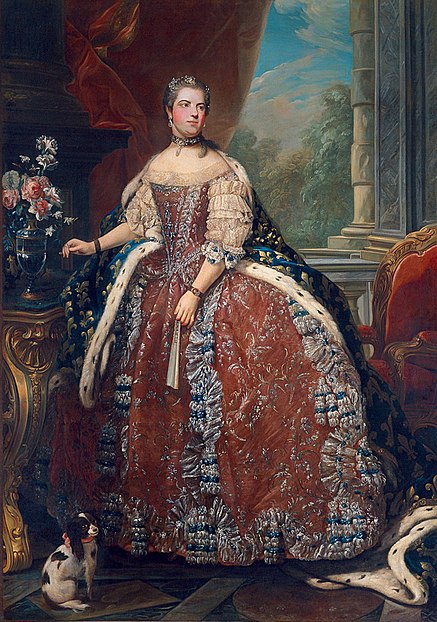
Louis-Michel van Loo & Pietro Melchiorre Ferrari, Portrait of Louise Élisabeth of France (1727-1759), Duchess of Parma, circa 1752

Louise Élisabeth de France, Duchess of Parma, by Jean-Marc Nattier, (posthumous, 1761)
Marie Leszczyńska was close with all her children, and was lucky enough to have loving relationships with both of the wives of the Dauphine Louis.
Before her tragic early death, Louis first wife, the Infanta Maria Teresa Rafaela of Spain was painted in the fleur de lys robes:

Louis Tocque, Portrait of Maria Teresa of Spain as the Dauphine of France, 1745
After Maria Teresa’s death, Louis married Maria Josepha of Saxony.
One would think this would have resulted in a disastrous daughter in law-mother in law relationship, as Maria J’s father had dethroned Marie L’s father, causing Marie L a very stressful childhood. In fact, the French court viewed the marriage (partly arranged by Madame de Pompadour) as a huge insult to Marie L.
Maria Josepha and Marie L both rose above the courts expectations of them (the story is really lovely – I’ll tell it shortly), and became close.
Perhaps because her mother-in-law liked them so much, Maria Josepha was painted in the fleur de lys robes on a number of occasions. First, a formal portrait celebrating her marriage:

Unknown French artist, portrait presumed to be of Maria Josepha of Saxony
Then, in a better executed formal portrait:

Jean-Marc Nattier, Marie-Josèphe de Saxe, Dauphine de France, 1751
Don’t you love the fruit on the dress?
Nattier’s portrait was so popular that another version was done of it:

Unknown artist after Jean-Marc Nattier, Maria Josepha of Saxony
Fleur-de-lys attire also featured in an allegorical portrait celebrating the birth of her beloved daughter, Marie Zephyrine.

Charles-Joseph Natoire, Allegory of the birth of Princess Marie Zephyrine of France, daughter of Louis Ferdinand of France and Princess Maria Josepha of Saxony. 1750
Eerily, the portrait seems to foreshadow Marie Zephyrine’s tragic death 5 years later.
Finally, at the end of her life, the ermine robes featured in a formal portrait in a crazy fur-trimmed dress:

Jean-Martial Fredou, Portrait of Maria Josepha of Saxony (1731—1767), Dauphine of France, before 1767
Maria Josepha did not live to see her son married to Marie Antoinette, who was only painted in the fleur de lys robes on one occasion.
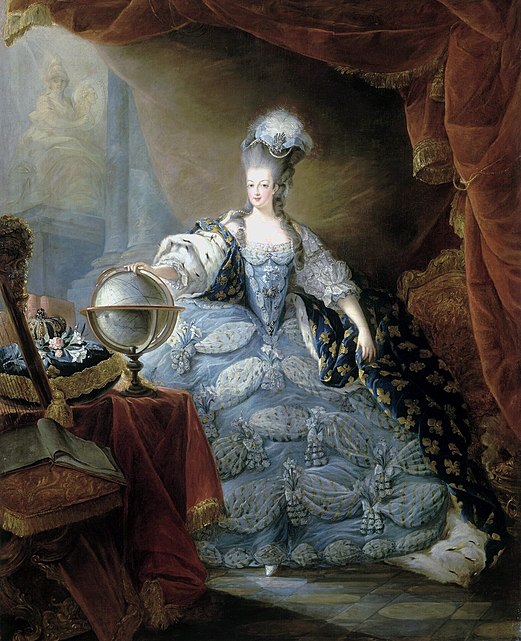
Jean-Baptiste Gautier Dagoty, Portrait of Marie Antoinette, 1775
You may note that Marie Antoinette’s portrait makes an allusion to the French monarchy in two ways: one, through the royal robes, and two, through the lilies on the table, and the lilies which are tucked into each gather of the poofs on her skirt.
Despite the grand claims of Dagoty’s painting, it is the last painting to feature a French queen in the fleur de lys robes.