I’m long overdue for a tutorial, and long overdue for an update on some sewing progress, so I’m multitasking.
I love multitasking.
I hemmed my not-so frothy fairy dress (now dubbed the Marianne gown, because it combines Sense and Sensibility) with self fabric bias binding, which is my favourite hemming technique.
It takes a little longer, but it provides a beautiful effect, especially on curved hems. It is also very strong, and can be replaced if the hem gets soiled (unlike traditional hems).
Whether you use it for hems, or any other technique, self fabric bias binding is a useful thing to know how to make. You can buy metal tools to make it, but I find they don’t save much time, and don’t give you nearly as much flexibility in terms of size.
To make your own self fabric bias binding, cut bias strips of the fabric you intend to use.
This tutorial uses many of the same techniques as my self-fabric piping tutorial, so you might want to check that out.
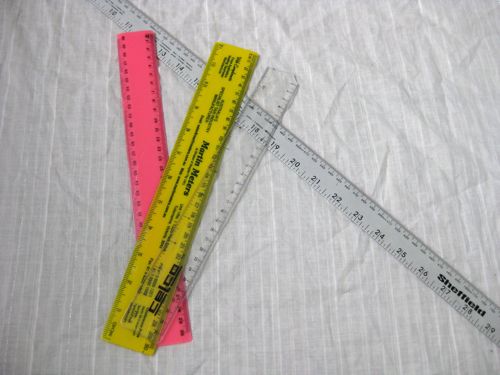
I collect rulers in different widths for instant bias-strip width guides
Your strips should be just under 4x as wide as the you want your final bias binding to be. I prefer to cut strips that are 1 3/4″ wide, to end up with half inch bias binding.
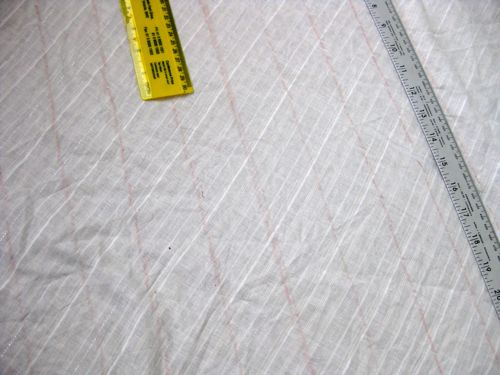
The bias lines marked on my fabric every 1 3/4".
Sew your strips end-to end to make one long strip.
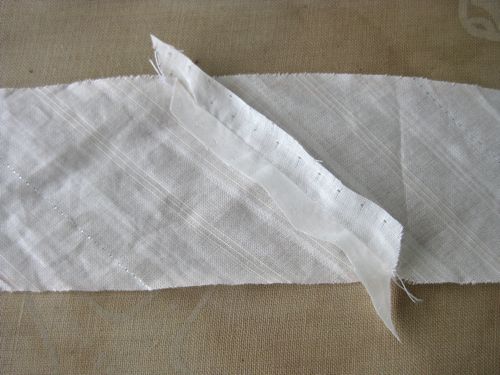
You will end up with diagonal seam lines
Press your seams open, and trim off the bits that stick out beyond the edges of your strip.

Ignore my disgusting ironing board cover. I really must get a new one!
Fold your strip in half lengthwise, and iron the crease.
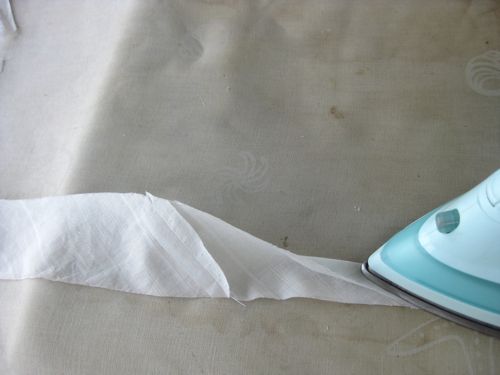
I find it easiest to fold as I press

The pressed crease
Once your entire strip is folded and pressed, fold in one of the edges till the raw edge meets the centre fold.
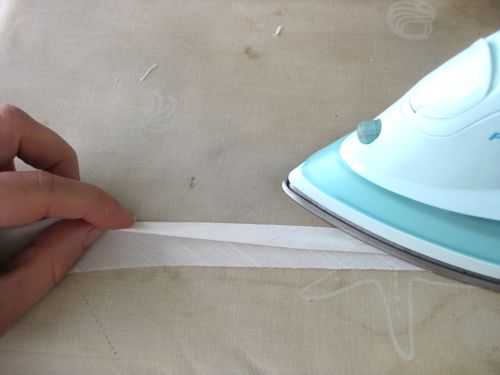
Press as you fold
Do this for the entire strip.

One side folded in and pressed
With the first side folded under and pressed, fold under and press the second side along the entire length of the strip.

Both raw edges will be hidden in the tape
The second edge should not be folded in quite as far to the centre as the first edge. This will help you to catch both edges as you sew. I find that the slight overhang on one edge happens naturally for me.
I wind my bias binding around a book or CD case as I iron it (even a piece of cardboard will do), to ensure that the creases remain crisp.

Just make sure the CD isn't one you want to listen to anytime soon!
To bind an edge, pin your bias binding around your edge with the slightly shorter side facing up.

The bias goes perfectly around curves
Once you have pinned the binding around your entire edge, you are ready to sew it. The slightly shorter top edge allows you to sew very close to the top edge that will be visible without any chance of the bottom edge not being caught by the stitching.

The pinned edge, all ready to sew.
Sew carefully along the binding, just catching the top edge with the needle.
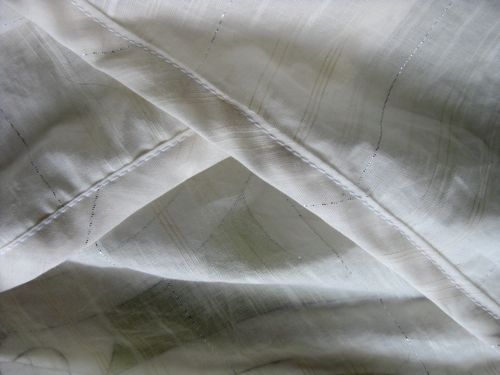
Pretty, and easy!
When binding a hem, you are working with a circle, so when you get back to the start of your bias binding you will have an overlap. I backstitch on the machine, leave the last bit hanging, and then finish it off by hand.

Just trim off the extra, fold under a bit, and then hand sew it down.
I find the effect of bias bond edges especially fetching when working with striped fabric, because the diagonal stripes of the bias add a nice contrast to the hem. The contrast of straight and bias stripes is something that is seen on quite a few historical dresses.
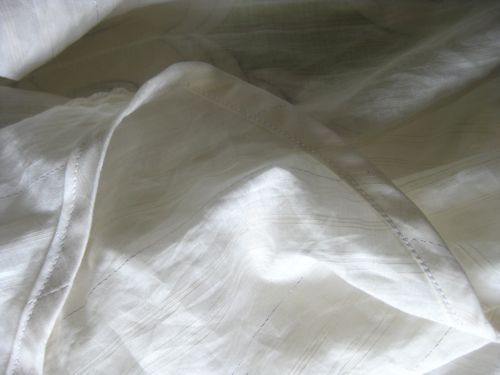
The contrast of straight and diagonal stripes is very subtle on my dress, but still noticeable
With the hem bound, I finished off the back fastening of the dress with more bias binding, some buttons, and self-fabric button loops.

Vintage shell buttons
The dress is at a good stopping point, so it’s going to languish in a bag for a few weeks while I do bits and pieces of prep for my upcoming Pompeii to Paris event.
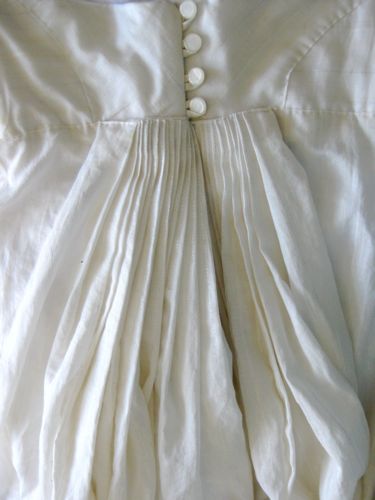
I'm in love with the pleating. It's beautiful in motion.