Latest Posts

18th Century Masquerade Costumes

A reader asked me about 18th century Masquerade costumes.

Specifically, she wants to make an 18th century Grecian inspired masquerade costume.

How fun!  It’s right up my alley!  I wish I had the time and reason to make one too!

The theme allows for either full on stays, stomachers and paniered robes, or simpler flowing ‘negligee’, permissible under the guise of classical inspiration.

There are so many possibilities!

Goddesses have always been popular, and would be perfectly appropriate – one of the top masquerade destinations in 18th century London was the Pantheon.

I could do Athena, goddess of wisdom, with a medusa-head stomacher.

Or Diana, goddess of the moon and the hunt, with star and moon spangled hair, and even stags and bow and arrows (if I was feeling really over the top!)

I bet Venus was popular in the 18th century; the goddess of love could wear a rose-wreathed frock, and have a miniature cupid in her hair.

There are non-goddess options available too: Elisabeth Cudleigh, Maid of Honour to Princess Augusta of Wales, attended a masquerade ball dressed as ‘Iphigenia ready for the sacrifice.”  There aren’t exact details of the costume available, but we know that it caused an enormous scandal because at least one of Elisabeth’s breast was brazenly on show.  Contemporaneous artists imaginings portray her as wearing anything from a very brief tutu of leaves, to an outfit that is astonishingly close to La Belle Otero’s exotic dancing ensemble – just minus some of the bust, to a Grecian chiton which slips off one shoulder.

Bare bosoms aren’t quite my thing, so I’d go for something a bit more formal.  Here are some images I would use for inspiration:
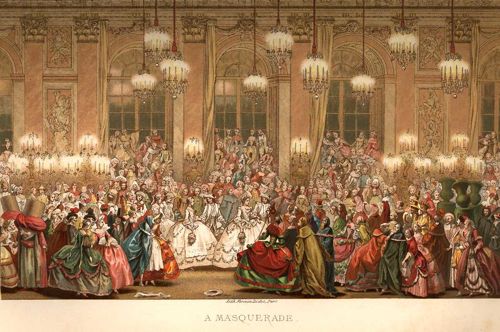
Lacroix's idea of an 18th century masquerade ball

I particularly like the two ladies carrying baskets of flowers.  My version would have the patterning on the skirts taken directly from a Pompeiian mural, and you would wear it with laurel wreaths, and go as Nike, the goddess of Victory.

A bigger version of the image can be found here.

Richard Samuel, Portraits in the Characters of the Muses in the Temple of Apollo

Samuel’s representation of the ‘nine living muses of Great Britain’ is an excellent example of 18th century interpretation of classical dress.  And the column even has the exact laurel swags I hanker after!
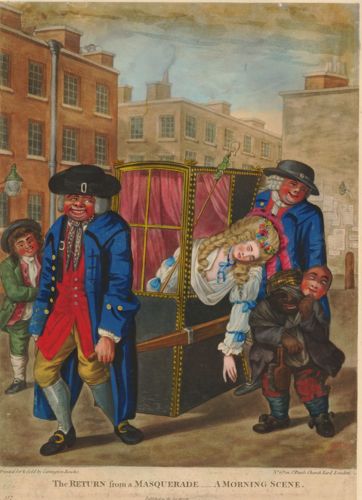
Robert Dighton, Return from a Masquerade, 1784

If this image is anything to go by, by the 1780’s chemise a la reine were  acceptable masquerade dress.  I can’t be certain, but the staff and draped neckline indicate that our sleepy party-goer might have been frolicking as a classical shepherdess.

Joshua Reynolds, Lady Elizabeth Keppel, 1761

I adore this painting of Lady Elizabeth Keppel draping a garland of flowers around a bust of Hymen, the god of marriage, in anticipation of her upcoming nuptials.  According to tradition, the dress she is painted in is the dress she wore as Lady in Waiting at the coronation or marriage of Queen Charlotte.  Reynolds has given the garment a classical flavour by styling it without paniers.
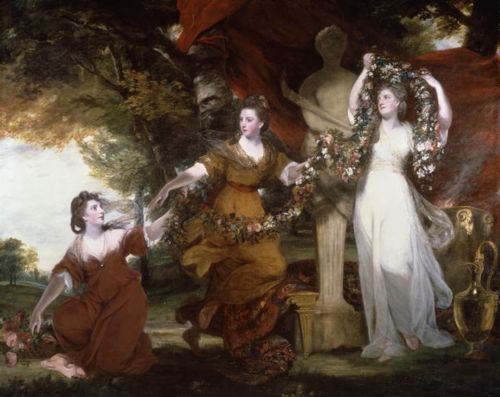
Reynolds

Joshua Reynolds, Ladies Adorning a Term of Hymen, 1773

Reynold’s also painted ladies in more literal takes on classical garments, such as in this 1773 painting.
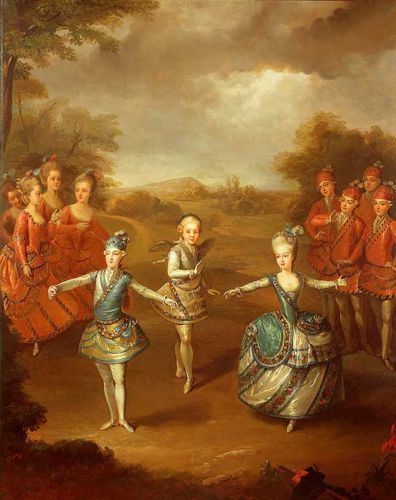
Marie Antoinette and her family dancing

This painting depicts the 10 year old Marie Antoinette and her brothers dancing at the wedding of her eldest brother.  I don’t know how much dancing costumes related to masquerade costumes, but it is worth looking into.  The wings on the younger boy would certainly indicate that he was intended to represent a cupid, which may mean that the rose strewn costume of Maria Antonia (as she was known as a child) was meant to represent Venus or Love

Jan Baptysta Lampi, Jekaterina Samojlow in fancy dress, 1794

I’ve never quite figured out what Jekaterina is supposed to be in this masquerade outfit.  A shepherdess?  Or a exotic Turkish maiden?  With her roses and classical wrap, she might have even been styled as Venus!  It certainly gives a costumer food for thought in terms of combining fantasy and actual historical garb.
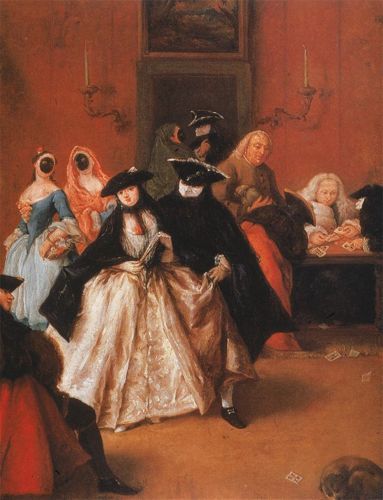
Masquerades and card games at the Ridotto in mid-18th century Venice

Masks are, of course, de rigeur for a masquerade, and seem to have been more important than a costume, at least in the first half of the 18th century.

Anton Raphael Mengs, Isabel Parreno Arce, Marquesa de Llano, 1773

Mengs’ portrait of the Marquesa de Llano may be one of the most famous, and beloved, 18th century masquerade images.  Isabel is shown dressed as a maja, a sort of Spanish gypsy.  I love how the costume combines actual elements of maja dress with the necessary formality of fashionable 1770s garments.

Thomas Gainsborough, The Honorable Mary Graham, 1777

It’s not clear if Mary Graham’s fancy dress in her famous portrait by Gainsborough actually existed or not – it’s certain that Mary did not wear it for any of the sittings, as she was too ill.  Even so, the mix of 16th century Van Dyke inspired historicism and 18th century fashion is charming.

The Comtesse d'Egmont Pignatelli in Spanish Costume (1740-1773) by Alexander Rosin, 1763, Minneapolis Institute of Arts

When the lovely Jeanne is described as being ‘in Spanish Costume’ I suspect her dress was supposed to resemble 16th and early 17th century Spanish dress – the costume of Spain’s heyday.  The ruff and puffed sleeves certainly indicate that era.  Whatever the inspiration, it’s a lovely dress.  I particularly adore her shoes, and the detailing of her lace hem.  It’s a pity that Jeanne looks so bored, and even her darling spaniel can’t get her attention!

From the bits of information available to us, it seems that pretty much anything goes for 18th century masquerades, from full scale stays and panier court dress with allegorical trimmings, through informal dress, all the way to..uhhh…leaf tutus.

For more information on 18th century masquerades, check out The World Upside Down: 18th Century Masquerades.
Frothy fairy dresses

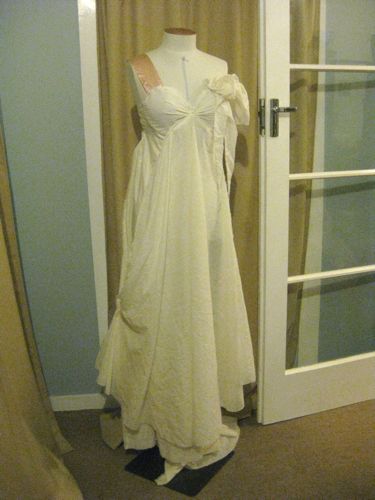
I’m sewing a frothy goddess frock – just for the fun of it.

It’s a nice break from the UFPro pile, and commissions, and historical costuming I’m working on, all of which have specific requirements for their creation.

The dress was kind of inspired by this week’s poll.  I don’t understand all this modern vampire and werewolf and zombie craze.  I want to be a fairy.  It turns out that I’m not the only one who wants to be a fairy – well over half of you have the same impulse.  So I’m making a fairy frock.  Not a tinker belle fairy frock, sort of a fairy godmother meets the traditional faerie queen fairy.  A study in contrast: natural materials with an etherial feel, elegant formality and whimsical fun.

I liked the idea of making a dress that looks a bit like a sarong tied around you, and a bit like a Regency gown.  One that blends total relaxation and classical formality.

The fabric is an ivory cotton voile with tiny woven-in stripes of silver, perfect for a earthy but celestial frock.

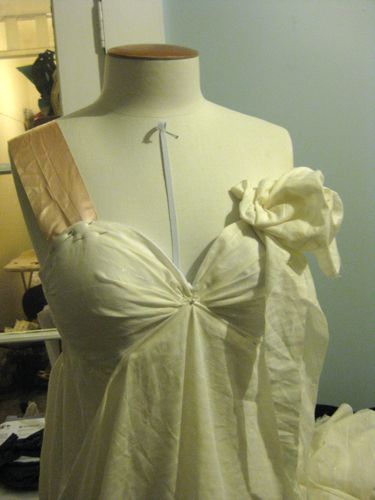
My quick, drape it on a mannequin prototype.

The first prototype was lovely, but had unfortunate hip-widening tendencies:

It's lovely, but even Isabelle looks larger than normal in it.

So re-did the skirt a little, and the bodice a lot (my prototype just had the fabric draped on a bra), and, in a lucky stroke of brilliance, I found a length of antique rayon tulle I have had for years, and it draped perfectly around the dress.

Pretty!

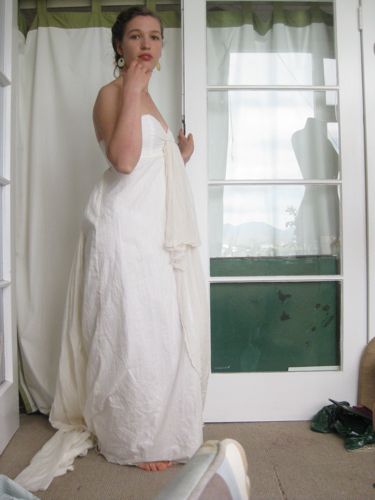
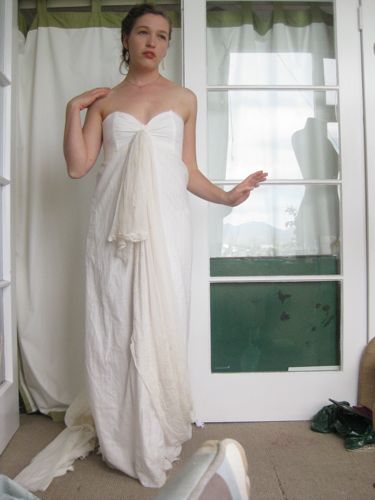
I thought about leaving the dress as a strapless, but the effect is too wide from front to back - the single sleeve strap really lengthens and slims the figure

Strapless is pretty from the front, but a bit fussier and not quite as 'goddess'

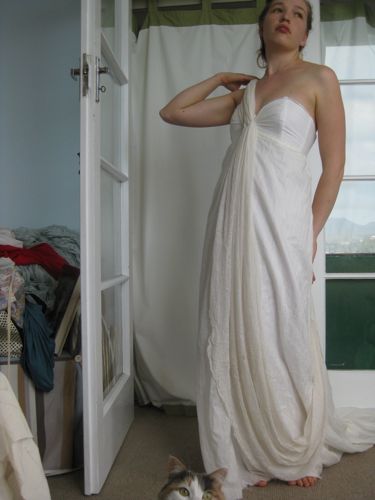
The mess on the left is my massive pile of working projects. Shame on me. Don't you love Felicity's cameo?

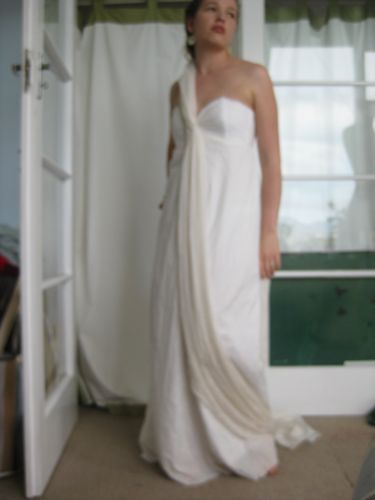
See how much slimmer the side view is with the strap? Even in an unfocused shot!

Swoon! (and did you notice that I have a bust in this dress!?!)

The side back view is still a little messy - I'm going to tidy it up

The back is visually too wide. And the swoop of tulle should join to the centre back waist seam, not disappear into the skirt

I’ve got a whole list of things I want to do to make the dress look better:

  • add another layer of lining under the skirt
  • drape another layer of fabric over the bodice to hide the seam lines
  • re-hang the skirt from the bodice to get rid of some of the wrinkling and odd hang of the skirt
  • re-cut a straight skirt seam into a diagonal to improve the fall of the skirt.
  • re-pleat the back pleating of the skirt – it’s too wide, and makes the back look wider
  • add false Regency-inspired back seams to help visually narrow the back.

In other words, I’ve pretty much completely taken the dress apart, and am re-putting it back together.  But at least I know exactly what I am aiming for this time!

In addition to my fixes, I plan to raid my stash of vintage lace scraps, and ornament the dress with all the froth and flowers my minimalist soul can stand.  I’m going to strew little lace flowers all over the antique tulle  to hide the old mends in it.  And add lace to the bodice.  And to the train.  Or at least that’s the plan.

Sewing my wedding dress

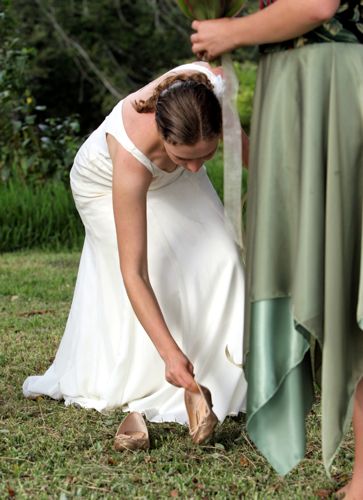
There is a superstition (which I am convinced was invented by the wedding dress manufacturers) that it is bad luck to make your wedding dress.

Marriage-wise, my own observation would indicate that it is extremely good luck to make your own dress- all the women I know who did have had long and happy marriages.

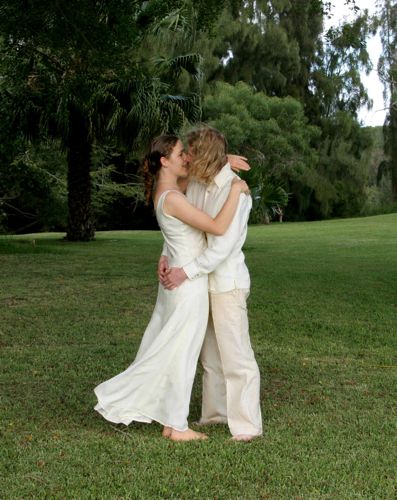
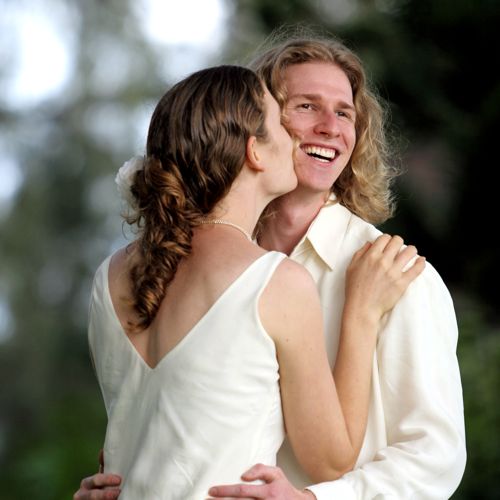
The beginning of a long, happy marriage (I hope!)

Perhaps the bad luck is in the making of the dress itself?

I could see that.  Making my dress was an unhappy and traumatic experience, and both my mother and mother-in-law suffered unfortunate incidences related to the making of their dresses (one of which involved brand new sewing shears, tripping over the toile, lots and lots of blood, a trip to the emergency room, and a permanent scar).

Still, if that is the price you pay for a successful marriage, bring on the wedding dress making horror stories!

My dress was a case of anything that could go wrong, did.  Part of the problem was that in between bouts of dress making, I wrote a thesis, graduated from university, moved from California to NYC, did an internship, moved from NYC to Hawaii via California and New Zealand, planned a wedding, did the immigration application to move to NZ, packed for an international move, and had a major health scare.

Oh, and I went from working in a professional costume shop with access to every machine and mannequin imaginable, to working in a tiny cramped, dark, damp room in Hawaii with only 1 (very average) sewing machine, and no dressforms.  And I was no longer surrounded by amazing professional costumers to give advice and help with fittings.

And then there was the ‘wettest autumn in recent memory’ problem in Hawaii, which meant that washed fabrics didn’t dry for days, I couldn’t use an iron as there wasn’t enough solar power, and fabrics mildewed given half a chance.

Not fun.

But somehow, with a lot of help from my Mum and sisters, and a lot of all round general patience, and the occasional willingness to re-cut new pieces of the dress when the original pieces got mildew stains, I persevered.

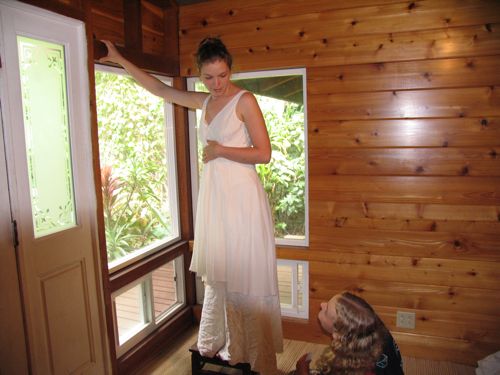
Goldie helps me hem the dress - she is working on one of two lining layers (which I neglected to iron).

Am I doing this right?

Part of the problem was me.  I can be a terrible perfectionist, and every bit of work that went into the dress was exquisite.  Every piece had to look as good on the inside as the outside, ever hem was hand stitched with nearly invisible stitches, and anything that wasn’t immaculately precise had to be done again, and again, and again, and then some.

The light shining through the dress shows how perfect the seam finish was.

The bodice was the part that gave me the most trouble.  The original pattern wasn’t flattering, and all the alternatives I came up with were very tricky.  I ended up cutting and sewing half a dozen different versions, before ending up with one that was acceptable, but which I never loved.

The original bodice - you can see how it is fitting funny around the neckline

Bulgy, bulgy, icky.

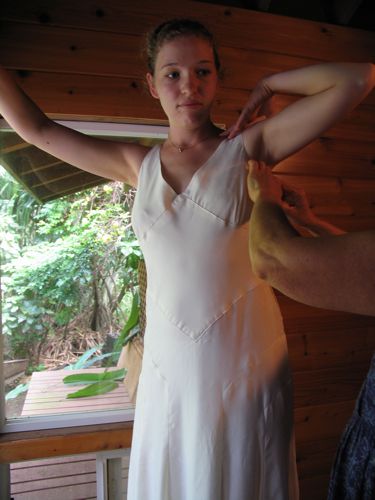
The final (well, wedding day) bodice.

You can see how it never quite fit right around the arms

Luckily, I had got a very good deal on the fabric, so I bought ridiculously much more than I thought I would use.  Thanks to the re-cutting, I used it all.

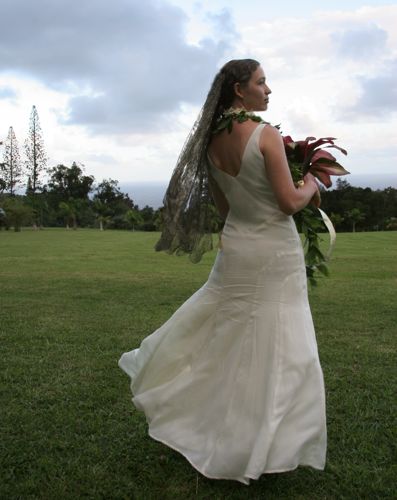
In the end, I had a dress which was wonderful to wear on the day (so light and cool and practical), and which I regretted, in a wistful “I missed my chance to wear something ridiculous” way, when I first saw the wedding pictures. Luckily I am growing to love the timeless and understated aesthetic of the dress more and more as the years pass.

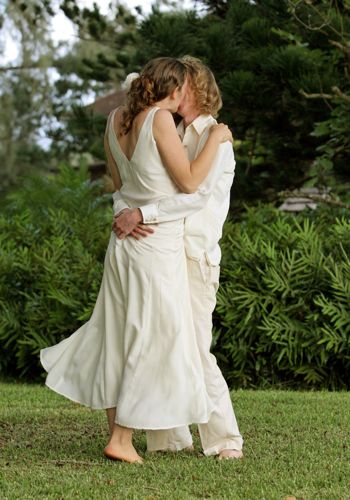
Light and cool and practical, and goes perfectly with bare feet.

And it moved wonderfully in the breeze.

And it was so fun to dance and spin in!

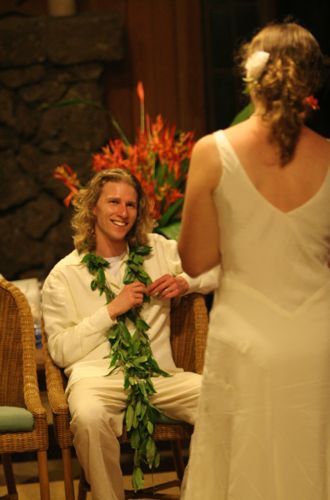
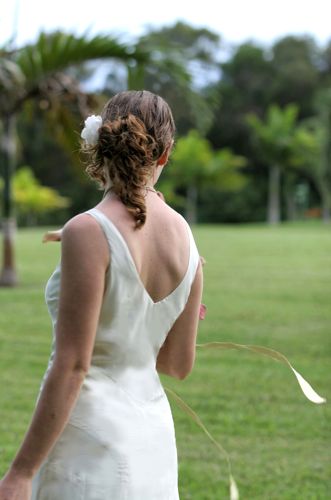
It looked lovely, but simple, from both the front and back.

Would I do it again if I had the chance?  I would, and I wouldn’t.  With what I know now (life wisdom, not sewing skills), I would make a dress that was easy to sew, but had much more visual impact.  The dress I made was ridiculously difficult, but the result was deceptively simple – a masterpiece that tricked the viewer into thinking they could throw the same thing together with just a few hours work.

Look at how beautifully it flowed and clung in back!

I've never figured out why I love this image so much, but I do.

I even like that the dress fabric creased and crumpled when I sat on it

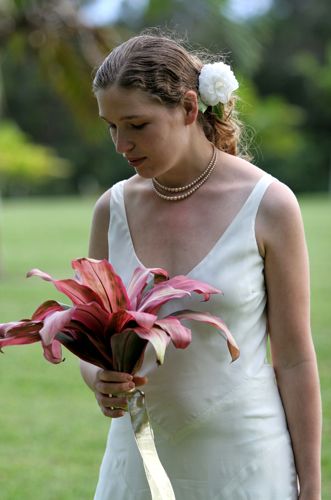
It made me look so slim! And did nice things for my bottom. My bouquet was made of pink ti leaves