Latest Posts

Reticule thedreamstress.com

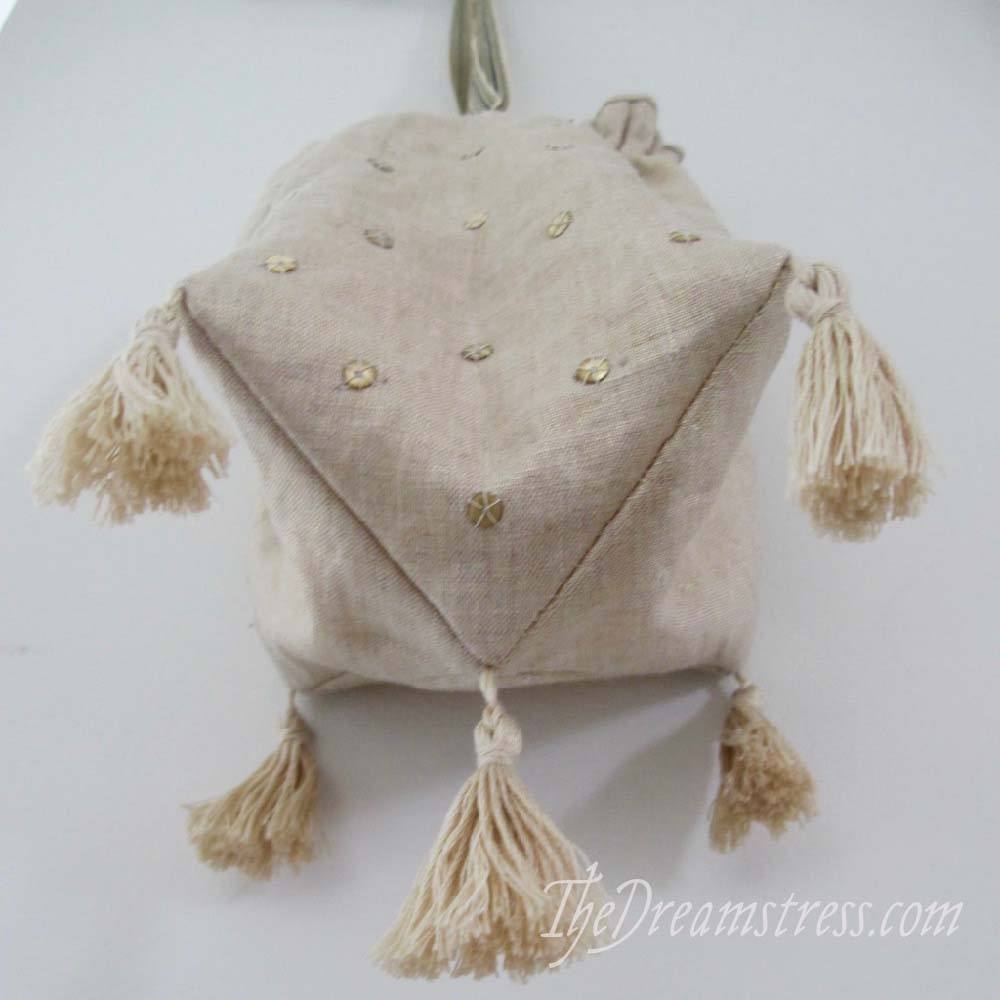
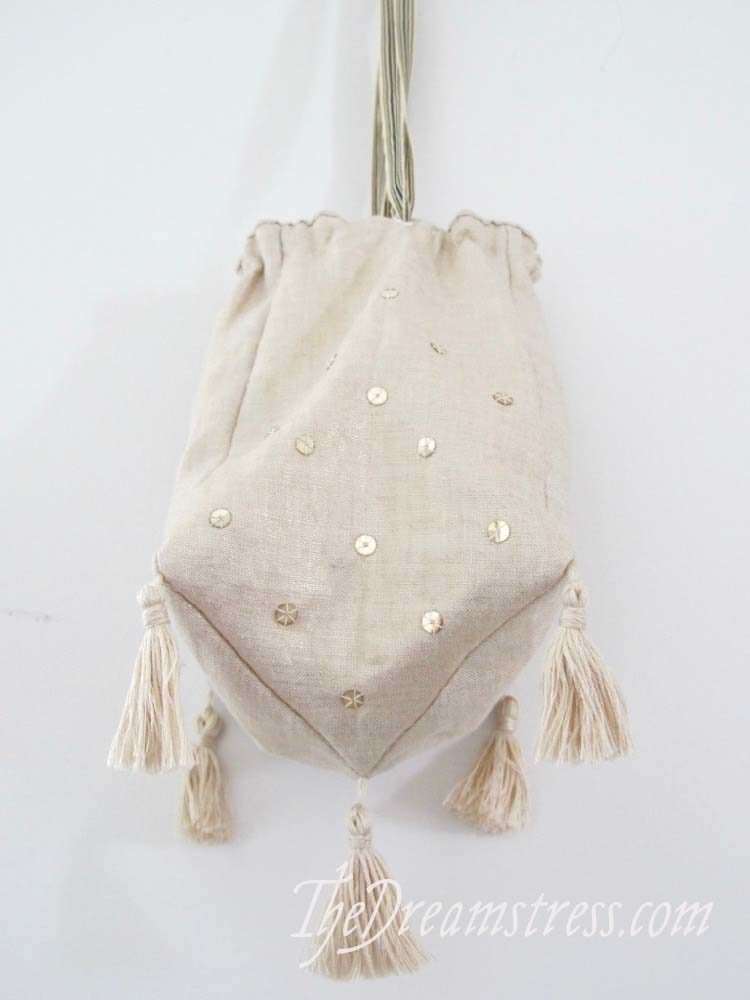
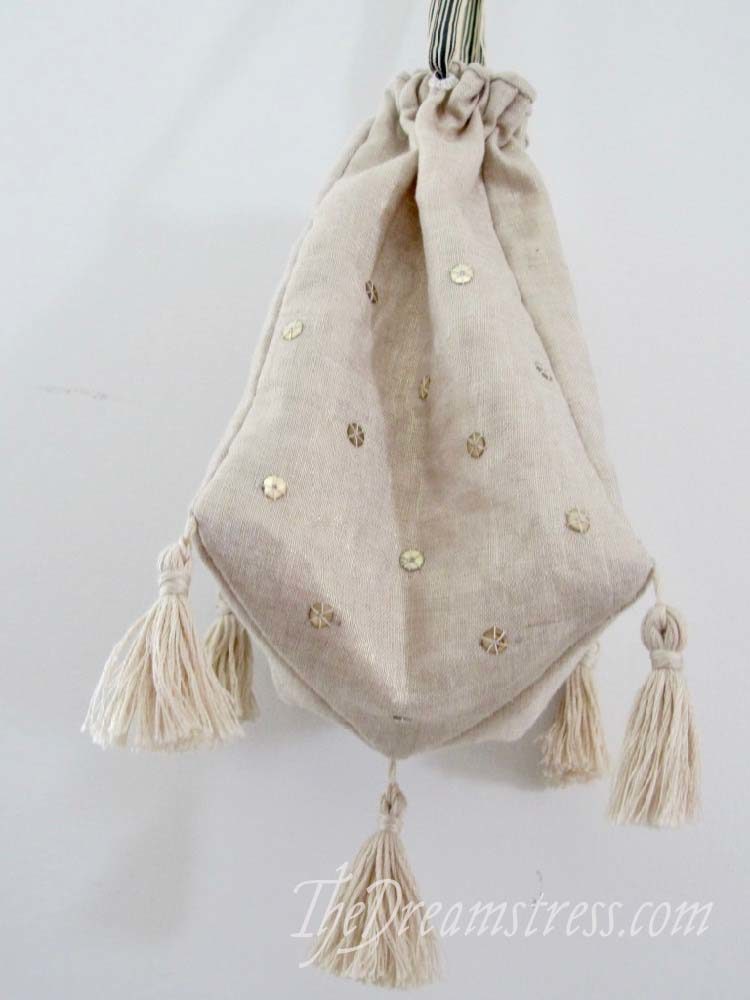
A sparkles and tassels reticule

November’s Historical Sew Fortnightly challenge was Purses & Bags – and, despite everything else that was going on, I managed to make a thing!
Reticule thedreamstress.com


It did take me more than a month though.  I started it at our Historical Retreat (we tried to cram reticule making and bonnet making into one weekend – and of course finished neither), and didn’t get it done until the first Wednesday in December.

I was inspired by the shape of this reticule from LACMA:
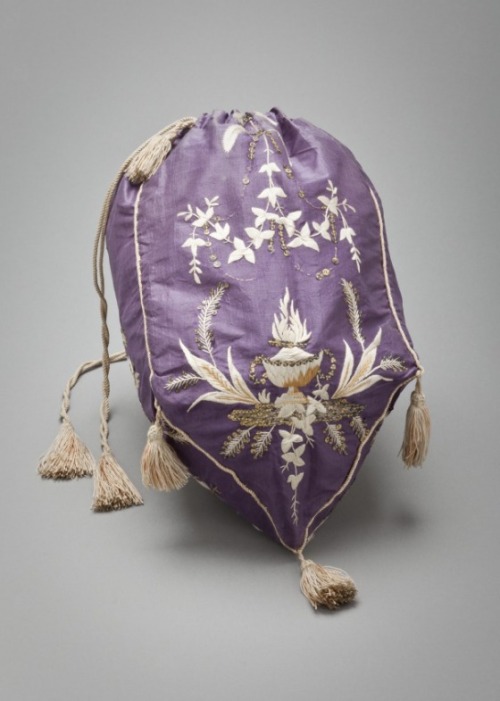
Reticule, 1800-1825, The Los Angeles County Museum of Art

And the decorations of this bag from MFA Boston:

Drawstring bag, American about 1800, Cross barred cotton, embroidery, MFA Boston 48.1222

I used my gilt linen of doom: the stuff I used for these stays, and this pair of bodies  (which were one of my entires for the very first Historical Sew Fortnightly – back when it was still fortnightly!) – and I still have a couple more metres of it to go!

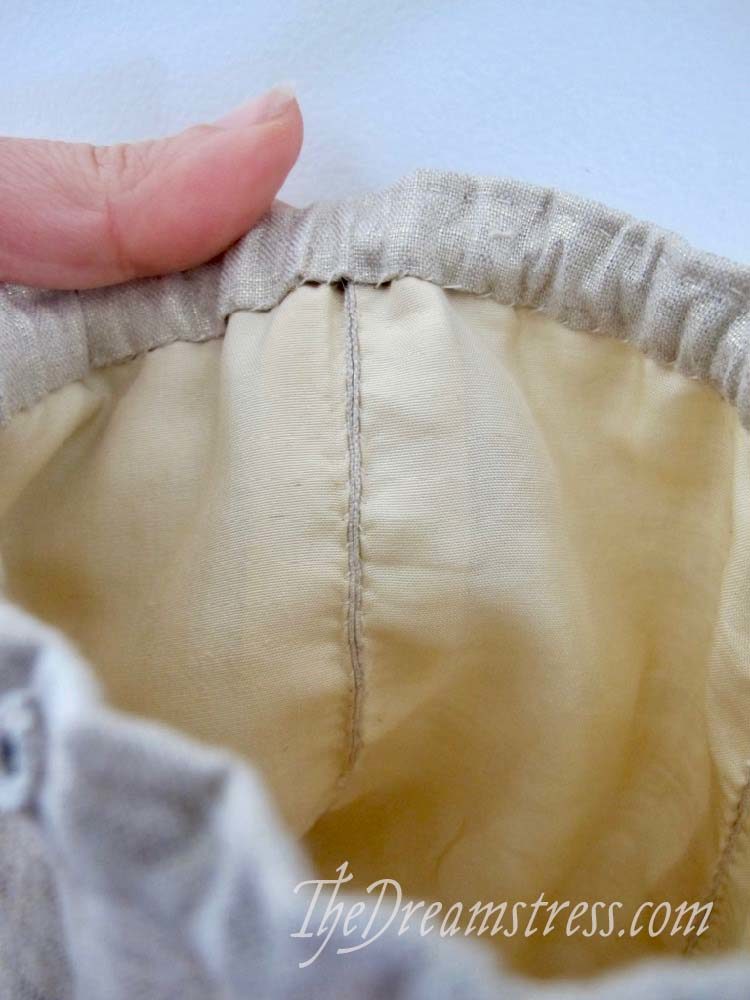
Because I was sewing sequins as decoration, I decided to line the reticule, to keep the knots and thread from catching on whatever I put in the bag.

Reticule thedreamstress.com


I used a blonde habotai silk for the lining, and the so-called ‘English Stitch’ to attach the four panels of the reticule.  The drawstring facing is a separate piece of fabric, and in retrospect I should have used the silk, or something else that was lighter weight.
Reticule thedreamstress.com

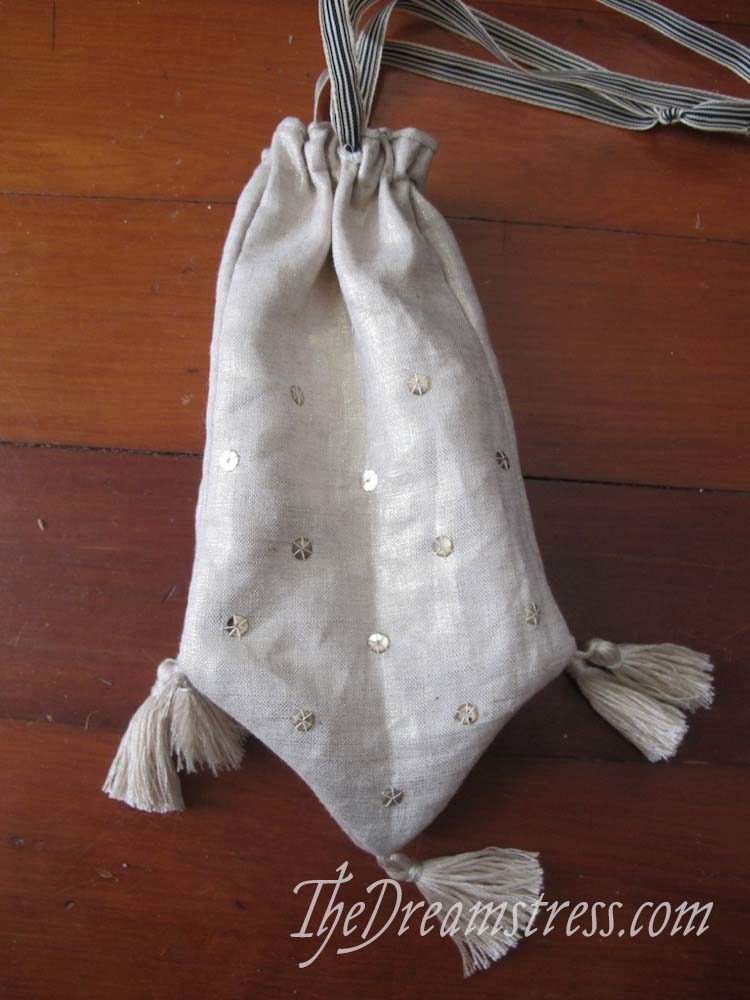
The tassels are made from cotton embroidery floss.

Reticule thedreamstress.com

The sequins are vintage, and I thought they were metal, but after an unhappy accident with the iron that required me to replace more than half of them, I discovered that they are NOT metal.  Ooops…
Reticule thedreamstress.com

All the stitches and techniques I used in the bag are documented in ca. 1800 sewing, but I’m not sure if they would have been used to make this type of reticule.

I’m moderately happy with the finished effect, but not thrilled.  I might re-do the top casing, and see if that makes the gathers more attractive.  And make a cord out of embroidery floss, with tassels at the ends, because more tassels is always a good thing!

The Challenge: #11 Purses & Bags

Fabric:  .3m of gilt linen ($4), .3m of silk habotai ($2, thrifted)

Pattern:  My own, based on the dimensions given in museum records

Year:  ca. 1800

Notions:  cotton thread ($1), sequins (20c), cotton embroidery floss ($9), cotton ribbon ($3)

How historically accurate is it?:  The fabric is questionable (similar-ish fabrics did exist, but I can’t fine any examples of it being used for a reticule), the sequins are a modern type, and in-period the tassels were probably silk.  All of my stitches are accurate to the period, but I can’t document them being used for this type of bag.  Maybe 60%

Hours to complete:  8ish, while doing other things.

First worn:  Not yet.  I need a ball to go to!

Total cost:  NZ$19.20 or thereabouts.
Reticule thedreamstress.com

Rate the Dress: Red & White Regency (with shoes!)

It’s entry #2 in my series of ‘Rate all the Party Dresses’.  This week we’re going back in time 210 years, and rating a formal Regency gown.  It’s a particularly exciting rating, because it also includes the shoes worn with the dress.

Last week:  a bright orange silk and embroidered net party frock from 1916

The reviews for last week’s frock were a very happy surprise.  I was afraid many of you would find it too bold and outrageous – but just one did.   I’m always delighted when you love a dress, and even more so when I’m really not sure you will.

(of course, it would be terribly boring if every one of you just adored everything, so don’t worry if you don’t!)

The Total: 9.5 out of 10

Definitely a belle of the ball dress!

This week: an 1800s dress – and the shoes to match

I found the bare footed mannequin that last week’s dress was displayed on rather disconcerting, so this week I picked an evening gown where we know what shoes it was worn with.  A museum’s choice of accessories can make or break a rating, and while this dress is otherwise shown un-accessorised, the shoes give us an authentic glimpse into how it looked when first worn.

The dress is a typical classically inspired Regency gown, with raised waist, brief bodice, and short sleeves, all intended to evoke Grecian drapery.

The simple shape is enlivened by embroidery in fine red wool.  Little scrolling floral motifs cover the skirt, and borders of modified ‘Greek Key’ or ‘Meander’ motifs follow the hem and divide the front of the skirt, emphasising the vertical lines of the frock.

The MFA Boston describes the ground of the dress as ‘cotton gauze’. The gown is probably made from gauze in the more generic sense: a very lightweight fabric with a slightly open weave, rather than the technical sense: a fabric with a leno weave.

The red and white slippers that accompany the dress feature a wide, low heel, and painted stripes that, like the embroidered lines of the dress, emphasise the fashionable shape of the shoe: in this case, the pointed toe.

So, with dress and shoes to imagine together, what do you think of our Regency Cinderella?

Rate the Dress on a Scale of 1 to 10

A reminder about rating — feel free to be critical if you don’t like a thing, but make sure that your comments aren’t actually insulting to those who do like a garment.  Our different tastes are what make Rate the Dress so interesting.  It’s no fun when a comment implies that anyone who doesn’t agree with it, or who would wear a garment, is totally lacking in taste.

(as usual, nothing more complicated than a .5.  I also hugely appreciate it if you only do one rating, and set it on a line at the very end of your comment, so I can find it!  And 0 is not on a scale of 1 to 10.  Thanks in advance!)

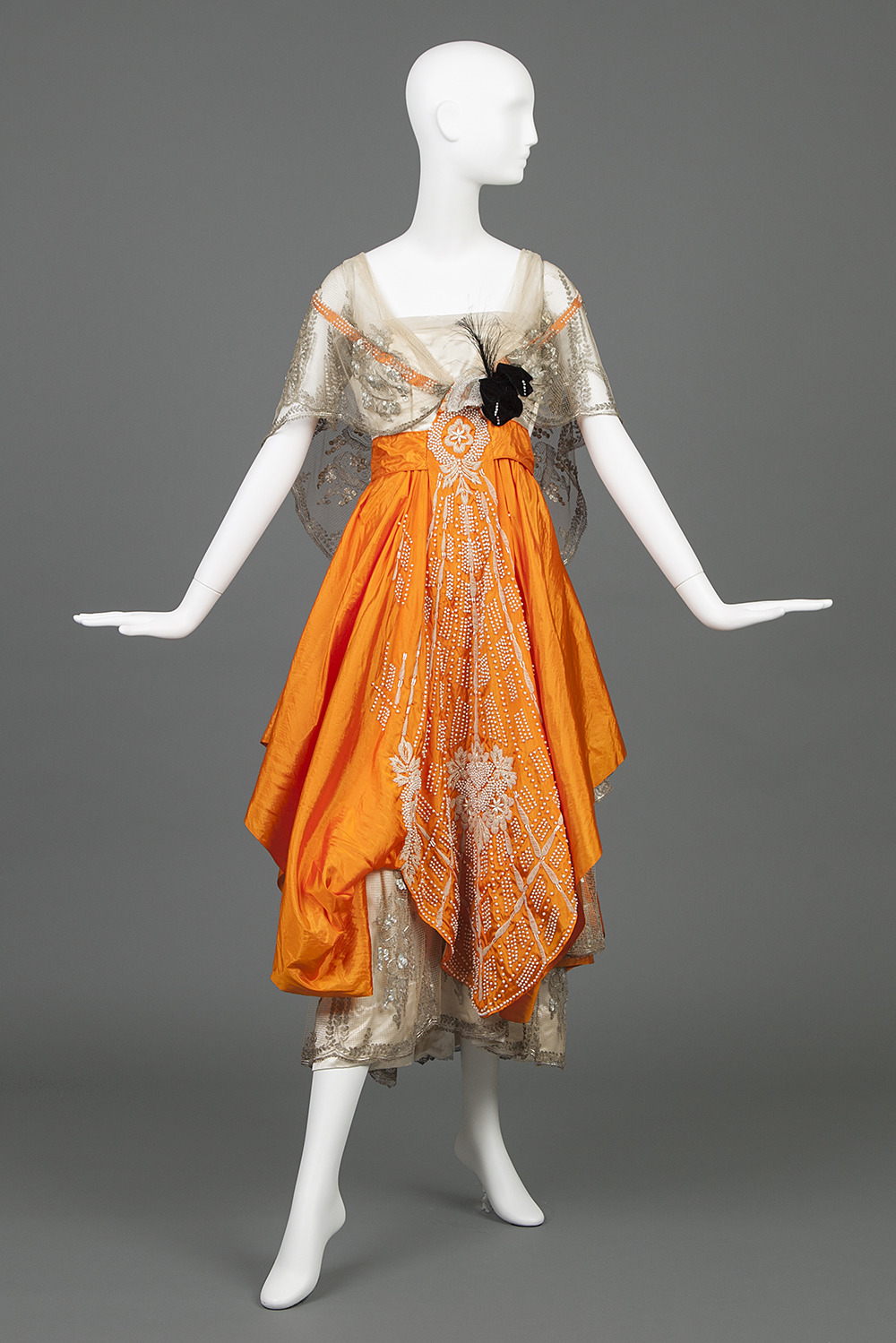
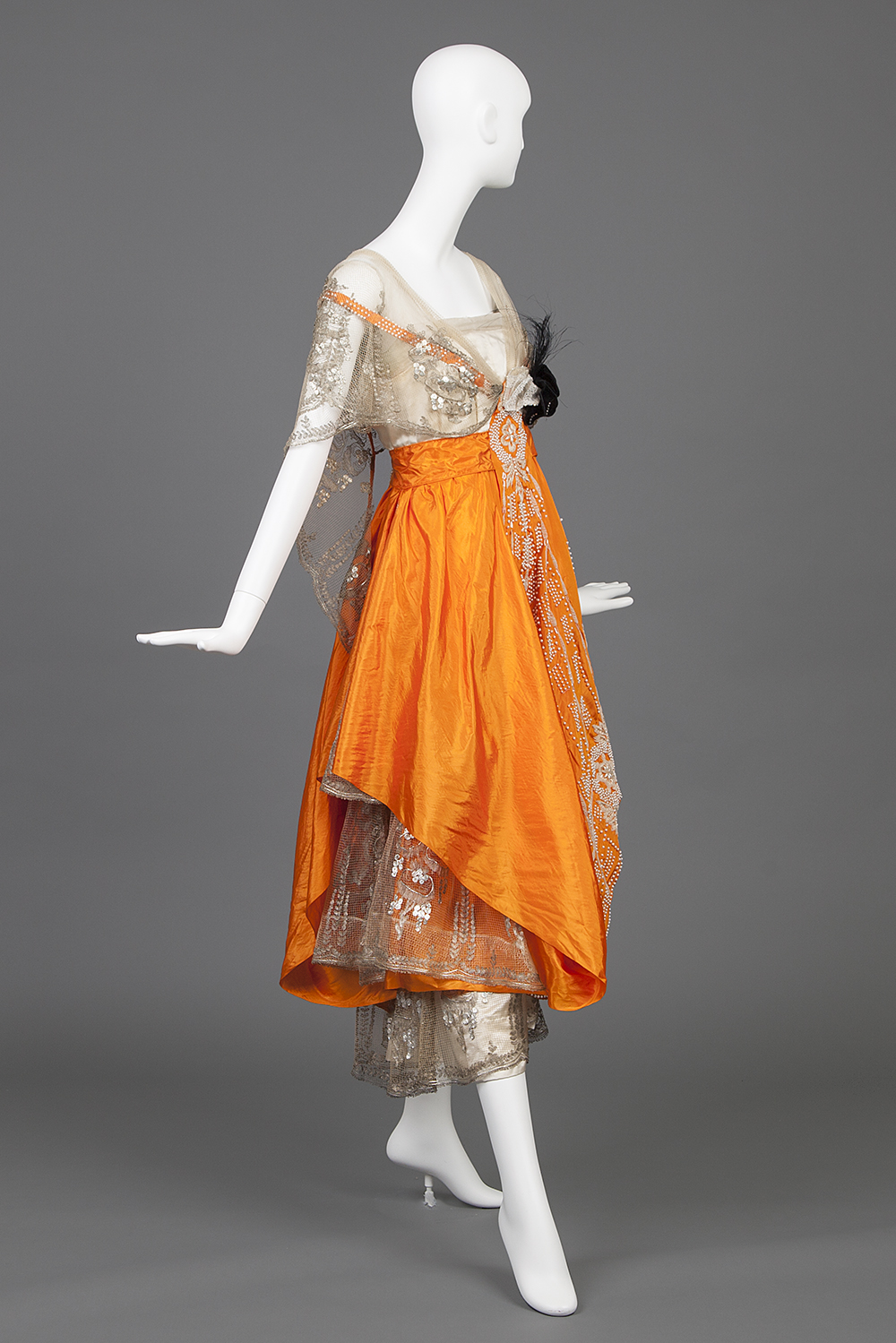
Evening Gown Of Cream Silk Satin and Orange Silk Taffeta, Hollander, L.P., 1916-1917, USA, silk, pearl beads, chenille yarn, aigrette feathers, Goldstein Museum of Design 1982.016.015

Rate the Dress: Holiday frocks for 1916

Holiday party season has just stepped into high gear here in Wellington, and every venue in town is booked out for the rest of the month.  My seasonal event schedule is sadly lacking in soirees that call for elegant frocks, but I’ve been doing fantasy event shopping in various museum’s collections, finding dresses that I would DEFINITELY wear had I the occasion, and ones that I want to show you, to see what you think of them.  So the next few weeks are going to feature event-worthy (well, maybe) party dresses.

Last week:  a bright spring green pelisse  

Mixed reviews for last week’s dress, with bonus points for some people because the dress looked like a historical superhero costume!

I was really intrigued by all the speculation of who it would look good on, and the claims that most women couldn’t carry it off.  Though it’s not easy to find, the pelisse’s fresh green colour looks really good on me – and is one I think of as very flattering on most women, at least in the historical sense of flattering (tends to make them look pale and mysterious, and the emphasise the contrast between skin and lips).

The Total: 8.3 out of 10

Exactly the same as the week before!

This week: a bright orange silk and embroidered net party frock from 1916

To start off my showcase of historical party dresses that a guest could wear to one of those historical extravaganzas I wish I could go to, I’ve chosen a frock from my favourite fashion year: 1916.

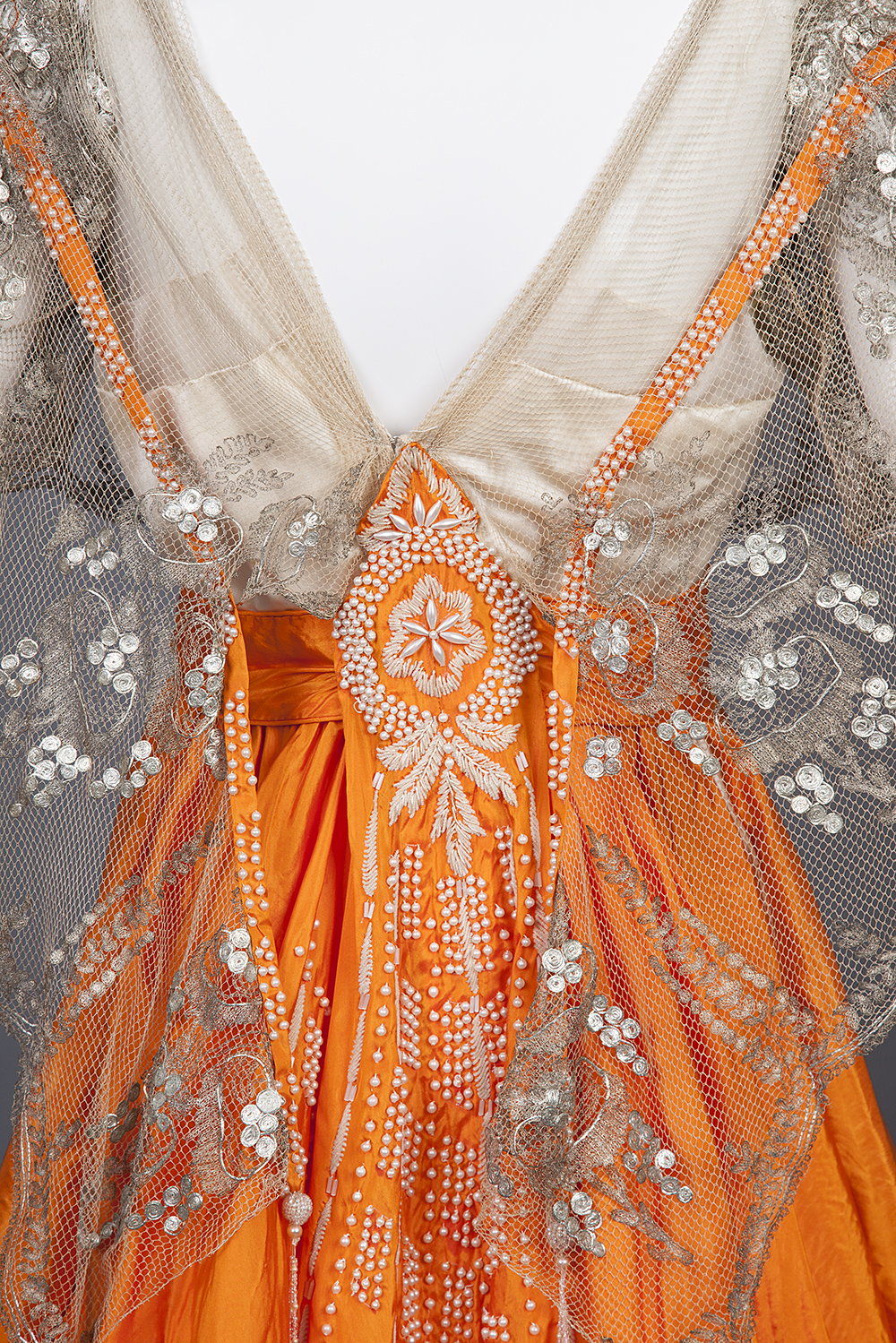
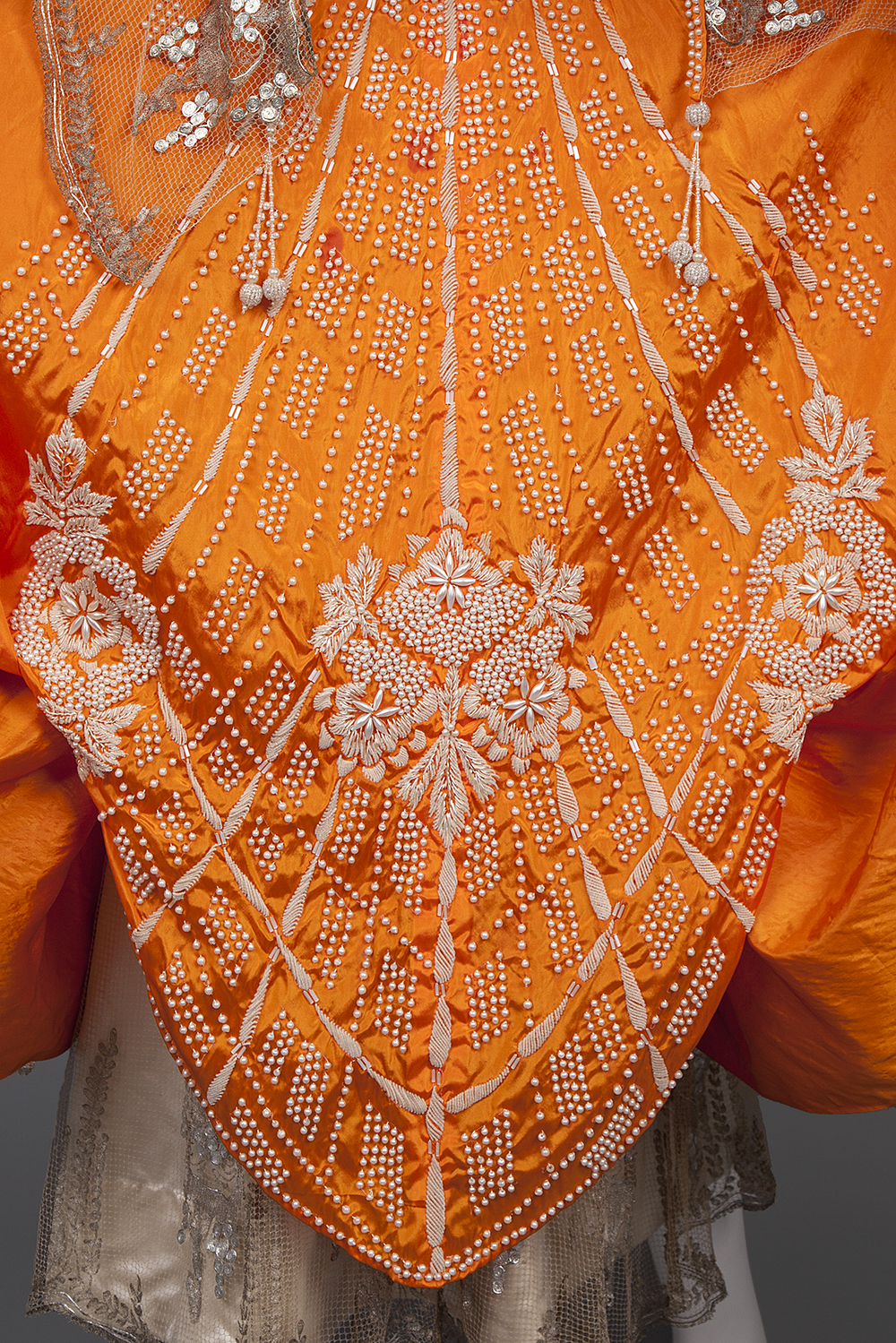
Evening Gown Of Cream Silk Satin and Orange Silk Taffeta, Hollander, L.P., 1916-1917, USA, silk, pearl beads, chenille yarn, aigrette feathers, Goldstein Museum of Design 1982.016.015 detail

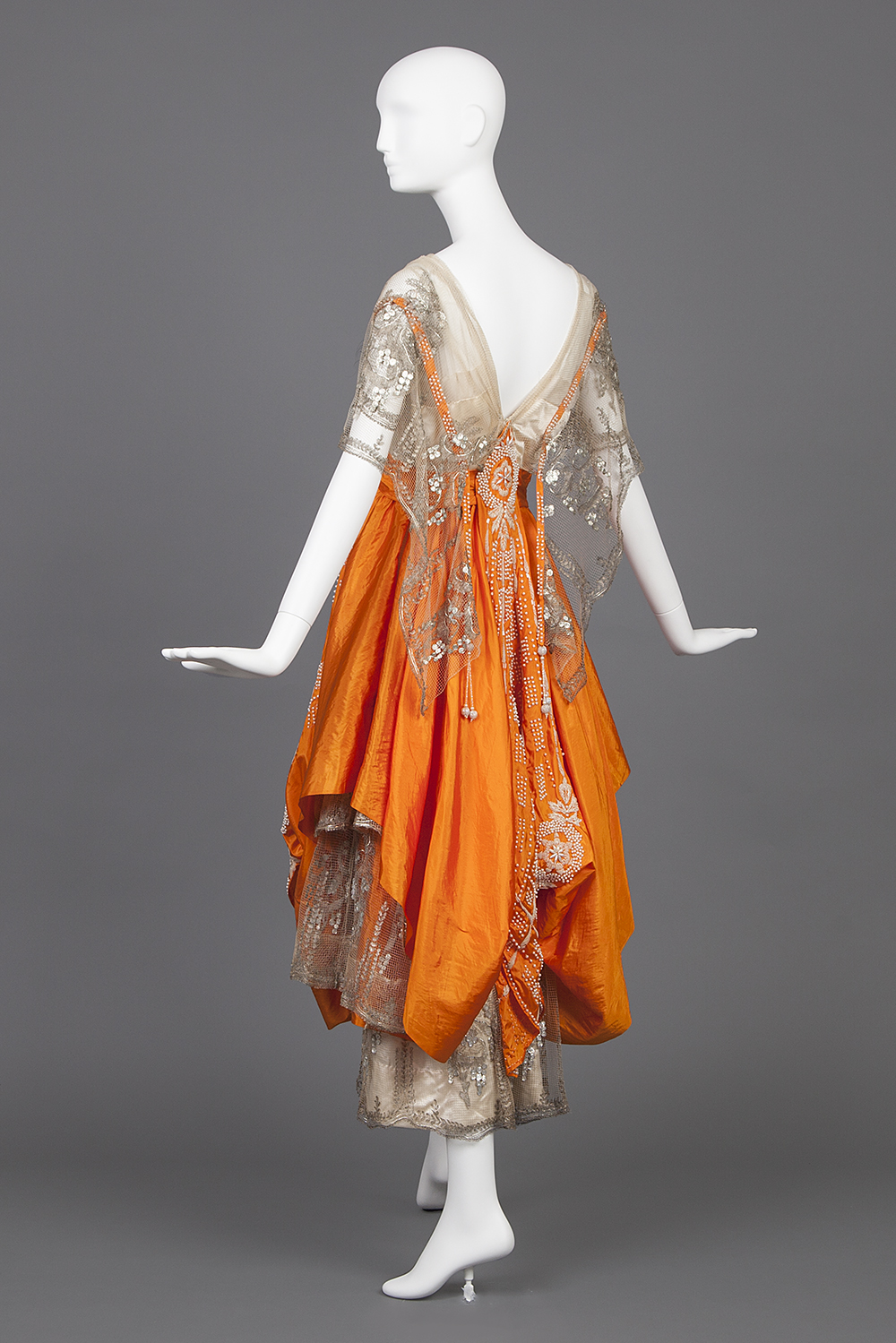
Evening Gown Of Cream Silk Satin and Orange Silk Taffeta, Hollander, L.P., 1916-1917, USA, silk, pearl beads, chenille yarn, aigrette feathers, Goldstein Museum of Design 1982.016.015

This dress would definitely benefit from a good steam, and the proper undergarments (a bit more petticoat-age in particular), but the basic essence of the design, and of the impact the dress would have had on the dancefloor, is still obvious.

Like many 1910s dresses, this evening gown combines two contrasting design ideas: a bold colour, and delicate layering, with each element of the dress revealing subtle detailing.

The skirt is made of three layers of net, each embroidered with silvery threads.  The topmost layer of elaborately worked net is almost completely hidden by the overskirt of vivid orange silk, and would only be revealed as the dress moved and swayed around the wearer.

The orange silk, vibrant as it is, is not left alone to speak for itself.  Instead, it features panels of heavy beading, with pearl and glass beads of different sizes, and chenille embroidery, forming forming floral and geometric patterning down the front and back of the dress.

The silver, orange, and white of the dress is offset with a splash of black in the form of a corsage of black velvet and aigrette feathers pinned to the waist.

The whole dress is a play on contrasts: muted and vibrant, bold and subtle, delicate and robust, fitted and voluminous.

The Goldstein Museum of Design website has some excellent images of the layers of the dress, and how it opens, which I highly recommend checking out if you’re interested in historical dress construction.

What do you think of it?

Rate the Dress on a Scale of 1 to 10

A reminder about rating — feel free to be critical if you don’t like a thing, but make sure that your comments aren’t actually insulting to those who do like a garment.  Our different tastes are what make Rate the Dress so interesting.  It’s no fun when a comment implies that anyone who doesn’t agree with it, or who would wear a garment, is totally lacking in taste.

(as usual, nothing more complicated than a .5.  I also hugely appreciate it if you only do one rating, and set it on a line at the very end of your comment, so I can find it!  And 0 is not on a scale of 1 to 10.  Thanks in advance!)