Latest Posts

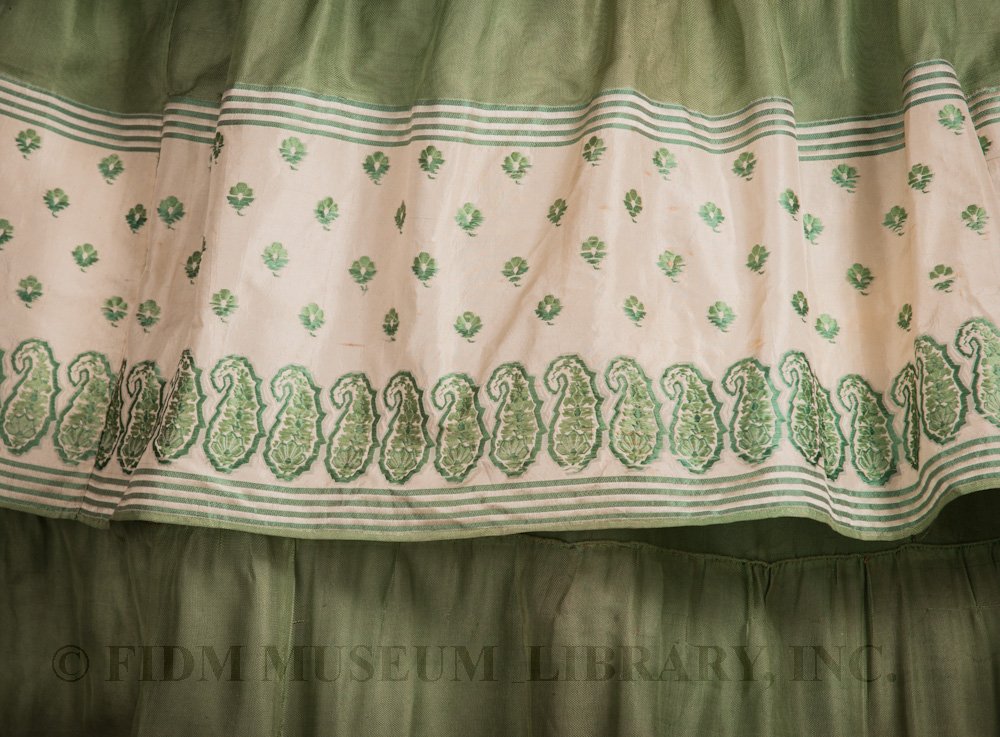
Silk gauze dress, c. 1855-1860 Gift of Jane M. Gincig and Patricia Larson Kalayjian, FIDM S2011.1087.189

Rate the Dress: Green gauze & paisley

This week’s Rate the Dress tones down the colours, with an 1850s dress in fresh green with touches of white and small formal paisley motifs.  From contrast to calming green: how will the ratings compare?

Last week: a bright blue and burgundy 1870s number

Well, moths were all the rage on most of the internet last week, but not here on Rate the Dress!  With very few exceptions the ratings were #teammothbowsarebad.  The colours were actually pretty popular, and a few people really did like the dress wholeheartedly.  The rest of you?  Not so much!

The Total: 6.6 out of 10

Ouch.  Even the rating is giving the dress side-eye.

This week: 1850s ruffles in green silk gauze

The overall style and silhouette of the dress is much simpler than last week: a classic second-half-of-the-1850s ballgown silhouette, with tiers of ruffles either woven a la disposition, or edged with a wide border print ribbon.

The border features a highly fashionable paisley motif, with a slightly blurred aesthetic that indicates it was created with a warp printed weaving technique.

The three tiers of the skirt are echoed in the sleeve tiers, and the three darts that shape each side of the bodice.  The simple fitted bodice has either lost its berthe, or never included one.

FIDM suggests this gown may have been paired with a Kashmiri shawl, for a paisley-on-paisley look.  However, paisley shawls had ceased to be fashionable evening accessories in the early 1830s, and fashion plates of the 1850s & 60s almost exclusively show them paired with daywear, so a wearer with any aspirations to being a la mode would likely have avoided such a combination.

What do you think?  Fresh and just fashionable enough to be interesting, or too much like too many other 1850s dresses.  Or perhaps there can never be too many tiered, ruffled 1850s dresses?

Rate the Dress on a Scale of 1 to 10

A reminder about rating — feel free to be critical if you don’t like a thing, but make sure that your comments aren’t actually insulting to those who do like a garment.  Our different tastes are what make Rate the Dress so interesting.  It’s no fun when a comment implies that anyone who doesn’t agree with it, or who would wear a garment, is totally lacking in taste.

(as usual, nothing more complicated than a .5.  I also hugely appreciate it if you only do one rating, and set it on a line at the very end of your comment, so I can find it!  Thanks in advance!)
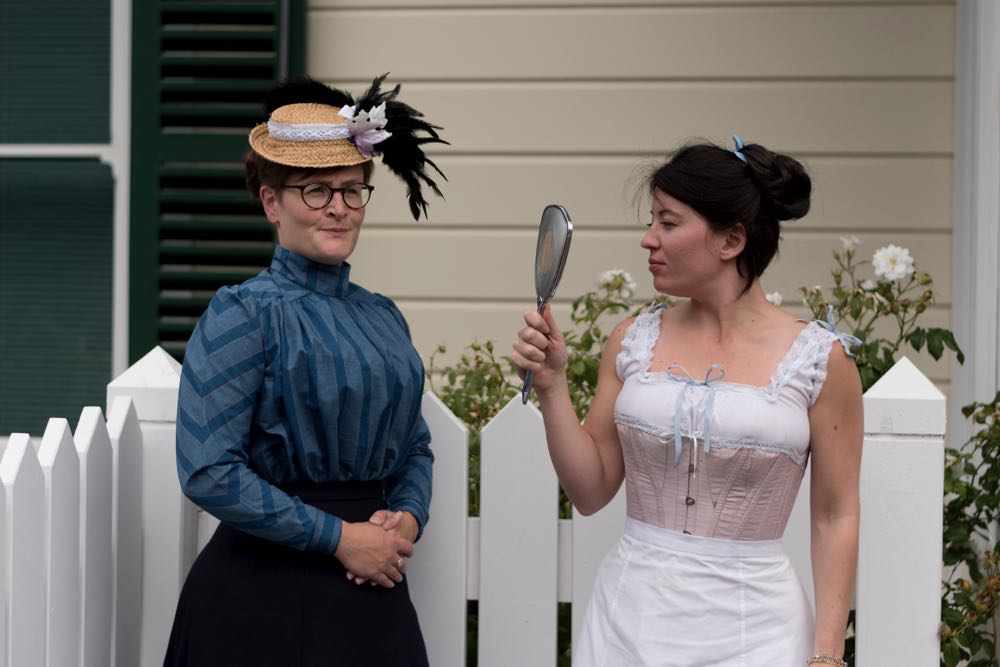
Ruffled unders at Ruffles & Rebellion thedreamstress.com

Mansfield & the Modern Woman: a fashion history talk

Need some fashion history in your weekend?

Come hear me talk about Katherine Mansfield, the New Zealand suffrage movement, and ideals and archetypes of femininity in late 19th & early 20th c New Zealand – all illustrated with models in gorgeous costumes.

Mansfield & the Modern Woman

New Zealand Portrait Gallery, Shed 11  

Sunday, 7th October, 1pm

Free

This talk is part of Mansfield 130 and Suffrage 125

There will be models in gorgeous dresses, fabulous artwork, and interesting history.  What’s not to love?

If you aren’t able to come in person, enjoy some of the media coverage of me in preparation for the event:

Rate the Dress: Bright blue & burgundy 1870s

One of my favourite things about Rate the Dress is the way it encourages me to find thematic links between different eras, and garments that seem otherwise unrelated.  This week’s 1870s Rate the Dress keeps with the theme of buttons playing peek-a-boo amongst the layers, and adds in a bold and unusual colour scheme that Poiret would have definitely approved of.

Last week: Poiret plays with buttons

Last week you either liked/really didn’t like the button trim, and thought the back bow ruined/made the dress, and were completely enamoured/turned off by the scalloped hem, and loved/hated the chemise effect and chiffon sleeves.  If any element of the dress was someone’s favourite, it was also someone else’s least favourite!

Except for all the ones that only had favourites, and the significantly smaller group that totally disliked it.  It was a bit of a marmite dress.

The Total: 7.4 out of 10

A dress where the total really doesn’t reflect the majority of individual feelings: out of 37 ratings, only one was a 7.5!

This week: Bright blue and burgundy 1870s

This first-bustle-era dress features deep burgundy red and vivid, almost electric, blue, tied together with a small floral pattern perfectly matched to the colours.

Like Poiret’s dress it features buttons running down the centre front, popping in and out of layers.  Unlike lasts week’s pick, these buttons are functional (and actually buttons) and end at the waist.

Also like Poiret’s dress, it features bows as trim (albeit significantly more of them).

Instead of chiffon, there are lace frills at the cuffs

And instead of flat scallops, the skirt is edged with elaborate pleating.

It’s certainly a different look to Poiret’s dress, but it has some of the same sense of whimsy and playfulness.  It’s possible that it was made for a very young woman: it’s quite small, and has only a 7.5″ difference between bust and waist.

Whether it was made for a teenager, or a very petite woman, it was certainly made for someone with personality and the willingness to wear something a bit bold.  What do you think of it?

Rate the Dress on a Scale of 1 to 10

A reminder about rating — feel free to be critical if you don’t like a thing, but make sure that your comments aren’t actually insulting to those who do like a garment.  Our different tastes are what make Rate the Dress so interesting.  It’s no fun when a comment implies that anyone who doesn’t agree with it, or who would wear a garment, is totally lacking in taste.

(as usual, nothing more complicated than a .5.  I also hugely appreciate it if you only do one rating, and set it on a line at the very end of your comment, so I can find it!  Thanks in advance!)