Latest Posts

Doing laundry in 1916

Some people have asked about laundry.  How am I going to do it as a housewife in 1916?

Advertisement for a Methven Copper, Wanganui Chronicle, 1 January 1916

Advertisement for a Methven Copper, Wanganui Chronicle, 1 January 1916

While the ‘Wash on Monday’ nursery rhyme made famous by the Little House books doesn’t appear to have been nearly as prevalent in New Zealand, there are still suggestions that there were definite routines to daily chores, and washing, done at home, was  most frequently done on Monday.

It makes sense: most visiting and social events would happen on the weekend, so washing on Monday would ensure there wasn’t laundry on view when visitors came around, or that the lady of the house was occupied for the full day doing laundry while she also had guests.  It also meant that any good clothes worn for social events or church could get laundered right away, before stains set in.  Another old rhyme explains that it was about drying time – and in the middle of winter, that may indeed take a while!

Poorer households would have done their own, but washing was considered one of the most onerous of chores, so in wealthier households the  maid did it, it was sent out, or someone was hired in. NZ newspapers are full of advertisements for a woman to ‘wash on Monday’.

Laundry was done in a number of ways in the 1910s.

The most basic, but most labour intensive,  method was to soak it in warm or hot soapy water, and then rub it vigorously on a washboard, rinse it thoroughly, and then wring it or (if you had enough money to afford one) put it through a mangler  to remove the excess water.  Advertisements and advice columns in NZ newspapers indicate that the simple washtub  was still a common method in NZ in the 1910s.  It was probably used most in poorer households, and wealthy ones where the lady of the house didn’t have to worry about how much work the washing was for her maid or laundress.
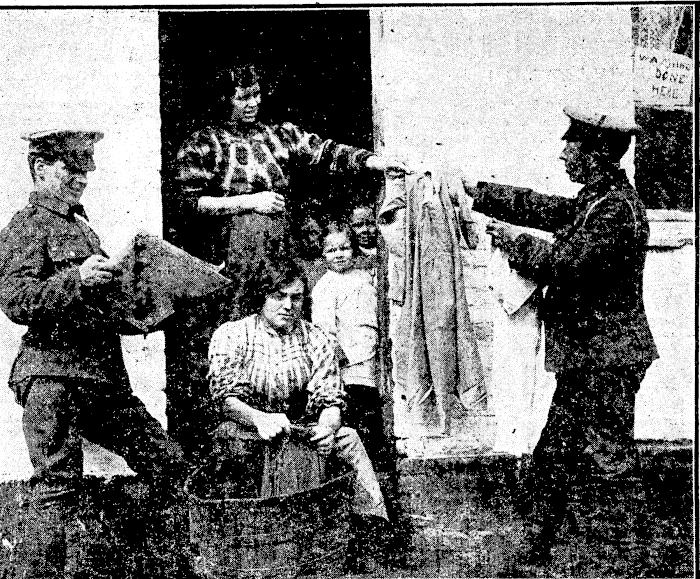
Sun, Volume II, Issue 414, 8 June 1915, Page 7 via paperspast.natlib.govt.nz

French women doing soldier’s laundry (note the sign that says ‘washing done here’) in a washtub during WWI  Sun, Volume II, Issue 414, 8 June 1915, Page 7 via paperspast.natlib.govt.nz

Another option was a washing machine.  Early washing machines either heated the water, or had hot water poured in or delivered through a pipe, and then had a mechanical system which rotated and agitated the wash to clean it.
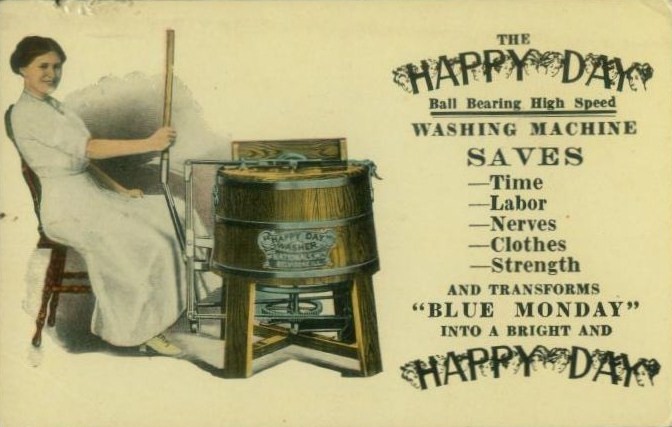
Laundry, 1910s

Middle class households without enough money to hire a laundry lady in, or to send out the washing, or who found themselves frequently without a maid due to the chronic shortage of ‘help’ in NZ, probably had the most incentive to purchase washing machines.

They were still a novelty in many areas in 1910,  being worthy of demonstration days and trade  fairs, but the seller of the most common brand in NZ bragged of 5,000 in use in the country in 1911.  They became  increasingly common as the decade wore on, as evinced by how often they appear secondhand in auction sales by 1916.

The first electric washing machines went on sale in the US in  1904, but I can’t find any evidence that they existed in New Zealand until after the war.

An advertisement for an electric washing machine, 1910s

An advertisement for Western Electric  home goods sold in the US, including a washing machine with mangle, 1910s
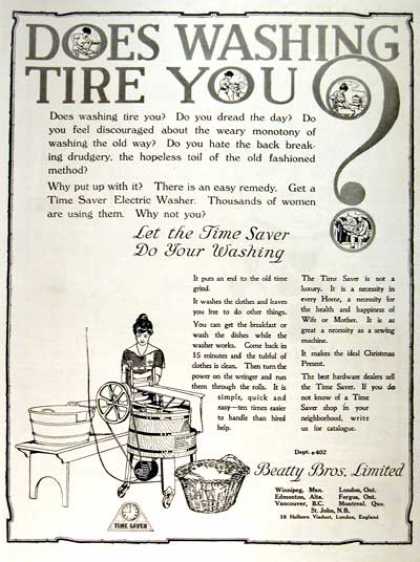
A washing machine advertisement, 1919

An advertisement for a Beatty Bros electric washing machine and mangle, 1919

Obviously I do not have a 1910s washing machine, nor a washboard (I’ve been looking for one since January, but haven’t managed to source a suitable one in my price range), nor a mangle.  So how am I going to do laundry?

I’m pretending that as a middle class woman, I previously hired someone in, or sent out my laundry, but, due to the combination of labour shortages due to the war and a reduced income due to my husband enlisting, plus the rising cost of basic goods, I can no longer afford to do so.  I also cannot afford a washing machine, due to the aforementioned reduced income, and  limited imports and a shortage in metals and other basics materials are making them quite scarce. (advertisements for new washing machines almost disappear from NZ newspapers by Nov 1915, though they appear frequently secondhand in auctions after that, particularly in more rural locations).  Or maybe mine has just broke, and I can’t find a handyman to fix it due to the labour shortages.

In any case, it’s plausible that I don’t have a machine, and don’t have a washing board or mangler.  So I’m going to do laundry more or less as described in this ad for Sunlight Soap – soak, rub (on itself) and scrub (with a brush), rinse and hang.  I even have vintage (probably 1960s-70s) Sunlight Soap I’ve been hoarding for years.
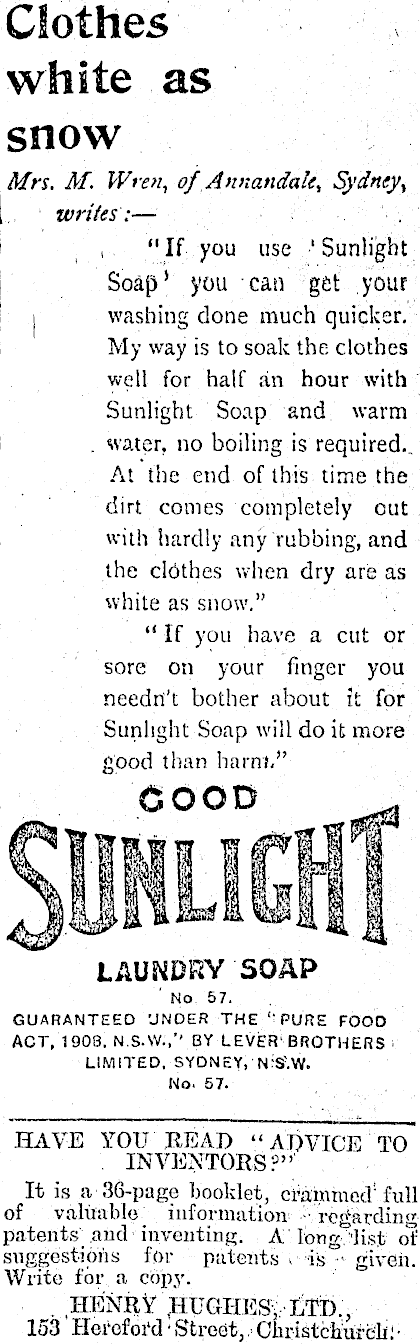
Sunlight Soap, Advertisement, Ashburton Guardian, 19 October 1912, Page 3

Sunlight Soap, Advertisement, Ashburton Guardian, 19 October 1912, Page 3

I’ll only be washing the clothes I’m wearing, and any other items that match 1910s ones (sheets, towels, etc), as I won’t actually get an accurate image  of what doing laundry was like if I washed my skinny jeans and modern unders!

I shall let you know how it goes…
The Fortnight in 1916: And so it begins…

Today was the first day of my two week attempt to live like a middle class educated housewife would have in Wellington in 1916.

It was…interesting.  And already I have learned some things.

I  had a meeting at 10am, so I rose at 8 (rather late for 1916, but Mr D was home, and I was trying to disrupt his schedule as little as possible), and got dressed, and made tea and porridge (oatmeal) with sultanas.

First thought: getting dressed took ages.  I’m pretty used to putting on historic garments in a hurry, but obviously I’d get faster through practice and repetition.  Still, there are a LOT of garments to put on: combinations, a corset, stockings, a corset cover, two layers of petticoats, a blouse, a skirt, cardigan and shoes.*  It all added up.  If you’re the sort of dresser who takes a lot of time styling your hair and makeup, this would be comparable, but on a daily basis I’m as speedy as possible: unders, jeans, undershirt, overshirt, cardigan, chignon, foundation (if that), sorted.

Second thought: despite the usual ‘shoes before corset’ joke of the costuming world, you can’t really put your shoes on before your corset if your stockings have to hook to your corset, and slide down while you’re putting it on your corset, thus defeating the whole point of putting them on first.

Because dressing took so long I was rushing to finish breakfast and wash up (as a good 1916 housekeeper would – no leaving dishes in the sink!), and then rushing to get to my meeting, so I made a terrible 1910s faux pas.

I forgot my hat.

And it’s a beauty.  Wait until I show it you to!

Anyway, oh, the horror!

So, scandalously hatless I stopped by The Fabric Store after my meeting (nothing purchased), and then did my shopping – no plastic bags, and dearly wishing I could just stand at a counter, read my list, and have the shopkeeper fetch it for me!

No one who didn’t know what I was doing commented on my outfit, because this is Wellington, and we don’t care how you dress as long as you do your job, plus  we’re all artsy and eccentric too, so what makes you think you’re so different? In any case, we are all much too cosmopolitan to comment on eccentricities.  Guy in a chicken suit and Death walk down Cuba Mall hand in hand?  Everybody pretends not to notice, because we are too cool for that.  Celebrities love it here.**  Basically, lady in 1916 garb doesn’t even register.

My afternoon got slightly off schedule due to a personal matter, so I didn’t manage to ‘Wash on Monday’.

By the time I got home at 3 I was definitely starting to notice how many hours I had been wearing a corset for.

I was also noticing how unsuitable modern cars and furniture are for corsets.  I’m writing this sitting on a very hard, straight backed chair, because modern couches are torture in a longline.  But, it’s past 10pm and I’m still in it, so I haven’t given up yet.

Third though: This corset is really compressing my bladder.  I’ve never gone to the loo as many times in a day as I have today.   Luckily, it’s really easy to use the loo in combinations and a longline corset.  Which leads on to:

Fourth thought:  Going without modern knickers feels really, really weird.  Especially when you discover how easy and uncomfortable it is to get a combinations wedgie.

I’ll leave this at that…

Fifth though:  In addition to compressing my bladder, the corset is squishing my stomach.  I can only eat a tiny bit at a time (though I do want to eat quite often).  I wonder if I’m going to loose weight, or gain it, because…

Sixth thought: this diet is killer.  Based on a menu suggestion from the Dominion from 1913 I made pea soup, sausages (they said pork, I substituted venison), and brussel sprouts.  I was also meant to make ‘chip potatoes’ (potato wedges), but realised I didn’t have the right kind of potatoes in the house.  And dessert, but I’m trying not to incite a rebellion from Mr D (who also got broccoli with his dinner).  Based on the ingredients called for, most of the recipes in the Dominion are for at least 6 people, and I’ve decided there is almost no way to cut them down for two while still making all the dishes.  I suspect wartime women living in small households had a lot more dinners that were tomato soup and sardine sandwiches and nothing else.

Right, back to the diet.  EVERYTHING in it is base.  And that’s hugely true for all the winter menus.  No wonder all the heroines in LM Montgomery books eat so many apples.  You are desperate for something acidic.

I ate an apple at 4pm.  It was heavenly.

Seventh though: moving is nice, sitting is not.  Poor seamstresses and typists.  Poor me.  Time for a sponge bath and bed!

* There will hopefully be photos of the outfit, as one of my students took some.

**Someday I will show you the photo of a seagull I took while sitting on a bench on the waterfront with Jermaine Clement sitting next to me, because no way was I going to be gauche enough to turn around and take pictures of him, but I already had the camera out to photograph the seagull when he sat down.

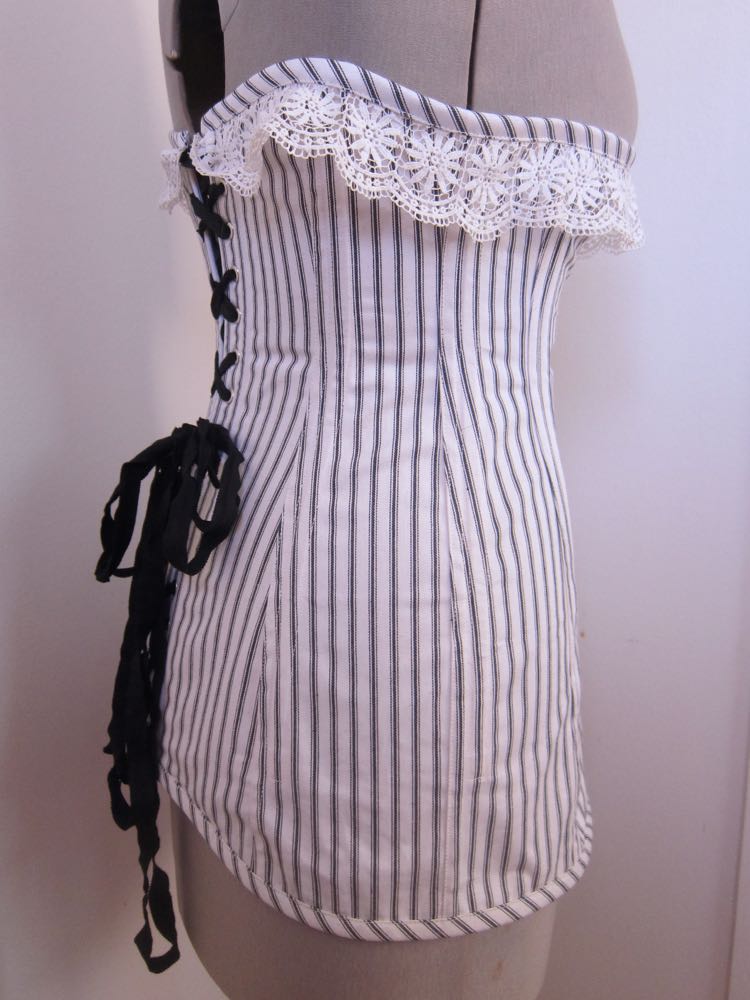
The Black & White 1916 corset

On Monday I’m going to start living as close as I can to a 1916 lifestyle for two weeks. Naturally, this means I need a wardrobe.  A whole wardrobe post is coming, but for now, let’s start with the item everyone is really interested in: corsets.

Based on my research, the average middle-class NZ housewife in 1916 had between 1 & 3 corsets at any given time: 1 or 2 for everyday wear, and possibly a fancier, more constricting one for dressing up.  Two corsets is ideal for everyday wear, because it means one can be airing while you wear the other.

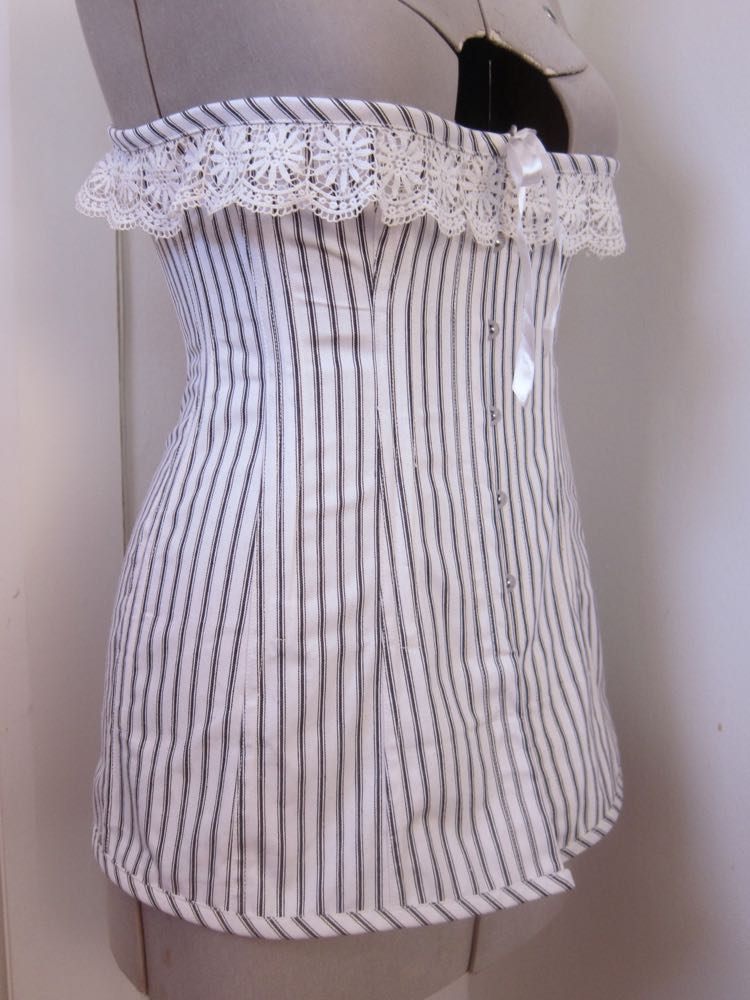
I’ve decided on two corsets for my experiment.  One, based on a slightly earlier cut, that Leimomi circa 1916 might have had in her wardrobe from before the war, and this one,  reflecting the more recent mid-teens cut:

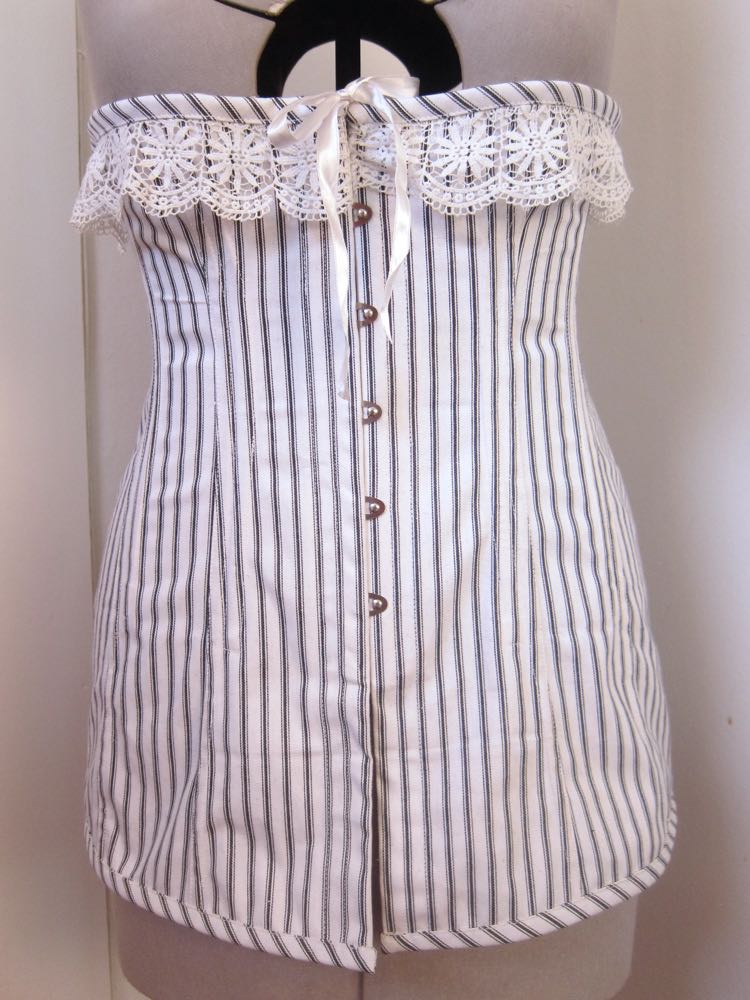
1916 black and white longline corset thedreamstress.com

Previously all of my 1910s corsets have been based on my personally fitted draft of the 1911 corset in Janet Arnold’s book.   However, very few women in NZ would have had personally fitted corsets.  The 1910s corsets I have studied in NZ collections show clear signs of uneven rubbing, where the body in the corset didn’t exactly match the cut of the corset.

So I thought it would be a good idea to have a corset made exactly from a period pattern, without fitting it specifically to me.  I also wanted a corset from the mid-teens, rather than the early teens.  Enter the 1916 German Ersatz corset pattern in Jill Salen’s Corsets: Historical Patterns & Techniques.  Fraternising with the enemy is a bit scandalous, but it’s one of the only mid-teens patterns out there!

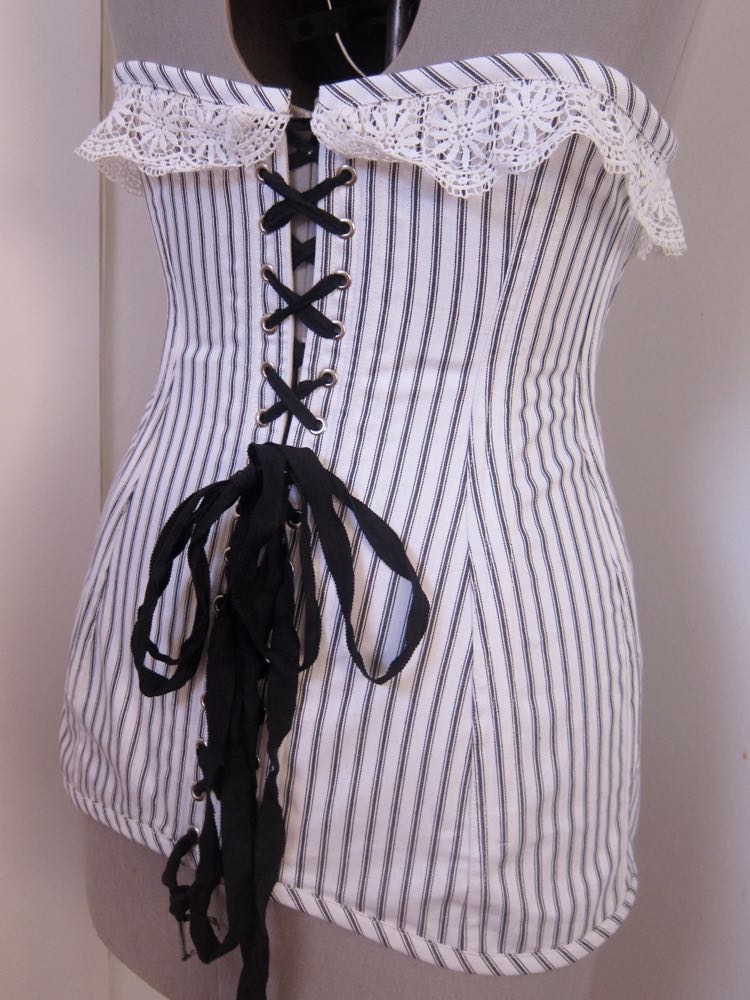
1916 black and white longline corset thedreamstress.com

Although the Ersatz corset dates to 1916, I’m reasonably sure that the base pattern wouldn’t have been significantly different to one from 1914.  The only thing that may have been changed is the looser fit at the bottom front of the corset (note how flappy it is in the photo above), which would accommodate more movement than a tighter, slimmer fit.

1916 black and white longline corset thedreamstress.com

The pattern as drawn in Salen’s book is for a corset with a 22″ waist.  I graded it up three sizes, which makes for a nice, easy to wear on an everyday basis corset, though I’ll probably go back down a size for any future iterations of this pattern.

1916 black and white longline corset thedreamstress.com

Although I went with a straight grade, the corset does fit me quite well.

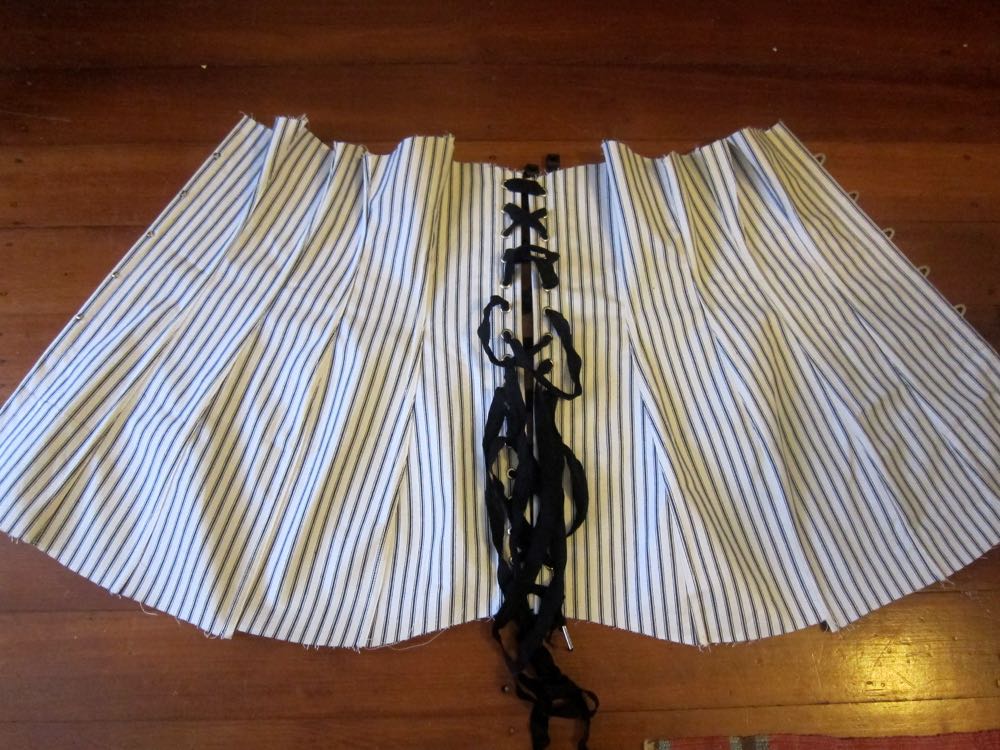
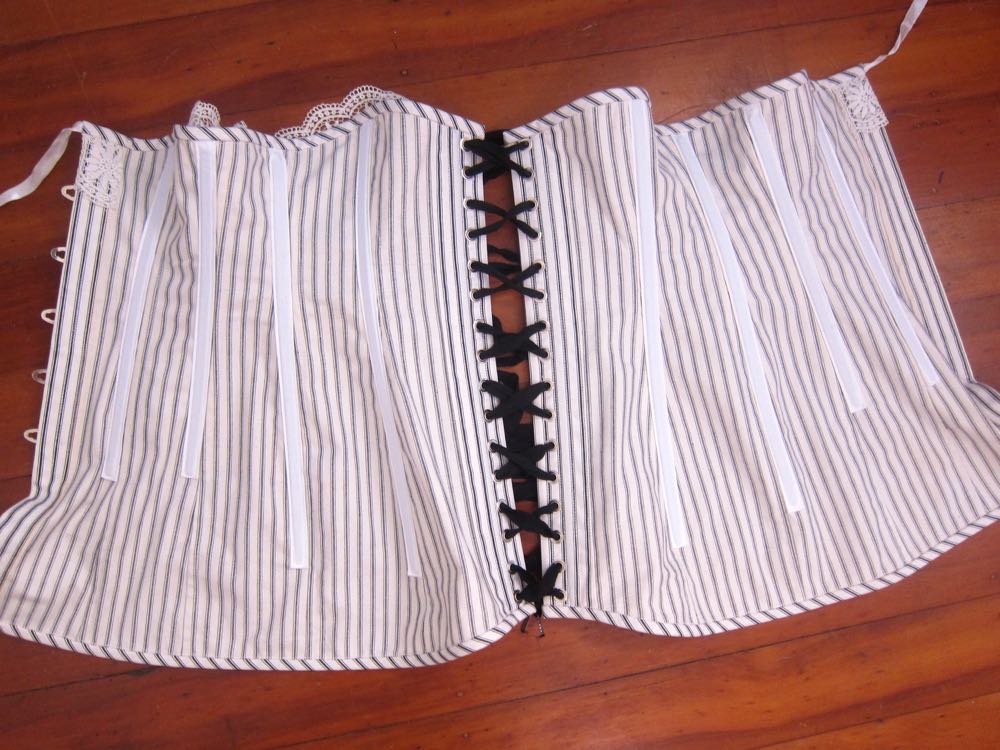
In general the pattern went together very easily, though there is almost certainly a major flaw in the busk measurements given in the pattern (they are drawn as if they are completely un-evenly spaced, but according to the photo of the extent corset they are evenly spaced), and the waistline does not line up from piece to piece.

1916 black and white longline corset thedreamstress.com

The corset is made from a single layer of black and white striped mattress ticking.

1916 black and white corset thedreamstress.com

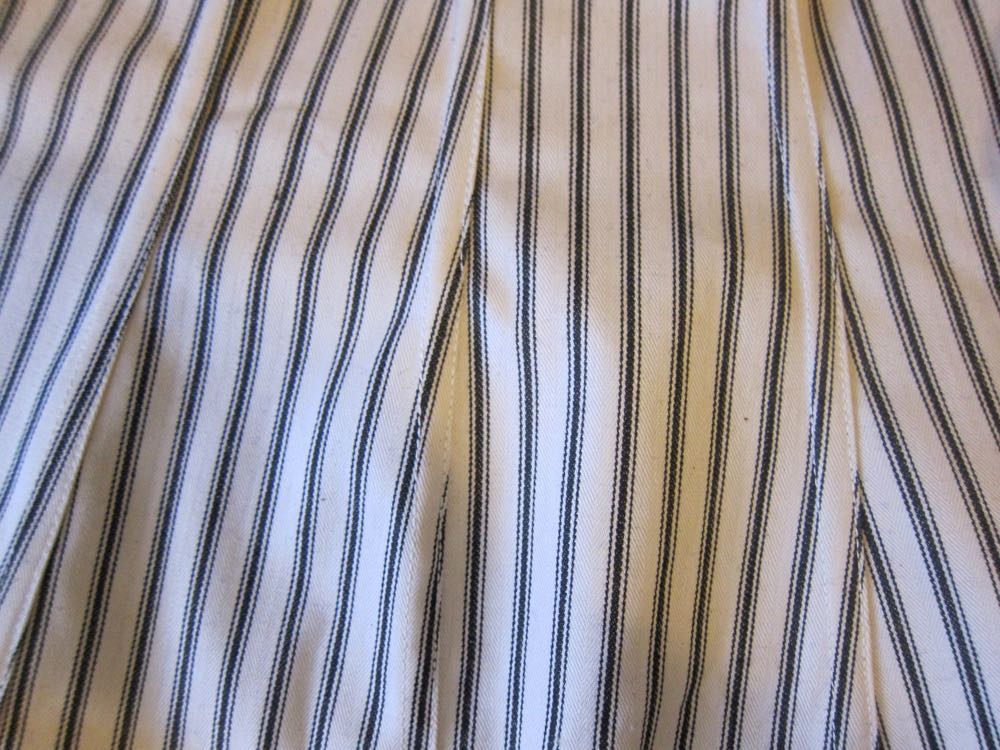
The seams are flat felled for strength (I LOVE flat felled seams.  I have to restrain myself from doing them on everything!).

1916 black and white corset thedreamstress.com

It is boned with cable ties, and the boning channels are all made from separate boning  tape.

1916 black and white longline corset thedreamstress.com

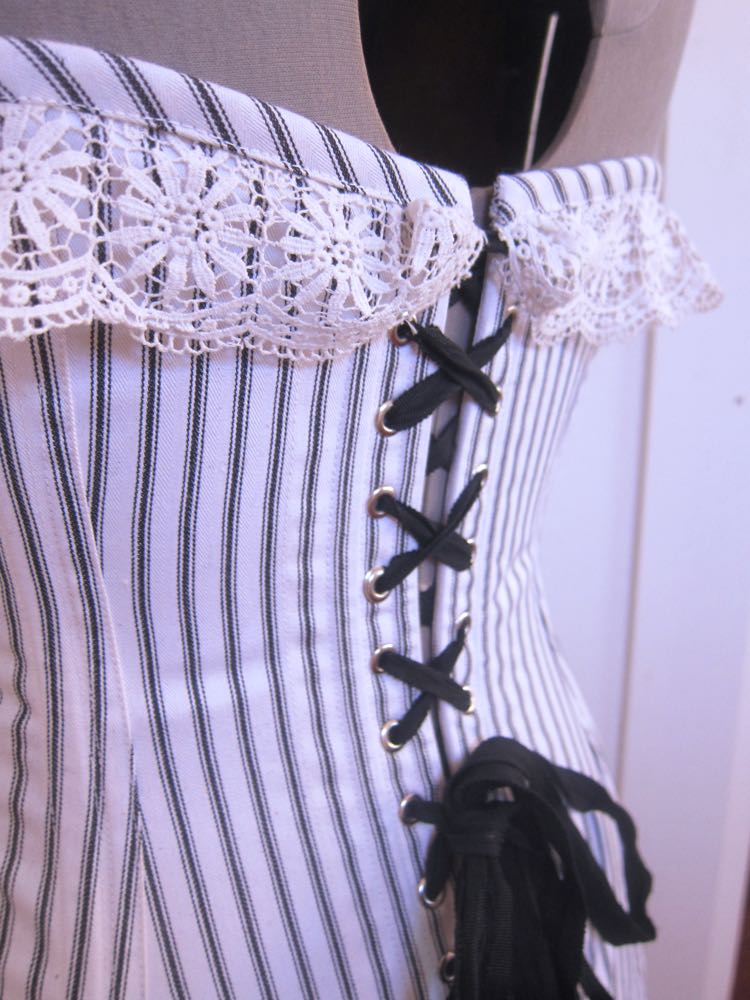
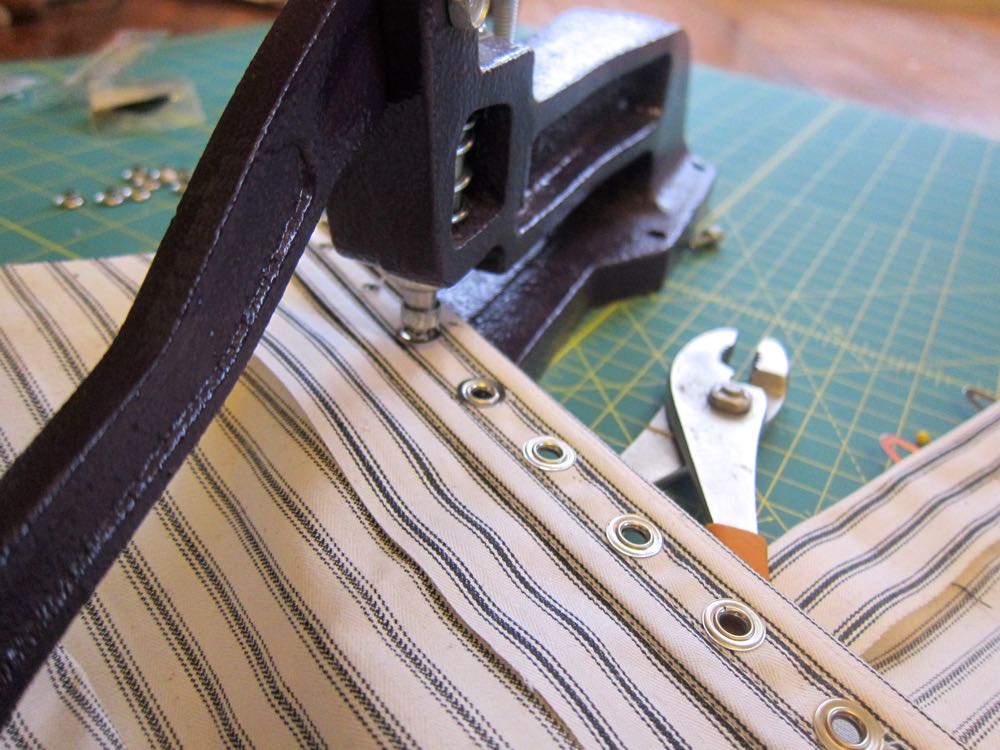
I had originally intended to use black grommets on the corset, but when I got out my grommeting equipment I could find all the black backs, but none of the fronts.  Grrrr…  So I had to go with antique silver.

1916 black and white corset thedreamstress.com

Now that is is finished, I’m quite glad I used silver grommets.  They work well with the white lace and the overall very restrained aesthetic of the corset.

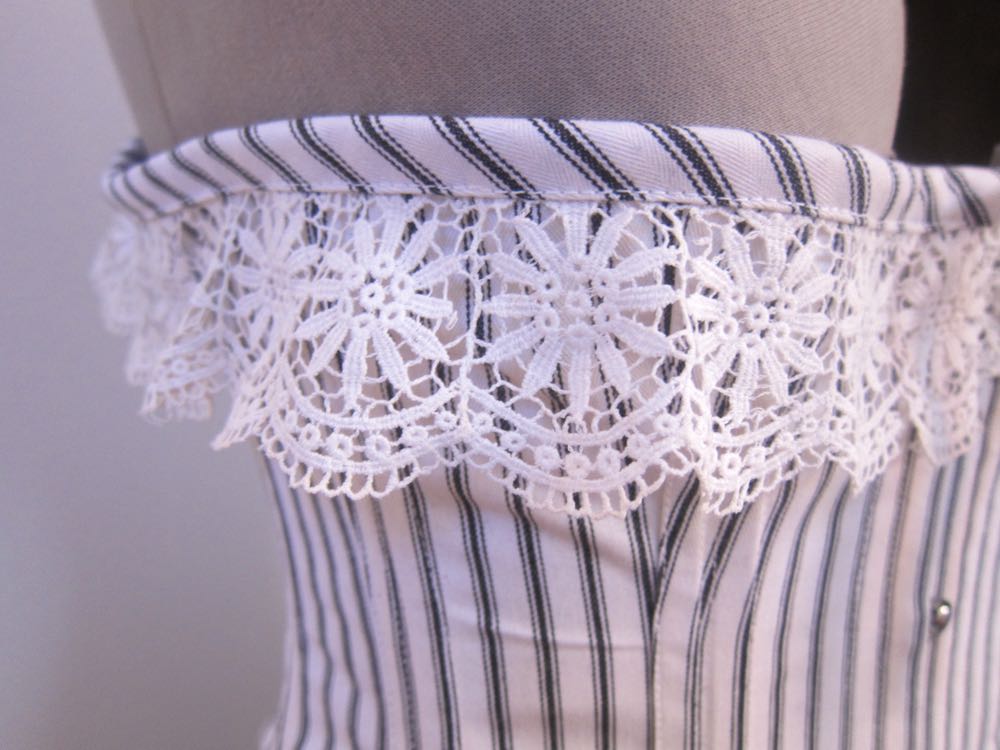
Speaking of the lace, it’s my favourite thing about the corset:  I had exactly enough, and it completely makes the whole look.

1916 black and white longline corset thedreamstress.com

As I was sewing the corset it kept reminding me of something, and I finally did a search and realised that Bridges on the Body made a beautiful 1910s corset of black and white ticking, which of course I’ve seen, and other costumers have made black and white striped ones inspired by hers, so it’s become almost a ‘thing’.  My inspiration wasn’t intentional, but I’m sure that subconsciously I remembered the others, and that’s why the fabric seemed so right.

Luckily I like mine best of all the versions (which is good, because I have to wear it) 😉   Black and white can be quite aggressive, especially with a strong contrast, but the  self fabric binding and the wide cotton lace tone down the stripes, and the overall effect is quite restful, which I feel is the correct look for a 1910s corset.  It wasn’t an era of assertive undergarments!

What the item is:  a 1916 corset.

The Challenge:  #7  Monochrome

Fabric/Materials:  1m of  black and white striped 100% cotton ticking (NZ$2 at Fabric-a-Brac)

Pattern:  The 1916 German Ersatz corset from Jill Salen’s Corsets: Historical Patterns & Techniques, graded up three sizes (in retrospect, I could easily have gotten away with grading it only 2 sizes, but it makes a good everyday corset in this size)

Year:  1916

Notions:  1 11″ busk (NZ$20), 1m of vintage cotton lace ($NZ4), 3m corset tapes (NZ $12), cable ties (approx $NZ5), rayon grosgrain corset lacing (approx NZ$8), cotton thread (NZ$1).

How historically accurate is it?  While the weave, materials and hand of the fabric are correct, to the best of my knowledge there are no extent striped 1910s corsets, nor can I find any visual evidence that any existed.  However, there were major fabric and materials shortages during WWI, and corsets were one thing where women were specifically asked to make-do and cut back during the war, both in Germany, and throughout the British Empire, so a not-entirely-standard corset is more plausible.  The cut and construction are spot on, and (other than the pattern), the materials are pretty good, though metal bones were much more common than whalebone (for which I have substituted cable ties) by 1916.  However, this is once again a place where a corsetmaker might have substituted older whalebones (perhaps lifted from an earlier corset), rather than the scarcer metal.  I’m going to go with 80%.  It will a certainly look perfectly accurate with a dress over it 😉

Hours to complete:  14, if you include  grading the pattern.

First worn:  Only for try-ons, but starting on Monday I’ll be living like it’s 1916 for two weeks, so it will get worn every other day.

Total cost:  NZ$52ish/US$40ish.

1916 black and white longline corset thedreamstress.com