Latest Posts

Let’s talk about toilets

Let’s talk about toilets.
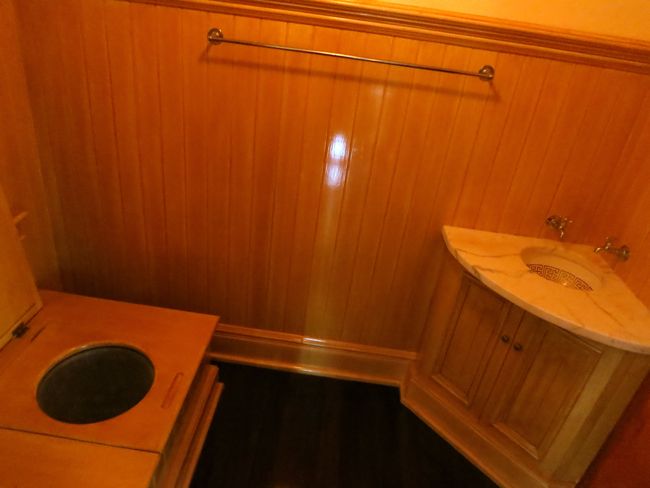
An indoor toilet just off one of the downstairs reception rooms, 'Iolani Palace

An 1880s toilet just off one of the downstairs reception rooms, ‘Iolani Palace

Yep. Actual toilets.  Not toilettes.

Toilets are actually pretty interesting from a historical sense, and they are something that I get asked about a lot when I give talks about historical costuming.  One of the most common questions people ask, for many different periods, is “How did they go to the bathroom in that?”

The answer, of course, depends on the dress, and the period, but it does give me an opportunity to talk about the lack of any sort of under-pants in earlier periods, and the benefits of divided drawers, and the  range of period toilets, depending on era and status.

My toilet experience is a bit unusual (almost, you might say, historical) in the Western world, so I thought you might find my perspective on them interesting.

I was raised predominantly with outhouses (or, as they would be called in NZ, long drops).

An outhouse on my parent's farm

An outhouse on my parent’s farm

When I was about 9 or 10, my parents got rid of the only normal flush toilet on the farm, and to this day there are nothing but long drops on the property.

As a kid,  it was terribly embarrassing to explain to my peers that we only had outhouses, but as an adult, now that I live predominantly with indoor toilets, my feelings towards outhouses have changed a lot.  I’ve come to respect, admire my parent’s choice to have outhouses, and I even envy them.

Yes. I wish I could have an outhouse.

Why?

Well, living in another country, and interacting with lots of immigrants, and reading, and simply thinking about it have taught me how  much our perceptions around toilets and cleanliness are shaped by culture.

In New Zealand, especially in older houses, it’s common for the toilet and bath to be in separate rooms.  This was something I had rarely encountered living in the US.  For many older Kiwis, and for most Maori & Pacific Islanders, having the toilet and bath/shower in the same room is disgusting.

If you think about it, it makes total sense: the toilet is where you do the most un-clean, gross thing that you do in a day, and the bath/shower is where you get clean.  Why would you put those in the same room?

I quite agree with the ‘baths and toilets should be in separate rooms’ philosophy, but there is an aspect to it that is a bit gross to many North American immigrants to NZ (and many younger Kiwis).  In many older houses (including, sadly, ours), there is no sink in the toilet room, so you have to go out of it into the bathroom to wash your hands – and that means the possibility of touching handles.

And yeah, that’s gross.  Putting a sink in the toilet room is top of my list for big changes to the house, so much so that I’ve even looked at the plumbing and said “You know…I’m pretty sure I could plumb in a sink here myself” while Mr D looks alarmed and says things about permits and regulations.

Western toilets as a whole can be a bit gross to other cultures, and the more I think about it, and the more I compare it to the outhouses I grew up with, indoor toilets ARE gross.

What you put in an indoor toilet is carried  to the entire inside of the toilet by the water, and is sent up into the air as a fine spray when you flush (which is why the answer to ‘lid up or down’ should  always  be down, even in an all-male house!).  Even if you put the lid down when flushing, the bacteria from flushing  is over the lid when you open it up again, and gets on to anything that touches the underside of the lid, like your shirt, or hair.    Since what goes in the toilet gets all over the inside of it, you have  to clean the toilets, and then that brush is sitting around the house…

I think ewwww covers the whole situation quite nicely…

Plus, from an environmental perspective, mixing human waste with water is just about the most un-sustainable thing you can do.  It uses tons of water, it’s really hard to clean and sanitise that water, and really hard to do anything useful with the waste.

With an outhouse, all the waste goes straight to its final destination.  It  doesn’t have to travel and get spread around.  No water needed.  No waste touching anything.  No spray.  No need to clean anything but the lid and seat.

For those of you who are thinking about the smell, there really doesn’t have to be any.  A reasonable diet (outhouses aren’t great if you are eating a ton of saturated fat, chemicals and super processed food), the judicious addition of woodchips or other cellulose material, lots of ventilation, and there is no smell at all.

Now, don’t get me wrong, there are huge advantages to indoor toilets, and the more I live in a temperate (hah.  Wellington, temperate?) climate the more I understand them.  An outhouse is perfectly nice in Hawaii, where 15 degrees Celcius is such a shockingly low temperature that we took a photograph of the thermometer because we were that excited (true story), but it would be horrible in the middle of a Wellington winter, and it doesn’t even get down to freezing here.  It would be really horrible somewhere with snow and ice.

So I wouldn’t only want an outhouse in Wellington.

But…

If council by-laws and our property space allowed it, I would have an outhouse to use any time the weather permitted it in a heartbeat.  So much cleaner, so much better for the environment.

An outhouse and a flock of ducks fertilising a banana grove.

An outhouse and a flock of ducks fertilising a banana grove.

If you’re wondering about my parent’s outhouses, they are very simple and rustic.  Here is one being used as a tool-shed when it is not in use:
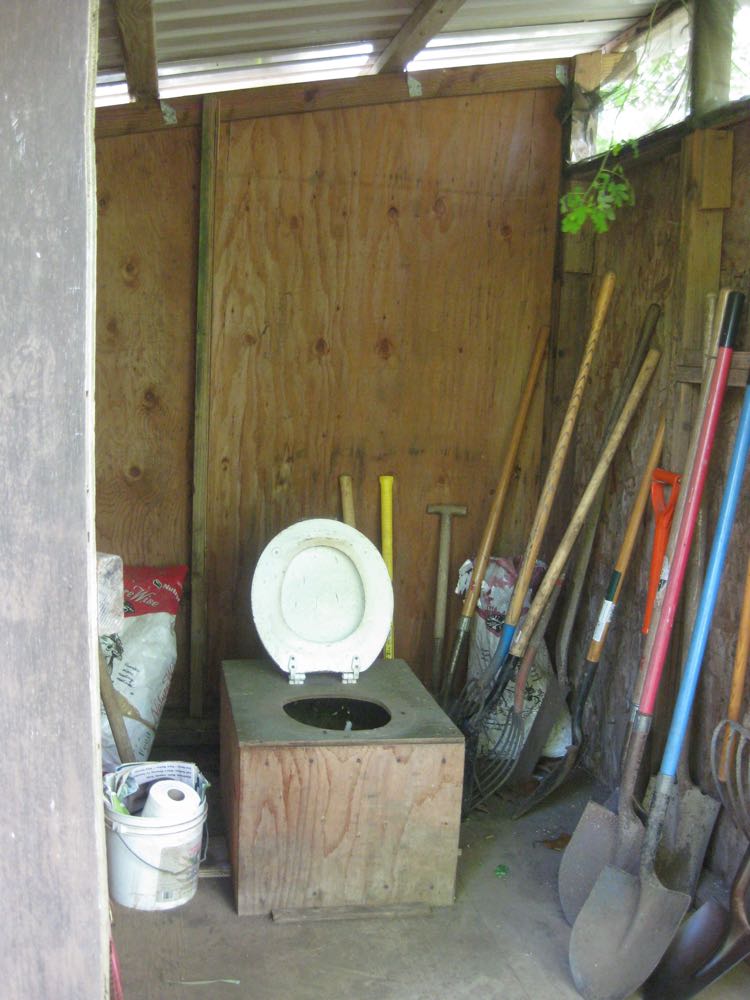
Talking about historical toilets, thedreamstress.com2

They switch between outhouses, giving them a few months  in use  and then a few  months on break, which also helps with smells.

Yep, they could be poshed up, with tiled floors and fancy seats, but basically, they are great.  You don’t have to touch anything but the toilet paper, you can go straight from them to an outdoor sink with soap to wash your hands.  Great for the environment, clean in the most important sense (but not so clean that it doesn’t matter if you are wearing your muddy farm boots), and eminently practical.

The outhouses on the farm are situated in groves of banana trees.  You cannot safely use human waste to fertilise field crops like lettuce and carrots, but fruit orchards are the perfect place to put  outhouses,  The waste will ultimately end up fertilising the fruit trees, without any chance whatsoever of passing on harmful bacteria.
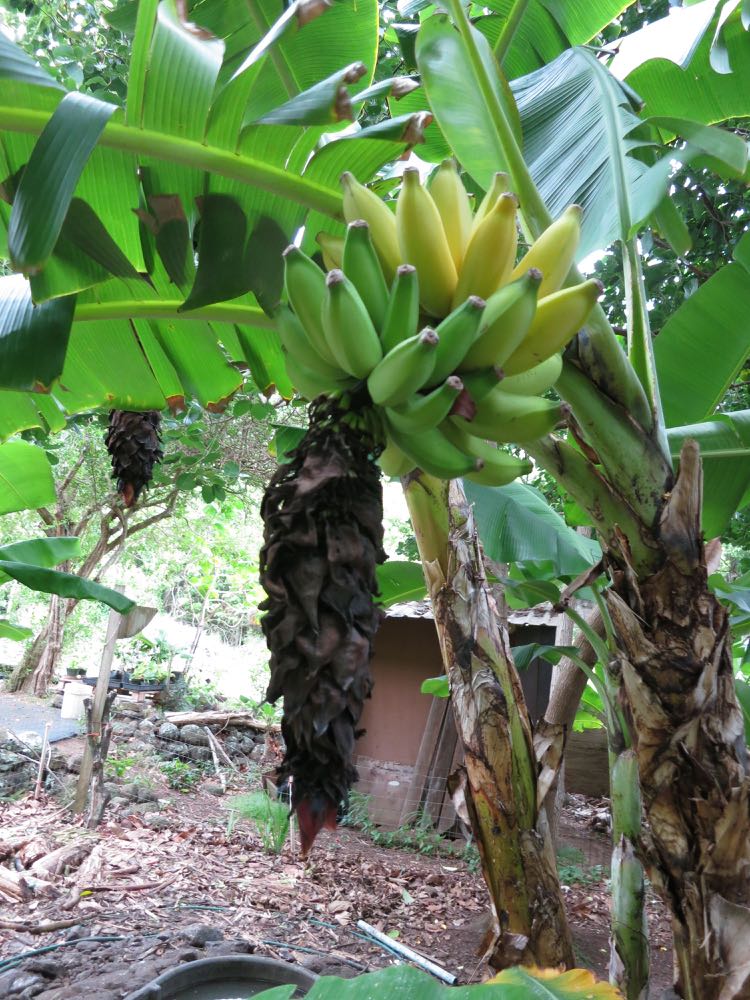
A stalk of ripening bananas near the outhouse

A stalk of ripening bananas near the outhouse

There are many, many things about the past that I am SO glad I don’t have to worry about, or live with.  But outhouses?  Maybe we need to re-think our stance on them.  In many ways outhouses  are actually better than the modern alternative.

At least if you live in Hawaii or it is summer!
The HSF/M 2015: Challenge #10: Sewing Secrets

Can you believe it?  10 challenge in, only 2 to go!

The theme for the Historical Sew Monthly Challenge #10 is Sewing Secrets:  Hide something in your sewing, whether it is an almost invisible mend, a secret pocket, a false fastening or front, or a concealed message (such as a political or moral allegiance)

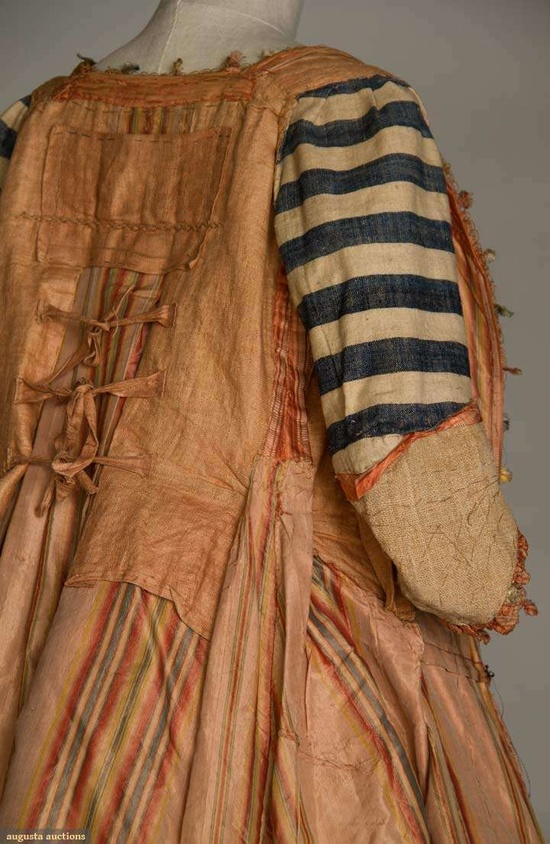
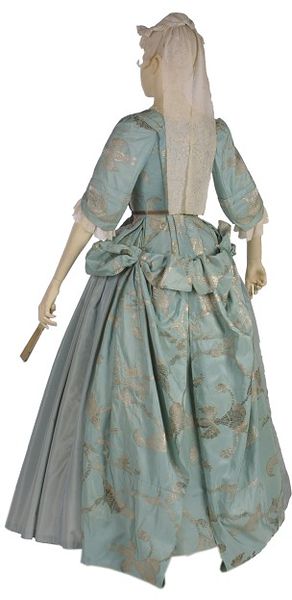
This mantua hides a secret.  In order to keep the right side of the fabric facing outwards with the complicated turning and tuckings of the bustling, the fabric has been sewn right side out at places, and wrong side at others, so it only looks correct when draped and bustled:

Many sewing secrets were done to save money.  Even Madame de Pompadour, whose clothing expenditure well outstripped Marie Antoinette’s, was known to have her petticoats made with cheap linen at the back of the petticoat, where it would not show, rather than the expensive silk that graced the front of the skirt.

François Boucher (1703—1770), Madame de Pompadour (1721-1764), 1759

François Boucher (1703—1770), Madame de Pompadour (1721-1764), 1759

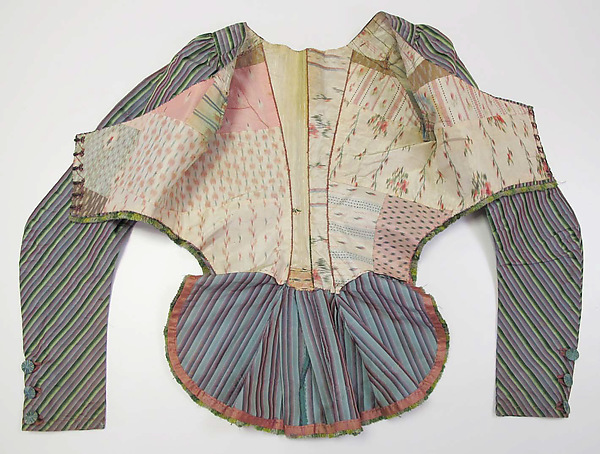
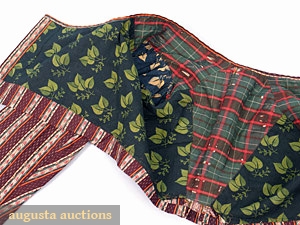
In addition to different fabrics hidden under the skirts of dresses, many 18th and early 19th garments feature surprising lining fabrics, as seamstresses used any scraps of fabric they had at hand for pieces that were not seen:

From the outside you would never know that this jacket lining is a veritable patchwork of silk:

Or that this  spencer is lined in a multitude of bright prints:


Making do has led to many a sewing secret.  One of my favourites comes from Louisa May Alcott’s An Old Fashioned Girl, where Polly tells the story of how her sister got a dress out of an odd bit of fabric:

This silk reminds me of Kitty’s performance last summer. A little checked silk was sent in our spring bundle from Mrs. Davenport, and Mother said Kit might have it if she could make it do. So I washed it nicely, and we fussed and planned, but it came short by half of one sleeve. I gave it up, but Kit went to work and matched every scrap that was left so neatly that she got out the half sleeve, put it on the under side, and no one was the wiser. How many pieces do you think she put in, Maud?”

“Fifty,” was the wise reply.

“No, only ten, but that was pretty well for a fourteen-year-old dressmaker. You ought to have seen the little witch laugh in her sleeve when any one admired the dress, for she wore it all summer and looked as pretty as a pink in it. Such things are great fun when you get used to them; besides, contriving sharpens your wits, and makes you feel as if you had more hands than most people.

In the mid-19th century the full folds of women’s skirts made it easy to hide pockets in the seams and at the waist.  Particularly in the 1840s & 50s, and into the first  part of the 1860s, pockets tended to be very discreet and hidden, possibly as a carry-on of the earlier association of pockets as particularly feminine, and visible bags as particularly masculine.  This dress features both a discreet watch pocket hidden just below the overlap of the belt, and an equally hidden larger pocket in the side seam under it.

Many late Victorian dresses feature hidden fastenings, like the lacing hiding under the false front of this evening dress which was recently featured on Rate the Dress:

Sewing secrets aren’t always about the construction of the garment: they can also be about the subtle messages conveyed through cut, colour and design.  We aren’t talking about  the broad, obvious messages that dress sometimes carries: the choice between Royalist or Roundhead garb in the 17th century is obvious, as is wearing a tricolour ribbon during the French Revolution.  This challenge is about the smaller, much more subtle actions.

This portrait of Marie-Josephe, dauphine of France, carries two secrets.  The first is her portrait bracelet: such bracelets were very common in 18th c dress, but the dauphine’s carried a portrait that would make no sense to most viewers of the time, but had a clear  message for the intended recipient.  Her other secret is the spray of jewelled lilies  in her hair: long associated with French royalty, the flowers declare both her purity, and her loyalty to her new family.  During the revolution the less common lily of the valley (rather than a full lily) as a motif was a subtler way to declare allegiance.

Maria Josepha of Saxony, unknown artist

Maria Josepha of Saxony, Dauphine of France, unknown artist

Sargent’s portrait of conservationist Harriet Hemenway looks conservative enough, but it caused a small scandal when it was debuted, because in the symbolism that Victorians attached to flowers the waterlily that Hemenway is tucking into her dress publicly announced that she was pregnant.  Hemenway’s flower is not integral to the dress, but specific flowers on a fabric or  trimming a bonnet could carry permanent messages.

Harriet Lawrence Hemenway (Mrs. Augustus Hemenway) by John Singer Sargent 1890

Harriet Lawrence Hemenway (Mrs. Augustus Hemenway) by John Singer Sargent 1890

There are so many ways to hide a secret in your sewing! I look forward to finding them all out next month!

Rate the Dress: a lady at home, ca. 1679

Last week I showed you a 1920s playsuit in blonde silk and green paisley.  Whether you liked it hinged hugely on your feelings about playsuits and paisley, and because those who don’t like them REALLY don’t like them, the playsuit came in at a barely acceptable 6.8  out of 10.

This week we’re look at a much more formal informality, but one that is equally about showing off your wealth and style by wearing the most sumptuous items to do the simplest tasks.  This fashion plate from the LACMA features a lady in an informal ensemble doing her sewing.

Recueil des modes de la cour de France, 'Damoiselle en Habit de Chambre' Henri Bonnart (France, 1642-1711), France, Paris, 1678-1680, Hand-colored engraving on paper, LACMA M.2002.57.85

Recueil des modes de la cour de France, ‘Damoiselle en Habit de Chambre ‘ Henri Bonnart (France, 1642-1711), France, Paris, 1678-1680, Hand-colored engraving on paper, LACMA M.2002.57.85

She wears a pink satin underskirt, trimmed with bands of brown, to match her golden-brown striped mantua.  The pink of her skirt is echoed in the trimmings of her headdress, and in the rosettes on her dress.  The full sleeves of her chemise extend well beyond the sleeves of her mantua, and a ruffled edge, To protect her dress and help carry her supplies she wears an apron in dark green silk, trimmed with gold braid or embroidery, and pink rosettes.  A handkerchief peeks from one of the pockets of the apron.  In one hand she carries her sewing basket, and in the other, a needle, though the text of the plate indicates that the author doesn’t actually believe she is sewing.

What do you think?  The perfect bit of relaxed glamour for playing domestic goddess while receiving your intimate friends?

Rate the Dress on a Scale of 1 to 10