April 25, Anzac Day, honouring anyone who has served in New Zealand’s armed forces, is probably New Zealand’s most widely commemorated holiday.
Waitangi Day is just awkward and slightly anger or guilt inducing. Almost everyone does something for Christmas, but New Zealand is a mainly secular nation, and few people really celebrate or commemorate it. Boxing Day is an excuse for sales, Guy Fawkes an excuse for fireworks, and New Years an excuse to get drunk (or set off fireworks – hopefully not both!). Easter is just a really awesomely long weekend – with the benefit or drawback of closed shops, depending on your views.
But Anzac Day is marked by almost everyone I know, regardless of their religion, politics, ethnicity, or age. Every news presenter, shop assistant, and person on the street wears a poppy, and almost everyone I know has, at least once, gotten up to go to the dawn service, if they don’t make an annual event of it. Sporting events in New Zealand and Australia have moments of silence before the game, and often play the national anthems of both countries – even when it is two home teams.
This year Anzac Day was a bigger event than ever, because it’s the 100th anniversary of the day the Australia and New Zealand Army Corps (ANZAC) landed on the Gallipoli peninsula to try to capture it from the Ottoman Empire. In 1915 New Zealand had been a Dominion for less than a decade, and Australia for just over a decade, and both countries were keen to prove their Britishness. William Massey, then Prime Minister of New Zealand told England “All we are and all we have is at the disposal of the British Government.”
Almost 3,000 Kiwi men (out of a population of just over a million in 1915), and 8,000 Australian men lost their lives in just one month of the Gallipoli Campaign. Overall, approximately 18,000 Kiwis would die in the war, and a further 40,000 would be wounded.
The Gallipoli campaign, and the entirety of WWI, were hugely influential in shaping New Zealand’s national identity and history. Not only did New Zealand participate in major global politics on a large scale as a country for the first time, but the country lost a whole generation of young men.
And this is where I struggle with Anzac Day ever so slightly. It’s been so long since the war, and so long since New Zealand officially participated in a war (participation in Afghanistan being covered by euphemisms like ‘training’ and ‘peacekeeping’), that too many people have forgotten how horrible and dumb it was. Anzac Day memorials and mentions sometimes (emphasis on the sometimes – as in ‘occasionally’, as in ‘definitely not the norm, but a very small percentage’) stray from commemoration to celebration and glorification. There is nothing there to celebrate for me. Even WWII, and other wars that were not illogical and pointless like WWI, were not glorious.
Just as bad, people who point out the stupidity of WWI, or the utter waste of human life, are accused of being unpatriotic (or worse). As soon as we fail to allow dissenting viewpoints, we’re falling into the exact group that we claim we send our soldiers to fight against.
What did we send our soldiers to fight for in World War I?
Thousands of men, barely more than boys most of them, went off overseas on promises of adventure and glory. They were told it would be ‘over by Christmas’ and were fed propaganda of German atrocities in Belgium to give their fight the guise of righteousness. They were told it was in service to their country and empire. Some of them were good men, some average, some bad. Some of them had never left their small corner of New Zealand before, and there were even soldiers from Pacific Islands like Niue and the Cooks who had never worn shoes before their army issued boots. And they all died.
Some of them were heroes in that they saved the lives of their comrades, or even their enemies, but there was nothing heroic about the war itself. War is not heroic, and WWI was a particularly dumb war. It was a war sparked by extreme nationalism, an arms race, imperialism, and machismo. In WWI in particular, I cannot agree that all those boys ‘gave their lives so we could be free’. They gave their lives so the powers that were could try to stay the powers that they were.
That doesn’t make their loss any less terrible. Whether they joined for patriotism, adventure, duty, peer pressure or the absolute conviction that they were doing the right thing and helping the world, when they died, it was a tragedy.
But I do not think it should be glorified.
As Jolley’s poem points out: “… our glory lies only in life as it’s lived – / Never in death and the dying. / The cenotaph knows the truth: / Its very own legend is lying.”
I think the best way we can honour them is to do everything to make sure it doesn’t happen again. That we never again hurl an entire generation to their deaths to settle an argument that 100 years on, we still can’t agree what it was actually about, or why it happened.
So for Anzac weekend, I try to honour the past in different ways, and spend my energy improving the world a little bit – sometimes in odd ways.
On Saturday (Anzac Day), we worked on painting the outside of our house, and tidying the inside. Our house was built in the early 1920s, and there were almost certainly veterans among the builders who constructed it, and perhaps the original owner was also a veteran.
Taking care of their tangible, lasting legacy: a building that has sheltered people and kept them warm and safe for close to a century, so it can continue to do so for another century, seems a very fitting tribute.
On the Monday holiday I did a little living history research, and tried to come to a closer understanding of the lives of the women who were left in New Zealand to carry on during the war. I put on my 1910s combinations and corset, stockings and shoes, two petticoats, and my just finished Wearing History 1916 skirt, and blouse (more on that later), and my 7 year stitch apron (slightly too modern, but the overall shape is still very close to a 1910s apron).
And then I did the laundry and made the beds, swept the house, dusted, and cooked meals.
Thanks to a modern washing machine and stove, that job was significantly easier for me than it would have been for my 1916 counterpart, but it still gave me a really interesting insight into what it was like to do that sort of work in the clothes of the era.
I’ll write an entire post about doing the housework in 1910s clothes as this one is too long, and covering too much ground.
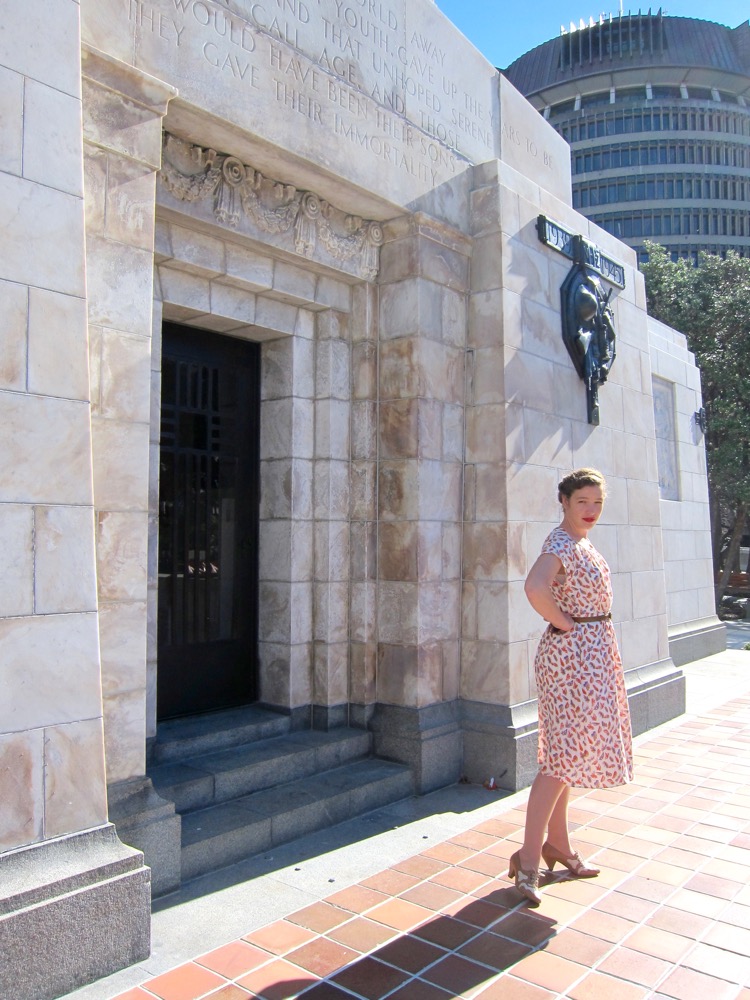
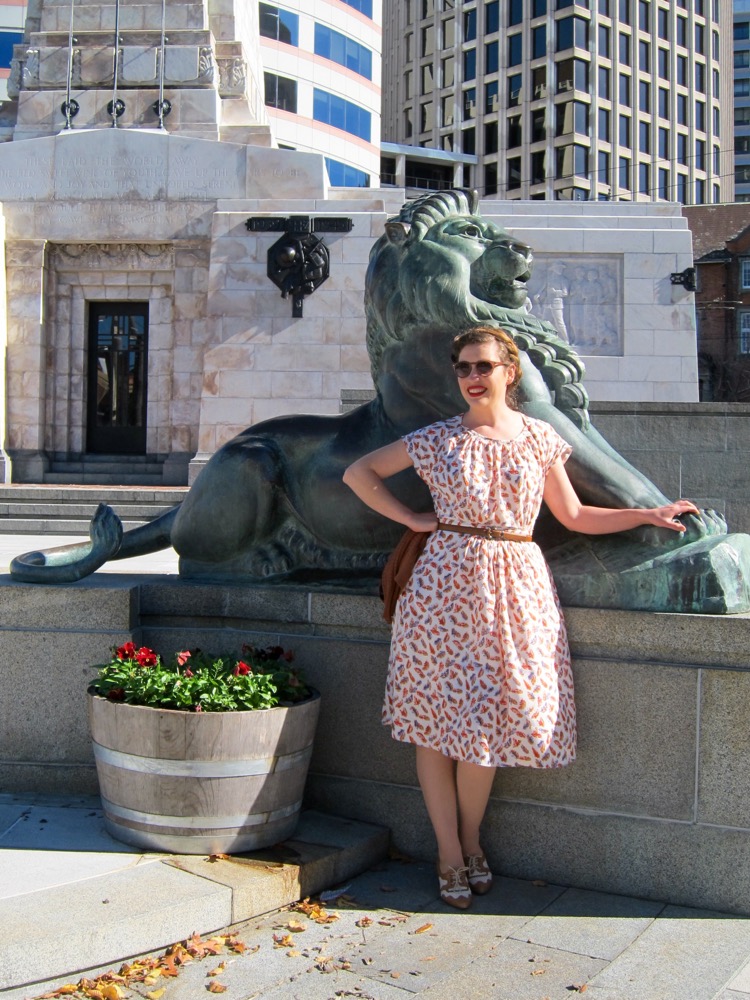
To finish off the day, Mr D and I made the trek to the Massey Memorial to take photographs of my outfit. It’s a bit ironic, as Massey was the Prime Minister who was so keen to offer England assistance in a far-flung war. On the other hand, he was also known for working for better conditions for the soldiers who were serving.
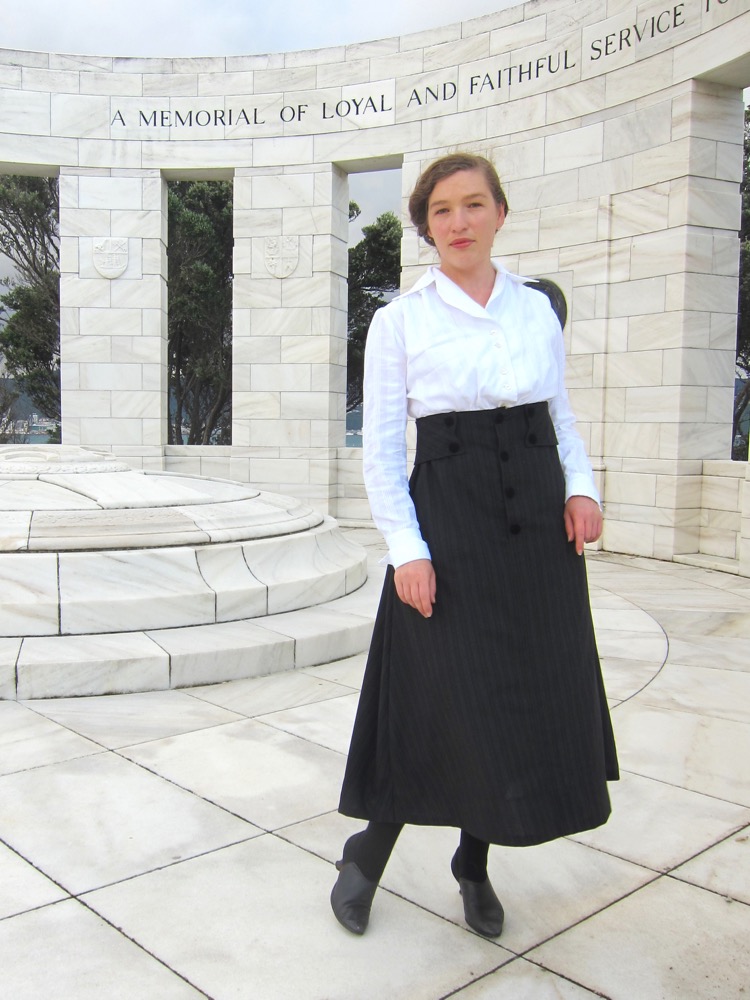
You can really see the wartime influence in the 1916 silhouette. The raised hemlines (as short as hemlines would be in the vast majority of ’20s frocks) and fuller skirts make walking and working much easier than the longer, slimmer 1913-and earlier skirts.

The blouse and skirt combination, ubiquitous in photographs of New Zealand women in the war years, is also incredibly practical. The blouses are washable, and with a half a dozen of them a woman would have a complete wardrobe for every day of the week.
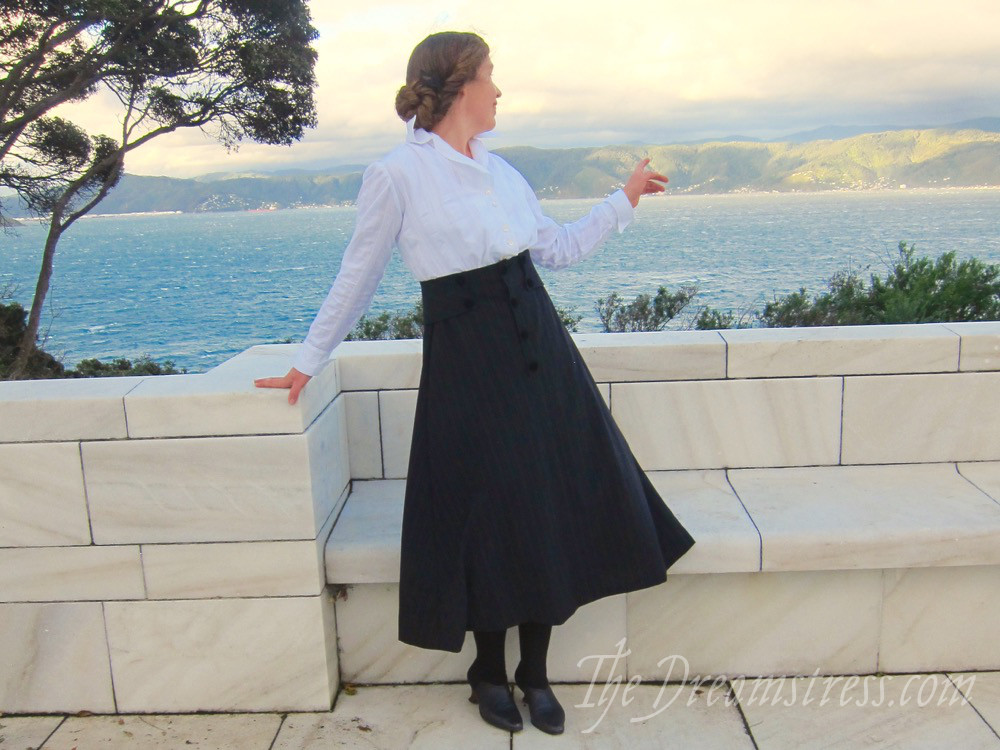
It’s not as well known as the shortages and rationing of WWII, but there were also clothing shortages in WWI. They were particularly dire in Europe, but New Zealand felt the run-on effects. One of the particular shortages was in dye. Germany had been such a major dye producer in the years before the war that the war left certain shades in very short supply. So practical suits in dull browns and blacks became common, and the vivid, exotic shades that characterised pre-war fashion were replaced by muted pastels in wartime frocks.
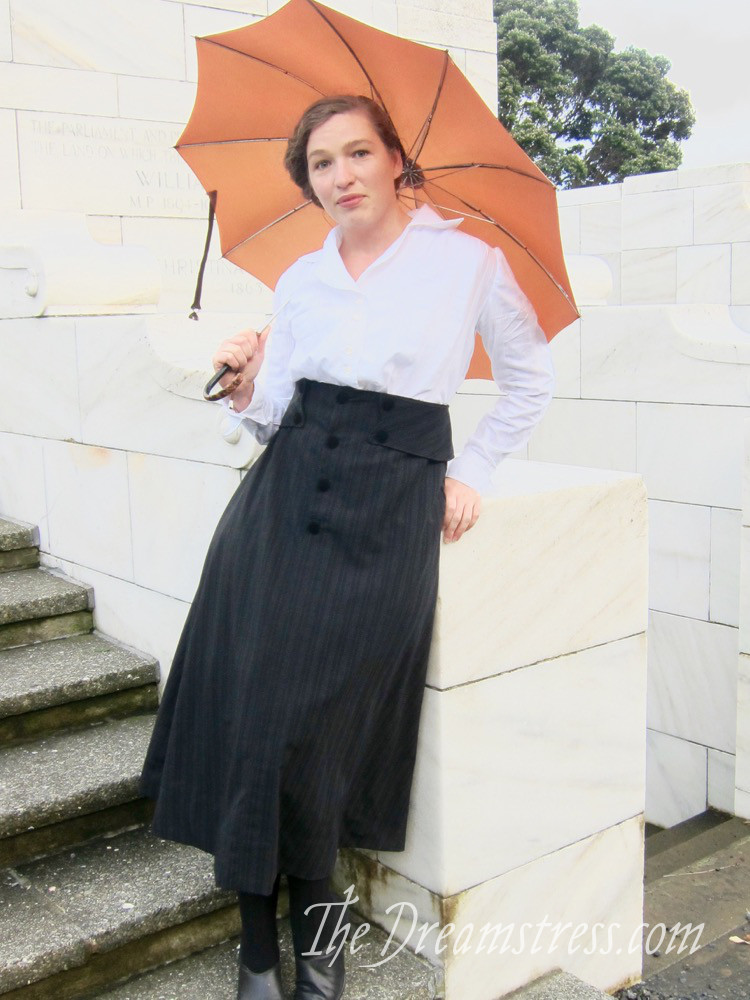
My fabric is a wool-rayon blend. Rayon (viscose) was available in New Zealand from 1911. Wool-viscose blends were used during the war, because so much wool was being used for the military that there were civilian shortages.
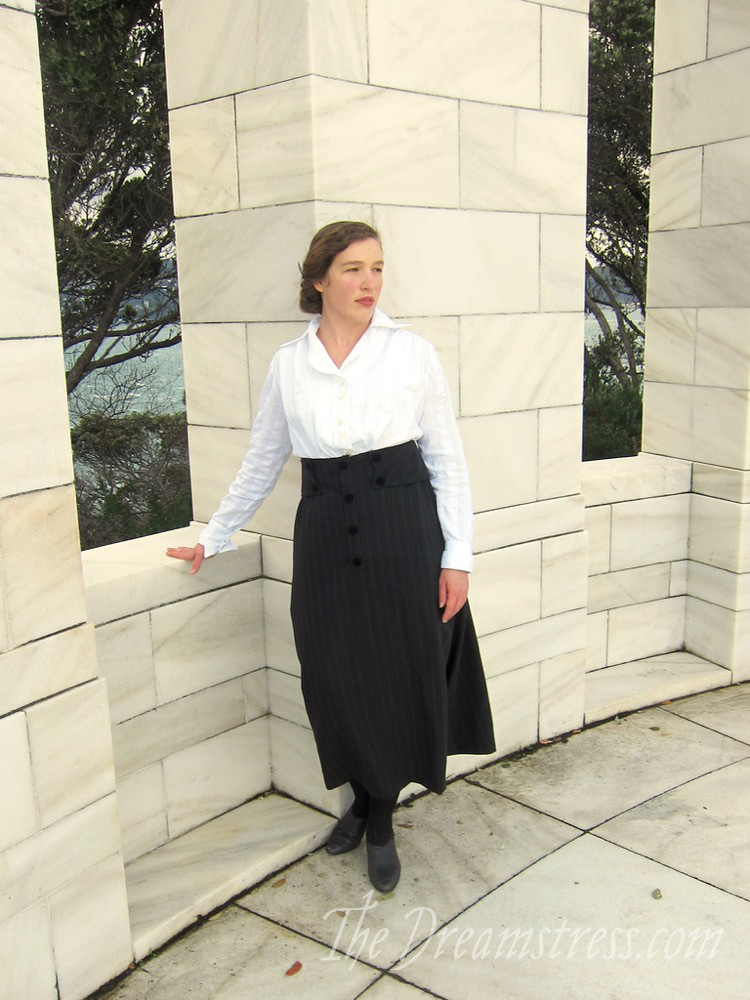
The Challenge: #4 War & Peace
Fabric: 1.2m of black and charcoal striped wool-viscose blend, found in the Fabric Warehouse $5 bin.
Pattern: Wearing History’s 1916 skirt pattern
Year: 1916
Notions: cotton thread (really old stuff – possibly as old as the pattern!), vintage velvet covered buttons from my Grandmother, horsehair interfacing, silk organza interfacing, vintage belting, hooks and loops.
How historically accurate is it?: I’m not certain about the use of velvet buttons on a 1910s skirt, but other than that the materials and techniques are period perfect, so 95%.
Hours to complete: 6 or so — this is an advanced pattern, and figuring out the interior belt was complicated.
First worn: Thur April 16, by a model, at the Museum of Wellington City & Sea ‘Home Front’ talk, and then again Mon 27 April, for cooking, cleaning, and a photoshoot.
Total cost: Under $10 — the fabric I picked up for $5, and the silk organza was also from the $5 bin (and I only used a fraction of it), plus $2 for hooks, $1 for thread, and another $1 worth of horsehair interfacing (thrifted).
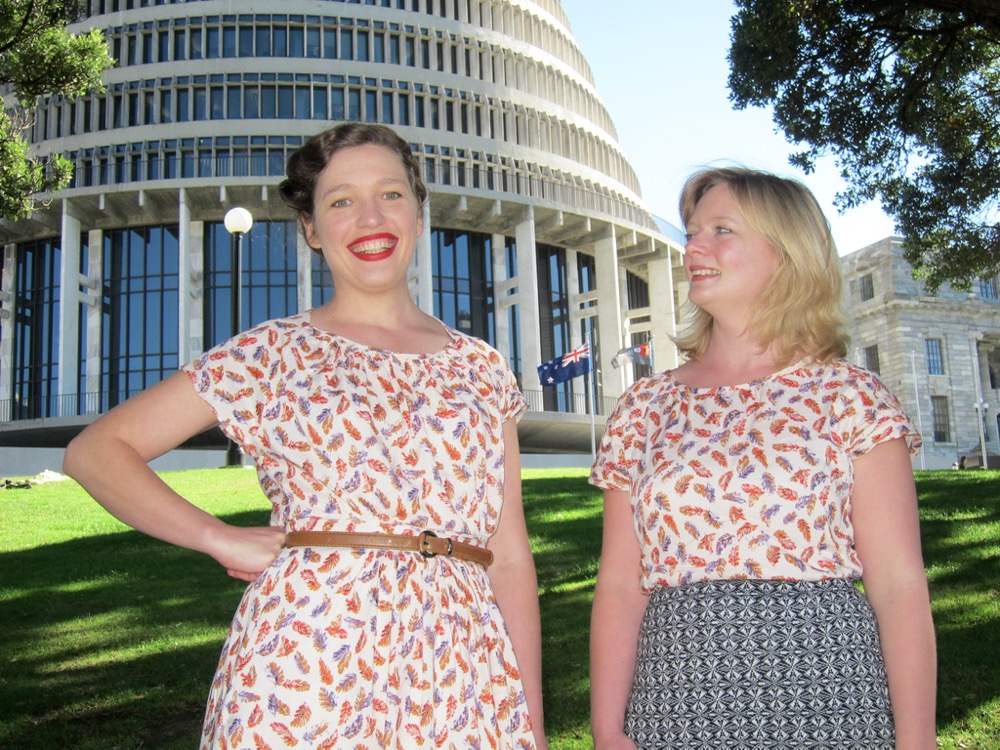
To end, a photo where I actually smile, as this has been a quite sombre and serious post: