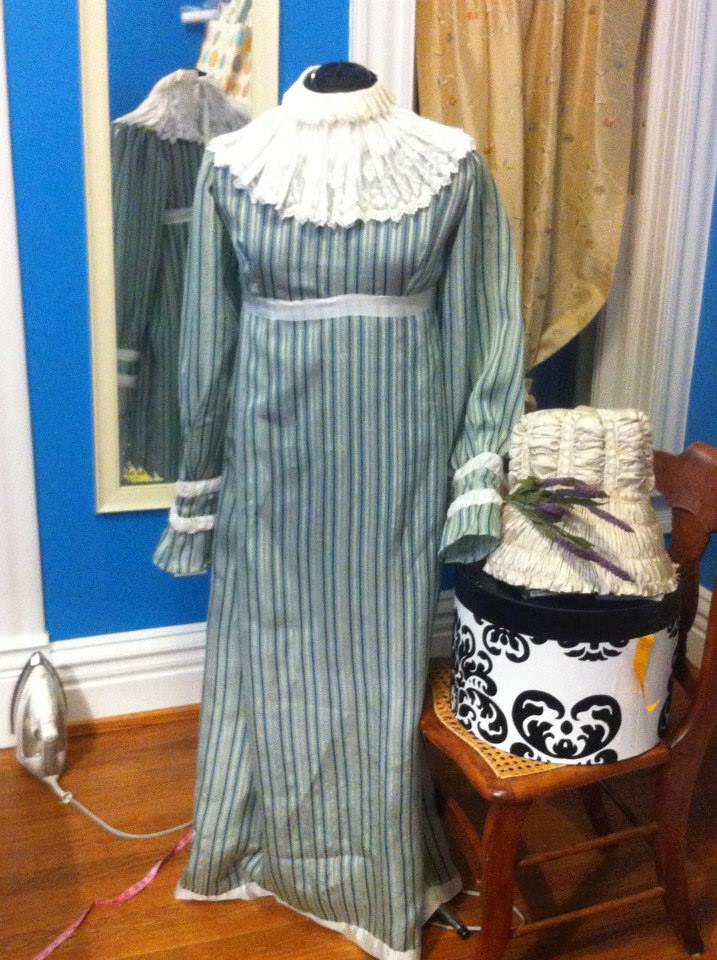
April’s Challenge in the Historical Sew Monthly 2015 is War & Peace: Make something that shows the effects of war, or of extended peace.
You may not know this (because it’s not always obvious from what I blog about), but as an undergraduate, I studied international relations. And art history. And costume design. (yes, I like to stay busy).
The relationship between the latter two was obvious: I was focusing on textiles and costume in art history, and in historic costume in costume design. The first one confused a lot of people. It seemed quite random. What does international relations have to do with costume history?
Well, everything. IR is everything that’s going on in the world: looking at why it happens, why countries interact the way they do, how they are likely to act in any given situation, why wars happened, and how their repercussions will effect the rest of the world.
Anything event that significantly impacts your country, or the world as a whole, is going to significantly impact on what you wear. War is, obviously, one of the most significant events that can happen to a country. Get involved in an extended war, with all your nations resources turned toward the war, and there are going to be clothing shortages, and a rise in patriotic and military inspired motifs. The flow of raw materials: oil, cotton, silk, linen, dye, may be interrupted, meaning that those materials are unavailable.
Clothing shortages famously occurred during both World Wars, with Germany resorting to making ‘austerity’ corsets out of fabric woven from paper thread in WWI, because Germany been importing most of its cotton and wool.
Patriotic motifs and colours were common in WWII: one of the most popular shades in the US was ‘Air Force Blue’. The Dazzle frocks and swimsuits I posted about last week are another example of patriotism in fashion, as was the name Government silk for rayon.

“Dazzle Bathing Suits the Latest Vogue’, Free Lance, 6 August 1919, Page 18
Military-esque trimmings on women’s spencers and pelisses were very fashionable during the Napoleonic wars.

Regency Silk Spencer Jacket. Circa 1819-1822, Metropolitan Museum of Art, 1975.34.9
During the American Civil War the South did not sell cotton to the North, and the North attempted (mostly successfully) to blockade the South, preventing goods from reaching the South, and Southern cotton from being exported to Britain, resulting in cotton shortages across Europe, and everything shortages across the South.
While the affects of war on fashion are quite famous, extended periods of peace can also affect fashions. Their effect is more subtle, and harder to pinpoint, but it can be seen. With extended peace countries are able to trade goods and ideas freely, new materials are seen, fashions become more elaborate and decadent, as resources and innovations can be focus on domestic goods and fashions.
Extended periods of (relative) peace along the Silk Road, for example, allowed Chinese silks to make it all the way to Rome (much to the governments displeasure, as they disliked the sort of free trade that saw Roman gold leaving the country for foreign silks.

Maenad in silk dress, Roman
For much of the 19th c., from the Congress of Vienna to the outbreak of WWI , Europe benefited from the (relative) peace of the Pax Britannica. It is not a cooincidence that this era saw enormous advances in science and industry, all of which affected fashions. Trains, steamships, telegraphs, photography, and advances in printing all assisting in spreading new fashions around the globe at ever increasing rates.
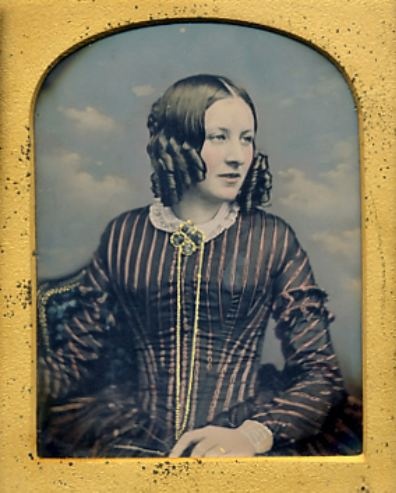
ca 1850’s hand-tinted daguerreotype portrait of a young woman posed in front of a cloud backdrop

Ackermann’s fashion plate 4, Seaside walking Dress, 1815
There were also advances in what kinds of fashions could be spread, like the discovery of aniline dyes (hugely helped by the peace, and an exchange of ideas between Britain and Continental Europe).

Reception Gown dyed with aniline purple & aniline black, 1870s, Whittaker auctions
I will admit that tracing a fashion to a lack of a specific incident (war) can be trickier than tracing it to a specific incident, and not all fashions that arise during peacetime develop specifically because it is an extended peacetime, but it’s still a fascinating idea to tease out.
I hope I’ve given you plenty to think about! Whatever you make, be sure to consider how it was affected by war or peace, and how that shaped it as a costume and fashion.