Since I don’t want my HSF-marathon posts to get monotonous, I’ve come up with the clever idea of combining them with other thematic posts, for double-goodness. Today I have a cute finished project, and a long overdue terminology post.
First, some terminology:
A reticule is a small drawstring bag carried as a purse by a woman in the 18th and early 19th century. It was also used as a synonym for any kind of purse or handbag carried by a woman.
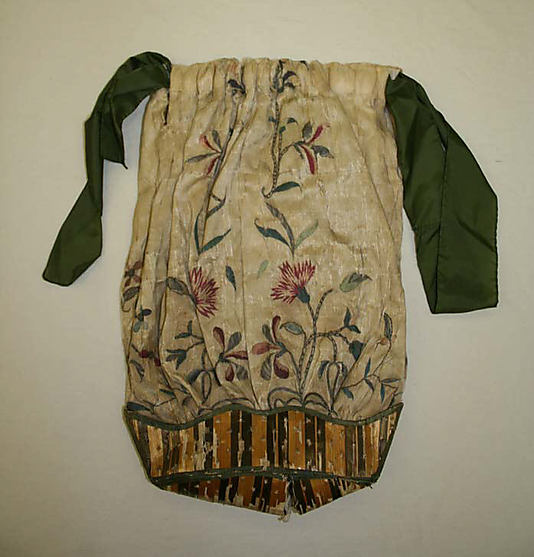
The name comes from the latin reticulum, meaning a net or mesh bag (the same word has given its meaning to reticle – the cross-hairs (or net) in a firearm scope or telescope). It entered English, as so many fashion words did, from the French, in this case, reticule.

Fichu de Velours, Redingote de Merinos (and a tasseled reticule), Costume Parisiene
The word was first used in the 1730s, but remained relatively uncommon through the 18th century. The Memoirs of the Reticule states ” I am not aware of any mention of the reticule until after the French Revoluton.” At the end of the 18th century, as fashions changed from full skirted dresses that could easily conceal pockets, to slim garments of light fabrics that would show unsightly bulges over pockets, that reticules came into their own. Easily made, easily carried, they were the indispensable accessory of the last decade of the 18th century and the first three decades of the 19th. They were, in fact, so very indispensable that they were also known as indispensables.
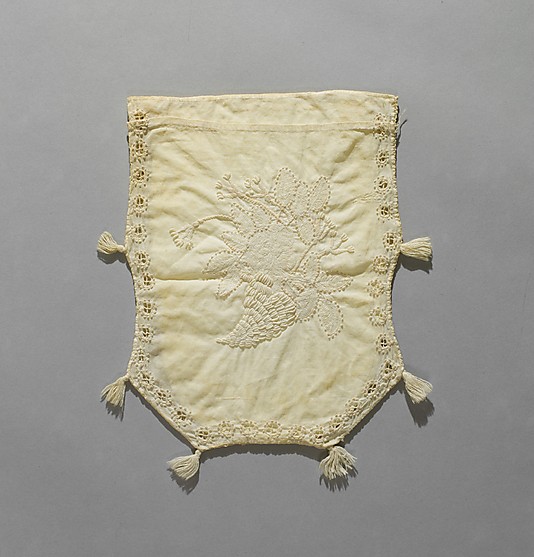
Reticules might be indispensable useful, but they weren’t beyond reproach. Older women continued to prefer pockets, and reticules were seen as being almost risque, because they were essentially pockets, and thus an undergarment which was suddenly carried on the outside. One could liken them to corsets in the modern world – while it is acceptable to wear a corset as evening wear, it’s still a bit suggestive, and certainly not appropriate for conservative dress. Reticules were also condemned for being masculine, because men carried their money and other items outside their dress, in pocketbooks and bags, and women hid their items away in pockets. Now women had a purse of their own that could literally be passed from hand to hand (and the obvious metaphor of pockets vs purses especially when your purses are the usual reticule shape all becomes a little well, obvious and weird about this point).

Reticule, 1818—30, Mexican, glass, silk, Metropolitan Museum of Art 2009.300.1902
Even if not scandalous, the idea of women carrying their private belongings externally, in their hand, was considered ridiculous. The Almanac des Ridicules, 1801, begins with a little rhyme about reticules and their riduculousness to the effect that a woman looses her reticule, and wants to post a sign “don’t do a thing, says her husband, you will always have enough ridiculousness.” Reticules were already widely known as ridicules by this time.
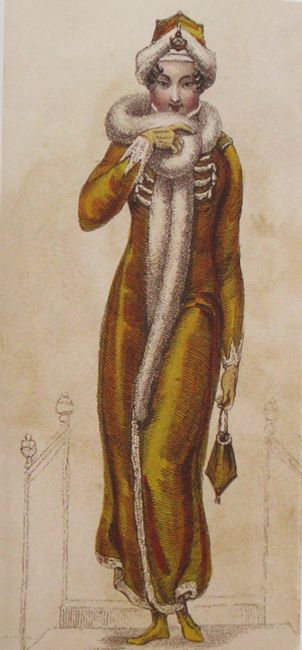
Walking outfit, Ackerman’s Repository, Vol. 5, Feb. 1, 1811
Although reticules ceased to be as important as fashion accessories once styles changed, and stiffer handbags, and full dresses with pockets, came into fashion as the 19th century progressed, reticules were still used, both as fashion items, and as a term to designate a specifically feminine carry-all. In 1867 a small dictionary was entitled: ‘The Reticule and Pocket Companion, Or, Miniature Lexicon of the English Language’. A male user would carry his edition in his pocket, but a woman, rather than having a purse, would have a reticule to carry hers in.
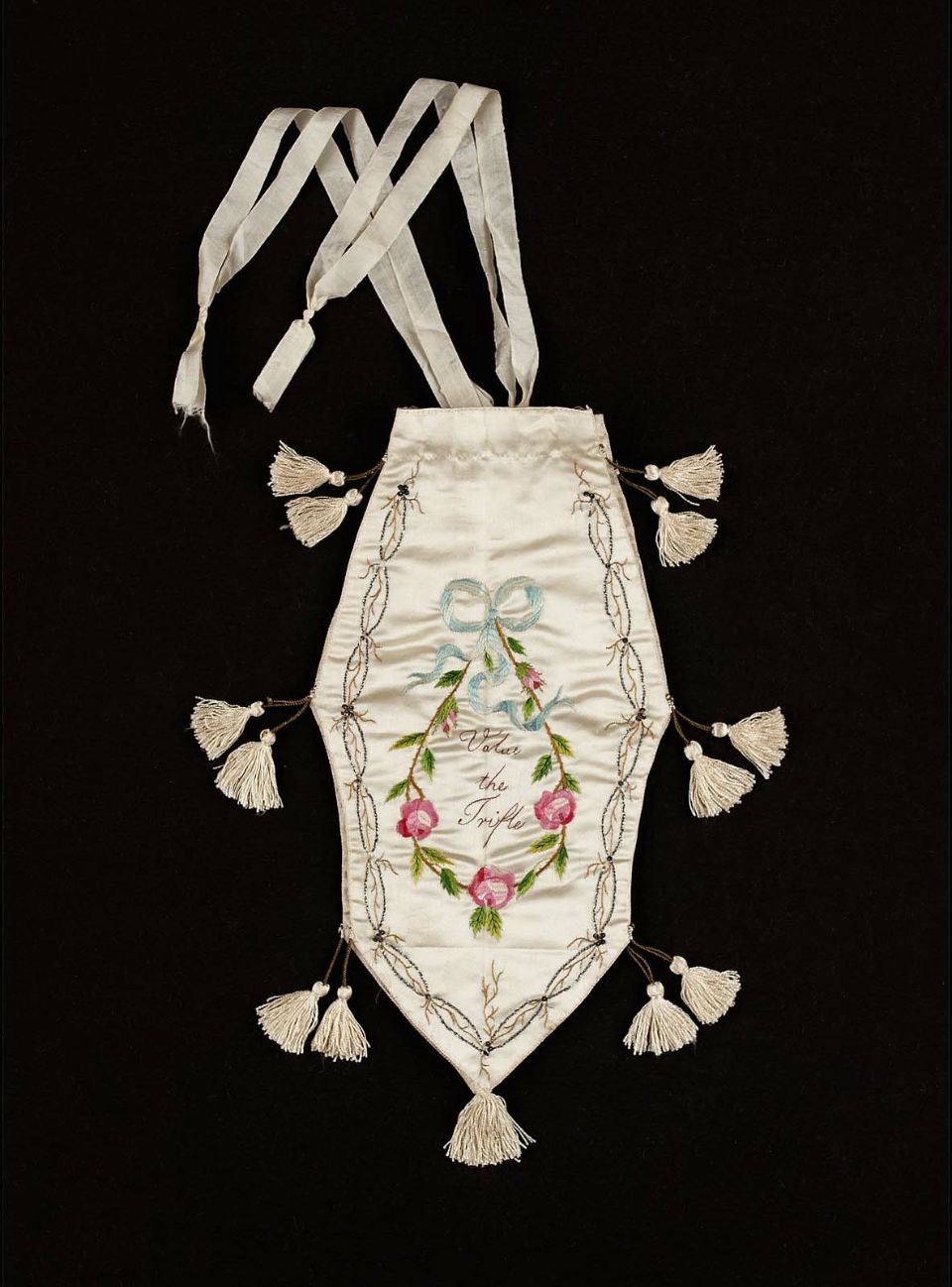
One of the many advantages of reticules was how easy they were to make. Stiff leather purses required special tools and strong hands, and were the provenance of leather workers, but any seamstress could make a reticule. The 1831 American Girl’s Book: Or, Occupation for Play Hours, has a whole chapter devoted to reticules, with instructions on ten different varieties, from a ‘melon shaped reticule’ to a ‘pocket book reticule’ (instructions for making all the reticules, with illustrations, begin on page 262 for those who are interested).
While the drawstring bags were never at the height of fashion again, reticule was used to describe small handbags and drawstring workbags into the early 20th century.
Sources:
Hiner, Susan. Accessories to Modernity: Fashion and the Feminine in Nineteenth-Century France. University of Pennsylvania Press. 2011
Monroe & Francis, The Spirit of the English Magazine. 1831
Riberio, Aileen. Fashion in the French Revolution. B.T. Batsford Ltd: London. 1988
Waugh, Norah. The Cut of Women’s Clothes: 1600-1930. Faber and Faber: London. 1968

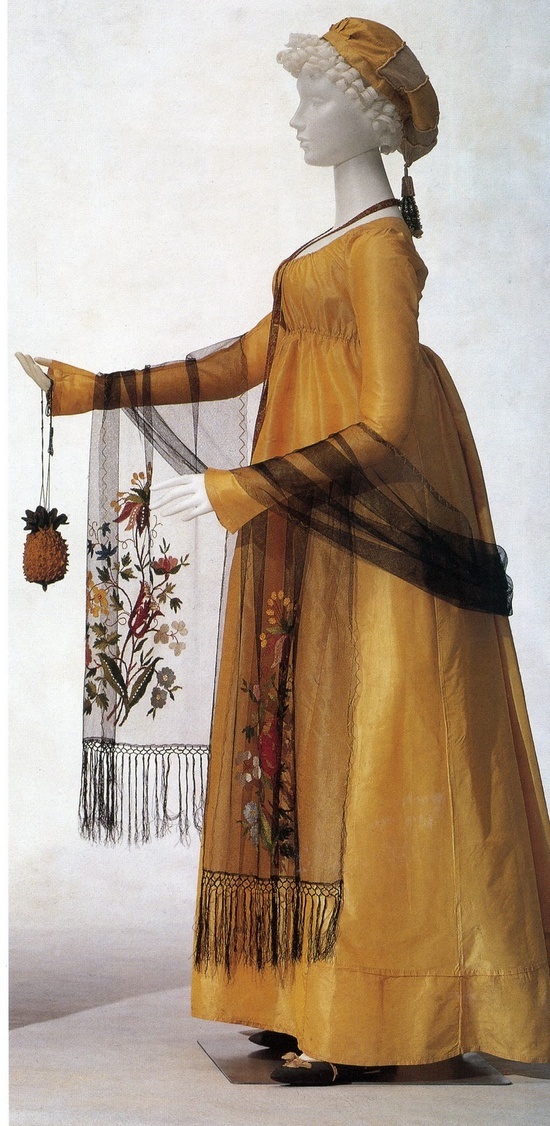
Knitted pineapple reticule in the Kyoto Museum’s 1800-1810 collection
One of the most famous, and certainly most charming, reticule fashions was for pineapple shaped reticules. Many sources credit the trend to a fashion for exotic fruits inspired by Josephine de Beauharnaises homeland of Martinique, but pineapples had been a symbol of ultimate exoticism and luxury in European arts and fashion since their introduction into Europe in the 17th century. They were grown in greenhouses across Europe from the 1720s, and in the late 18th and early 19th century you could even rent pineapples for your dinner party centrepieces, to give your event that final touch of wealth and elegance.
Historical examples of pineapple reticules were usually knitted or crocheted, but in my usual “I can’t knit, but how can I replicate this style” way, I’ve been working on sewn versions of the pineapple reticule for years now. American Duchess won my first one in a giveaway, and I was thrilled to see in a recent photo that she still carries it.
For the HSF, to cross a few more challenges off my list, I’ve made another pineapple reticule. This is my fourth attempt, but I’ve misplaced at least two along the way.
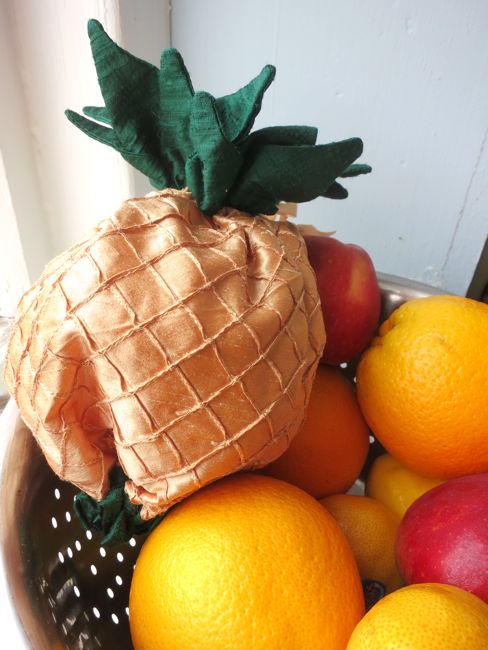
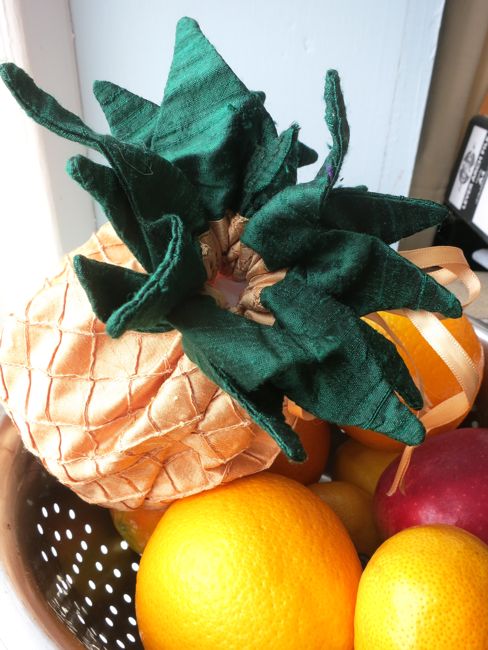
It’s not as cute as the crocheted versions, but I like it! So what challenges does it cover?
#1: Bi/Tri/Quadri/Quin/Sex/
#7: Accessorize – It’s a reticule!
#9: Flora and Fauna — It’s a pineapple!
#11: Squares, Rectangles & Triangles – Two rectangles and 11 triangles = one pineapple reticule.
#21: Colour Challenge Green — The green leaves and bottom should make it qualify, right?
#22: Masquerade – This ones a teeny bit of a stretch, but since it’s not perfectly historical, and it is quite fantastical, I think it works.
#25: One Metre — Clearly not a lot of fabric in it!
#26: Celebrate — Since pineapples were so celebratory, I think I can count this one as well.
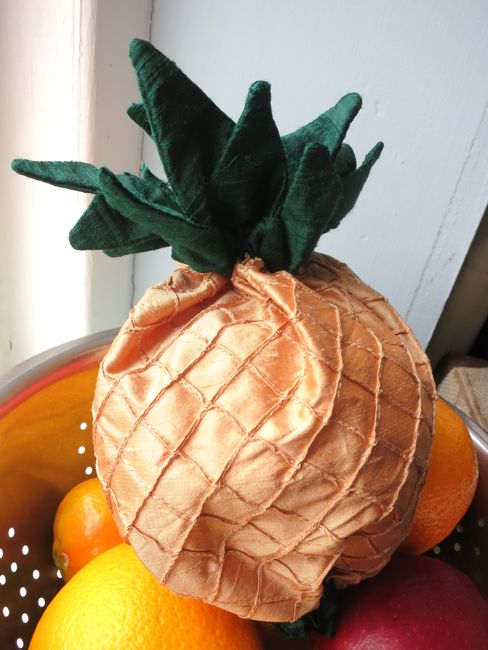
Fabric: scrap of orange-gold silk with pintucks, scrap of green silk (both from stash, and free)
Pattern: my own
Year: 1800-1830
Notions: Ribbon (icky poly satin, so I need to find a better alternative
How historically accurate is it? The idea of a pineapple reticule is accurate, but the materials (despite being silk) and execution are not.
Hours to complete: 2ish. Fun little evening project.
First worn: Not yet, but it will make appearances with Regency gowns.
Total cost: $0
Knitted pineapple reticule in the Kyoto Museum’s 1800-1810 collection