Latest Posts

The HSF Challenge #25: One metre

This is it!  The second to last challenge to be posted!

I was a little stuck on this challenge, as all my ideas were either too elaborate and demanding for such a busy time of year, and for the end of a marathon, or too similar to the challenges around it.  So I opened the suggestions up to popular opinion on the HSF facebook group.

Clearly you guys weren’t too worried about ‘too elaborate’, as the second most popular suggestion was ‘Copy a Painting’, but the slightly more restrained ‘One yard/metre’ suggestion won out in the end (Make something in under 3 hours was also very popular, which had me a bit worried.  If it ended up taking longer, did you fail the challenge?).

So, for Challenge #25, due 16 December, make an item that takes one metre or less fabric (I went with one metre, rather than one yard/or metre to be consistent).

So what takes less than 1m of fabric?.  Lot’s of things I’m sure!  I’ve thought of :

1920s & ’30s tap pants & camisole bras (my tap pants pattern takes less than a metre for up to 50″ hips):

Tap pants & Brassiere by Boue Soeurs, French, 1920's via Vintage Textiles

Tap pants & Brassiere by Boue Soeurs, French, 1920’s via Vintage Textiles

Swiss waists:
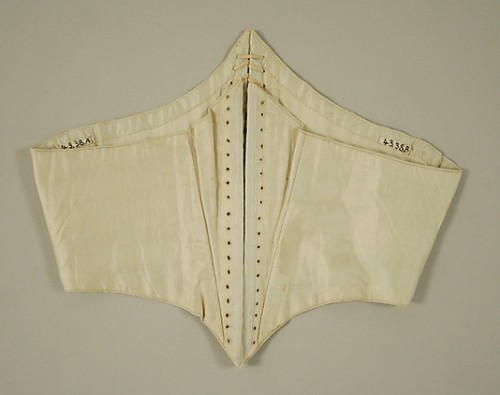
Swiss waist, 1860s, American or European, via the Met

Swiss waist, 1860s, American or European, via the Met

Regency short stays:
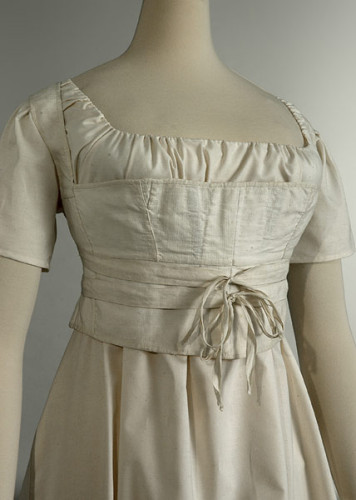
Wrapped corset, ca 1800, Musee Galliera

Wrapped corset, ca 1800, Musee Galliera

Mid-19th century evening bodices (truly, I got Rowena’s bodice out of far less than a metre):
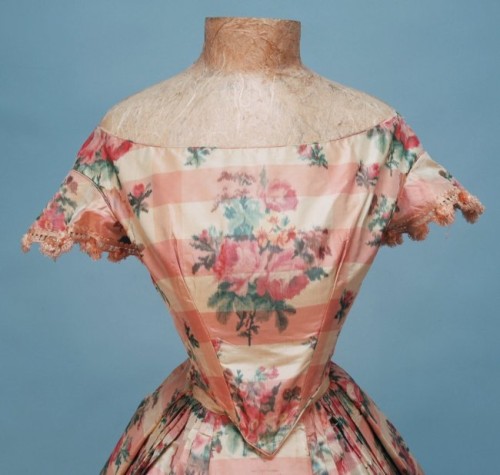
Ball gown, warp printed silk, 1840s, Whitaker Auctions

Ball gown, warp printed silk, 1840s, Whitaker Auctions

Stomachers:

Lady Innes, Thomas Gainsborough, 1757

Lady Innes, Thomas Gainsborough, 1757

Pockets:

Pocket, printed cotton & linen, 18th c, American, MFA Boston, 48

Pocket, printed cotton & linen, 18th c, American, MFA Boston, 48

Aprons:
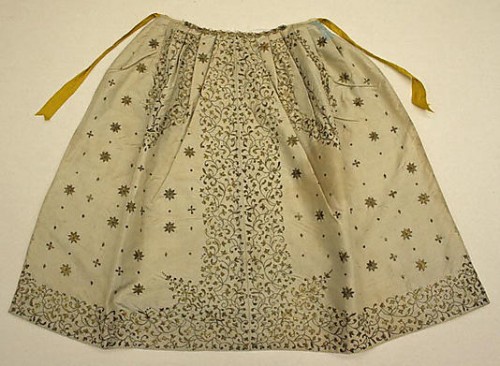
Apron, 18th century, British, silk, metallic, Met

Apron, 18th century, British, silk, metallic, Met

Fichu:
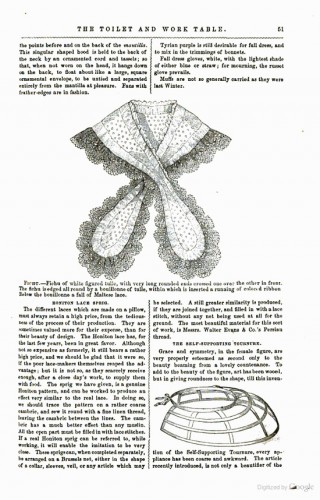
The Ladies' Home Magazine 1860 - Fichu

The Ladies’ Home Magazine 1860 – Fichu

Bust improvers:
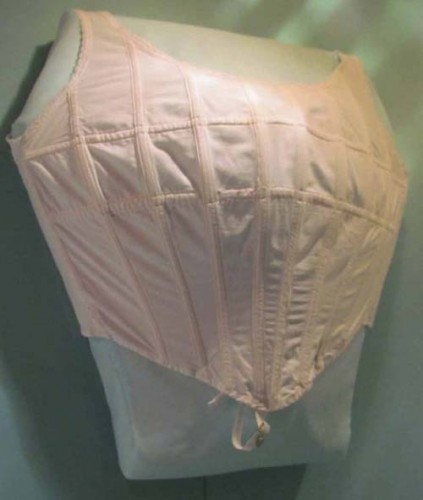
Bust improver or reducer, made of cotton with metal boning, by Spirella Styles, (patented) 1907

Bust improver or reducer, made of cotton with metal boning, by Spirella Styles, (patented) 1907

Muffs:

Muff English, 1785—1800 England, MFABoston

Muff English, 1785—1800 England, MFA Boston

Crazy awesome men’s cap thingees:
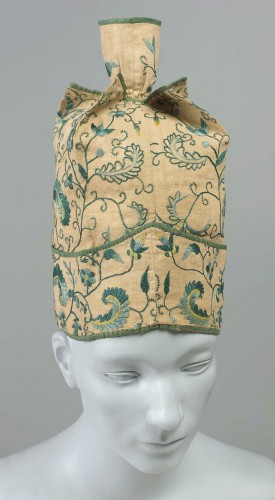
Man's cap, American (Boston, Massachusetts), 18th century, MFA Boston

Man’s cap, American (Boston, Massachusetts), 18th century, MFA Boston

Those little teeny-tiny evening spencers that have been all the rage among Regency costumers over the last year:

And I’m sure that there are many more that you could suggest!

To keep within the spirit of the challenge, try to avoid making something that also involves metres and metres of trim (so a stomacher covered in ribbon bows rather defeats the purpose).
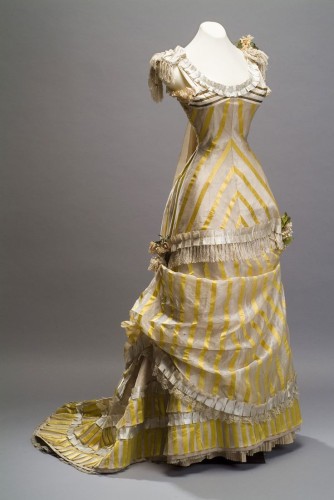
Rate the Dress: Stripes & fringe and pleats and ruffles (and more stripes) ca. 1880

Last week one suit faced off in a Dudes Dress-Off with two different looks: the first, as Joanne put it, Mr Darcy, restrained with a matching waistcoat, and the second Sir Percy Blakeney, with bright coral waistcoat and pompadour hair.  While Joanna preferred Sir Percy, ultimately we’re all suckers for Mr D (which is not, as it happens, why my Mr D is Mr D), and the simpler styling came in at 8.4 out of 10, compared to 7.5 out of 10 for the pink waistcoat.

The biggest criticism of the suit with the bright waistcoat was how the LACMA had styled it: everyone agreed that the corsage was a thing of horribleness and a eyesore forever.  Be glad I didn’t post the close-up of the corsage!  It was beyond hideous…

This week, I’m presenting another corsage-bedecked bit of finery, but with this one the corsages are original to the garment.  This striking natural-form evening gown makes use of at least three corsages, and pretty much every other type of trim possible.  There is pleating, fringe, bows, more pleated ruffles, draping, plus fun with stripes involving two different striped fabrics.

There is a lot going on!  What do you think?  Does the gown pull off elegant excess, or is it all just too much?

Rate the Dress on a Scale of 1 to 10.

1780s shoe re-make

On Friday I posted a tutorial on how to dye leather shoes.  The observant among you may have noticed that I used a pair of ca. 1790 shoes as my inspiration, and wondered if the dyed shoes were going to get a bit more historical.

Shoes, ca 1785-95 the Netherlands, Rijksmuseum Leather with silk ruches

Shoes, ca 1785-95 the Netherlands, Rijksmuseum Leather with silk ruches

Of course they were!

1780s shoe remake thedreamstress.com

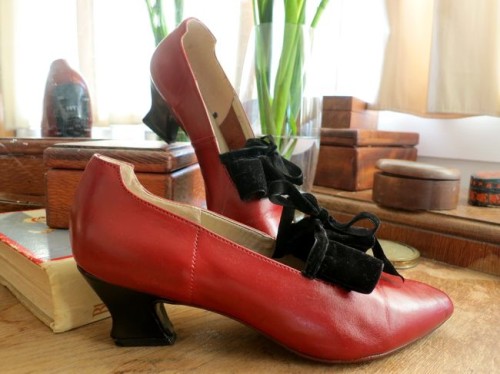
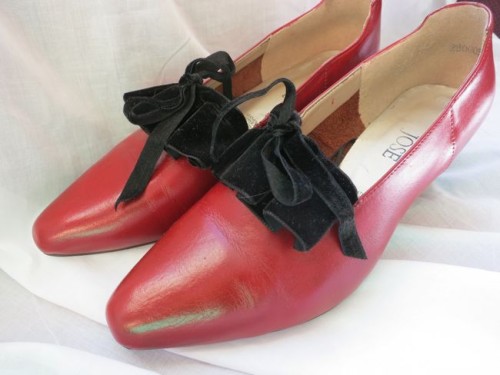
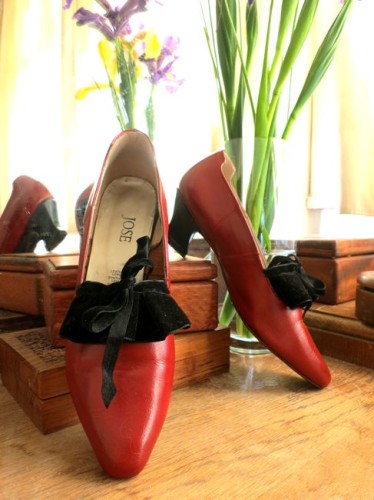
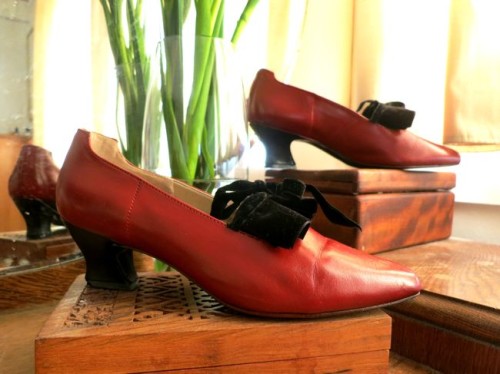
Well, sort of.  They ended up looking more 1900s does 18th century than 18th century proper, at least when you just photograph them, but they are extremely fetching and quite 18th century on, which is what counts.

1780s shoe remake thedreamstress.com
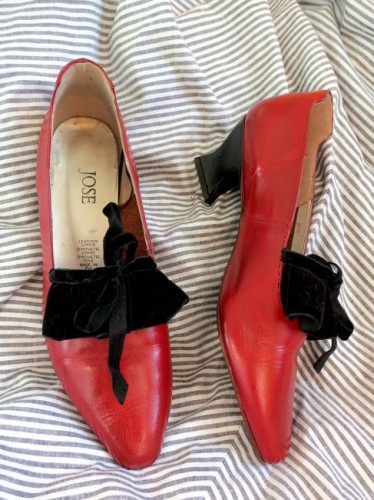
Also extremely comfortable and all-day wearable, which is another major bonus!

1780s shoe remake thedreamstress.com

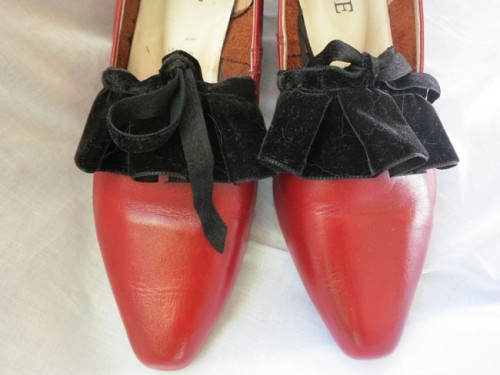
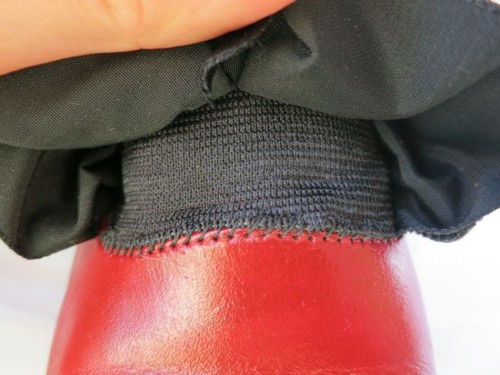
To finish them off, once I’d dyed them, I pleated and sewed a piece of rayon velvet to a piece of elastic (I know, I know – in my defense, I did try to use leather, but couldn’t get a needle through it and the shoe leather to hold them together).

1780s shoe remake thedreamstress.com

Then I hand-stitched the elastic to the leather, using the stitching holes that were already in the leather as a guide.

1780s shoe remake thedreamstress.com

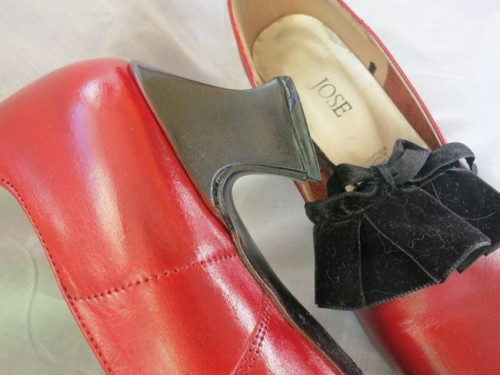
Finally, I hand stitched two final narrow pieces of velvet to the top of the pleated velvet, leaving enough of a gap in the centre that I could tie them in a bow, a la my inspiration.

1780s shoe remake thedreamstress.com

The pleated velvet is perhaps a little over the top, and I wish I’d managed a curved join between the velvet and the shoe, but overall, I’m pleased.  Also, these are going to look spectacular with the pet-en-l’aire outfit.

1780s shoe remake thedreamstress.com

The Challenge:  #18  Re-Make, Re-Use, Re-Fashion

Fabric: 1990s leather shoes ($6).

Pattern:  None

Year: 1780-90 inspired

Notions:  Black & red TRG leather dye (approximately $6 to colour the shoes), rayon velvet in two widths, elastic, linen thread (all stash).

How historically accurate is it? More inspired than accurate, but with shoes my priorities are fit and comfort, then aesthetic, then accuracy.

Hours to complete:  3.

First worn:  Not until I have them re-heeled.  Like many vintage shoes, the heels have gone brittle.

Total cost:  NZ$12

1780s shoe remake thedreamstress.com