Latest Posts

Terminology: What are ‘symmetricals’?

It’s been a while since I’ve done a terminology post, and I’ve got a fun one today.
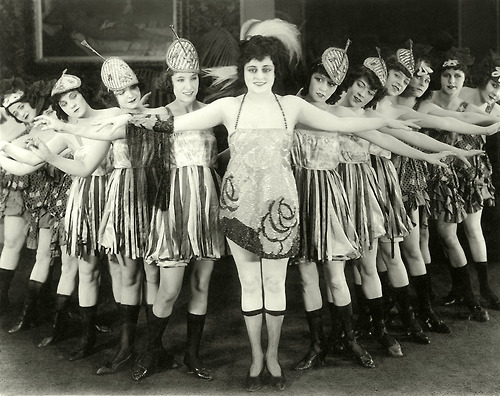
Chorus girls, 1923

Chorus girls, 1923, showing the last vestiges of the Edwardian figure

Remember how I posted two images of Madge Bellamy, one in full Edwardian curves, one in slim, flattened ’20s?  Madge’s curvy Gibson Girl silhouette was achieved with corsetry and padding above and below.

Extremely voluptuous (if fake) figure were the desired look throughout the late 19th century and for the first decade of the 20th, and actresses like Madge often found such curves a useful attribute in advancing their career.  As we can see from Madge, these curves weren’t always real.

It’s not that hard to fake curves in a dress, but what if you were a chorus girl, expected to show off your legs?  Or an actress given a role that demanded a little more exposure?

Enter symmetricals.  Symmetricals were knit tights that were padded to create full calves and thighs, instantly giving the effect of voluptuous curves from the waist down.

Symmetricals were primarily the provenance of actors, as they were the only ones likely to need them on a regular basis, but non-stage folk resorted to them for fancy dress balls, as this account of a society ball in New York in 1893 attests:

Some of them looked enviously at the fat calves of the flunkies.  Some regarded their own with apprehension.  They were padded outrageously, and everyone knew it, but as long as the ‘symmetricals’, as stage people call them, did not get out of place it did not matter.

Symmetricals could be bought, but those on the lower pay scales made their own by carefully sewing cotton wool into flesh coloured silk-cotton tights.  The actress Gertrude Lawrence describes how, as a child, she helped her slim-legged chorus girl mother with the tedious task of  creating the “much -desired and seductively rounded thighs”, and thus learned that “frequently a woman’s legs (and not her face) are her fortune.”

Actress Miss Kitty Lord (who may or may not be wearing symmetricals) shows off her seductively rounded thighs

Actress Miss Kitty Lord (who may or may not be wearing symmetricals) shows off her seductively rounded thighs.  Via the Museum of London

Sources:

Lawrence, Gertrude,  A Star Danced.  London: W.H Allen and Co Ltd.  1945
Finished! 1813 Kashmiri dress

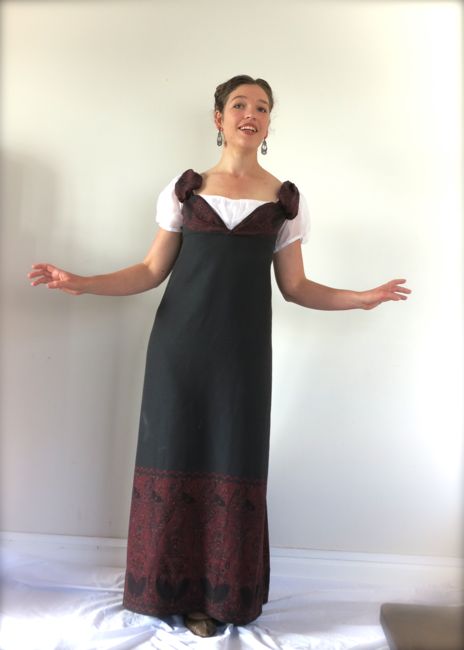
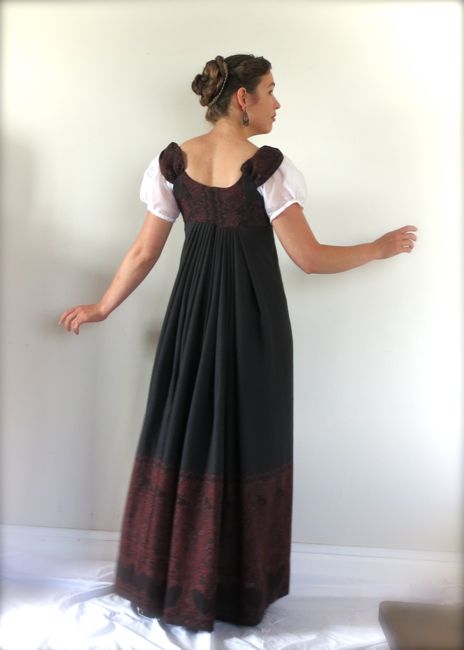
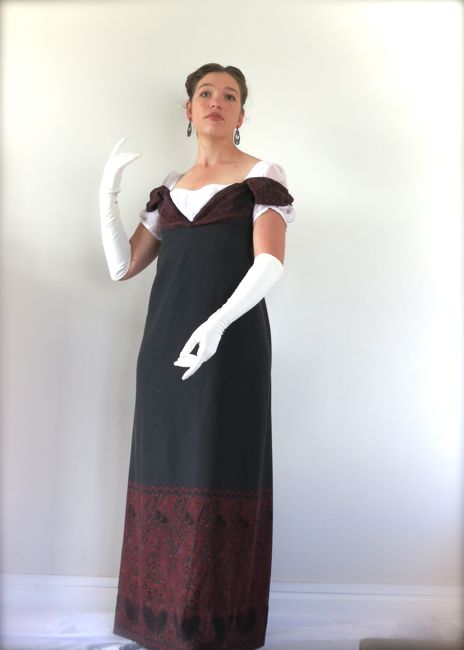
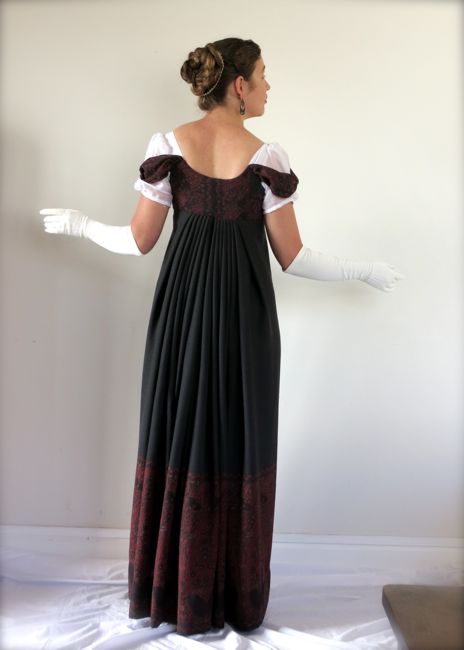
After pulling apart and reworking the 1813 Kashmiri gown to considerable degrees, I’m now pleased to announce that it is finished!

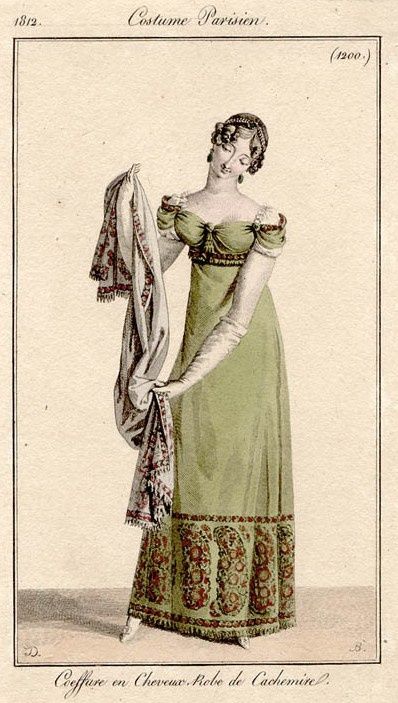
Fashion plate featuring a dress made of Kashmiri shawls, 1812

Fashion plate featuring a dress made of Kashmiri shawls, 1812

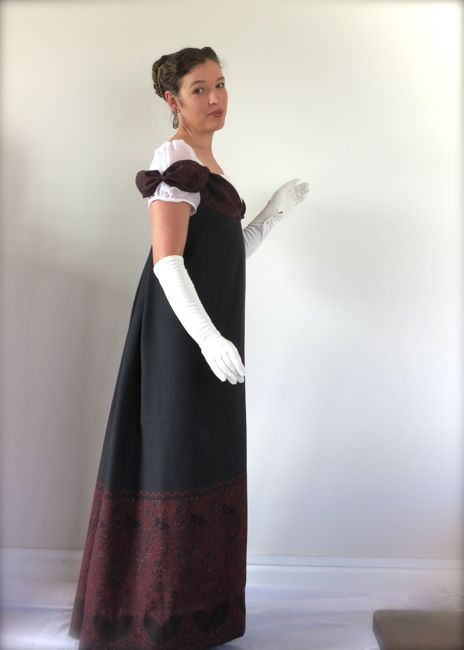
Or within an hour of finished.  I still need to decide if I prefer the sleeve swags on the shoulder or dropped, and if I want trim on the shoulders as in my fashion plate, and if I want the button trim you can see in the plate where the bust meets the sleeve swags.

So what do you think?  Sleeve swags on the shoulders:

1813 Kashmiri dress

1813 Kashmiri dress

Or dropped:

1813 Kashmiri dress

1813 Kashmiri dress

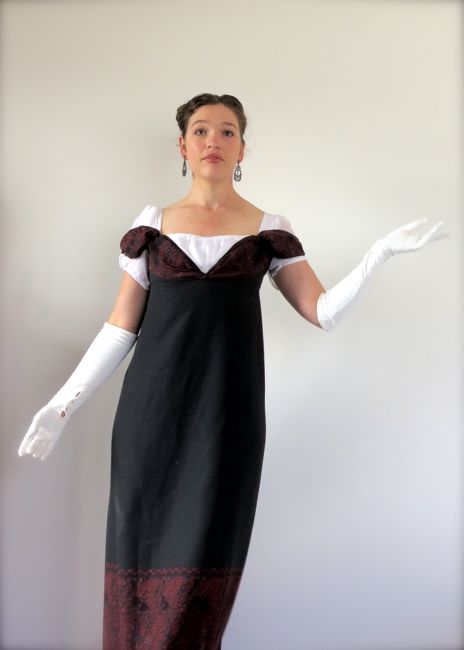
I forgot to pin on the cameo brooch for the photos, so you’ll just have to imagine it in and tell me if I should do gold clips or buttons or something at the join of bodice and sleeve swag.

1813 Kashmiri dress

And what about the ruffles/puffs you can see around the neckline in the fashion plate.  Should I have those?

1813 Kashmiri dress

The important thing though, is that the dress is done, and done properly, and that all the issues I had with it are fixed.  The back, while still low, is considerably higher, the centre back is level with the centre front, the hem is now even, the back pleats look spectacular (if I do say so myself), and the sleeves are working.

1813 Kashmiri dress

Most importantly, I actually like the dress!  It was an interesting excersize in balancing historical accuracy with modern availability and fashion plate fantasy with extant reality.

I know these photos are quite dark and soft-focus (it’s been dark and rainy and really hard to get photos).  I’ll post more detail images tomorrow and try  to do a proper photoshoot very soon.

Just the Facts Ma’am:

The Challenge:  Bi/Tri/Quadri/Quin/Sex/Septi/Octo/Nona/Centennial

Fabric:  2 1.5 metre lengths of wool twill with an early 19th century inspired paisley pattern, linen for bodice, silk for sleeve and bodice overlay.

Pattern:  Mainly the 1805-09 gown featured in Janet Arnold, with reference to other extent gown patterns from 1810-15

Year: 1813

Notions:  Thread, hooks for the back of the bodice, a cameo inspired brooch for the bodice front.

How historically accurate is it?:  I’d say 7/10. It’s entirely hand sewn and constructed in a period-accurate fashion, but in an effort to balance the needs of the fabric and the effect of the fashion plate some of the details are not backed up by extant examples.

Hours to complete:  Somewhere around 40.  Way more than it should have taken!

First worn:    When mostly done for a photoshoot on Sat 12 Jan

Total cost:  I think I paid $25 for each of the panels, so $50 plus say $5 each for the bits of silk and linen I used = $60

Rate the Dress: 1842 does 18th century

Last week’s Rate the Dress was inspired by the first Historical Sew Fortnightly challenge:  a 1710s portrait of Frances Howard as the goddess Flora.  Many of you loved the colours of the outfit, but in general you weren’t convinced by the classical inspiration, and you really weren’t convinced by her crazy over-the-top shoe bows, bringing the rating down to a 6.9 out of 10.

The next challenge in the Historical Sew Fortnightly is UFO (un-finished-object) – the perfect excuse to finish one of those things sitting on your to-do pile.

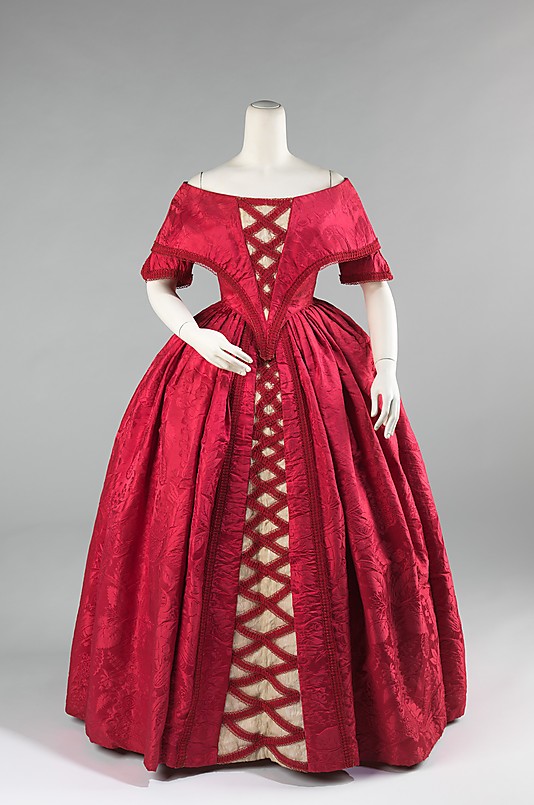
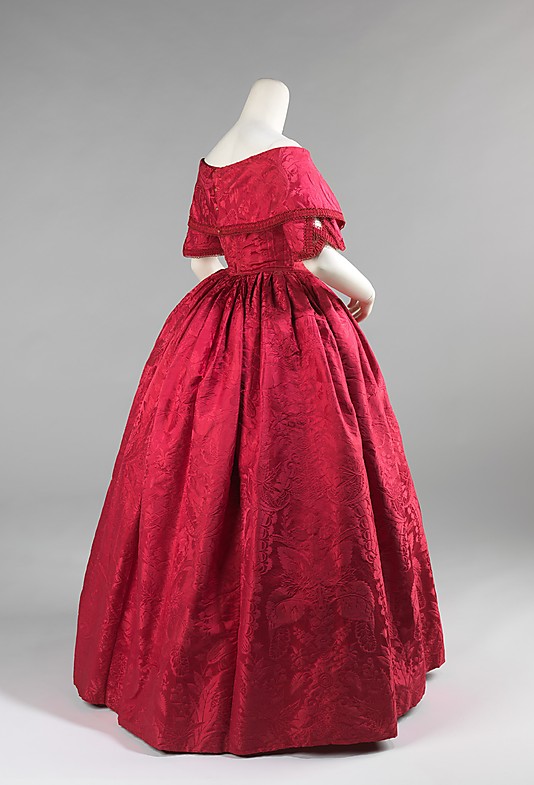
Showing you an unfinished dress for Rate the Dress probably wouldn’t be very exciting for you, but I did find this ca. 1842  evening gown from the Met  which has been re-made from an 18th century gown.  The fabric dates to the 1740s.

It’s quite amazing and wonderful that fabric could be so well made that it could be sewn and worn as a garment, and then re-sewn and worn again as another garment 100 years later.  And now, almost 175 years later, it’s in a museum and looks to still be in excellent condition.  It’s a lovely reminder that a project may be finished, but it can be un-finished and remade again.

Ball gown, ca. 1842 (fabric 1740s), British, silk, cotton, Metropolitan Museum of Art

Ball gown, ca. 1842 (fabric 1740s), British, silk, cotton, Metropolitan Museum of Art

Ball gown, ca. 1842 (fabric 1740s), British, silk, cotton, Metropolitan Museum of Art

Ball gown, ca. 1842 (fabric 1740s), British, silk, cotton, Metropolitan Museum of Art

In addition to the 18th century fabric, the design of the gown gives a slight nod to the 18th century, with a false front and false petticoat which give a nod to stomachers and petticoats, both with 18th century inspired trim.

What do you think?  Was the fabric worth re-using?  Does the dress do the fabric justice?  And are the 18th century influences an elegant addition, or a bad pastiche?

Rate the Dress on a Scale of 1 to 10