
Latest Posts

A very ‘Gay Red Shirt’

Definition of  GAY (via  Merriam-Webster)

1
a  :  happily excited,  merry  <in a  gay  mood>
b  :  keenly alive and exuberant  :  having or inducing high spirits  <a bird’s  gay  spring song>
2
a  :  bright,  lively  <gay  sunny meadows>
b  :  brilliant in color

Having embarked on knitwear, I’m having lots of fun making simple knit tops and mastering my knit techniques.

I’d already earmarked this awesome red fabric with widely spaced navy blue & white stripes for a simple boat-necked T when  NZ’s Prime Minister stuck his foot in his mouth  and told someone they’d never make it because they were wearing ‘a gay red shirt’.  Wow.  Thanks John Key.

Whatever your feelings on homosexuality, using personal descriptors as insults is  NOT OK.

Everyone, up to and including Sir Ian McKellan, has come down on Mr Key for his comment.  He tried to defend himself by saying he heard his kids say it, and thought it meant ‘weird’.  I don’t think he’s helping his case at all.

Someone decreed Friday the 9th of October as ‘Gay Red Shirt Day’ as a protest against his insult, and hey, I’d just finished this and was planning to wear this  anyway.
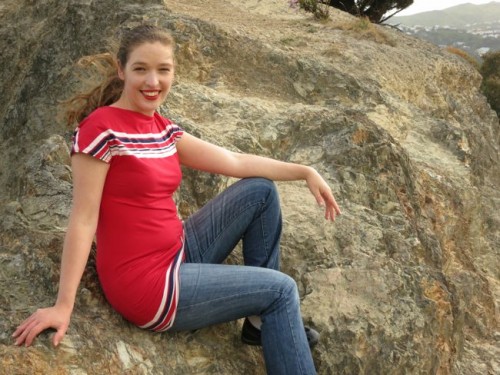
I had an extremely gay time making my shirt  on Wednesday (it was so easy – and provided a fun alternative to following the US election), and wearing it on Friday to visit a friend and her four-year-old.  We gaily rambled along the beach, and spent a gay hour in the awesome neighborhood playground, going ’round & ’round on the octowobble, discovering that I am very bad at the ‘mouse house’ (like a hamster wheel for humans), and climbing to the top of the super slide and going down it over and over again.

I liked it so much I threw it in the wash that evening, hung it to dry over the dehumidifier, and wore it again on Sat.

In the afternoon Mr D and I went for an explore in the town belt with my camera.

It’s quite impossible to go on a ramble with me, especially in spring, without things getting very gay indeed.  I start bouncing along the trail and finding things and exclaiming over them “Ooooh…look!  Daisies!”  ”Oh, the first forget-me-nots of the year!  Aren’t they just darling?”, “A meadow!  With clover!  Lets go roll around in it!”, “Oooooh…honeysuckle!  Isn’t it just divine?”.  ”Oh look at that funny little shed with the graffiti!  Take a picture of me in front of it please!”

And I  skip.  And  frolic.

It’s quite ridiculous, and I just can’t help myself.

Oooh, speaking of getting excited, I really want to show you this picture:

It’s a terrible picture of me (what on earth am I doing with my hands?), but a great view of Wellington — and not the usual one you see on the tourist postcards.  Also, it’s full of glimpses of places where I’ve taken pictures.  The oval of grass on the far left is The Oval where I did the photoshoot for the  Win in Black & White jacket, and the red-shrouded tower that you can see behind it is the War Memorial Campanile, where we did the Grandma’s Blue Dress photoshoot.  The Campanile is right in front of the old Museum building where I did this photoshoot, and this photoshoot, and this photoshoot, and this talk.  Somewhere in the green hills right behind the Campanile is the valley from the  Rodeo & Wrangle outfit.  Wellington is such a photogenic little city!

To balance out the weird picture of me, here is my new favourite photo of me (even though the photo, and my shirt, make it clear that I have a little winter squidge to get rid of):

Just the facts, Ma’am:

Fabric:  90cm of mid-weight viscose jersey with added spandex, thrifted

Pattern:  3HoursPast’s Blank Canvas Tee, with a boatneck, and 8″ in length added so there would be a stripe at the hem.

Year:  2012

Notions:  Thread

And the insides?  Red, white & blue overlocking!

Hours:  2

First worn?:  Wed 7 November (US election day on the other side of the dateline) and then after a wash on Friday 9 November for GayRedShirt Day, and then  again  after a wash on Sat 10 Nov for a walk & photoshoot.

Wear again?:  Yes! in fact…

Make again?:  I think I’m going to have to, seeing as I’m tempted to wear it constantly!

Total cost:  $2

Thoughts on late 18th century pet-en-l’aire trimmings

In preparation for the upcoming High Tea charity fundraiser for Ronald McDonald House I’m trimming my Indienne chintz pet-en-l’aire.

I’ve dyed pretty new rayon and cotton ribbons (the closest I could get to silk) to replace the nasty synthetic ones on the front, and am figuring out how to do the ruffled trim.

Earlier mid-18th century pet-en-l’aires, like this yellow example, have pinked ruffle trim:

Pet-en-l’air, mid-18th century, sold by Christies

But later 18th century examples, the era I am aiming for, have flatter trim that is finished or turned on the edges:

Pet-en-l’aire, 1770-90, Manchester City Galleries

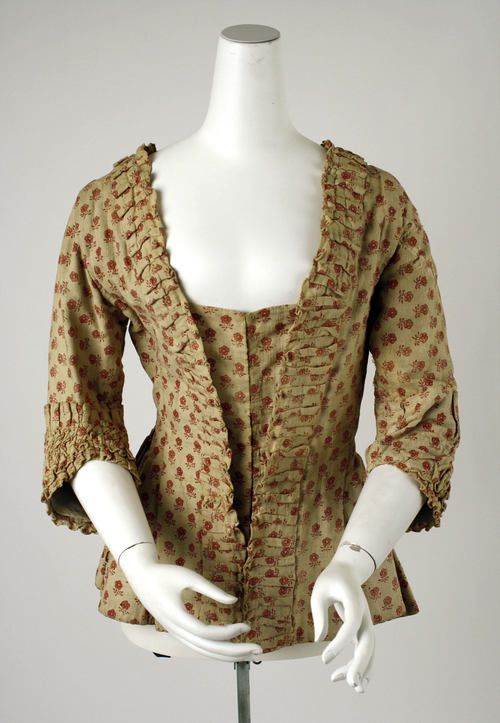
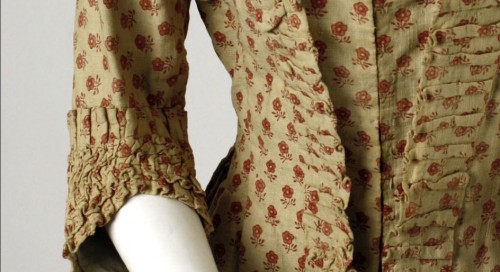
Pet-enl’aire, 18th century, cotton, Belgium, Metropolitan Museum of Art

I’m trying to figure out exactly how the ruffles are made.  I have 3.5 options to make the ruffles shown in the examples above:

  • Option 1:  The ruffles are cut in strips more than 2x the width of the ruffles, the sides are folded back and overlapped in the middle, and then the ruffles are sewn down, with the raw edges hidden on the middle underside of the ruffles.
  • Option 2: The ruffles are cut in strips the width of the ruffles, plus turning allowance, and then the sides are turned and hemmed, and the ruffles are sewn down.
  • Option 3: The ruffles are cut in strips the width of the ruffles, plus seam allowances, and sewn in a tube with a backing of another, cheaper fabric, turned, and then sewn down.
  • Option 3.1:  The ruffles are cut in strips the width of the ruffles, plus seam allowances, and a backing of another, cheaper fabric is applied, with the edges turned in on each side and sewn down in a tube sewn from the outside.  The ruffles are then sewn down.

The extremely sewn-down nature of the ruffles on the MCG pet-en-l’aire, and the Metropolitan pet, makes Option 1 very plausible.

Pet detail, Metropolitan Museum of Art

The peep of a ruffle lining on this jacket from just a few years later than my inspiration pets indicates that in at least some cases, Option 3 or 3.1 was used:

Jacket (Spencer) Date- late 18th—early 19th century, silk, French, Metropolitan Museum of Art

However, there is yet another thing to consider with my ruffles.  There are a few examples of pet-en-l’aires and other late 18th century jackets with contrast trim on the edges of the ruffles.

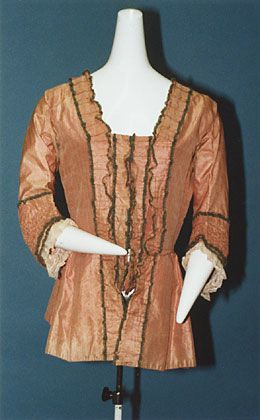
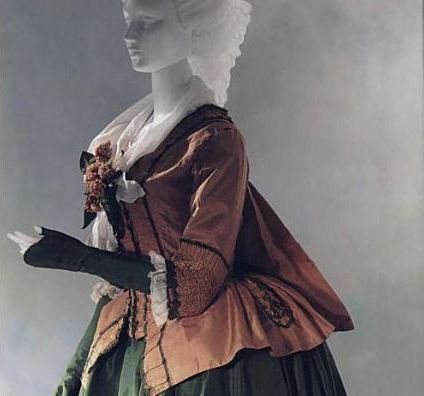
Jacket , c. 1775. French, silk taffeta,  

Pet en l’aire with sabot cuffs, 1775, Kyoto Costume Institute

(are those the same jacket btw?  If so – what a difference display makes!)

I could use a contrast trim on my ruffles – I’ve got narrow red and cream cotton satin ribbon, both of which would look beautiful with the flowered silk of my pet.  But the fabric is already quite busy, would that be too much?  And if I do do contrast trim, what is the correct way to do it?

So, aesthetically, and historically-accurately, how shall I tackle this?  What technique should I use?  And what should my ruffle placement look like?

Rate the Dress: Damask, velvet & chiffon in 1888

What consistent ratings last week’s Chanel fireworks dress received!  It’s very unusual for so many of you to agree on a dress, but excepting one 7, every single rating was an 8, 9 or 10 (no Sadie, you can’t give it an 11 – or you can, but I’ll still count it as a 10!).  Not surprising that the final rating was a balanced  9.3 out of 10.  The only mark downs were for the lack of resolution at the waistline.  It almost looks as if the dress ought to have had a sash or belt.

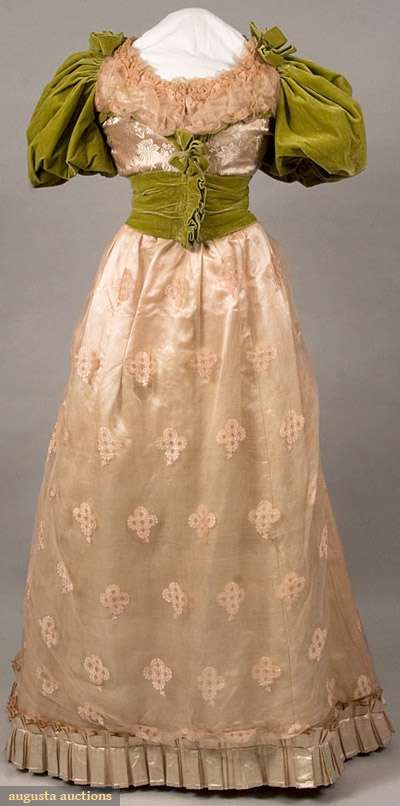
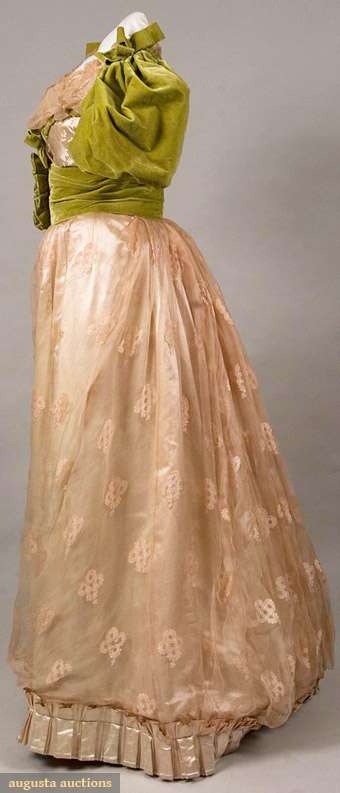
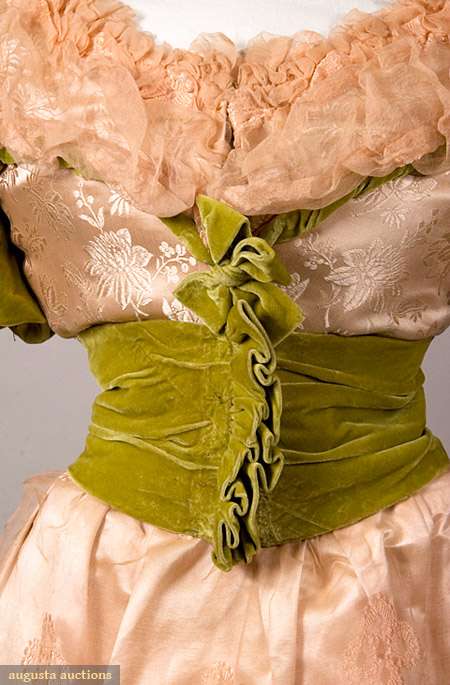
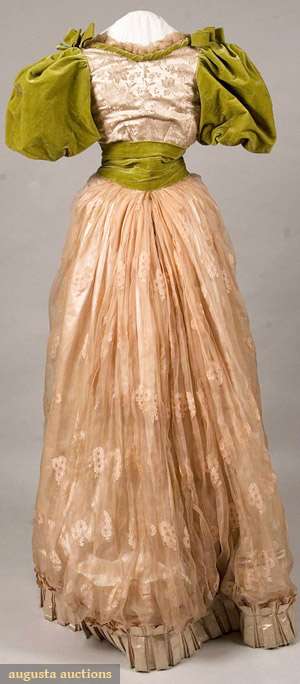
This weeks dress definitely has a sash.  It may not be a Chanel, but it does have an impressive pedigree, having been worn at Benjamin Harrison’s inaugural ball in 1889.  It’s come down in the world a bit them, having  sold at August Auctions in 2009 for a measly $540 (even if you don’t like it, you’ll have to agree that was a steal).

The dress combines silk damask, silk velvet, and silk brocade chiffon ballgown in pink and green.  Pink and green usually a popular combination, but what if the green is a sort of chartreuse/poison shade, and the pink is barely blush?  And what about the combination of all those different fabrics?

Dress worn to Benjamin Harrison’s Inaugural Ball, January, 1889

Dress worn to Benjamin Harrison’s Inaugural Ball, January, 1889


Ballgown, silk damask, brocade chiffon & velvet, 1888

Ballgown, silk damask, brocade chiffon & velvet, 1888

There is a lot to ponder when it comes to this dress.  What is your verdict?

Rate the Dress on a Scale of 1 to 10