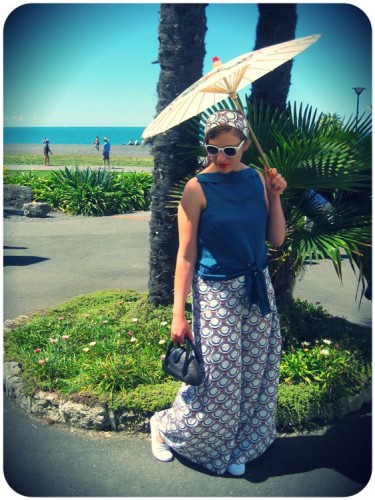
Latest Posts

Early 1950s fashions and fabrics in Japan, Part I of 5

When I bought Murisaki the dress form, something exciting happened.  The proprietor of the Asia Gallery said “Oh, you might like these as well” and showed me these:
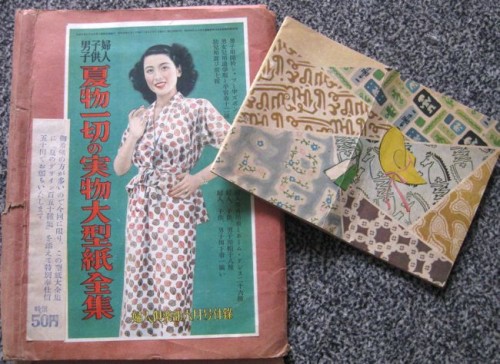
Pattern envelope and book of 50's dresses & fabrics

The patterns in the envelope

Ooooooh…..

And then he gave them to me.  For free!

Squee!

(They like me.  I buy a lot of stuff).

Now, my Japanese is limited to what I remember of high school Japanese after a dozen+ years.  So what I know about these is based on what I can tell from the images.
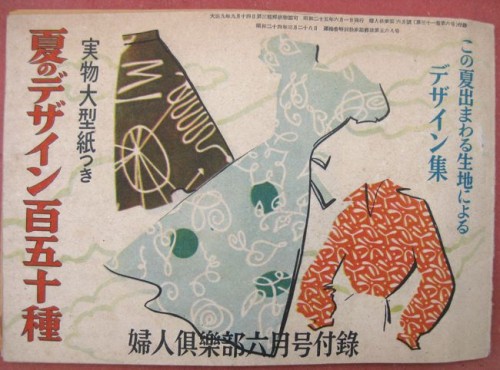
The dress catalogue/pattern illustrator, whatever it really is

At first I thought it was a dress catalogue, and a packet with one commercial pattern and a homemade pattern for tabi socks.  Then I looked at it closely and realised that the pattern has ALL the dresses – every single child and adult dress shown in the catalogue – all drawn over each other ready for you to break your brain over as you sort them out.
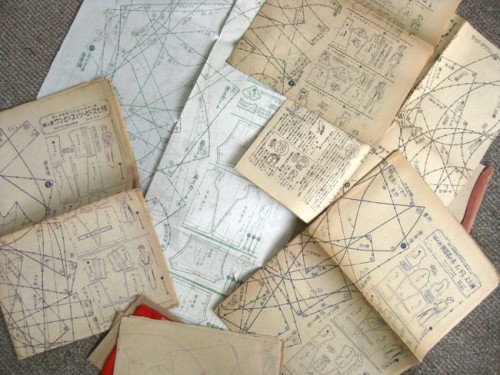
Wow! Yay! Eeek!
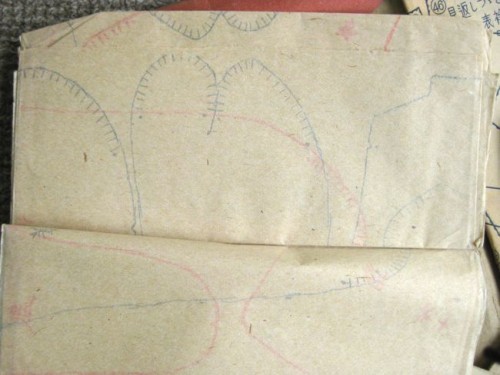
The homemade (or at least hand-drawn) tabi sock pattern

Based on the style of the dresses I’d say the patterns are from 1951/52.  There are dozens, and dozens of them, and even illustrations of fabrics.  I’ll show you all the images in a number of posts over the next few weeks, but here are a few fabric designs and dresses for starters.

First the fabric designs:
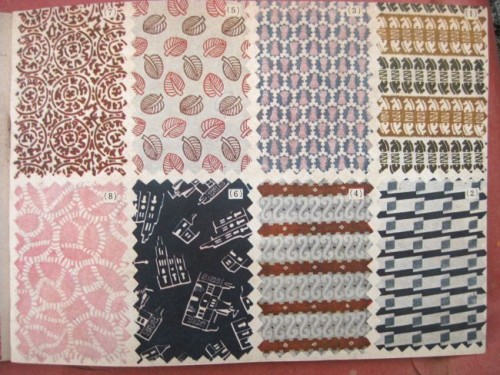
Oooooh...I want these all to be reprinted! I love the pinks and russets and muted blues
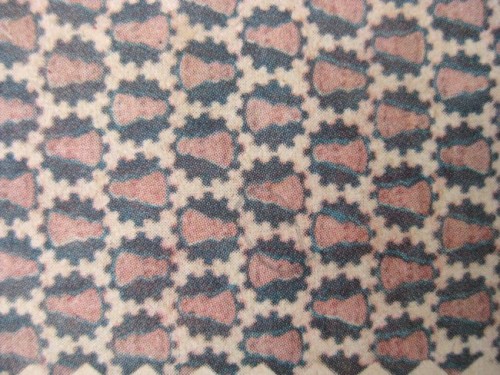
Look at the adorable little old-fashioned girls in their cog-circles! It's like Crinoline Lady goes steampunk, with pink AND black.

Someone should design a fabric just like this for Wellington, with Welly buildings
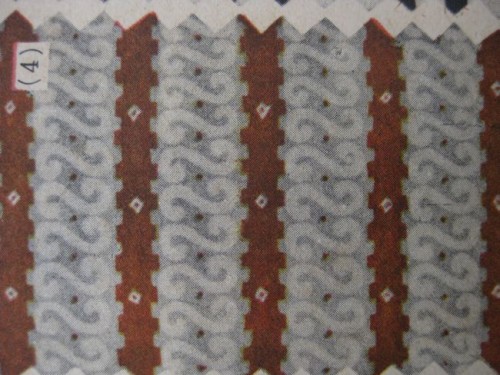
This one feels very Pacific
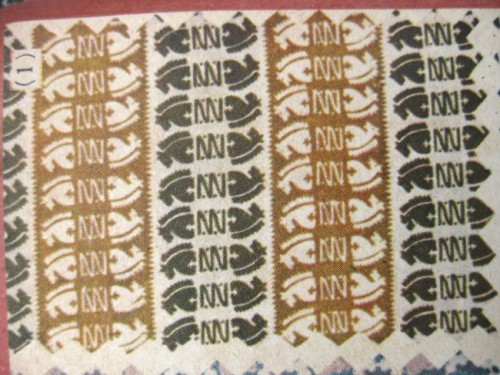
I don't like chess, but I love these little chess knights!

And then the dresses:
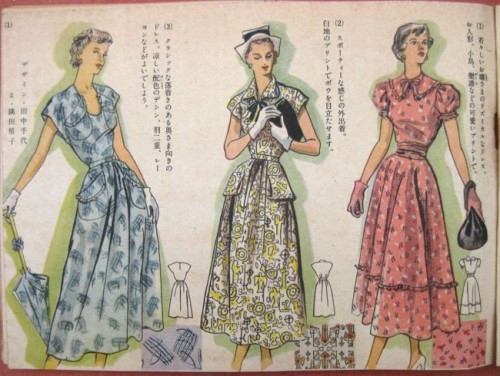
Darling dresses, with more darling fabric designs - little birdcages, something weird & Aztec, and musical notes on pink.

Notice how the pattern book, being Japanese, reads from the ‘back’ and from right to left.
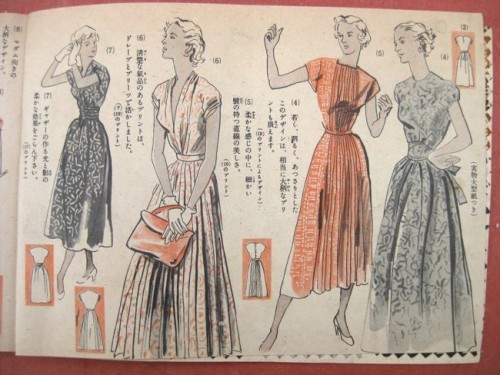
I like how simple and sweet these are. #6 is my favourite!
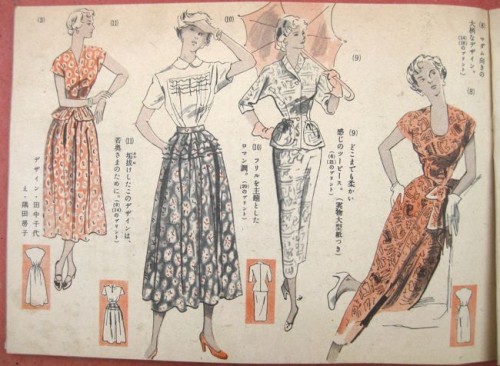
That suit is just too cute, even if the pockets might be dreadful on me!

One day I may even attempt to unsort and copy the patterns, brave the total lack of instructions I can read, and make some of these up!
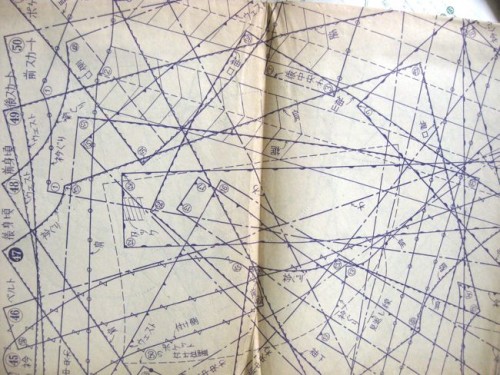
That doesn't look easy
Tutorial: How to make the ‘Deco Echo’ blouse

As promised, and per popular demand, a tutorial on my Deco Echo blouse!

First, a caveat.  This blouse best suits a figure with a small bust and less than 10″ bust/waist difference. If you have larger bust, you could try adding length and side-bust darts.  It would also help to taper the side panels in at the bottom, and to add a opening (either buttons up the CB, or a side fastening with snaps or hooks).

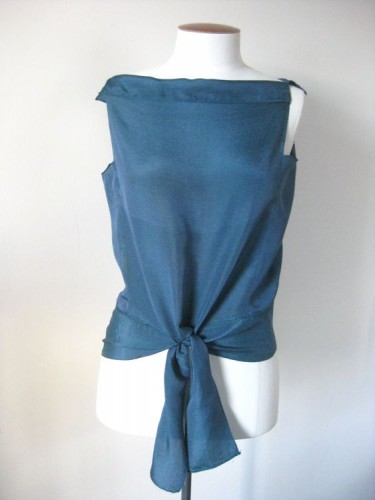
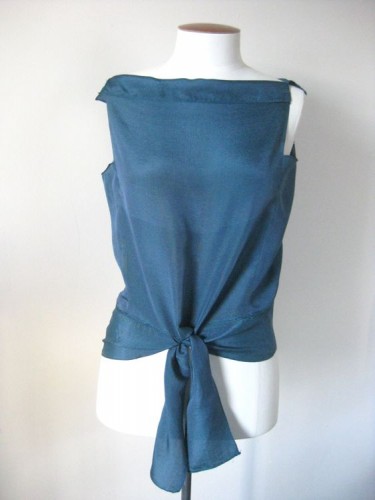
The finished Deco Echo blouse

Fabric: I used the panels of silk crepe from the susomawashi (the lower lining) of a kimono for my blouse.  I recommend lightweight silk or cotton fabrics.  Silk crepes are particularly nice because of their drape.

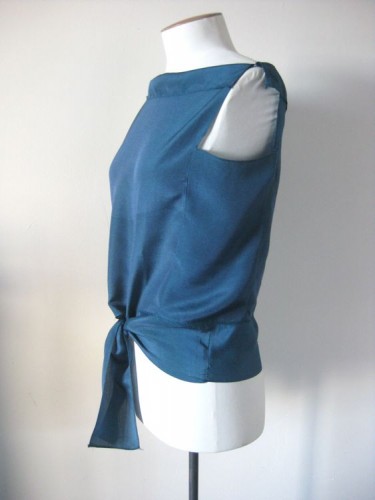
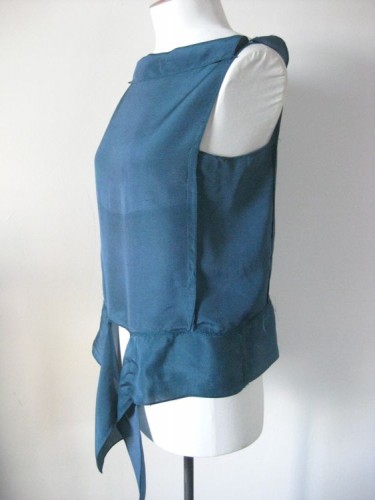
My blouse of silk crepe, side view

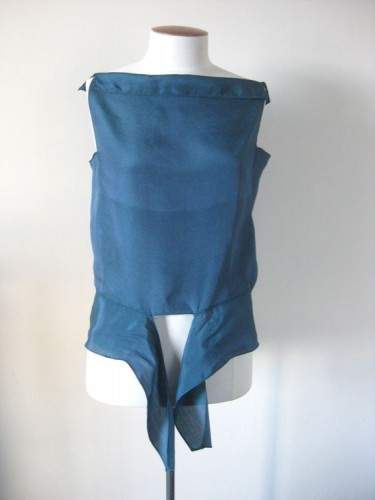
The blouse is made from 5 rectangles – two large ones, two narrow ones, and one really long and narrow one for the waist tie.

The blouse with the ties undone so you can really see the shapes

To make a blouse to fit a 34″ bust you will need:

  • 2x  21″ x  13.5″ (l x w) rectangles – these will be your front and back panels.
  • 2x  10.75″ x  6.5″  (l x w) rectangles – these will be your side panels
  • 1x 54″ x 4.75″  (l x w) – this is your waistband

To make a blouse to fit a 36″ bust you will need:

  • 2x  21″ x  14″ (l x w) rectangles – these will be your front and back panels.
  • 2x  10.75″ x  7″  (l x w) rectangles – these will be your side panels
  • 1x 56″ x 4.75″  (l x w) – this is your waistband

To make a blouse to fit a 38″ bust you will need:

  • 2x 21″ x  14.5″ (l x w) rectangles – these will be your front and back panels.
  • 2x 10.75″ x  7.5″  (l x w) rectangles – these will be your side panels.
  • 1x 58″ x 4.75″  (l x w) – this is your waist tie.
If you are very tall or have a long torso, you may wish to add length to the front/back and side panels.  If you are petite, don’t worry about the length – that’s easy to adjust later on in the sewing process.
  • Step 1: Finishing:  Finish all four edges of all the panels with narrow hem stitching.  It’s important that all the edges are finished nicely, because the finished seams of the panels also form the armhole & collar edges.

    Seam & top edges finished with narrow hem stitching

  • Step 2: Side seams:Sew the narrow side panels to the front & back panels using 1/2″ seam allowances, right sides together, carefully lining up the bottom edges.

    The side front and back seams

  • Step 3: Fitting the sides and shoulders, and checking the length:Hand-baste the shoulders of the blouse together 2 1/2″ from the loose collar ends.  Make sure you do it really loosely – so its easy to unpick if it needs adjusting.  Pull the blouse on over your head.  Check the fit.  Is it too loose?  Take in the side seams.  Too tight?  Let them out.  Check the fit of the shoulders.  If the side panels are too low on you, sew the shoulder tacks lower.  If the side panels are too high, let the neckline out.  Now, check the length.  The bottom as it is should sit right at, or just the tiniest bit below your natural waist.  Remember that you have about 4 1/4″ of waistband to add.

    The inside out blouse with the waist-ties undone

  • Step 4:  The shoulders:   Hand-sew the shoulders together properly – .  Use matching thread, because it will show on the outside (I used white so you could see what I did).  Sew in from the front of the blouse, out the back, and in through the front again, enclosing the edge in your thread.

My sewn shoulder seams

  • CFStep 5:  The waist tie:   Carefully mark the CB & CF points of the bottom of the blouse, and the mid point of the waist tie.  Pin the waist tie to the blouse body, matching the CB of the blouse & the mid point of the waist tie.  Leave a 3″ gap unpinned at the CF of the blouse.  Sew the waist tie to the blouse using a tiny less than 1/4″ seam allowance, or an edge to edge machine faggoting stitch (this is what I did, but it’s a bit trickier), leaving your 3″ gap at the CF.  An easy way to do a cheater machine-faggoted join is the lay the two edges right next to each other, and use the stitch that looks like a zig-zag with running stitches.  

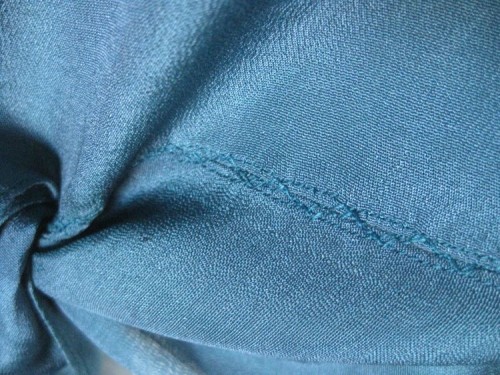
My machine faggoted join

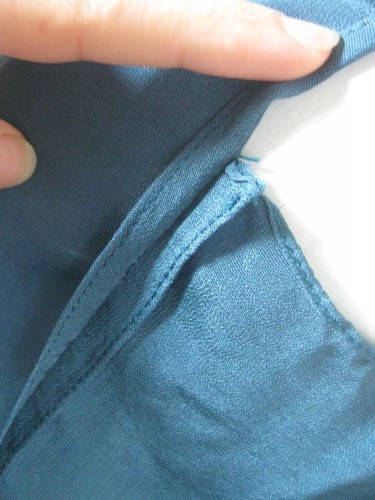
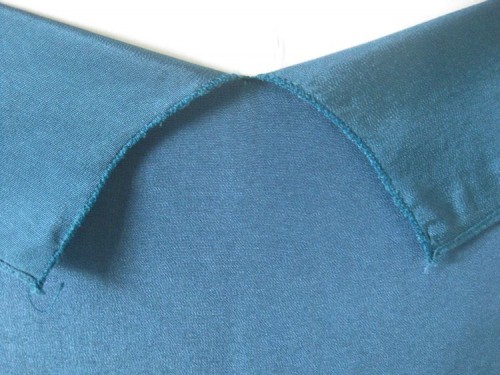
  • Step 6:  The divided back collar:   Carefully mark the CB of the blouse, and cut a line 4″ down from the top of the collar along the centre back line.  Finish the edges of the cut with a zig zag stitch with a moderate length, and the narrowest width (basically, a buttonhole zig-zag).  Reinforce the bottom of the point.  I know it sounds like cheating, but it actually looks quite good!

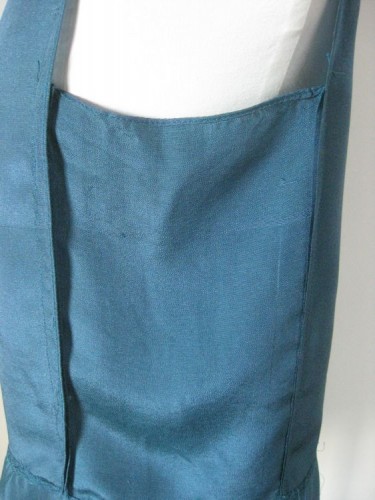
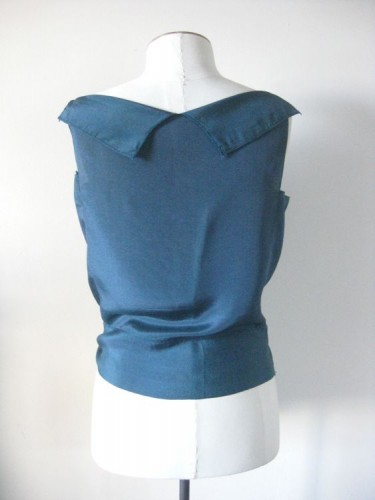
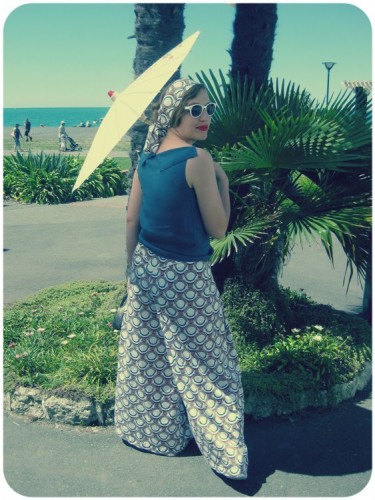
The blouse back

The finished edges of my divided back collar

And that’s it!  You are done!

I had fun making my ‘Deco Echo’ blouse – it was so fast and easy.  And I had fun wearing it.  I hope you have the same experience!

There are all sorts of variants that you could do to this blouse – add a divided collar in front as well as back, or instead of back.  Add a button opening up the back.  Play – have fun!

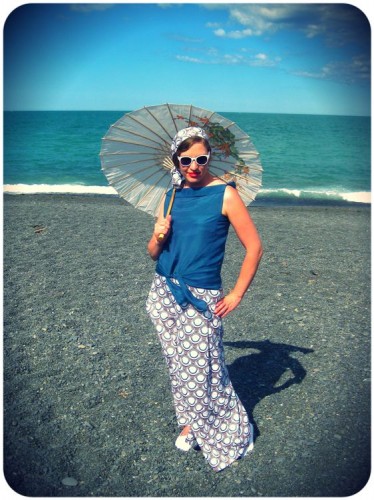
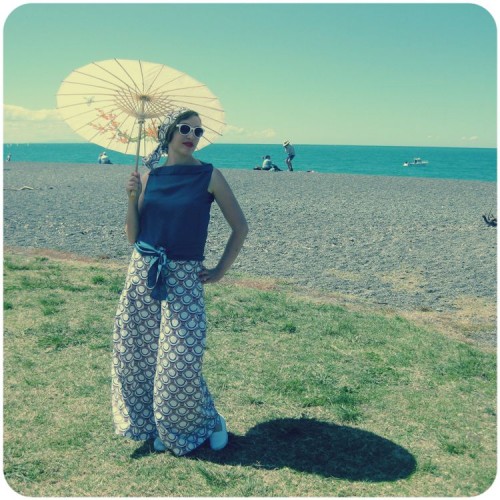
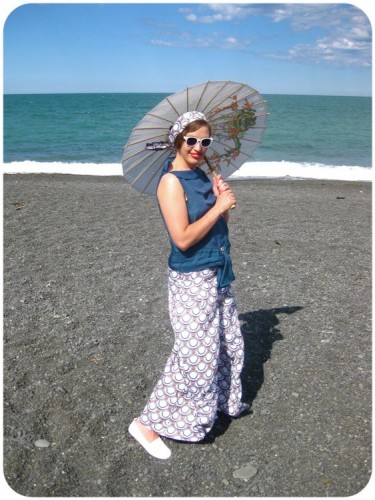
The ‘Deco Echo’ blouse

I’m madly sewing something new and exciting, and working on the tutorial for this blouse, so instead of spending a lot of time on writing a post for today, I’m concentrating on those, and instead you are getting (a slightly better and updated) version of my post for the Sew Weekly  on my ‘Deco Echo’ blouse (I want to have a version on my blog…just in case):

The Deco Echo blouse

______________

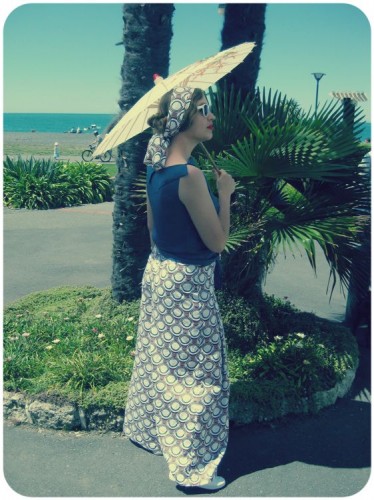
Planning my wardrobe for Art Deco Weekend in Napier,  top of my list of things I really wanted to make was a pair or beach pajama pants made from fantastic Art Deco inspired fabric. Problem. The fabric is maroon and dark teal on white. And maroon and dark teal are not colours I usually buy — it’s just so hard to find fabrics in them that don’t look cheap (why is that that some colours always look cheap in most fabrics?). I don’t own any maroon and dark teal fabrics! What on earth was I going to do for a top? I completely turned over my stash, to no avail. Nothing.

And then…a miracle! I remembered a very damaged (torn and missing a sleeve and most of the lining) 1930s kimono that I had picked up for $5 at the Asia Gallery because the lower lining (the susomawashi) was such a glorious shade of dark teal. The silk lining matched perfectly, but I only had a tiny amount of it — a long thin rectangle piece, and three rectangles each approximately 13″ x 15″ inches. I pulled apart the kimono, washed it, pinned the pieces to Isabella the dressform, and figured I could make a blouse from them.

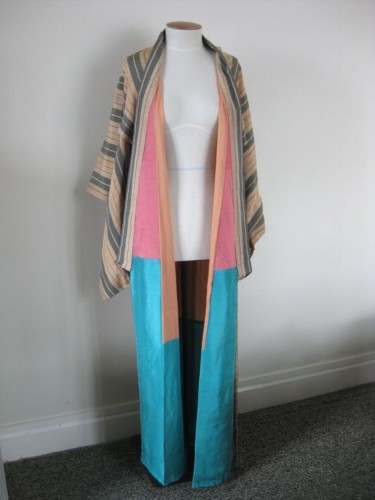
Sadly, I didn’t take a photo of the kimono I pulled apart, but here is a similar one:

A kimono similar to the one I pulled apart, with an aqua susomawashi

I had one of the long panels you can see at the front, and then the three rectangles that go around the hem.

The blouse was super quick. After all, it’s just a series of rectangles. Two of the hem rectangles for front and back, the long narrow one divided in half for each side, and the third rectangle cut into thirds and sewn together end to end to form the piece that goes around the waist and ties in front.

I finished all the edges (including the interior ones) with rolled hems, made a turned back collar in front, and the same in back, with a slit in the CB to form a back V-neck with a split collar — very 1930s.

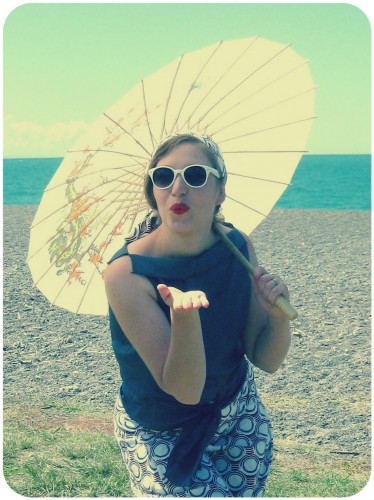
I wore the blouse all Saturday with my beach pajama trousers. It was lovely and cool and comfortable, and great for running around on the beach and taking photos and generally having a good time.

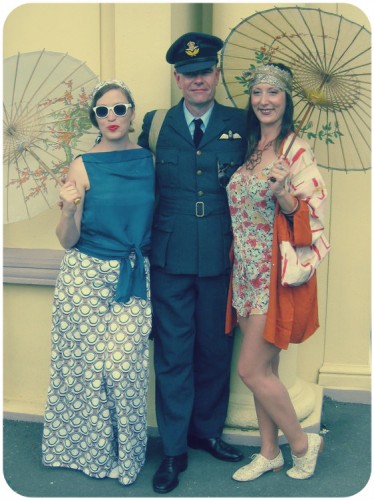
I’m not sure that everyone ‘got’ that it was a reasonably accurate 1930s outfit, but at least this Air Force Officer looks pleased to be posing with me and another beach belle:

I love that this remake looks just like a 1930s garment, but also manages to honour its origins by using the exact shapes of the kimono it started as. The symmetry of a 1930s kimono having its own life, going into a rag pile, being pulled apart in 2012, and becoming a 1930s style blouse makes my heart happy.

Just the facts, Ma’am:

Fabric:  Scraps of silk crepe from the bottom lining of a very damaged vintage 1930s kimono

Pattern:  Self draped (though it’s just rectangles, so it hardly seems fair to call it that).

Year:  2012 does 1932 via Japan with 1930s materials.

Notions:  None!

Hours:  2 hours (not counting ripping apart and washing the kimono)

Techniques used:  Draping, narrow hemming.

Will you make this again?  Maybe.  I love it, but there are so many other delicious blouse ideas brewing in my mind.

Any changes?  For future editions I’ll reinforce the front more and angle the buttons and pleats for a more flattering line.

Total cost:    $5 (though I still have all the outer kimono silk to play with, so really, $1.50 or so)

And the inside?:  All the raw edges are narrow hemmed, and I used the natural finished edges of the kimono fabric, so its reasonably snazzy.

The blouse was so easy to make that I’d make it a dozen times more if I thought the weather would support that kind of wardrobe. Alas, as that isn’t the case I’ll be posting a tutorial on how to make it tomorrow, so that at least other people can try it!