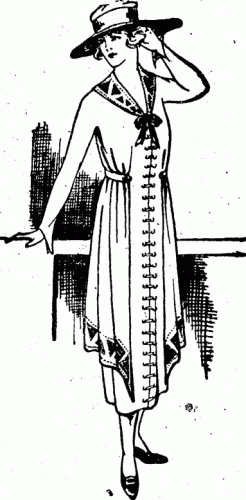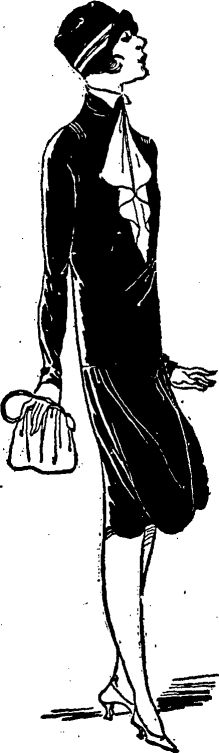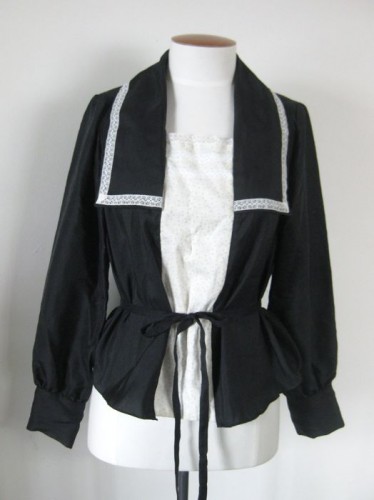
In designing costumes for the Home Show, I consulted hundreds of photographs of New Zealanders during WWI, and noticed that many women were wearing blouses similar to the classic 1910s blouse pattern: Folkwear #210, the Armistice Blouse. I’ve had this pattern for years, but never used it. Perfect opportunity to make it up for Maggie!
(apologies in advance for the dreadful photographs of the pattern. I spent all day hunting for it, and finally found it once the light was gone. I’ll take better ones tomorrow and replace them)
What it is:
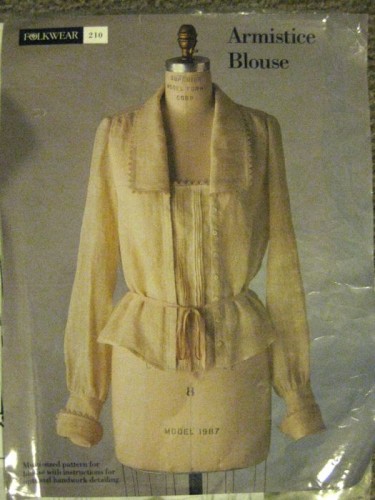
The pattern
A pattern based on blouses from 1915-1919. It’s not clear if the pattern is based on an extent blouse, extent patterns, or just a sampling of the most common blouse characteristics from this period, though I really suspect from making it up that it isn’t 100% historically accurate.
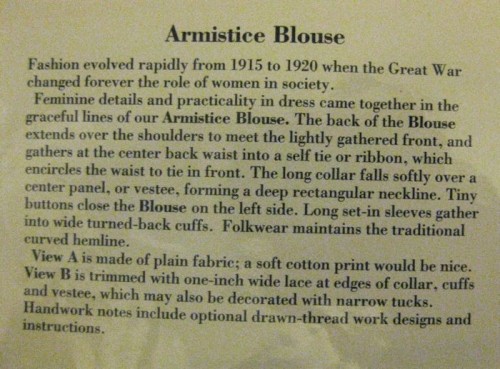
The description of the blouse on the pattern
It comes with options for a drawn-thread-work front, or a pintucked front, and for lace trim.
My version:
My version is made of a hard-wearing, washable black silk with a slight slub (I made Mr D a shirt out of this fabric before he was Mr D, some 7 years ago, and it’s still going strong, so I know the fabric is robust). Too add drama and a sense of change when Maggie’s maid apron comes off, I did the front panel out of a contrast fabric: an ivory cotton with woven in stripes and a faint floral pattern. It’s trimmed with a delicate cotton inset lace on the collar.
I did the front piece without drawn thread work or pintucks: both are too fussy and delicate for theatre wear. I did, however, do three lines of inset lace, just to give some sense of detail and handwork, and to tie in the lace trim around the collar. Rather than having button fastenings down one edge of the front panel, I sewed the front closed at both edges, leaving it open on the PR edge under the collar, where it fastens with snaps (domes). It’s still easy to pull on and off over the head, but gets rid of the tricky front fastenings.
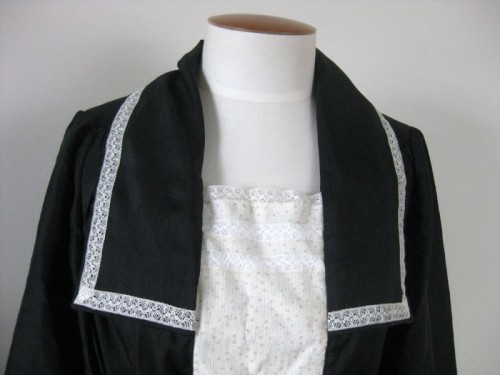
The front panel, with fastening hidden under the PR collar edge
I also added a pleat to the centre back, to give Rowena a bit more stretch and ease across the back as she hangs out laundry and dusts onstage. For such a simple thing, I’m inordinately pleased with it.
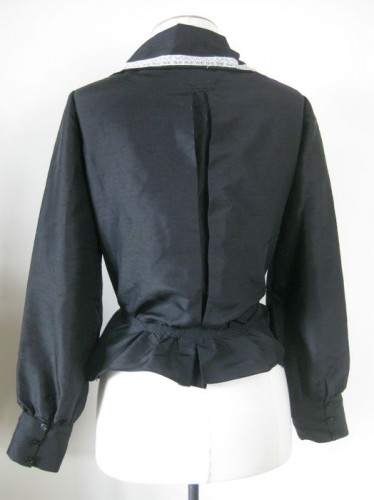
The clever centre back inverse box pleat
I also omitted the turn-back cuffs (see ‘The Ugly’ for why), and raised the neckline 2″, to fit with the conservative fashions Maggie would have worn.
As this is for theatre and needs to be robust (and sewn by me, and thus obsessively finished) all the interior seams except the shoulder seam are finished with French seams. The shoulder seams are bound with bias tape. Nothing to fray or catch anywhere!
The Good:
The pattern is relatively simple, relatively historically accurate, but also wearable in a modern setting, easy to adapt to different looks, and attractive. And it really does represent a very common style for the era. The instructions are reasonably historically accurate, but not quite exact.
The Bad:
There are four five things that are difficult/tricky/irritating or just wrong about this pattern: The instructions, the front facing, the sizing gradients, and the sleeves.
First, the instructions aren’t always clear. It’s tricky to figure out what the options are and what pieces to use and omit for each option, and there aren’t illustrations for Option A. Once you do figure that out, the sewing instructions are a bit vague and confusing. I did a lot of unpicking, grumbling, and pinning pieces on Isabella to figure out how they went together. Once you figure it out, the blouse is really easy, but the technical writing on the pattern leaves a bit to be desired.
Second, the pattern has you cut a long, narrow, barely curved front facing, which you then finish along one edge with a narrow hem or a back fold, and stitch down to the main blouse fabric. This is ridiculous. It’s tricky to cut, tricky to hem or back fold, tricky to install, a pain to sew down,and doesn’t look that good in the end. A piece of bias tape fulfills the same function much better, with much less work, and it’s already basically finished. And yes, I’ve seen bias tapes and twill tapes used for similar functions in 19teens garments, so my option is historically accurate.

The facing that should really just be a bit of flat fold bias binding
Third, the sizing gradiations are ludicrous. In many places they are so slight as to be well within the slight variations that will happen with cutting, meaning that the smaller sizes are a little big, and the bigger sizes not big enough (something other people who have made this have noticed).

The SA given is 1/2", so you can see how tiny those gradients are
For the fourth issue, as other reviewers have pointed out, the sleeves on the pattern are ridiculously too long. I measure all the primary measurements on my patterns against my measurements (or, in this case, the measurements of the actor) before cutting as a matter of habit, so it wasn’t a problem – I immediately noticed the sleeves were 2″ longer than Rowena’s shoulder to wrist measurement, and did my adjustments before I cut. I have longer arms, so the sleeves are 1 1/2″ too long on me. I can’t imagine that there are many people who would find the pattern sleeves to be the right length as they are.
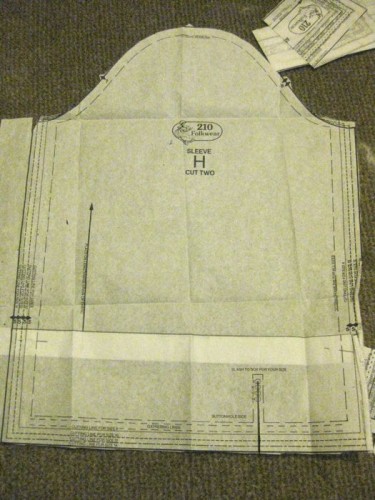
My shortened sleeves pattern
Finally, for the fifth issue, which I remembered after writing the rest of the review, there is the little problem of the waist tie. Folkwear has you cut turn, and sew, an incredible long and thin tie. So annoying! Especially when you go to sew it on and realise that it is a good 15″ longer than it should be (after all, you don’t want the front bow hanging to your knees), meaning that you either have to trim from either end, or cut from one end and sew it with the seam in it off-centre (which is what I chose to do). And then you look at their pattern illustration, and realise that they didn’t bother doing the waist-tie for their blouse – they used a piece of twill tape! And there is no way they cut it as long as the tie pattern piece. So annoying! The instructions should definitely give using a piece of twill tape or ribbon as an option.
The Ugly:
I really don’t like the turn-back cuffs. They are odd, tricky to do, and don’t look right to me. I haven’t found many extent examples or historical patterns with this cuff either, so I omitted them from my pattern. Easy to do.
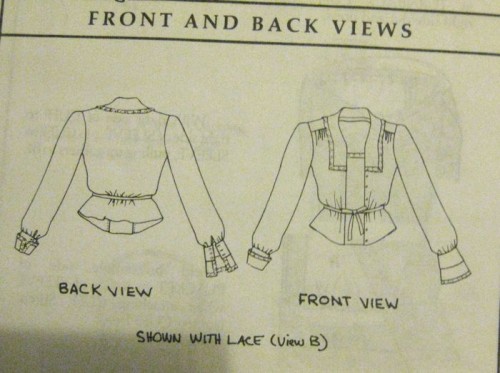
View B with the turned-back cuffs (no illustration of View A is given)
The Verdict:
A good, easy, basic 19teens blouse pattern, with a few flaws. Know the flaws, know to watch out for them, and it’s good as gold.
7 out of 10