Latest Posts

Finished project: The Summertime Southerly 1931 dress

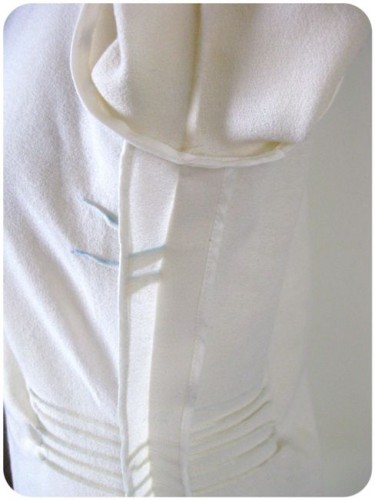
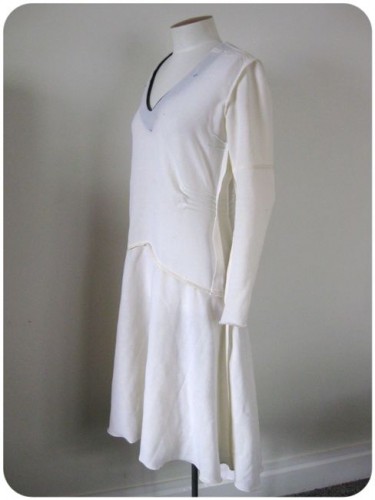
I’ve finished another dress this week: a wool crepe dress from a 1931 pattern.

I killed two birds with one stone with this dress: this week’s theme on the Sew Weekly was ‘Down Under’ (sew something from the opposite season to the one you are experiencing), and next week’s theme is ‘UFO’.  This dress does both.

Well, sort of.  It’s definitely a UFO: I started it at the beginning of spring, with the idea that if I sewed a wool dress Murphy’s law would the weather would definitely be too warm to wear it!  The weather may have cooperated, but the dress got set aside when other stuff became more pressing.
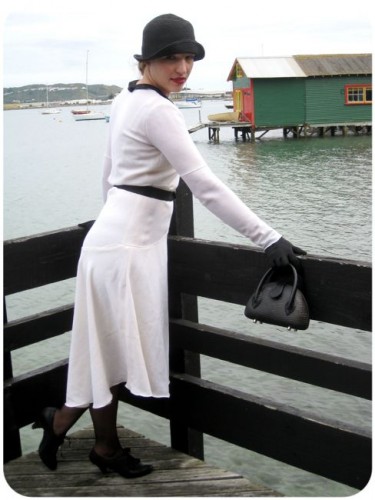
The ‘Down Under’ challenge was a bit murkier.  The whole idea of ‘seasonal’ weather in Wellington is just ridiculous though.  We are the land of four seasons in one day (yes, I know you have that stuck in your head now.  You’re welcome).  On various days this week I’ve been in jeans, wool tops and wool socks, and shorts and a singlet.  What on earth is seasonal appropriate weather in Wellington!?!
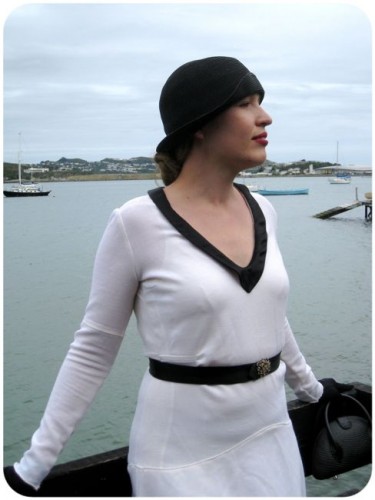
I went for a dress to wear all year round, and never: too warm for summer, not warm enough for winter, no good in a stiff breeze, but charming nonetheless.  I’m calling it the Summertime Southerly.  One of those things that shouldn’t exist, but does.*
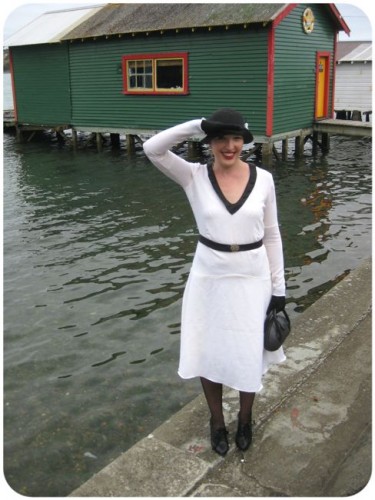
Southerlies in Wellington are stiff winds that blow straight off Antarctica, up the Cook Straight, and into Wellington, where they chill you to the bone no matter the time of year.  Sometimes in the summer they come as light breezes, rather than stiff gales, and those days are perfect for dresses like this. So are still days in winter.

I’m reasonably happy with the dress.  I still want to find the perfect buckle to go with the belt, and am going to re-finish the cuffs with black satin bias tape.  And wear it with a better slip.  And I wish I had given the side seams Hong-Kong finishes AFTER I fit the dress, because I ended up taking in a LOT of fabric with the fitting, and it’s all still there.

Just the facts, Ma’am:

Fabric:  2ish metres of thrifted vintage 100% wool crepe (the fabric had pieces cut out of it already, and I forgot to measure it before I cut, so I can’t tell you exactly how much there was.  Trim of vintage black silk satin from an obi.

Pattern: Excella E3169 ca. 1931 without the cape, with long sleeves.  This is the same pattern I made the Frumpy Dress from.

Pattern alterations:  The collar is a not-very successful self-draft.  And I didn’t have enough fabric to do the sleeves properly, so I pieced them along the line where the hem would be for a short sleeve.  If I get tired of the long sleeves I can just unpick the bottom half!  I also dropped the back hem just a bit to add flair to the skirt.  (See Steph, I don’t dislike mullet skirts!)

Year:  ca. 1931

Notions:  lots and lots of thrifted cream bias tape to finish the inside.

Hours:  Ergh.  Lets not go there shall we?

Techniques used:  French seams, Honk Kong seams, pintucks, rolled hems, and a tiny bit of pattern drafting..

Will you make this again?  The pattern?  Yes!  But not in wool crepe.  It’s much better as a proper summer dress in floaty chiffon.  And I’d rather save the wool crepe to make stuff like the Dress Clip Dress.

Total cost:  Don’t remember exactly, but under $3 for the fabric.

And the inside?:  bias-bound Hong Kong seams at sides and waist, french seamed sleeves, hand stitched collar.  All rather decent.
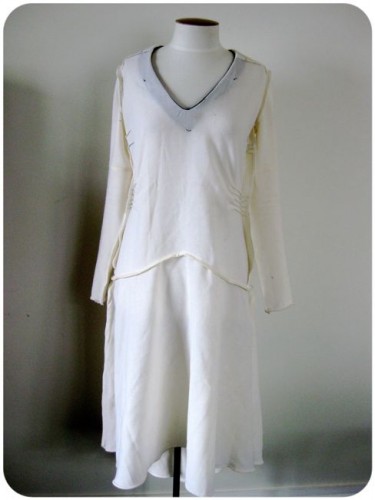
*I was going to call this the Edna dress, because it reminds me of a 1920s photo of Edna St Vincent Millay.   Then a friend pointed out that the juxtaposition of ‘Down Under’ and Edna really wasn’t a smart move.  It took me a minute, but I had to agree that I didn’t want people thinking Dame Edna!
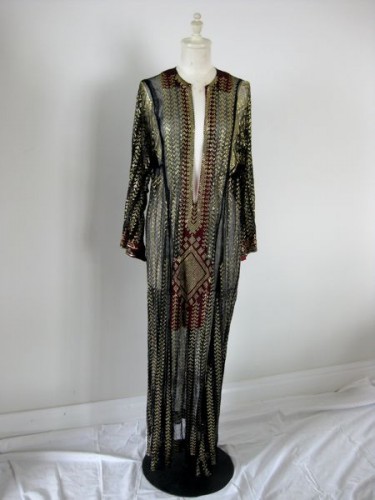
Elise’s gift: the 1920s tunic

Sometimes my life is really amazing.

Almost two years ago Elise asked me about inspiration for an Art Deco wedding gown.  I posted a whole week’s worth of pictures.  We chatted a bit by email, she picked the most adorable modern Art Deco dress, and I sewed and sewed.

And then she contacted me again: her mother had given her a bunch of 1920s and 30s clothes from a museum clear-out.  Would I like them?

Would I!?!

So I paid shipping and Elise sent me a box of gorgeous vintage things which I drooled over and meant to show you right away and just got caught up in too much other stuff and didn’t get around to photographing.

But now, months and months and months later, I have.  So for the next couple of months I’ll be showing you images of the stuff Elise sent, and giving a bit of info on dates and background and stuff.

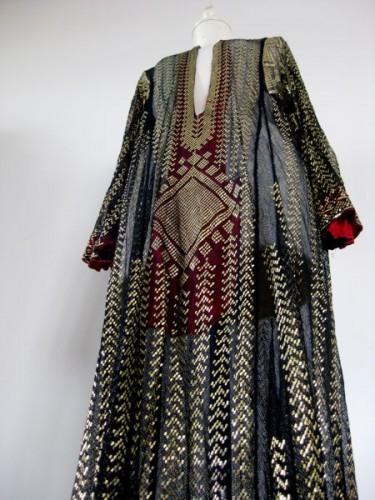
And because I’m nice, I’ll be showing you the most interesting garment first: a spangled gold on black tunic.

Tunic, front view

All the clothes probably came from a museum in Houston, Texas.  The few that have labels have Houston labels.  And you are thinking “what does that have to do with this tunic?  It doesn’t look very Texan”

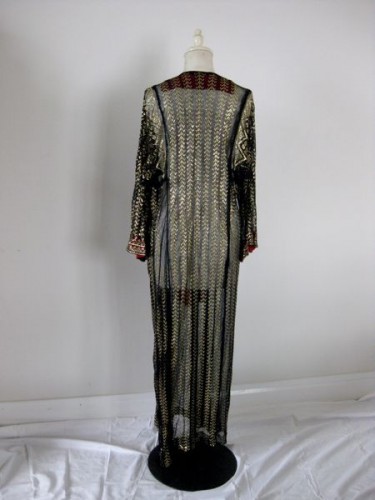
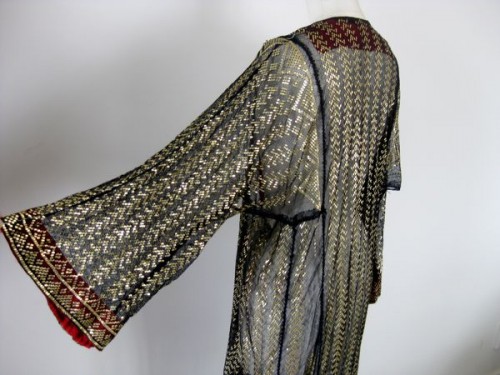
Tunic, back view

And you are right.  The tunic almost certainly didn’t originate in Texan.  It is almost certainly from North Africa or the Middle East.

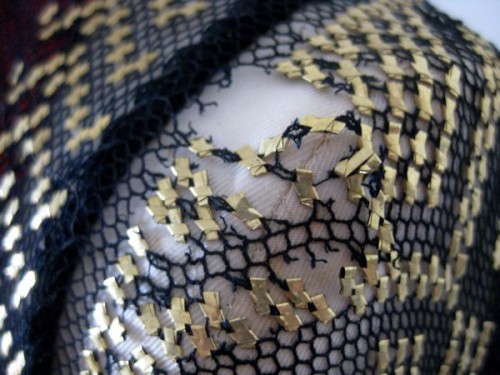
Detail of the metalwork on net fabric

The 1920s saw a huge interest in Egypt and the Middle East, partly because of WWI and all the soldiers who visited that area at the time, partly because of archeological finds like the 1922 discovery of Tutankhamun’s tomb, partly because of the Ballets Russes and their Eastern-inspired visual design, and partly because of a new English translation of the One Thousand and One Nights in 1923.

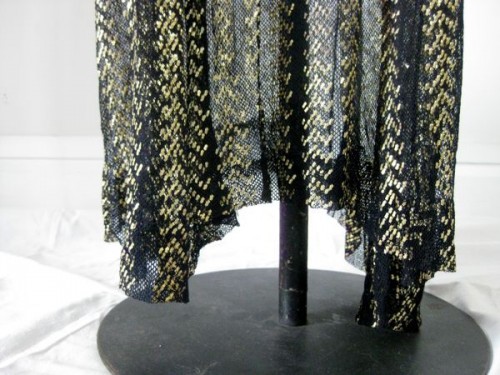
The irregular hem, and turned-up hand hemming

High Society Houston in the 1920s was incredibly wealthy, and quite avant-gard and innovative.  Elise said she could just imagine a Houston socialite  in this dress at a soiree at the end of the 20s.  It might even have been a masquerade ball, or an ‘Oriental’ themed party, such as the 1002 Night party that Poiret was famous for.

The tunic may have been imported into the US, though the market for Middle Eastern and North African imports and textiles never reached the volume of the Far Eastern textile exports.

It’s more likely that the wearer bought the tunic on a Grand Tour, which would have included Egpyt and Jerusalem, as well as other parts of the Middle East.  What an amazing souvenir!

The tunics sleeves

The tunic would have been worn over a slip, probably of red silk to match the vivid red cotton the lines the neckline and the sleeve edges.

Red cotton cuff linings

The material of the tunic itself is net: almost certainly made of cotton.  The really exciting thing about the tunic though, is the metalwork.  From a distance you might think it was ordinary metal pailettes sewn onto the net, but it’s not.

Instead it’s something amazing and unusual that I have never seen on any other vintage garment: little rectangular strips of soft metal, folded through the net and then wrapped around itself and crimped down.

Details of the metal folded through the net

As the metal hasn’t tarnished or oxidized in any way I suspect it actually is at least partly real gold.

Brilliant gold metal patterning on black net

It’s certainly heavy: the tunic weighs an impressive amount.  Because of the weight, it’s quite fragile as you handle it.  I prefer to have helpers to put it on a dressform, so that there are extra hands to support the hem and sleeves.

Once on a body or dressform the shoulders and bulk of the body support the tunic, and it’s actually very robust.  Sadly, it did have some damage when it arrived from being hung for storage or displayed on the wrong dressform.

The damage: little rips on one shoulder

Because of the weight and fragility, and to keep the metal from catching on the net or any other material, I store this in a padded bag, with a slightly padded piece of fabric slipped through the middle, to keep the front and back from catching.  With the tunic in, the padded bag gets rolled up.  The padded bags are something that many museums use to store heavily beaded garments, such as 20s evening dresses, as they support the weight and protect the beads from catching.

The sleeve backs and the piecing of the garment panels

Someday (when I find the right fabric) I’ll make a red silk slip to go under the tunic, so that it can be displayed properly.

Thank you Elise for the amazing gift!

Terminology: What is a Pierrot jacket?

This week’s terminology post is by a guest author that many of you will be familiar with: Lauren Reeser of American Duchess.  We all know Lauren for her gorgeous 18th century recreations (and other eras), but mostly for her amazing, fabulous reproduction historical shoes.

In fact, pre-orders for the delightful early 20th century ‘Astorias’ close on the 3rd of Feb (just two days from now) so hurry if you want to nab yourself a pair at a discount!

Instead of talking about shoes, Lauren is going to discuss the history of one of her favourite 18th century garments:

~~~~~~~~~~~~~~~~~~~~~~~~~~~~~~~~~~~~~~~~~~~~~~~~~~~~~~~~~~~~~~~~

Those of you who are into 18th century costuming may be familiar with the various styles of jackets that became popular in the second half, and particularly the last quarter, of that century.

Woman's jacket, brown printed cotton ca. 1790, France, Acc. No. 1991-520, Colonial Williamsburgh

The most common tag for a jacket is “caraco,” but within that vast and over-used term, we have most commonly the casaquin, pet en l’air, and pierrot. Each of these has its own styling cues, and interesting origins of their names.

How about “pierrot” though? First off, what exactly is it?

A pierrot is a jacket style that became very popular in the 1780s and 90s. It consisted of a bodice with a ruffled “tail” in back. Sometimes pierrot jackets closed in front, and sometimes were made in a zone front style. The ruffled skirting in back could be various lengths, with any sort of trimming, and were most commonly added on to the bodice at the waist seam, but many fashion plates show them cut in one with the back of the bodice.

Pierrot Jacket, ca. 1785, French, Metropolitan Museum of Art

So why is it called a “pierrot?”

The literal French definition of just the word “pierrot” is “sparrow,” which makes a lot of sense when looking at the style of this jacket. They show a puffed up front, like a bird’s breast, and a little fluffy tail out the back. The French liked to name some of their fashions after animals, for instance, the Hedgehog hair style (“Jeune dame coeffee au herisson…”), so it may seem that “pierrot” was meant to say that the wearer of such a garment was like a little bird.

Birds - Tibetan Snowfinch Montfringilla adamsi by Adams, 1867-72 & a Pierrot in the Journal de la Mode et du Gout, April 1790

Or a fool.

When alone, “pierrot” may mean sparrow, but in a sentence, the meaning changes to “clown.” This is referencing a specific clown, also named “Pierrot,” who, as part of the initially Italian Commedia dell’Arte, became a prominent and popular figure in French pantomimes, beginning in the late 17th century, and gaining in popularity throughout the 18th century. (1)

Antoine Watteau, Pierrot, 1717-1719

In Pierrot-the-character’s case, his name is diminutive of Piero or Pier, or Pete. He is literally Little Petey. Initially the Pierrot character was a buffoon and badly defined, but he began to change in the 18th century, and take on the roles we know today – the sympathetic, lovesick clown in the floppy white suit. By the 19th century, Pierrot had become completely poeticized.

So what does this have to do with 18th century jackets?

The French loved to label their fashions with satirical names. The “reticule” is a common one, supposedly derived from “ridicule” or “ridiculous.” “Pet en l’air” translates to “fart in the air.” One hat style found in the Galerie des Modes is labeled “Bonnet au mystere ou Chien Couchant,” which has something to do with mystery and hunting dogs (setters). Several descriptions including the word “pierrot” could be translated as “clown,” for instance, below, “…a clown back with buttons of steel tile…” and “…clown with a stripe skirt trimmed with gauze…”

Pierrot Jacket, 1787. Translates to "a clown back with buttons of steel tile.", via the MFA Boston

Illustration of a pierrot jacket, 1787. The caption translates as: "clown with a stripe skirt trimmed with gauze" MFA Boston

It may be more likely that the jacket style, with its ruffled tail, may have more to do with Pierrot the clown that a sparrow. Pair this idea with the typical white skirt worn with pierrot jackets, in relation to the Pierrot character’s baggy white suit, and additionally the white powdered face of the clown in relation to the popularity of white makeup in the 18th century, and we may have made our connection.

A pierrot in the Journal de la Mode et du Gout, February 1790

Perhaps the French are having a laugh at themselves, but there could be something else at work here. The pierrot jacket became popular in the late 18th century – 1780s in to the 90s – just before and then during the French Revolution. Just as the Revolutionaries had specific clothing to indicate their political associations, those who opposed the revolution also had their own look – for women, the “costume catholique,” which consisted of a pierrot jacket, white linen skirt, red and black shawl, black bonnet, and a white feather, each symbols of the ancien regime. (3) The name “pierrot” may have come from the Revolutionaries, meant to be an insult.

It is difficult to pin down exactly where the fashion term “pierrot” came from, especially as an English speaker, but perhaps these thoughts have given some insight. What do you think?

(1) Source: http://en.wikipedia.org/wiki/Pierrot
(2) Source: http://www.allaboutclowns.com/pierrot.html
(3) source: The Lure of Perfection: Fashion and Ballet, 1780-1830 by Judith Chazin-Bennahum)
http://www.venetianmasksshop.com/history.htm
http://www.allaboutclowns.com/history.html
http://www.britannica.com/EBchecked/topic/448641/Pedrolino