Latest Posts

Shell’s dress: draping the bodice (finally!)

I’m sure some of you were wondering if I was every going to get to this point on Shell’s dress.

Yes!  It’s here!  It’s done!  After an afternoon in Mrs C’s sewing room and another in mine all the ruching on has been draped on Shell’s bodice, and here is how I did it.

First I sewed on the blue silk taffeta bindings from the back, but didn’t sew them down in front.  Then I basted on my first draping panel, and stood back to admire how beautifully it draped:

Beginnings

Then I told Shell that she wasn’t going to be able to sit down, eat, or use the loo for the next four hours while I did the ruching on her bodice:
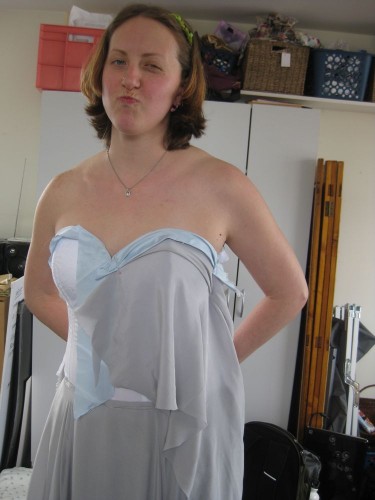
I don't think she likes that very much

With the bride under control, I began controlling the fabric, carefully pinning a pleat at the bodice centre, tacking it as it curved across the bust, and then pinning it at the side seam.
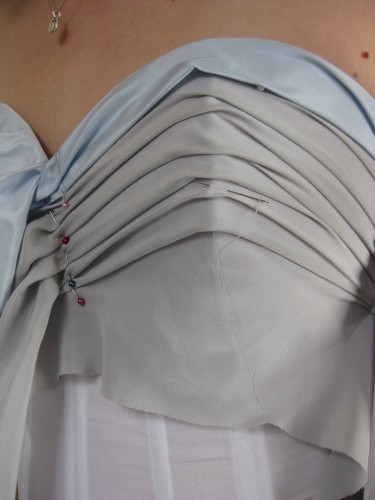
Carefully pinned and basted pleats

It’s very time consuming and detailed work: getting all your pins in the right place (as opposed to the bride, or your fingers!), having three or four needles going at once to baste all the ruching down, and making sure that the fabric tension was even.
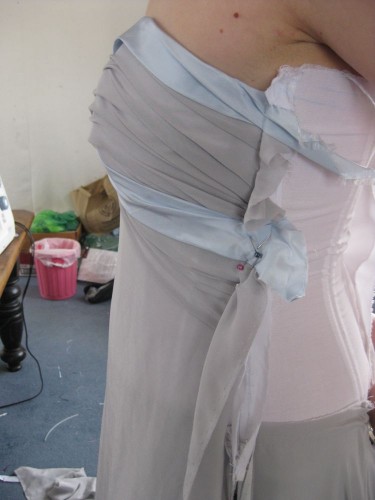
The basted side draping

It was exhausting, for me and the bride.  Every 20 minutes or so I would take a break to stretch my fingers, and Shell would get to sit down for a bit.
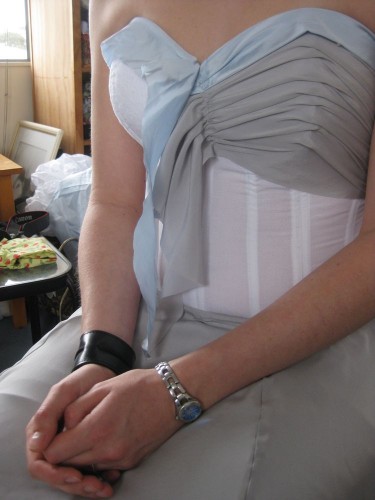
Beautifully stitched down ruching, and sat down bride

She would take the opportunity to let the world know the current status of her wedding dress.
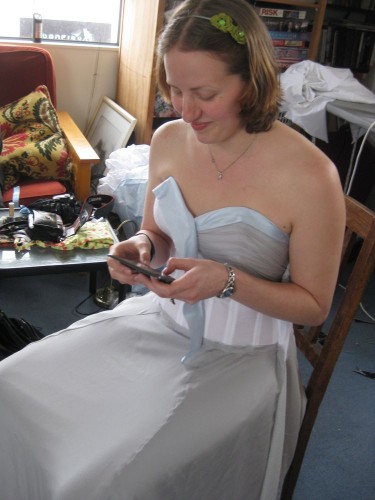
The modern bride: An in-draping facebook update.

After an hour and a half of draping, we needed more than just a rest, so I popped down to the dairy (corner store) for high-calorie reinforcements: crisps and candy bars.  Crisps (potato chips) are not the best wedding dress food: all that grease won’t come out of silk!  So Mrs C came to the rescue with an apron and tongs.
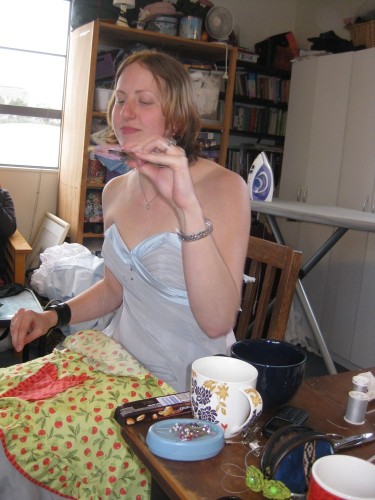
Tongs: how to eat crisps without getting your dress dirty

Refreshed, we pressed on, and I got almost all of the front draping done that afternoon.
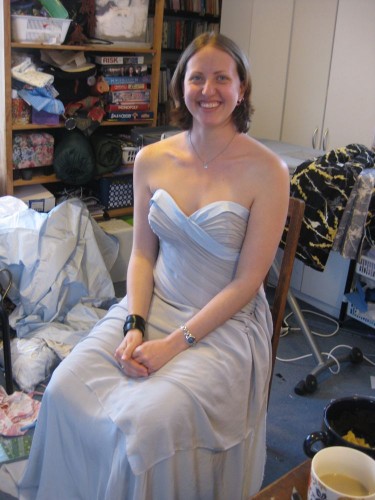
Front draping almost done!

I was pretty knackered by this point, as was Shell, so we called it a day, I took the dress home, turned some of my basting into proper stitching,a nd we attached the dress again the next day in my lounge.
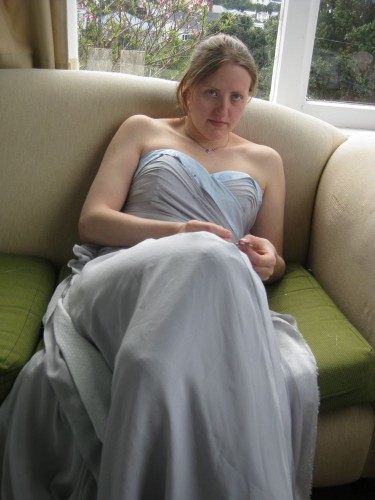
More status updates

I learned something interesting doing the back draping.  My left hand is so much weaker than my right that draping from left to right on the left side of the bodice back took almost twice as long as the right, and was much harder to get right.  I didn’t notice it doing the front of the bodice, because it isn’t symmetrical.

It all looks a bit wonky in the photo below because the skirt side seams aren’t sewn together, so pull apart, and the bodice is pinned very loosely, but it really is almost done!
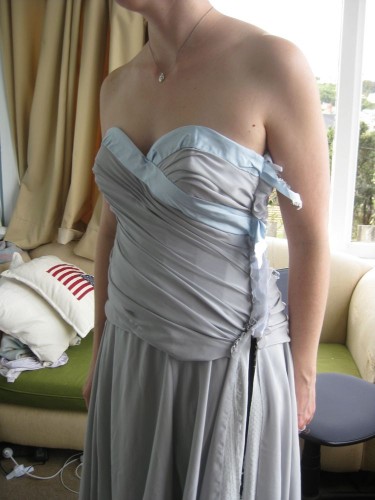
The front and back draping with basted side seams.

 

More terminology: What is a pardessus?

Continuing on from my post about guimpes, I’ve been noticing all sorts of costuming words that I see, and can guess what they mean, but never properly research.

My latest word is pardessus.  V&E posted a gorgeous 1874 pardessus pattern that started my research.

Pardessus, unglamorously enough, just means ‘overcoat’, from the French ‘passed over’.

We can see the term, or variants of it, used in early French fashion magazines.

Fashions from Gezsler Mode, 1814

The notes for this fashion magazine from 1814 described the garments as

 1. Robe de Levantine et fichu-canezou garni en broderie. Chapeau en Gros de Naples garni dune ruche de gaze.
2. Canezou de velours. Jape de reps garnie en rouleaux. Chapeau en velours epingle garni de plumes d’Autruche.
3. Par-dessus four-6 en merinos garni de chinchilla. Toque de velours plein garni de roses.

The term pardessus gained popularity in English in the 1840s as a term to describe a mantle, along with pelisses, paletots, camails, and crespins.  Mentions of pardessus are most common in English fashion magazines in the ’40s & ’50s, and American in the ’60s.

At first the term was used almost interchangeably with paletot for a short to half-length coat, though there seems to be a quirky distinction in that pardessus was often, though not always, trimmed with fur or velvet.  Occasionally an almost full-length coat-cape was called a pardessus.

A pardessus could be either quite loose, or fitted at the waist, depending on the wearer and the fashions of the season.  A June 1848 fashion article describes

The pardessus were never prettier than this winter; the forms are various, whether in velvet, satin de chine, casimir or drap cachemir; those for young ladies, of satin a la reine, are with sleeves and made close to the waist.

The design of the pardessus would also depend on the inspiration, with pardessus inspired by seasons, historical & mythological figures, such as Madame de Maintenon, as well as exotic cultures, such as the Turkish inspired ‘pardessus bizantin‘.

Here are some examples of 1850s & 60s pardessuses (pardessi? pardessusen?  or is the name plural itself?).

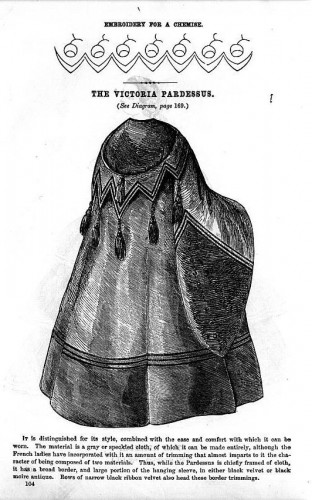
An unfitted late 1850s pardessus with cunning zig-zagged and tasseled faux-hood:

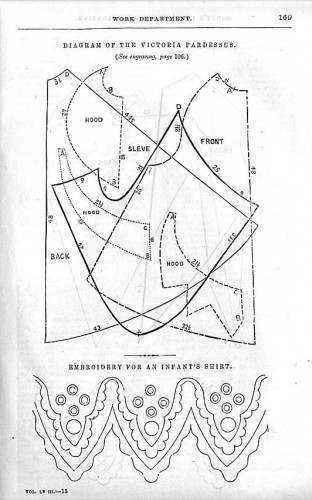
The Victorian Pardessus, Godey's Ladies Book, Feb 1859

And it comes with a pattern!

The Victorian Pardessus, pattern, Godey's Ladies Book, Feb 1859

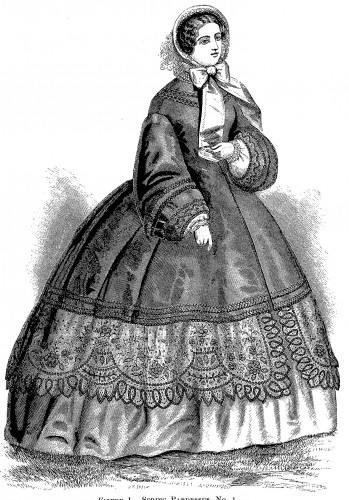
The caption for these two pardessuses from 1861 reads “We illustrate two styles of Spring Pardessus, which are among the most pleasing of the season. They are made of silk of two colors, and ornamented with passamenterie and lace”.

"Spring Pardessus, No. 1", fashion plate from Harper's Monthly Magazine, 1861

"Spring Pardessus, No. 2", fashion plate from Harper's Monthly Magazine, 1861

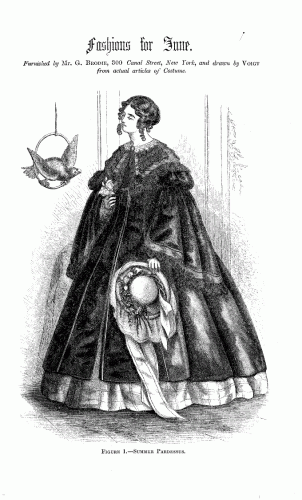
Like the Spring Pardessus No 2, this pardessus from 1861 is almost floor-length.

Pardessus, Harpers, Summer 1861

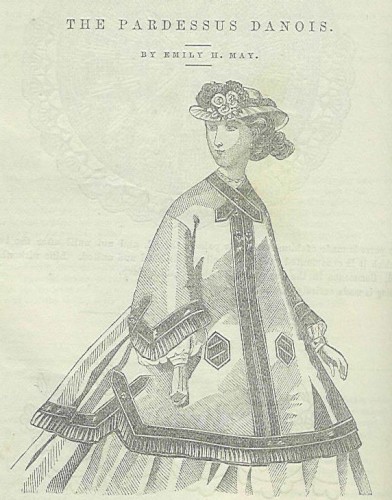
In 1863 we see another, unfitted pardessus.  The pattern for this one is given here.  As you can see from the pattern, unfitted they are a very easy, basic shape.

Pardessus Danoise, Peterson's Magazine. August, 1863

Want to some real woman in a pardessus?

The Viscountess Somerton’s unfitted pardessus has the classic fur trim, though she may also have called her coat a paletot.  (on a side note, does anyone else look at her hat and want to start singing “Whip it”?)

Viscountess Somerton, May 24 1861

And to make things even more obscure, here is the famous (or infamous, depending on how you look at it) Countess de Castiglione posing in a photograph titled “Le pardessus dècore”, though we can’t be sure if the title indicates the exact garment, or just that she was covered.

Le pardessus dècore (feat. the Countess de Castiglione), 1860s, Pierre-Louis Pierson

In the 1870s the pardessus changed.  An 1875 fashion article describes the change:

The new pardessus…is made rather full, long in front, falling at the sides, but short behind; the sleeves are wide.  When the pardessus is in malatesse it is generally trimmed with feathers or fur, but when in cashmere or sicilienne; lace, beads or spangles are preferred.

You know what that sounds like?  Long in front, short behind, wide sleeves?  That sounds like the infamous Pingat mantle.

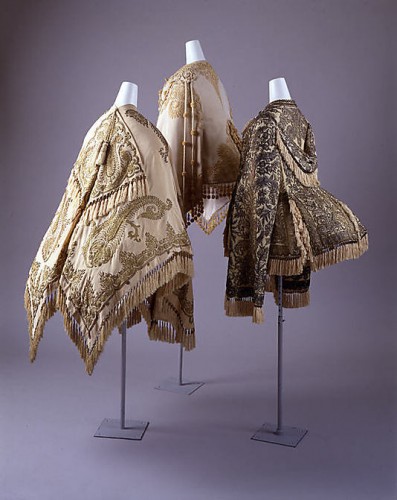
Yep, that’s what pardessus became after the 1870s!

Three mantles (pardessus), 1870-75, French, Met

By the 1880s pardessus as a name for a specific garment (as opposed to a general term for an outer wrap) seems to have fallen off.  An article from 1887 describes how changing fashions make extra outergarments superfluous, and how “the redingote has taken the place of the pardessus.

And so ended the fashion


Spring shoes

Spring has come to New Zealand.

In fact, it’s almost summer.  My spring flowers are almost finished (and I managed to not inflict a single post with macro images of them on you this year), and I heard the first cicada of the year last week.

To celebrate, here are a rainbow of pretty, pastel-y, spring-y shoes.

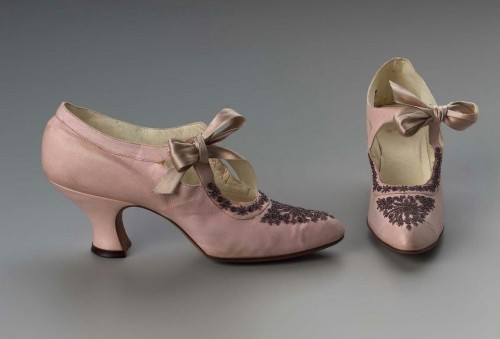
There are pink ones:

Pink kid shoes, Early 20th c, American (Boston), MFA Boston 53.1063

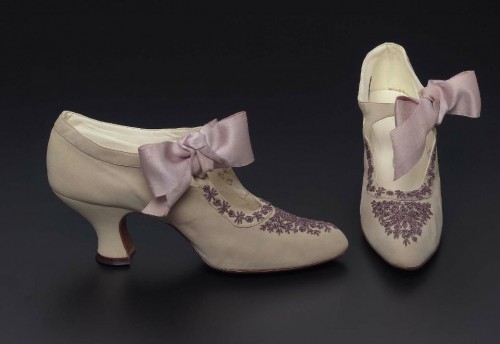
And purple ones:

Light purple suede shoes, Early 10th Century, American (Boston), MFA Boston, 53.1064

And green ones:

Green silk half-boots, 1818, MFA Boston

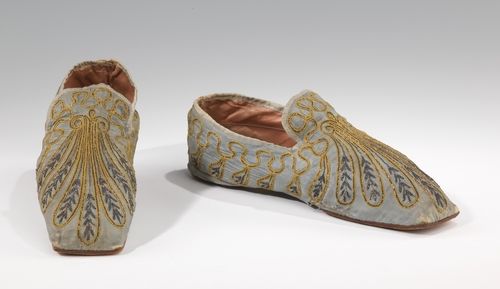
And blue ones:

Blue slippers, 1835-40, Met

And yellow ones:

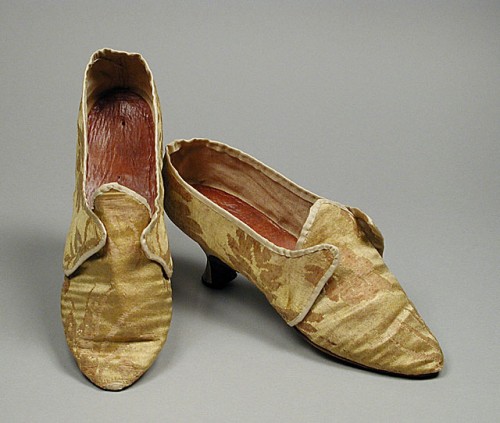
Yellow silk brocade shoes, England or US, 1782-83, LACMA

And some that have a whole garden of colours:

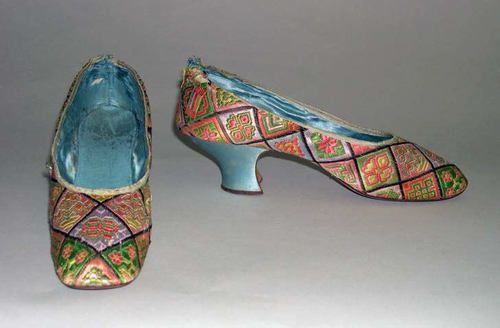
Pumps lined with blue silk, Russia, 1890s, Met