When the question “Why do brides wear white” is asked, the most frequent answer is “Because Queen Victoria did”, or “to show that they are virgins.”

Queen Victoria in her wedding dress by Winterhalter, 1842
The first answer is more or less accurate, but glosses over centuries of white wedding dresses worn before Queen Victoria’s wedding, and decades of coloured wedding dresses after her wedding, and also doesn’t explain why Victoria wore a white wedding dress. The 2nd answer is mostly rubbish and dates to the mid-20th century.
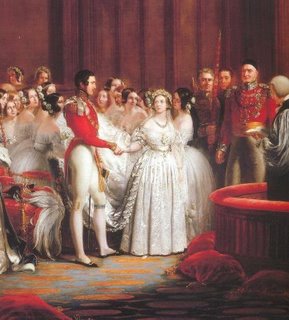
The wedding of Queen Victoria and Prince Albert
Long before Victoria, white was a popular choice for wedding dresses, at least among the wealthy nobility.
Weddings were usually more about political alliances and transfers of wealth than they were about romance, and so the wedding dress was just another excuse to show the wealth and culture of the brides family. Wealth could be demonstrated with jewelry (brides in some parts of Renaissance Italy, for example, wore their dowry sewn onto their dress as jewels), but textiles were also an important means to display wealth, and the more elaborate the weave of the fabric, and the richer the fibres uses, and the rarer the colour, the better the demonstration of wealth. Before the invention of effective bleaching techniques, white was a valued colour: it was both difficult to achieve, and hard to maintain. Wealthy brides, then, often wore white to demonstrate their money, not their purity.

Robe a la francaise, British, 1775-1780 V&A. Said to have been a wedding dress
There also seems to have been some traditions involved with wearing white and luck in the late 18th century. In The Good-Natur’d Man, a play by Oliver Goldsmith, first performed in 1768, a maid laments the lack of a white dress at her mistress elopement, saying “I wish you could take the white and silver to be married in. It’s the worst luck in the world, in anything but white.” Unfortunately, we don’t have any further context to the tradition, and how widespread it was, and in what cultural context.
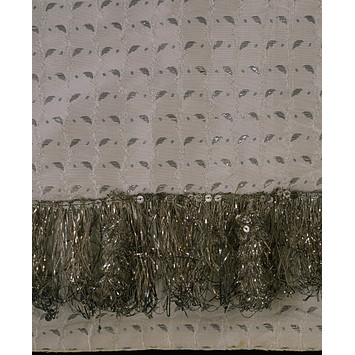
Detail of white and silver wedding dress petticoat worn by Miss Sarah Boddicott, 28 September 1779, V&A
Historical records though, do back up the frequency of gowns of white and silver. Metallic fabric were also very common among the nobility, as nothing says wealth more than cloth woven with gold or silver. Victoria’s tragic cousin Charlotte (who would have been queen had she not died in childbirth, and who was also her aunt because she married Victoria’s mother’s brother ) was married in a metallic cloth, as were most brides in the English royal family for centuries before her.
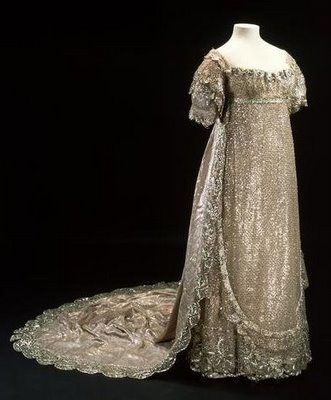
Princess Charlotte’s 1816 wedding dress (this dress has been altered, the ‘apron’ is not original)
So, if royal brides in England and other European countries wore cloth of gold and silver, why did Victoria break with tradition and wear a white dress?
Well, because Victoria was not an ordinary bride. Unlike most royal brides, she did not enter the marriage as a princess, about to become the Queen Consort. She was the Queen, the head of state. She needed to make a statement as the leader of her country, not as an ornament to the throne and the future mother to the heir to the throne. So Victoria chose a dress that made a political statement. A dress that put her duty to her kingdom on display, rather than her wealth or beauty.
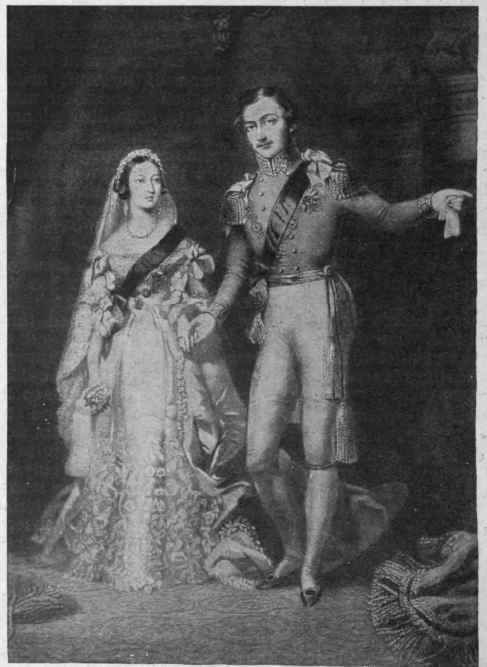
Queen Victoria and Prince Albert pose in their bridal and monarchial regalia
One of the main concerns in late 1830s England was the effect the Industrial Revolution was having on traditional textile industries. In particular, the invention of machine laces was decimating handmade lace industries across England, and causing widespread poverty and unemployment among the skilled artisans.
In order to stimulate and support the lace industry, Victoria chose for her wedding dress a large piece of handmade Honiton lace (read more about it here, on my now defunct textile blog). The rest of the dress then became a vehicle to showcase the lace, and white was chosen as the most suitable colour to do this. In the case of Victoria’s dress, white symbolised practicality and patriotism, rather than purity.
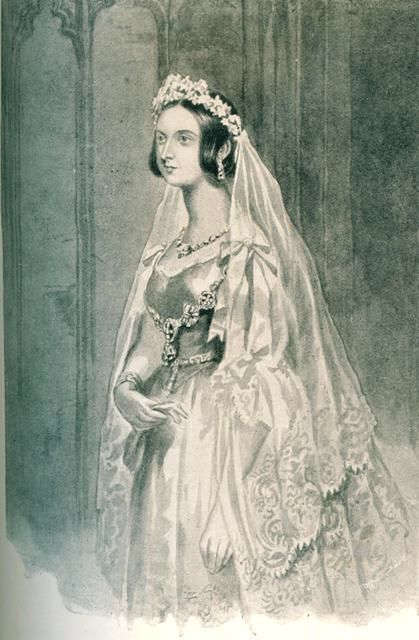
Queen Victoria’s lace trimmed dress and veil
Alas for us, the skirt lace has since been removed from Victoria’s dress and recycled in other garments, and is now lost.
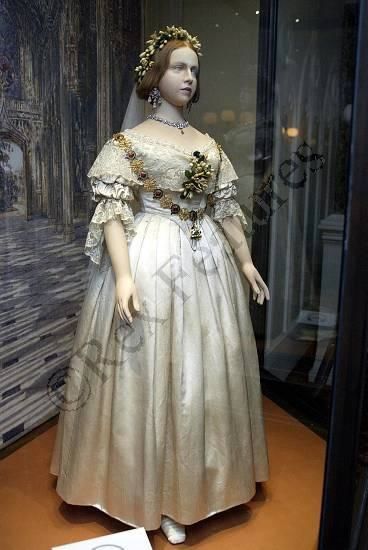
Queen Victoria’s wedding dress, now sans skirt lace
Victoria was so fond of her wedding attire, or so besotted with Albert and the whole romance of the wedding, that she posed for numerous paintings in her dress, and she and Prince Albert also dressed up in their wedding attire years later and recreated the wedding in photographs. A close inspection of all the different depictions of Victoria’s dress reveals numerous minor differences, making it very likely that she had elements of the dress altered as the mood suited her, and to align with changing fashions.

A middle aged Victoria and Albert recreate their wedding day
Victoria’s wedding attire was not devoid of symbolism though: she wore a wreath of orange blossoms (symbolising purity) and myrtle (symbolising love and domestic happiness), and these became the most common flowers carried and worn in Victorian weddings. A sprig of myrtle from Victoria’s bouquet was planted, and cuttings from the resulting bush have been carried by every royal bride in her family since then. Kate will almost certainly have one in her bouquet come the 29th.
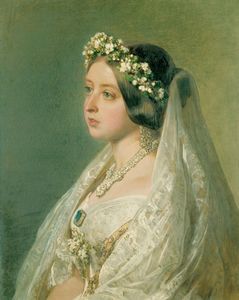
Queen Victoria in her wedding attire, Franz Xavier Winterhalter, 1847
Victoria’s wedding was widely publicised, and widely copied, sparking a huge increase in the number of brides who wore white (and the brides who wore lace, and the popularity of honiton lace, just as she had hoped). However, it wasn’t enough to make white the mode for every bride. In the 1840s white was still a very expensive fabric and colour, and only fairly wealthy women could afford a white dress. Some with just enough money did manage it, and then re-dyed the dress successively darker colours to hide marks and make it last for further seasons, meaning that there are less extant white wedding dresses than we might expect.
In addition, in 1840 the US was still struggling to establish its national identity, and women in the US were less inclined to take up fashions started by a British queen. This would change in the 1860s when the American Civil War encouraged women in both the South and the North to look to Britain as a cultural and fashion leader.

An engraving of the wedding of Victoria and Albert allowed wide distribution of images of her wedding dress
It was not until the 1850s and 1860s that the trends that Queen Victoria had initiated became widespread for brides. The high profile marriages of other British royal brides, such as Victoria’s daughter, Victoria the Princess Royal, and her daughter in law, Alexandra of Denmark, who both followed the traditions set by Victoria, helped to further conventionalise white wedding dresses. Other international royal brides, especially ones such as the Empress Eugenie, who were marrying into less stable monarchies, also followed Victoria’s lead to lend substance and respectability to their marriages.
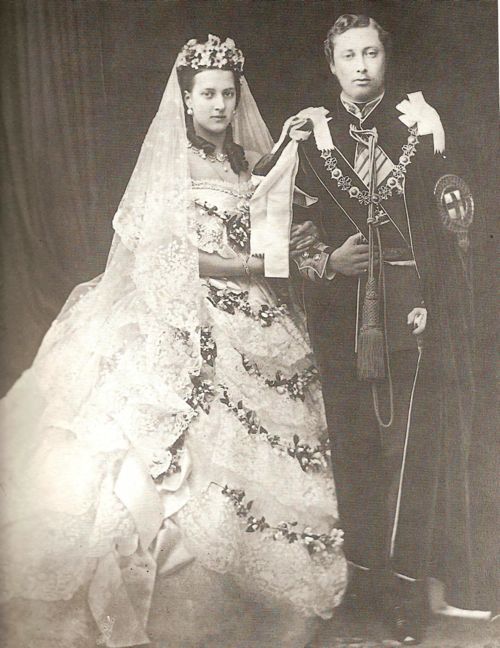
Princess Alexandra and Edward VII on their wedding day
The biggest factor, however, in popularising the white dress, was changing socio-economic circumstances. The 19th century saw the rise of a large middle class with expendable income for the first time in modern history. This middle class strove to emulate the customs of the upper class, and had the means to do so. And what family more epitomises the enviable aristocracy than the British royal family? Between Queen Victoria in 1840, Empress Eugenie in 1853, Princess Victoria in 1857, and Alexandra in 1863 the die was cast. White was the thing for brides to wear. If they could afford it.

Alexandra of Denmark’s 1863 wedding dress (with lace removed)
Despite the rising middle class, many still couldn’t afford a dress only for their wedding day, and so ‘best’ dresses of any colour were worn by brides until the advent of very cheap and effective bleaches made white dresses for any occasion very common at the turn of the century.
Only in the 20th century would would all the meanings that we associate with white wedding dresses (virginity, for example), be retrospectively, and mostly incorrectly, applied to Victorian brides.
For an interesting visual tour of royal brides from the 19th century to today (and to see how many of them wore white!), check out this album.
And finally, for something both related and random, check out Victoria’s darling wedding shoes:
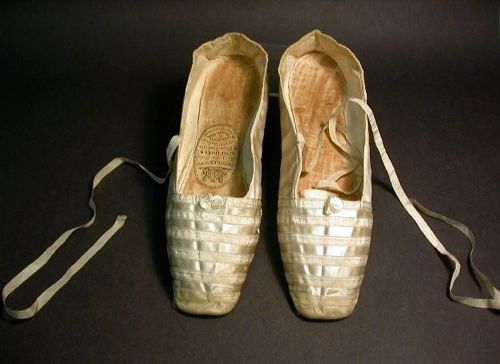
Queen Victoria’s wedding shoes
And a close up of the message inside:
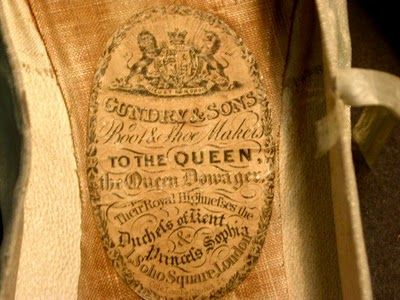
Queen Victorias Wedding Shoes (detail)
Want!