There has been a bit of a brou-ha-ha in costuming and re-enacting circles over the last week over how to behaving in public while dressed up, and how much we should expect from the public to accommodate our particular needs due to our lifestyle choice.
I don’t want to get involved in the specific drama that has triggered this, but I thought that a bit of a guideline of the things that I keep in mind, and the things that I warn models and friends dressing up with me to be aware of, when dressed in costumes of period attire, might be helpful.
These are rules of etiquette I stick to when I’m out and about in costume or historical dress, whether it’s just having fun wearing a costume for a day, being in a public space for a photoshoot (formal or informal), stopping at the supermarket on my way home for a talk, or living as much as possible in the past for the Fortnight in 1916.
My goal is always to be as courteous as possible to the general public and the businesses and institutions that generously allow me to use their facilities, and to give people a positive impression of costumers.*
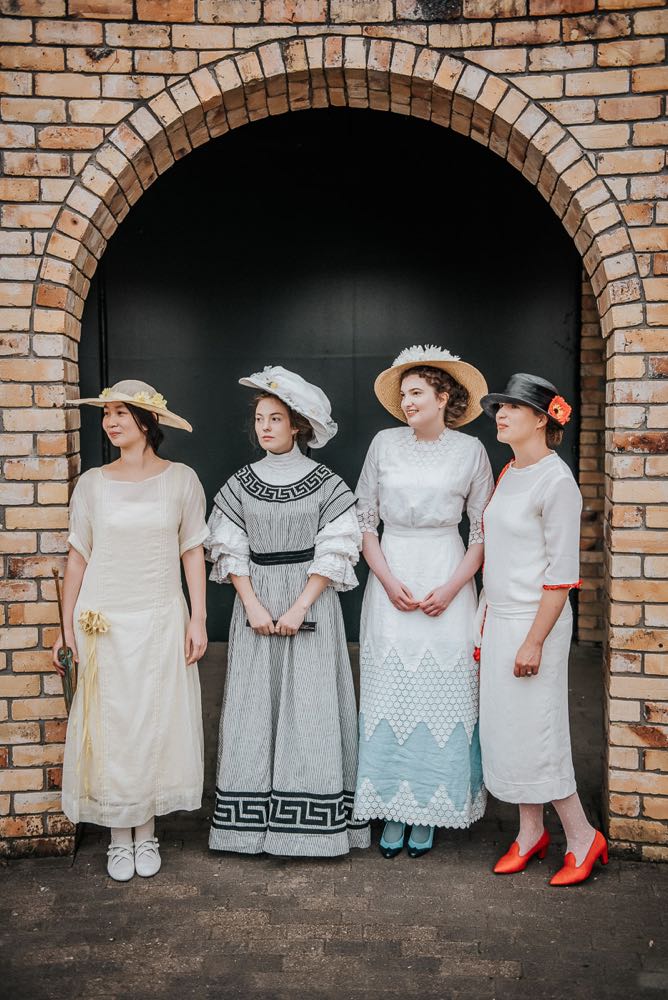
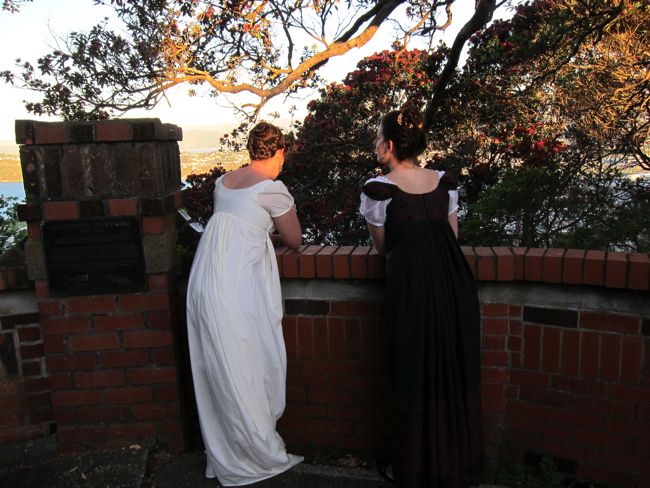
Courtesy of Tony McKay Photography and Glory Days Magazine
1. When you’re in public in a costume or historical dress, you’re an ambassador for all costumers and re-enactors.
Most of the public don’t encounter a huge number of costumers or people in historical dress. So whatever impression you give will be the impression that they take away of costumers. If you are kind, welcoming, and polite, they will assume we all are, and will treat us in like manner. If you’re snobby, and demanding, and a know-it-all, the next five costumers who encounter this person will pay for your rudeness.
So when people say ‘Oh, you look just like Belle from Beauty and the Beast‘ when I wear Ninon, I smile and say ‘thank you!’ and take the compliment in the spirit it was intended, although I personally do not care for Disney princesses. Then, if they seem really interested, I may tell them my dress is actually based on a 17th century portrait of the French kings cousin, wearing a style of dress that did indeed influence the design for Belle’s gown (via Robe de Cour). But I do this with enthusiasm, and a smile, so they learn something, but don’t go away feeling that historical costumers are snobs, or that all I did was correct them.
I try to behave well in public at all times, but I try particularly hard in costume: I’m less anonymous, and I represent a group. Unless it’s for a large public event where lots of people will be in costume, or I’m feeling particularly and unusually extroverted, I do find it a bit hard to be so noticeable, but I smile and respond to comments so that people don’t think costumers are mean and clique-ish.
2. If you assume that people will react positively to you in a costume, 99.9% of the time they will.
If you go out assuming you will get a positive reaction, and treat people well, in my personal experience, people will react positively. I have never encountered a negative reaction to going about in costume or period dress.**
I have met dozens of little girls who asked if I was a princess, delighted hundreds of tourists who asked if they could take my picture at scenic spots, been told I ‘looked just like my wife did when I courted her’ by an elderly man, complimented on how elegant I looked by staff in stores, and asked if I was dressed for an event, or where someone could get a similar outfit. Dozens upon dozens of people have said I looked like (insert current most famous period drama here). Most often I’m given a slightly startled look, and then treated exactly as I would be in normal clothing.
The many people I know who costume report the same experiences: people either like (or love) seeing something a bit different, or don’t mind, as long as we don’t interfere with their life and rights.
3. Always check ahead to ensure that the event or place you are going to is OK with your outfit and event plans.
When I’m in outfit I’m usually planning to do something: have a picnic or high tea, give a talk, take photos, go to a movie or a museum exhibition, etc. I’m familiar with most venues in my area, and what their rules are, but when going somewhere new, or somewhere that might be different than usual (a particularly popular film or museum exhibition, for example), I always check to make sure that what I plan to do is acceptable to the venue.
Some venues do not allow costumes. I have found that with some venues that don’t allow costumes, if you call and manage to speak to someone a bit higher up, and explain your situation if it’s a bit unusual, and if you’re extremely polite and charming, you can be given an exemption (and sometimes venues say ‘oh, we’ve been thinking about changing that, why doesn’t your group come as a trial, and we’ll see how that goes’, in which case your group should try exceptionally hard to behave exceedingly well so that other groups can have the privilege). Most of the time though, venues have chosen a ‘no costume’ policy for really good reasons, and that’s that.
If you do happen to get caught at a venue or event in an outfit that is deemed a costume (after all, I wear a lot of ’20s & ’30s, stuff, complete with hat, as normal attire) and not OK, ask if there is anything you can do to tone down your outfit be allowed in. Be polite, and work with the venue. If you’re apologetic and courteous and willing to compromise, I’ve never encountered a venue that won’t try to make it work for both of you. You may have to take off your hat and most of your accessories, or put someone’s cardi on to tone it down, but you’ll get to be where you want to be.
Checking ahead applies to talks and movies and shows and museum openings, unless the host/business has specifically indicated that costumes are OK. People often ask me if it’s alright to dress up for my talks, and while I’ve always been delighted to say ‘yes’, I really appreciate that they ask.
If you’re going to an event specifically to outshine the show. Don’t. That’s just another level of rude.
4. While we may be dressed for another timeperiod, in public we’re still in the 21st century, and need to behave according the rules and mores of this time.
You may be doing extremely serious re-enacting, following the social rules and mores of another timeperiod in every way for days on end, but once you leave your reenacting area, even if you’re still in costume, you’re in the 21st century and you need to act like it. You can’t expect men to open doors for you as a lady (unless that’s still the standard where you are), or that you should be able to make decisions for women if you’re a man. Continuing to act in period, and expecting the world to act along with you, and to be aware of the dictates of polite society that ended decades or centuries ago, is rude, selfish, and frankly, incredibly immature.
Remembering that we’re still in the 20th century includes things like taking off hats if you have to go into a bank, and removing masks and any weapons (even peace bonded ones) for any business.
And finally…
5. Our needs in costume or historical dress are not more important than other people’s right to use a venue, and to go about their business in normal fashion.
Whether we’re cosplayers, re-enactors, or social historians doing living history experiments, we’ve chosen to wear the clothes we’re wearing. And it’s a lifestyle choice, not a religion, so we don’t get the same rights and allowances as people who wear clothes dictated by their faith do in most Western countries. We can’t expect society to rearrange itself to accommodate our needs in costume.
Remembering that we only get the same rights as everyone else can include things as simple as not hogging a desirable photo location. Most people will give you right of way, and more time at a pretty spot, if you are particularly dressed up, but you have to be very, very careful not to take advantage of this. Tourists in pants-that-unzip-to-shorts have just as much right to get their picture taken as a group in historical dress. Step aside, give people time, be quick, don’t take more time than anyone else if there are others waiting. Costumers hogging spots is a good way to get costumes banned from a venue permanently (I’ve seen it happen).
If you’re going to the theatre, make sure your hairstyles aren’t going to get in anyone’s line of vision. Make sure your skirts aren’t so big they take more than your chair space at a restaurant.
If you need to be sure you won’t burp while wearing a corset (yes, this is a problem!), call ahead to a dinner event and make sure that there will be non-carbonated options, and that supplying them isn’t too much of a hassle for the venue.
Just be aware that there are other people in the world, and they need to get their business done. Don’t make your choice a problem for them.
* For the purpose of simplicity and brevity I’m going to use costumers as a general synonym for anyone in non-standard, non-period to the 2010s attire. I know that not everyone feels it is the most technically accurate term for people in period dress, but in this case I’m sure you will all understand the intent of my usage.
** For the purpose of honest, I suppose I should acknowledge that I was once yelled at by men driving past while taking photos near a road, but since I have been yelled at by men dozens of times while in modern clothes, I think we can safely (or un-safely, as it were) say this is about men who feel they have a right to yell at women, not about whether I was in a costume of not.