Latest Posts

Sherbet Seersucker details

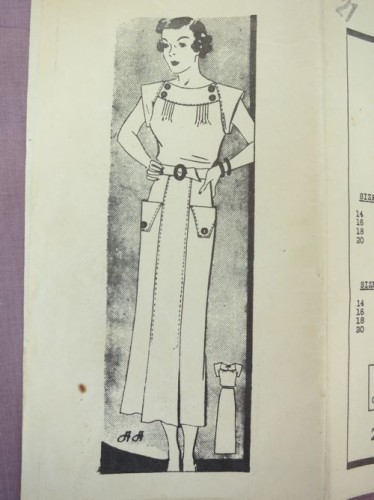
I posted the fun stuff about my Sherbet Seersucker dress yesterday, here are all the construction details for Anne Adams 2653, and a few thoughts on the pattern, for anyone interested in 1930s sewing patterns and techniques.
Anne Adams 2653

Anne Adams 2653

The Good:

It’s adorable, comfortable, practical, and goes together in a matter of hours – even with a lot of hand finishing.  
Anne Adams 2653

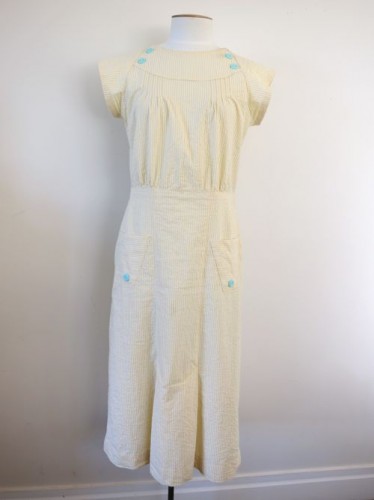
Anne Adams 2653 in yellow seersucker

I used a size 34 bust (I have a natural 37″ bust, but find that size 34″ patterns from the 1930s generally fit me perfectly), and it fit perfectly, though I did have to use all the ease given at the side seams.

This is an ideal pattern for working with stripes.  The pleating, pockets, pin-tucks, cap sleeves, and yoke all lend themselves to interesting stripe placements.
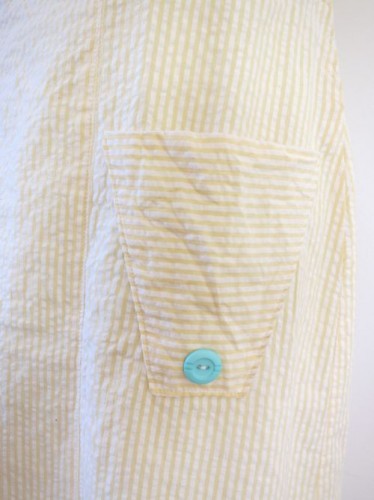
Horizontally striped pockets

Horizontally striped pockets

I cut the main body of the dress with vertical stripes, set my pockets and cap sleeves with horizontal stripes, and did the same thing on the sleeves.  I matched the stripe pattern where the bodice front met the yoke, and finished the insides of the sleeves with strips of fabric cut on the longways stripe, giving an interesting glimpse of the interior as I moved my arms.
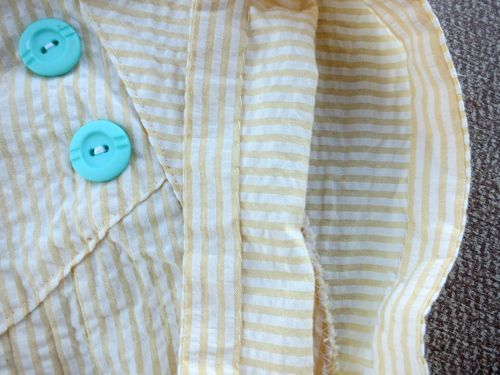
Sleeve stripes and sleeve finishings

Sleeve stripes and sleeve finishings

The Bad:

The bodice is really short.  I mean, really, really, really short!  I’m very high waisted, with a quite short torso, and the waistline in the bodice fell half an inch up on my ribcage.  I ended up having to re-cut the main bodice pieces (and re-sew the pintucks – my favourite), adding 1.5″ to the bodice length, to get it to fall at my waist.  Note to self and other sewers: add extra length to the bodice in this style of dress, because you can always cut it out later.
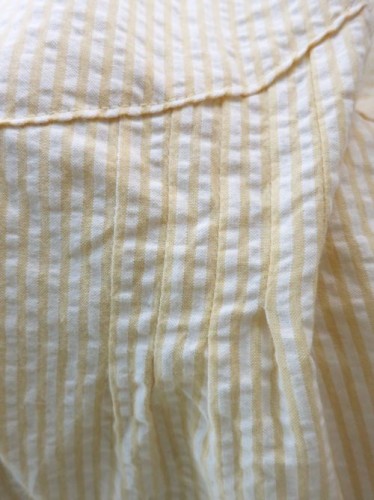
Stripe-matched pintucks in the bodice front

Stripe-matched pintucks in the bodice front

Changes I made:

Other than lengthening the bodice, the only other major change I made was to simplify the back fastening, switching it from two bound buttonholes which would close with a double connected button (time consuming, fiddly, and fiddly to wear) to a simple button and worked-loop closure.
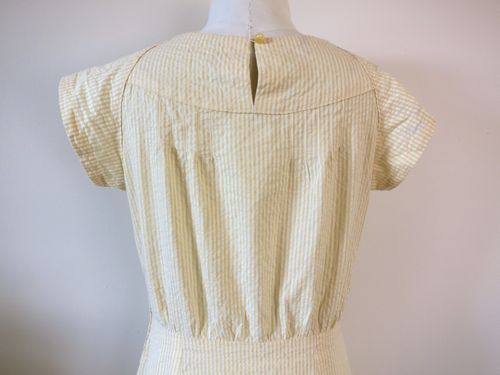
Back fastening with button and worked loop

Back fastening with button and worked loop

Changes I would make next time:

None but the lengthened bodice, the pattern is pretty much perfect as it is, and I’ve got plans for it in a number of other pieces of stash fabric.
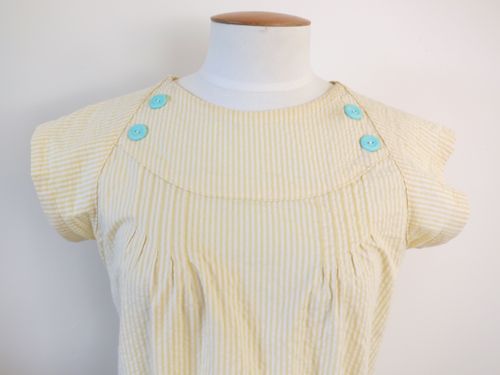
Just perfect!

Just perfect!

And the inside?:

Zig zag to finish the main seams (yes, that is period accurate, though hand-whipstitch and pinking were more common), hand hemming, bias finished neckline.
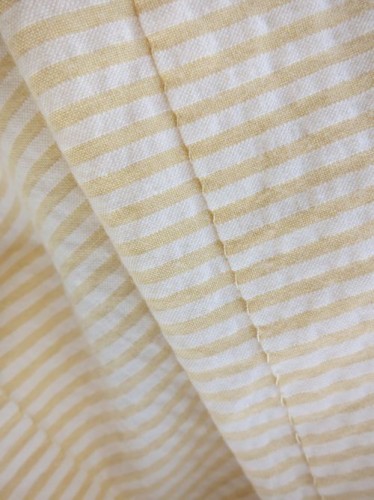
Hand hemming

Hand hemming

The dress fastens at the proper left side with a continuous lap placket, a hook and hand-worked loop at the waist, and domes (snaps) for the rest of the placket.  And yes, it stays closed, and stays flat and smooth.
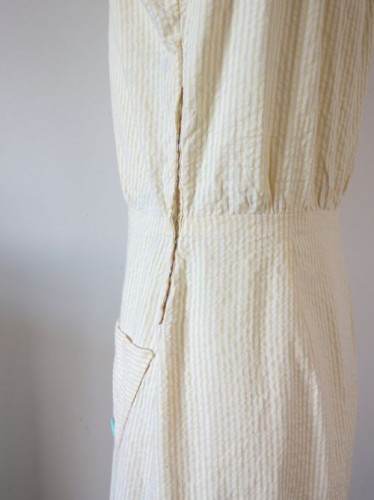
Side opening placket
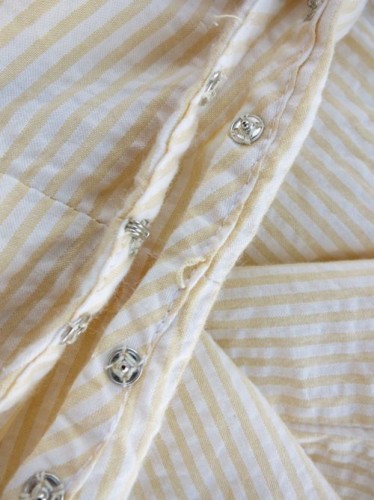
Side opening placket

Hook, loop and domes to fasten the side placket

Hook, loop and domes to fasten the side placket

Update: I’ve located the new belt!  Isn’t it pretty?
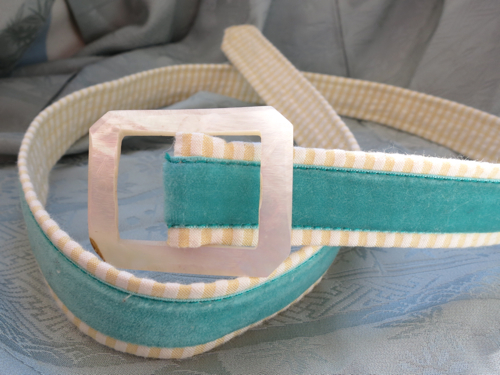
The belt, with vintage shell buckle and velvet ribbon

The belt, with vintage shell buckle and velvet ribbon

I wasn’t able to find an aqua buckle, but this vintage shell one tones in well, and picks up the lagoon blue of the buttons well, and the velvet ribbon (which I’ll also put on my hat) pulls the whole outfit together nicely.
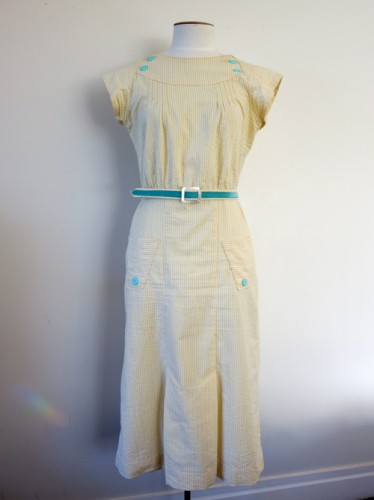
Anne Adams 2653 now with belt

Anne Adams 2653 now with belt

Just the Facts Ma’am:

The Challenge:  Stripes

Fabric:  2 metres of 100% cotton seersucker, 145cm wide – $12pm

Pattern:  Anne Adams 2653

Year: circa 1934

Notions:  6 aqua buttons, 1 yellow button, 1 hook, domes (snaps), thread, vintage shell belt buckle, lagoon blue velvet ribbon.

How historically accurate is it?:  Perfectly.  Period identical fabric, period sewing and construction techniques.  The buttons are a modern plastic, but other than that it is 100% accurate.

Hours to complete:  6 – despite having to re-cut the bodice

First worn:  Art Deco Weekend 2013 (but I still needed to make the proper belt)

Total cost: under  $30 including notions
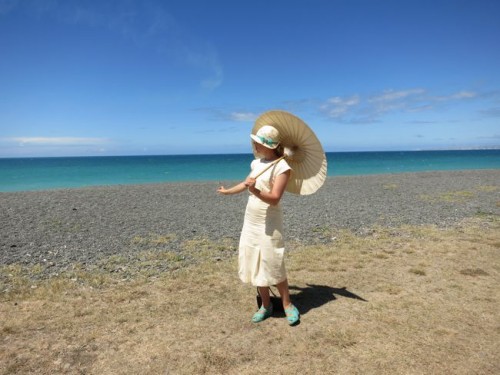
The ‘Sherbet Seersucker + Shoes’ 1934 frock

Well, I love bold stripes, but everything I’m making for the HSF ‘Stripes’ challenge has turned out to be quite subdued stripes; in this case, seersucker.

Anne Adams 2365

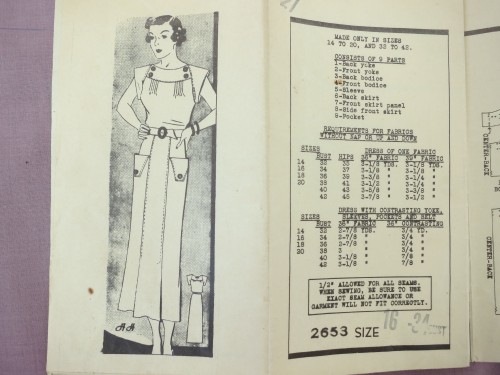
This dress started out with this pattern, Anne Adams 2653:

Anne Adams 2653

Anne Adams 2653

How cute is that!

A lovely and kind friend owns the pattern, and let me take a copy in trade for a copy of one of my patterns.

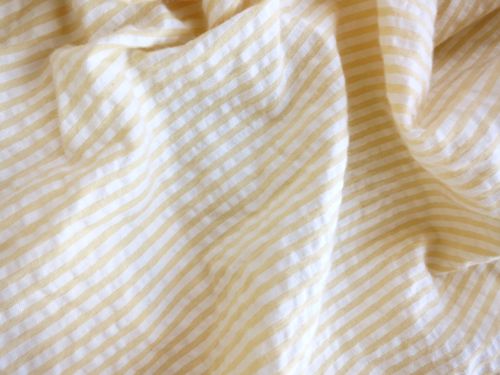
The pattern was perfect, but finding the right fabric for it turned in to an epic production.  First I found what I thought was the perfect fabric: a geometric broderie anglaise that was both sweet and Art Deco-y.  I bought four metres, rushed home, compared it to the pattern, and realised the broderie anglaise openwork would clash horribly with  the pleats and neck yoke.   Grrrrr!  Next, I found the perfect blue and white striped cotton poplin in my stash but unfortunately I had less than half what the pattern said I would need in fabric – even if I did a contrast yoke, sleeves and pockets.  Grrrrr!  Then I realised I had a really cute blue and white polka dotted fabric, but I hate wearing polka dots to vintage events, because it seems so cliche.  Grrrrr!  Finally, I went fabric shopping, drove the friends I was shopping with crazy comparing robins egg blue linen and white linen and blue and white stripes before finding this yellow and white seersucker.

Yellow and white striped seersucker

Then there was the drama of finding buttons to match.  I’d originally pictured them in red, but on the seersucker they looked to primary and kindergarten-ish.  Dark blue was too abrupt, yellow too matchy-matchy, white too subtle and boring.  Then an epiphany: I had the amazing lagoon blue suede 30s/40s inspired platform sandals I’d let myself buy as an indulgence earlier in the summer.  What about lagoon blue/aqua buttons?

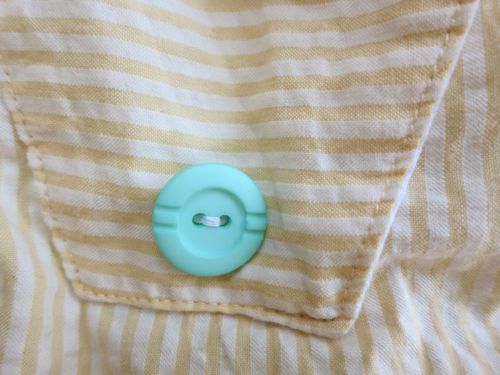
A hunt through the Wellington haberdasheries revealed that aqua buttons are REALLY hard to find, but I persevered and unearthed these darling deco inspired beauties:

Art deco inspired aqua beauties
I’d originally been looking for darker, more subdued buttons, but the shop staff convinced me I should go all the way, and I like the way the motif on the buttons evokes stripes.

Unfortunately an aqua belt buckle was too big an ask, and I had to get creative with the belt.

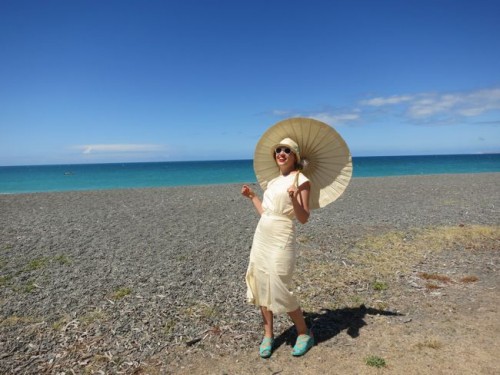
I wore the not-quite-finished frock (I still needed to perfect the belt) to Art Deco weekend, and loved it, and got tons of compliments on it, and was extremely comfortable in it.

Sherbet stripes dress thedreamstress.com

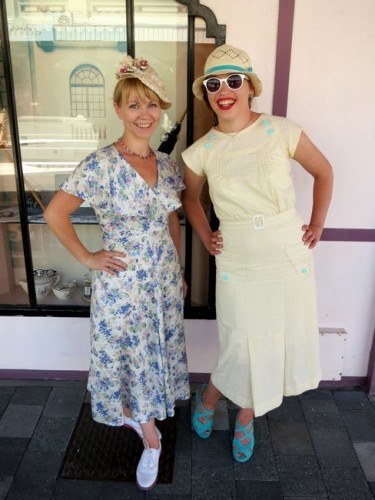
With the friend who gave me a copy of the pattern:

Anne Adams 2653

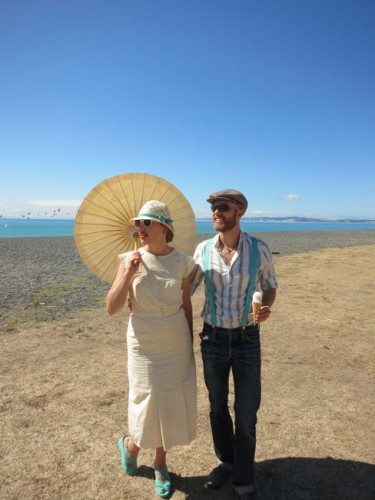
With a swing dancing friend who I insisted pose with me because his braces (suspenders) matched my shoes and buttons.  I so overwhelmed him with excitement about his braces that he sold them to me just to get rid of me.  I guess Mr D needs to do a photoshoot with me now 😉

Turquoise braces!  (and Anne Adams 2635)

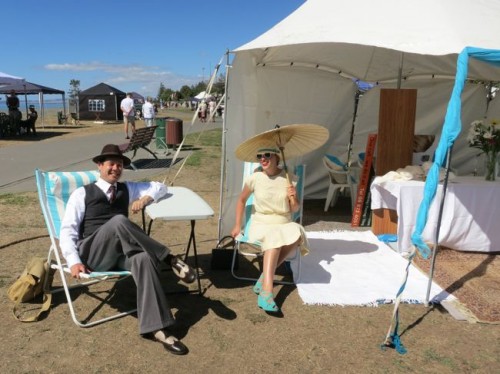
And then I found something awesomer than braces to match my outfit: a whole tent in lagoon blue and white!  With striped deck chairs!

Look!  The tent decor matches my shoes

Unfortunately I couldn’t find a vintage car that was the perfect match:

Anne Adams 2635 in seersucker

Love this dress!

After Art Deco weekend the dress came home and sat in my closet while I turned the house upside down looking for the extra fabric in which to make the perfect belt.  Luckily I located it just in time for this challenge, so tomorrow I’ll show you the finished, finished Sherbet Stripes frock and all the construction details.

Five for Friday: HSF favourites so far

When I first posted the Historical Sew Fortnightly I promised to post my favourite item for each challenge.  And then the HSF got so big that I’ve spent so much more time than I had planned on organising and administering it and I ran out of time to post about favourites.

To make this up, here is a quick round up of my favourites for the first 5 challenges (plus a bonus for the bonus challenge).

It  was REALLY hard to pick favourites – there are so many amazing things that have been produced, and such a range of periods, experience levels, and personal taste.  I’ve chosen the items I thought best represent the spirit of the Historical Sew Fortnightly; the quest to explore history, raise our skill levels and standard, stretch ourselves (or sometimes just get something done, rather than just procrastinating);  and the spirit of the individual challenge.  Inevitably there are some projects that I adored that I just haven’t been able to post about.  I didn’t purposely try to pick different seamstresses for each challenge – that just happened!

Challenge #5 – Peasants and Pioneers

  1.    Governante Astrid’s early 20th century Swedish peasant dress – One of the things that I’ve found really amazing and exciting about the HSF is learning about regional peasant dress.  I’ve only every really studied historical costuming from the most fashionable, cosmopolitan perspective, so seeing very specific regional dress is fascinating.
  2. Teacups Among the Fabric’s yellow 1830s pioneer ballgown – I love the way she considered the entire life of a pioneer in Texas in the 1830s, and how there would have been events to dress up, but a fancy gown would be something that would be used for years, and might be a bit outdated.
  3. Wearing History’s 1930s ‘Dust Bowl’ dress – Lauren’s sewing is always impeccably done, which I hugely appreciate.  I also have a real interest and soft spot for the Great Depression – it was such a major event in the life of my grandparent’s generations that the effect it had on them rippled down to me.  The Great Depression is both recent, and definitely historical, and the Dust Bowl dress is both modern wearable, and distinctly historical.

Challenge #4 – Embellish

  1. Asa’s late 16th century blackwork shift – it was her first try at embroidery, and it’s amazing!  Just look at how beautifully done it is (and how cute are those snails?).
  2. Ewa’s soutache trimmed 1920s dress – this may be the best 1920s era dress I have EVER seen a historical costumer make.  It is spot on, looks like a fashion plate or a vintage dress, and has such fabulous but understated embellishment that really underlines the ’20s aesthetic.
  3. Frolicking Frocks’ striped Pemberley shoes – a gorgeous reminder that not everything for the HSF needs to be sewn, and that sometimes an accessory really makes an outfit.

Challenge #3 – Under it All

  1. Jenni’s version of the much-discussed ca. 1800 KCI brasserie – beautifully made, and on her, they actually work, thus helping to answer all the questions about whether they are really bust supports, and whether they actually work.  Pretty sewing and research?  I like it!
  2. Girl with the Star Spangled Heart’s 1910s corset – her first proper corset ever, and it’s a stunner!
  3. Kitty Calash’s 1775-1783 shift and 1790-1800 petticoat – She got two things done, they are both lovely, and one of them had been hanging around as a UFO for a year but finally got done, which I call a HSF win!

Challenge #2 – UFO (this one was particularly hard to pick , because some people had elaborate, striking project that just needed a little finishing, and some people were new to historic costuming, so didn’t have much at all)

  1. Kleidung um 1800’s yellow spencer – Right.  So, the way to get featured on this list is to make something in golden yellow ;-).  Because I am SO madly in love with this spencer, how could I not feature it?  
  2. Danielle’s 1860s mourning dress is beautiful and unusual, and finally got finished after 9 months.  Not as bad as my UFO, but I’m glad the challenge finally allowed us to see it done!
  3. Romantic History’s 1830s day dress – probably the most popular item to come out of this challenge.  Everyone wants this dress, and it’s not hard to see why!

Challenge #1 – Bi/Bi/Tri/Quadri/Quin/Sex/Septi/Octo/Nona/Centennial

  1. Festive Attyre’s 1913 Titanic survivors outfit – 100% stash, 100% fantastic.  Brilliantly researched, so striking.  
  2. Cation Design’s 1813 bodiced petticoat – can you believe this is her first foray into historic sewing?  And check out the dress she made to go over it.  Sheets dream of ending up in her stash!
  3. Caddams Betraktelsers’ 1313 hood – excellent research into historical accuracy and historical probability, a fascinating garment, and a great blog post.

And the bonus challenge: Starting Simple

  1. Hanna’s 15th century long-tailed cap, made with period accurate fabrics and sewing, extensively researched.
  2. Wanda B’s 1850s-60s fingerless gloves – she says they aren’t particularly historical, but as a non-crocheter, I’m massively envious of them!
  3. American Duchesses’ plaid 1930s dress – just adorable.

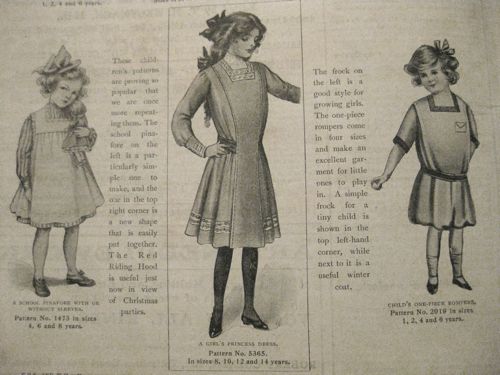
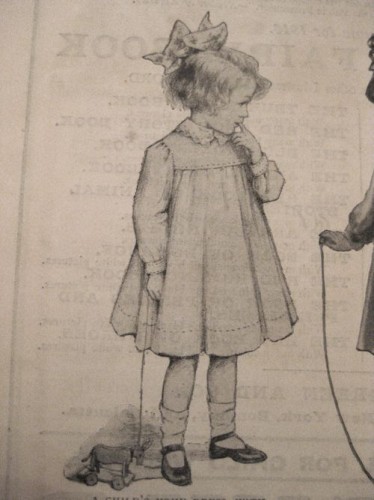
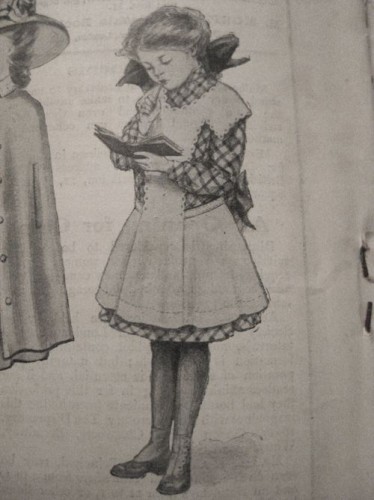
Since I don’t have any pictures to illustrate this post, here are some random images of adorable children’s fashions from the 1911 Girls Own Paper:

Children's fashions, Girls Own Paper, 1911

IMG_6733

IMG_6734

IMG_6735

How cute are they!