I’m coming to the end of the fantastic textiles that Elise sent. I have just today’s dress, and then one more dress (and it’s a doozy – I’ve saved one of the best for last) to show you.
Today’s dress is another velvet item, this one in the same glorious midnight blue of the leaf-patterned devore dress. Midnight blue velvet was an incredibly fashionable colour & fabric in the mid-late ’30s. The velvet is accessorized by a posy of flowers in lavender, peach & pastel-magenta – such a lovely, quirky, completely 1930s touch.

Midnight blue velvet with a pastel posy
In addition to being made of a similar fabric, this dress shares an almost identical cut to the devore gown – with an inverted V waist, a gathered bust, full sleeves, and a bias skirt. It even shares the clever tucked pleat collar construction, as you can see in the photo above.

Blue velvet dress, front view
Alas, not only does the dark clolour mean the dress is tricky to photograph well, it isn’t looking its best because it doesn’t remotely fit Isabelle. It is unusually large for a 1930s dress – probably a true size 16 or 18, and made for a figure with a prominent bust and slim hips. I’m searching for the perfect model to wear it for one photoshoot – no more, because the fabric (like that of the devore dress) has tiny holes, and is rather fragile.
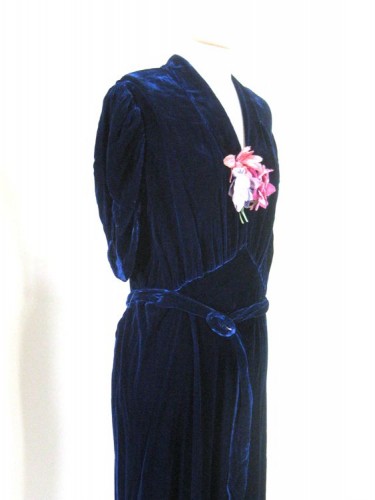
Gathered bodice, full sleeves, belt
The flowers are particularly fragile and moth-eaten, but you can still see their charm, and how fantastic they would have looked when the dress was new. I wonder what they would have called the colours in the 1930s. Wisteria, coral and mauve perhaps?
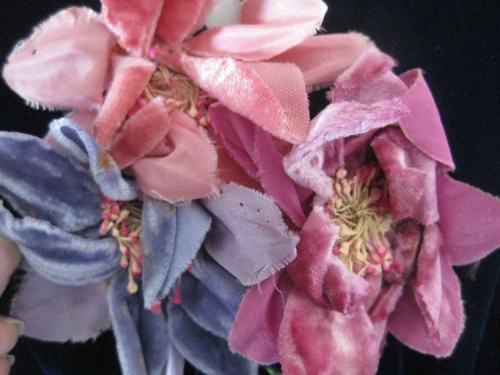
Gorgeous but slightly time-worn flowers
The fabric may be hard to photograph, but it is quite scrumptious. It’s a rayon velvet, with a slightly open pile (so not the very best quality). It’s still fantastically soft and pet-able.
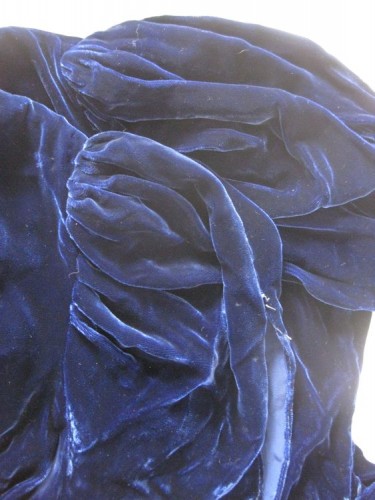
The luscious fabric
The dress construction isn’t of the highest quality either – it’s clearly the work of a home seamstress, and she had a rather hard time getting the front V of the bodice right. It looks decent in photographs, but on a body the V is ever so slightly off, and the velvet is noticeably squashed.
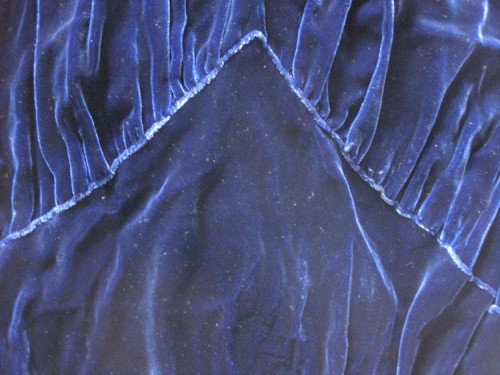
The V of the front bodice
She did do a rather decent job of making a tiny rolled hem around the bottom of the sleeve edges and the hem of the skirt – no easy task with the velvet fabric.
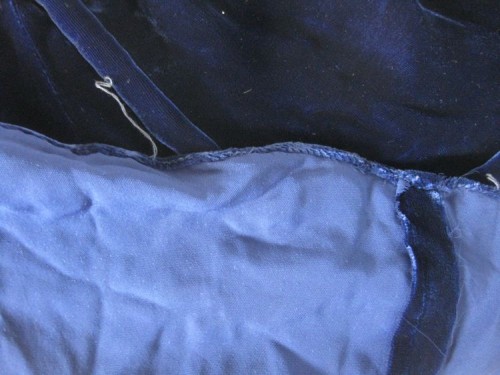
The tiny rolled hem
As with many 1930s evening dresses, the interior seams are left unfinished. The fabric isn’t particularly susceptible to fraying, and, as the fabric wasn’t meant to be washed, and the dress wouldn’t have been worn that often, the raw edges would see minimal stress.
The dress fastens with a size zip – one of those fantastic early models with metal teeth that just last and last and last and never pop open at inopportune times. It’s a fantastic illustration of how important the invention of the zipper was, and how quickly the new technology was adapted by everyone from couture designers to home seamstresses.
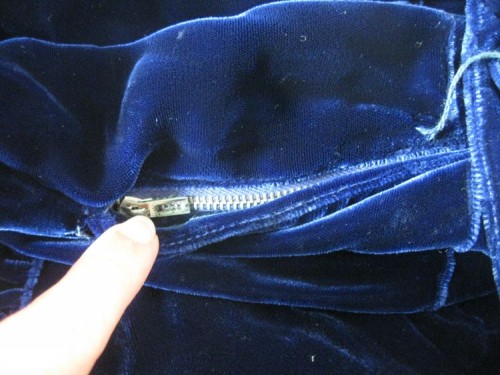
The metal side zip
Despite it’s universal adoption, few designers and seamstresses (with the notable exception of Schiaparelli) valued it aesthetically, and so every attempt was made to hide the fastening. In this dress, a lapped opening does part of the job, and the belt helps with it, holding the lap closed, obscuring part of the zip, and doing the bigger job of accentuating the waist.
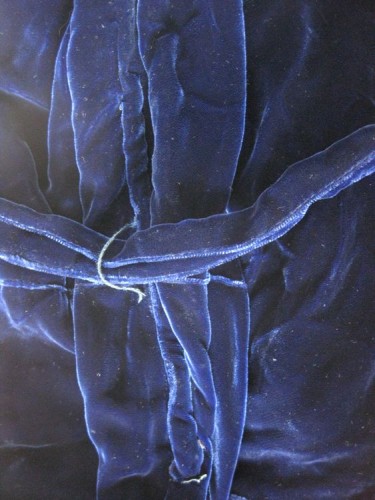
The belt hiding the zip
The belt is held on with hand-worked loops of heavy blue thread that has faded with age.
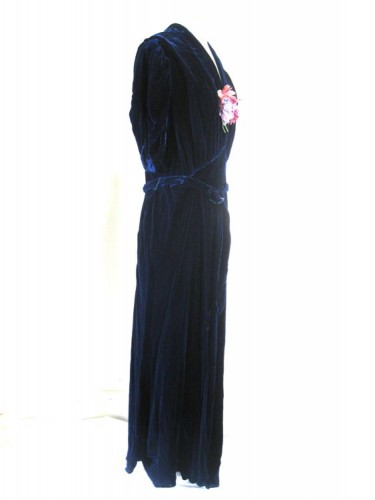
The posy dress, side view
So there it is – not the fanciest dress, not the most interesting in construction, not the best made, or the most innovate and unique, and not the most valuable in a technical sense.
And yet, that makes it all the more interesting and valuable, because it really does represent what the average woman would have worn for her nice events in the mid-late ’30s. And she probably felt beautiful in it. I wonder if, like me, she particularly loved that posy of flowers: the bright, quirky combination of colours, and the sense of life it gave.
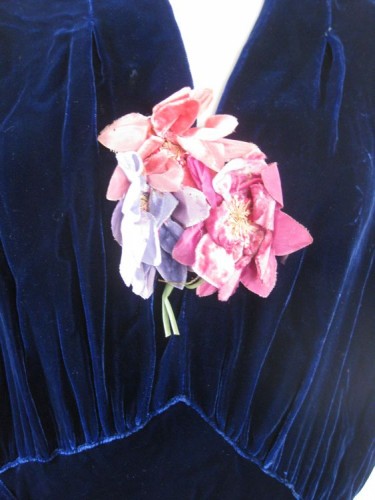
A posy of velvet flowers