Set aside your sweatshirting, it’s silk time! For this week’s Rate the Dress I’ve chosen a lavish, high-end dinner dress, complete with matching shoes.
Last week: an 1840s dress in striped silk
Quite a few of you liked the striped/plaid silk dress from last week, but more of you had reservations about it. You felt that the silk was neither one thing nor another (not striped or plaid), and that the dress itself was not one thing or another – and was definitely in need of accessories to bring it to life.
The Total: 7.2 out of 10
A neither here nor there, needs some trimming, kind of score.
This week: an 1870s evening dress ensemble – complete with shoes

Dinner ensemble Department Store-(a, b) Kingsbury Designer-(c, d) Dupuis-Jacobs, 1874, French, silk, Metropolitan Museum of Art, 2009.300.862a—d
This 1870s dinner ensemble comes complete with perfectly matching shoes, which come with their own quirky design feature: binding and lining in blue on one shoe, and gold on the other. The detail would have been hidden under the wearers skirt most of the time: a secret for herself, and anyone lucky and observant enough to catch a glimpse of them peeping out from her skirt.

Dinner ensemble Department Store-(a, b) Kingsbury Designer-(c, d) Dupuis-Jacobs, 1874, French, silk, Metropolitan Museum of Art, 2009.300.862a—d
The rest of the ensemble is carried out in the same minty green and gold,

Dinner ensemble Department Store-(a, b) Kingsbury Designer-(c, d) Dupuis-Jacobs, 1874, French, silk, Metropolitan Museum of Art, 2009.300.862a—d
I am certain that the ribbon lacing the bodice in the museum photos is a modern recreation – so please don’t discount your rating on account of it!

Dinner ensemble Department Store-(a, b) Kingsbury Designer-(c, d) Dupuis-Jacobs, 1874, French, silk, Metropolitan Museum of Art, 2009.300.862a—d
The predominant fabric on the front of the dress is a lush jacquard woven silk in shades of gold, overlayed with a blond lace which lends subtle depth and texture to the dress.
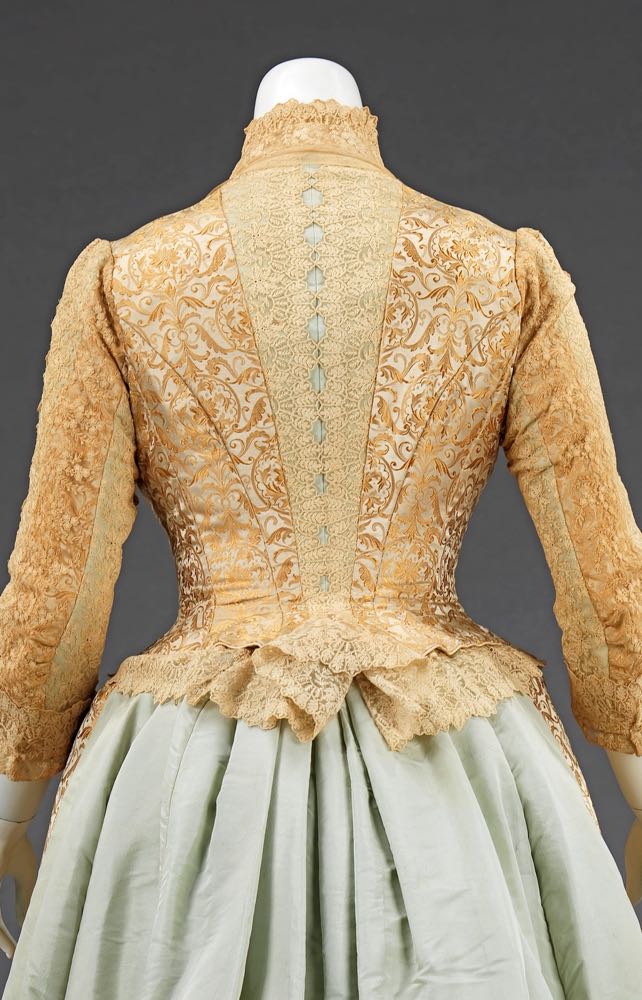
Dinner ensemble Department Store-(a, b) Kingsbury Designer-(c, d) Dupuis-Jacobs, 1874, French, silk, Metropolitan Museum of Art, 2009.300.862a—d
The same lace is used across the dress, to frame a panel of pale green that runs up the centre back of the dress, as a frill to the hem of the bodice, and to curve up and around the neck.

Dinner ensemble Department Store-(a, b) Kingsbury Designer-(c, d) Dupuis-Jacobs, 1874, French, silk, Metropolitan Museum of Art, 2009.300.862a—d
The spine at the back of the dress is echoed in a line of lace framed green on the sleeves.

Dinner ensemble Department Store-(a, b) Kingsbury Designer-(c, d) Dupuis-Jacobs, 1874, French, silk, Metropolitan Museum of Art, 2009.300.862a—d
The green satin, used in such restrained amounts across the front of the dress and bodice, dominates the back skirt, both in a long smooth bustle, and in the pleats trimming the hem.

Dinner ensemble Department Store-(a, b) Kingsbury Designer-(c, d) Dupuis-Jacobs, 1874, French, silk, Metropolitan Museum of Art, 2009.300.862a—d
What do you think? Will this gold and green ensemble take home the gold rating?
Rate the Dress on a Scale of 1 to 10
A reminder about rating — feel free to be critical if you don’t like a thing, but make sure that your comments aren’t actually insulting to those who do like a garment. Our different tastes are what make Rate the Dress so interesting. It’s no fun when a comment implies that anyone who doesn’t agree with it, or who would wear a garment, is totally lacking in taste.
(as usual, nothing more complicated than a .5. I also hugely appreciate it if you only do one rating, and set it on a line at the very end of your comment, so I can find it! Thanks in advance!)