Latest Posts

Rate the Dress: Evening shades for ca. 1910

I’m always surprised by what does and what doesn’t come under criticism with a Rate the Dress. I knew the print and non-symetrical matching of last week’s credited-as-1860s-almost-certainly-early-1850s-instead frock wouldn’t be everyone’s favourite, but it didn’t occur to me that quite a few of you would castigate it for the anatomy it was meant to fit over.  The lady who wore it couldn’t help her very long torsos and slope-y shoulders (and the shoulders, at least, were very fashionable at the time)!  Many of you did, however, appreciated the pairing of a very busy fabric with a very simple design, which helped to give the dress a modest but respectable 7 out of 10.

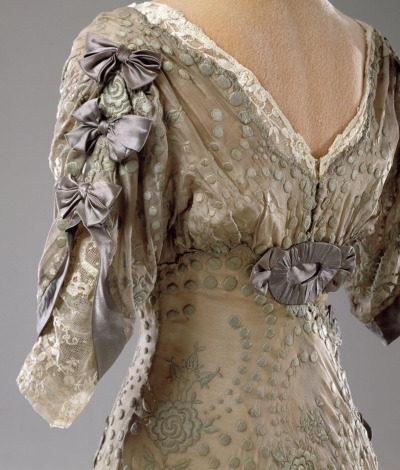
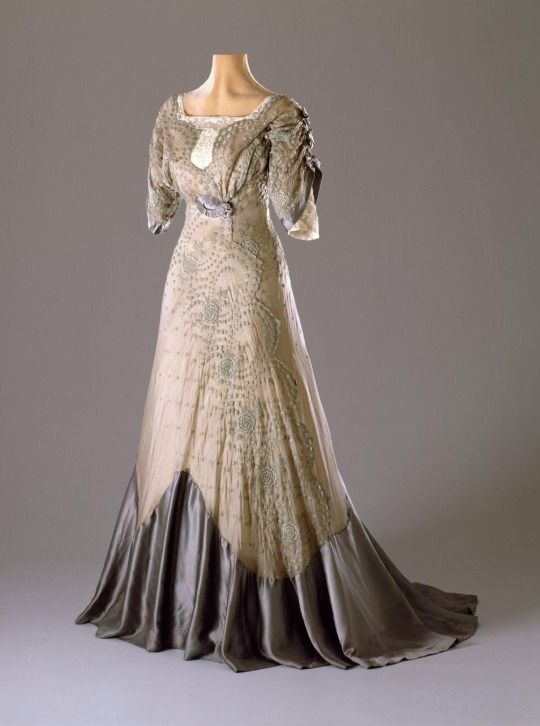
This frock, from the Hillwood Estate Museum, features very muted fabrics, and the transitional silhouette of 1909ish, as fashions moved from the sweeping skirts and drooping bodices of the first decade of the 20th century, to the raised waists and slim columnar shape of the second.

This evening dress still features the sweeping skirts, but they are considerably restrained.  The colours are the fashionable pastels of the 1900s, given a slightly off-tone twist that anticipates the wilder colours of the 1910s.  A slight hint of blousing in the bodice remains, but the waist is raised, and the sleeves hint at the newly fashionable kimono or dolman sleeves, albeit with a very uber-feminine Edwardian touch of bows.

How do you feel about the mix of styles? Is it the best of both eras?

Rate the Dress on a Scale of 1 to 10

Fittings, lacings, and gores: progress on the medieval gown

There has been a bit of blog silence on it for the last few months, but I have been plugging away on the 1370ish dress, but there has been an awful lot of effort on it that doesn’t look like anything, because it was just unpicking and re-doing.

I got it all sewn together, did an initial fit, and it just didn’t feel quite right, which prompted a LOT more research.  Based on the research, I decided that lining 14th century gowns with linen is almost certainly not accurate, and gives a fit that doesn’t match the fits shown on effigies of the period.

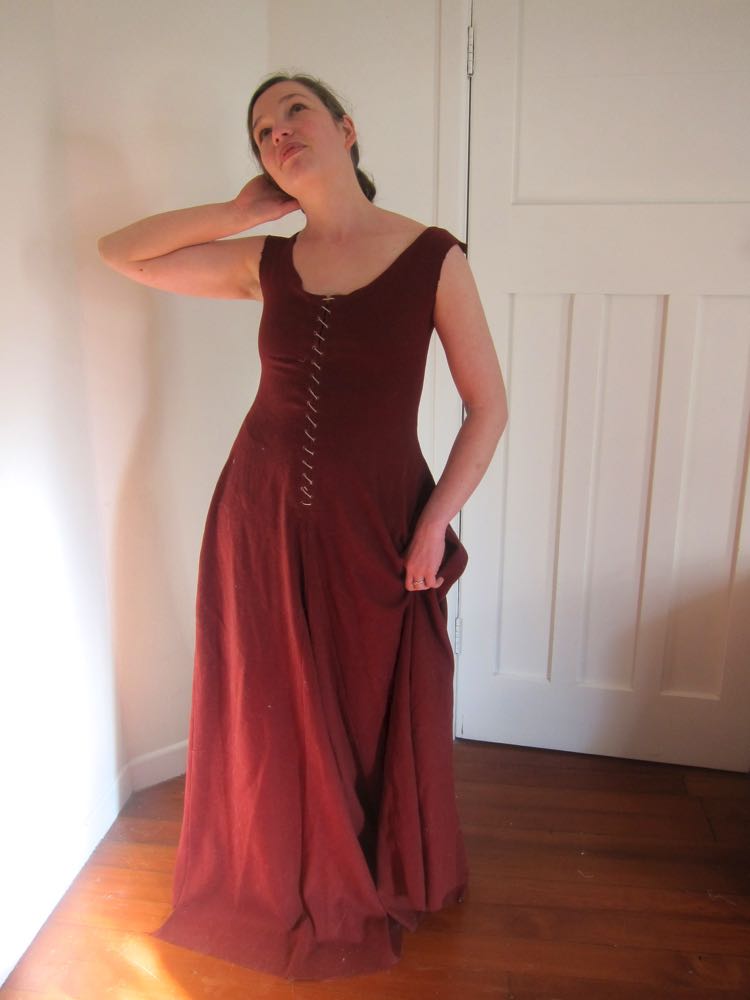
This is what the dress looked like with a linen lining:
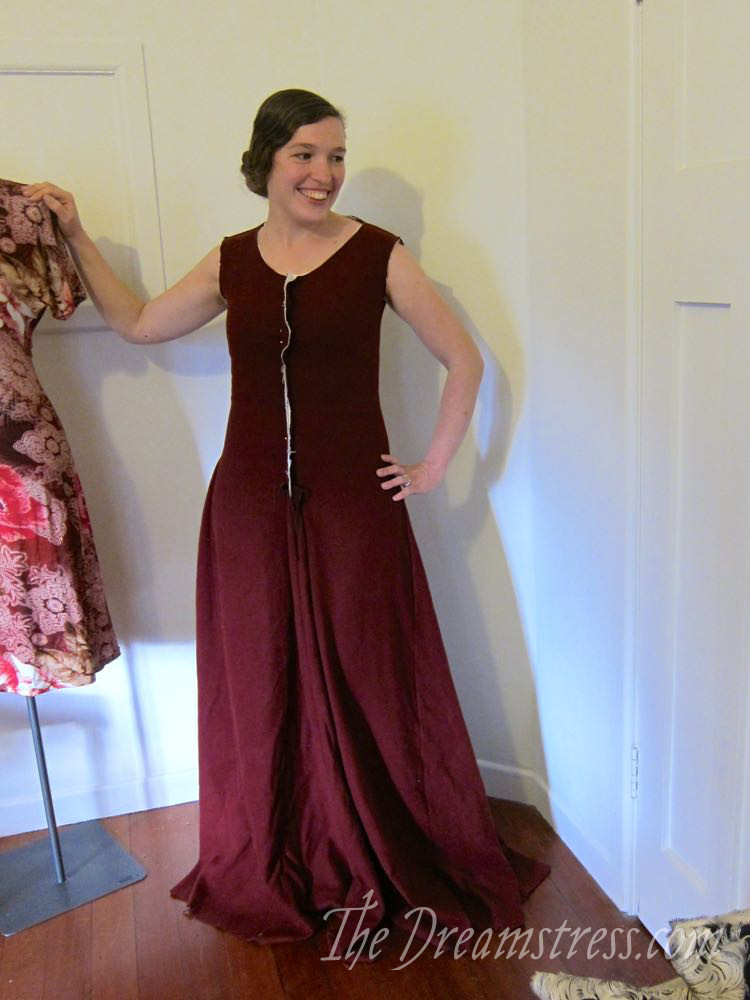
Fitting a medieval gown thedreamstress.com11

It looks really good, but it’s very constricting.  It just didn’t feel right.

So I sucked it up and unpicked the lining.  And all my gores.  And then I re-sewed the entire gown without a lining, and with the gores placed almost at my waist.
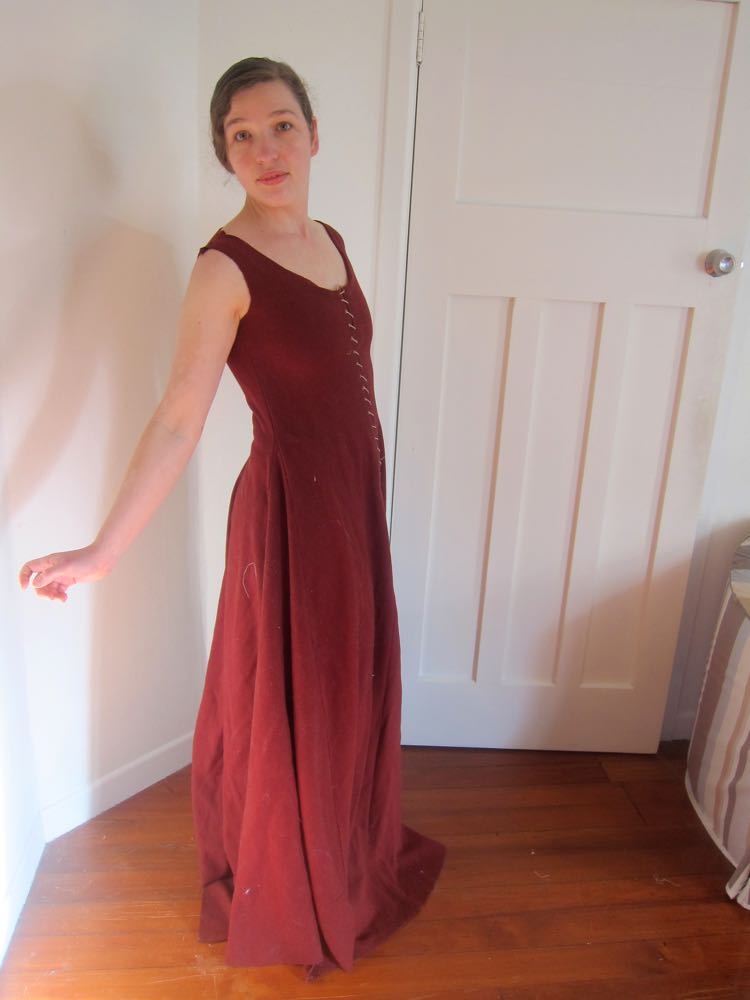
1350s-70s gown fitting & details thedreamstress.com05

As soon as I tried on gown 2.0 I knew two things.

First, the fit is SO much better without a lining.  It feels much more correct.  The gown is much easier to wear, much easier to move in, and provides support without constriction.  I can move and pose in exactly the stances shown in illuminations and effigy, and it feels comfortable, whereas it felt awkward and as if I was fighting the dress when it had a lining.

It’s not just that I’m small busted.  Even a MUCH bustier friend who tried on the dress was impressed by how much support the dress supplied with a snug fit and slight give from the wool.

Even though it was extra work, I’m very glad I tried the lining, because I was able to compare it to a dress without the lining and really understand the difference in fit.

The second thing I found from version 2.0 isn’t so good.  I DO NOT like the higher gores.  They ‘poof’ out way too much over my hips, and rub against the top of my hipbone, and basically don’t match the more androgynous 1360s-70s silhouette I am going for.
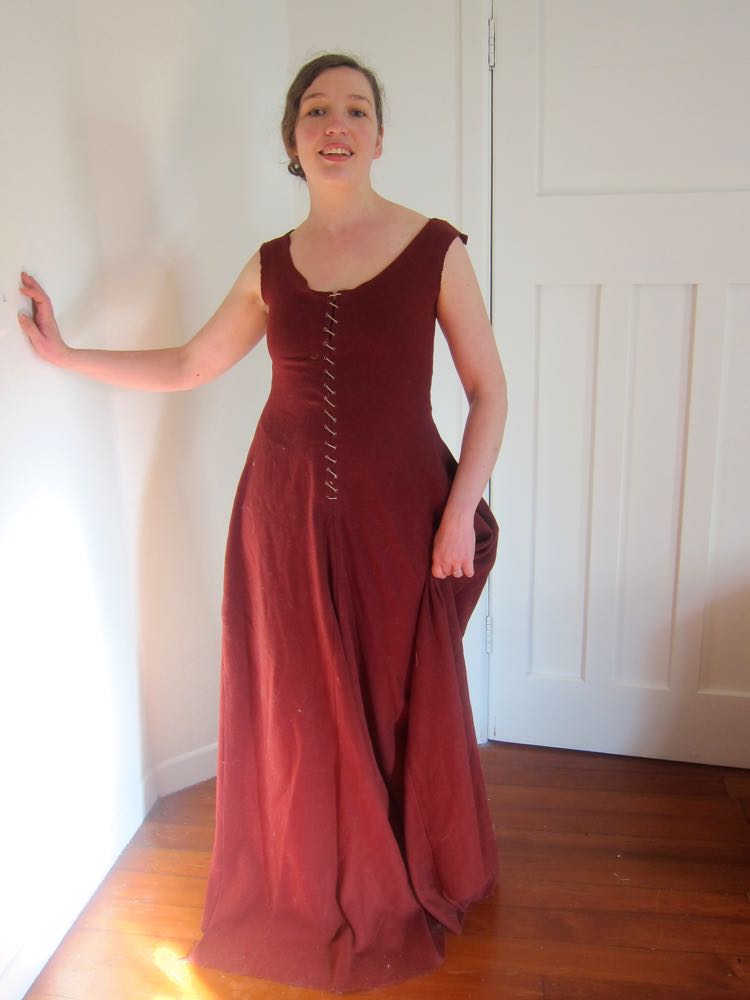
1350s-70s gown fitting & details thedreamstress.com03

They haven’t, of course, had time to really hang into place, and they would benefit from a really good pressing, both of which would would help.  If I were doing 1390s the silhouette would be more appropriate, but as they are I don’t like them.
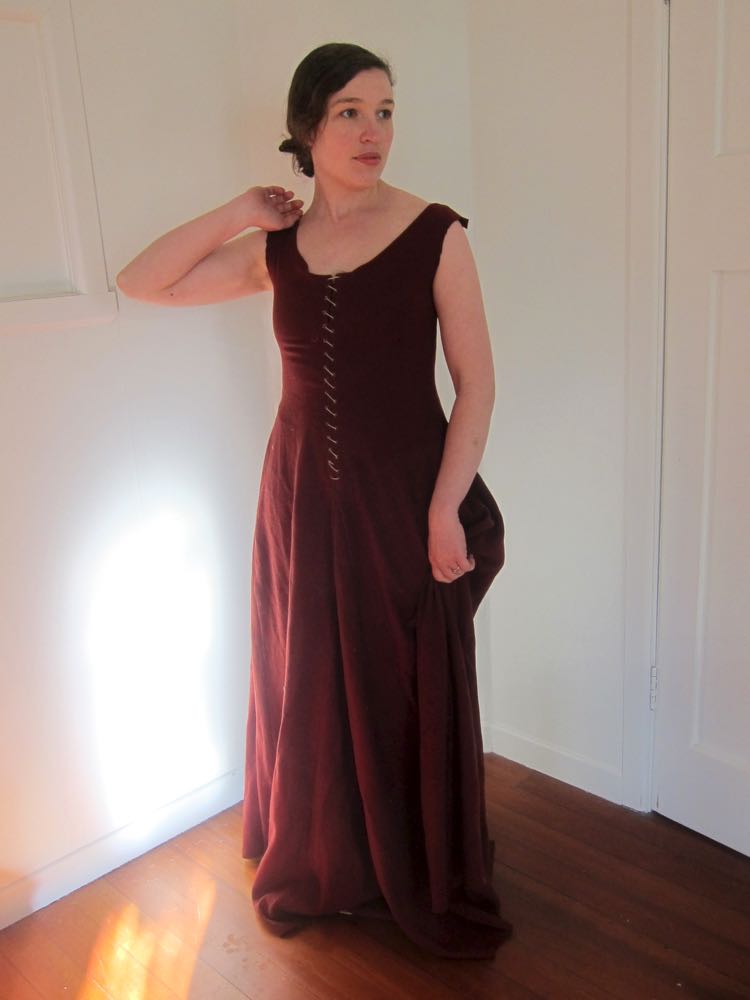
1350s-70s gown fitting & details thedreamstress.com01

So….more unpicking.

Yay.

(yes, I know I like unpicking, or at least don’t dislike it, but not heavy cotton thread (yes, inaccurate but this was always a test dress) on fulled wool in the middle of winter when the pressure of the quick-unpick on my finger gives me a big chillblain lump where it rubs as I hold it is not fun!).

I’ve got one other tiny thing I wish I could change, but can’t.  I’m not in love with the neckline.  I lowered it a couple of cm from the first fitting, and widened it quite a lot, and I wish I’d only widened it – it’s a little lower than I would like.
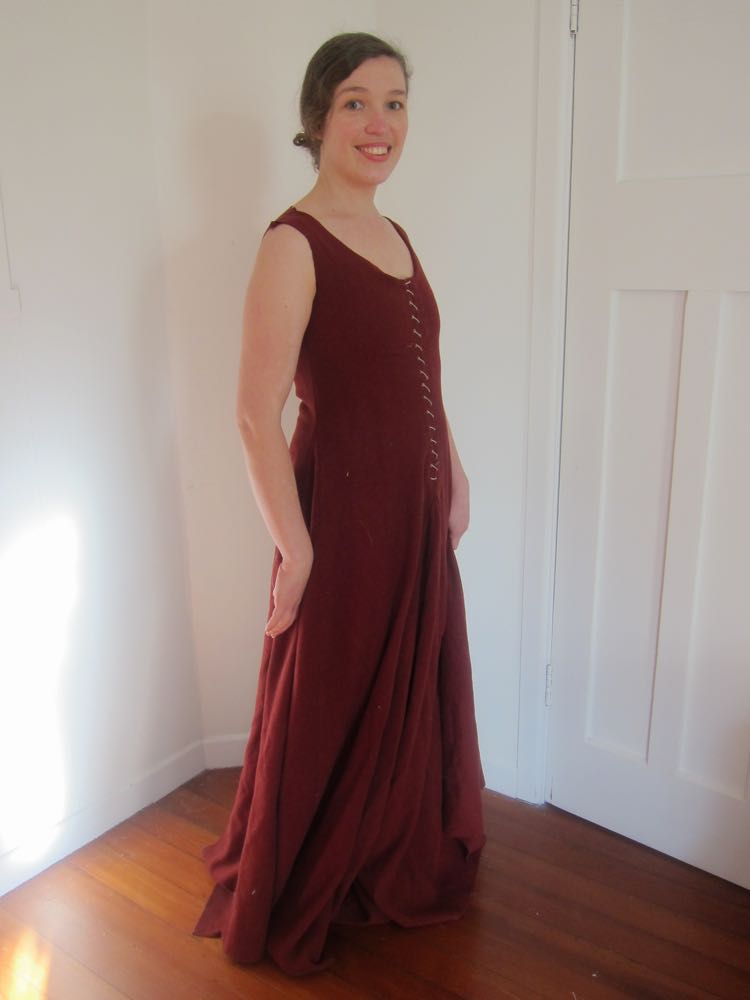
1350s-70s gown fitting & details thedreamstress.com02

I’ve ended up with lady in blue instead of lady in red after all:

Guillaume de Machaut epiant les amoureux deçus. - Le Jugement dou roi de Navarre.Maître du Policratique. Enlumineur de l'œuvre reproduite Date d'edition - 1380-1395

Guillaume de Machaut watching the disappointed lover. – The Judgement of the King of Navarre. Maître Policratique . 1380-1395

I may try to widen the neckline as much more as I possibly can.  The good thing about a low, wide, neckline, is that I can wear every possible layer over it, and their necklines will fit, so that’s a bonus!

In addition to tons of unpicking and re-sewing, I finished and faced the front edge:
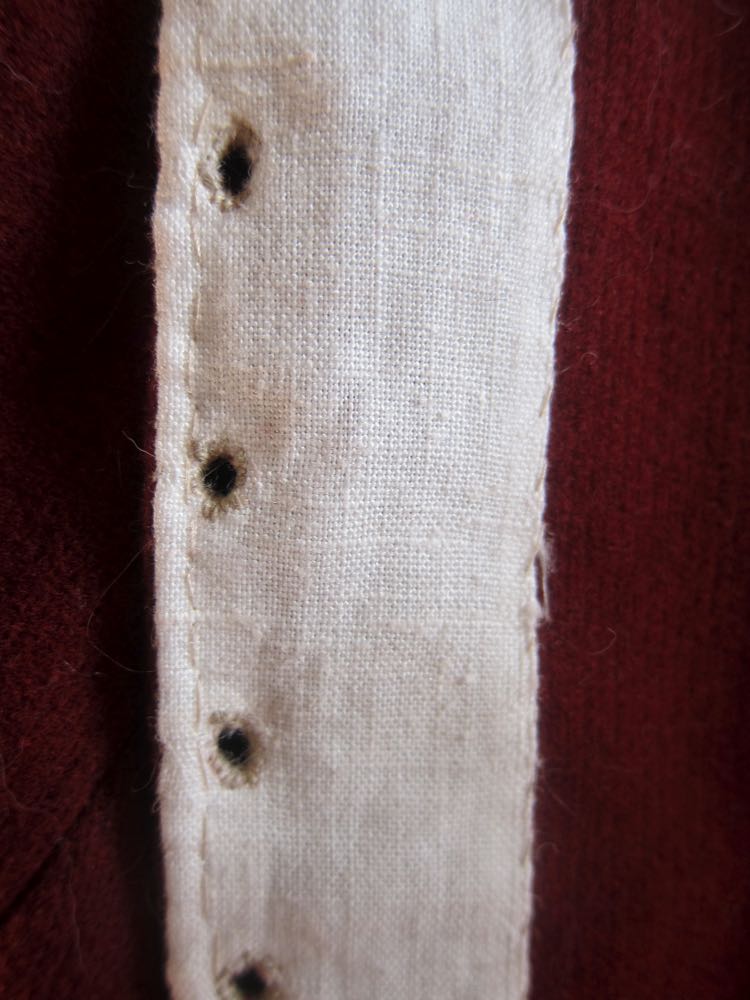
1350s-70s gown fitting & details thedreamstress.com11

The sewing is done with a combination of silk and linen thread, and all of the lacing holes are worked in linen thread.

There are 32 hand-worked lacing holes going down my front, placed one inch apart, and offset so that the dress laces in a spiral.
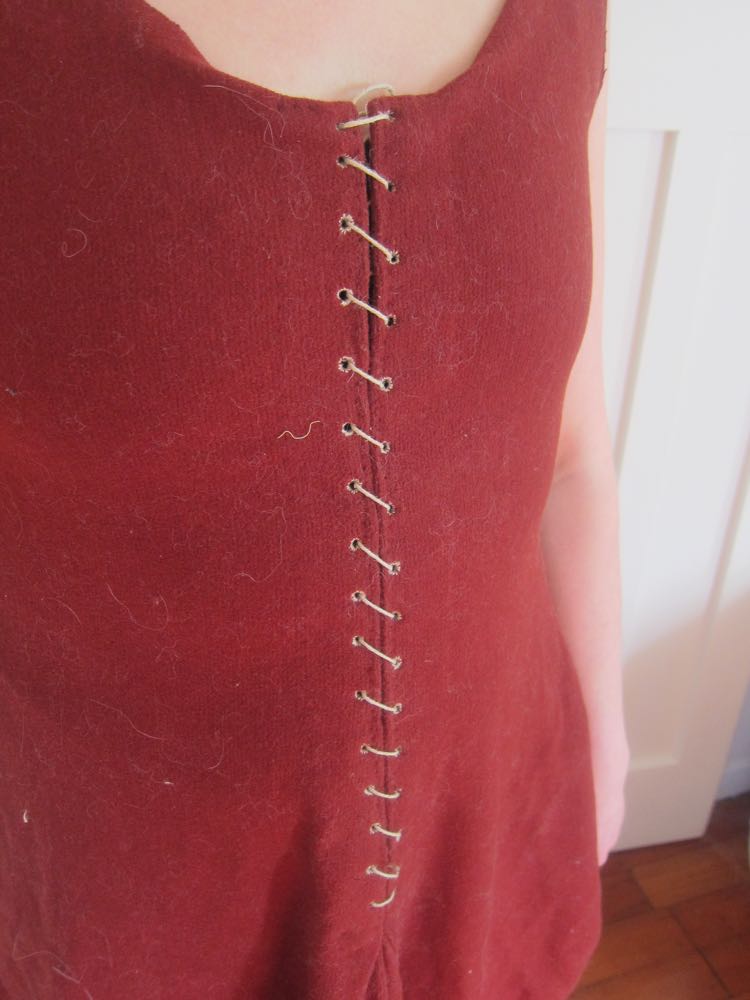
1350s-70s gown fitting & details thedreamstress.com06


Look how beautifully they match Katherine’s lacing:
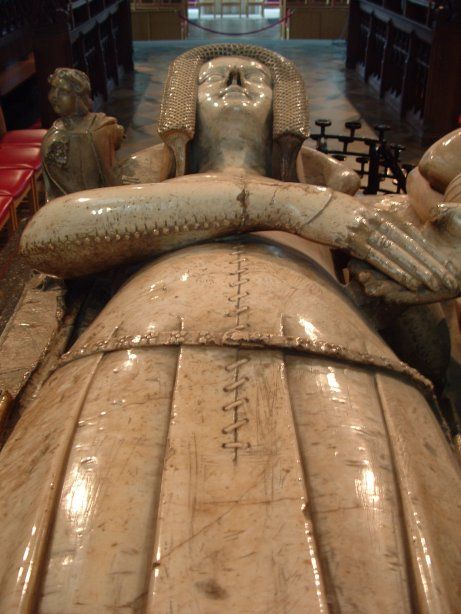
Effigy of Katherine, Countess of Warwick, died 1369

Effigy of Katherine, Countess of Warwick, died 1369

Only mine slant the other way!  I hope that isn’t bad or not-period-accurate.  I didn’t even think about it when I started the lacing holes, just picked one side, started, and assumed the other could  be offset!
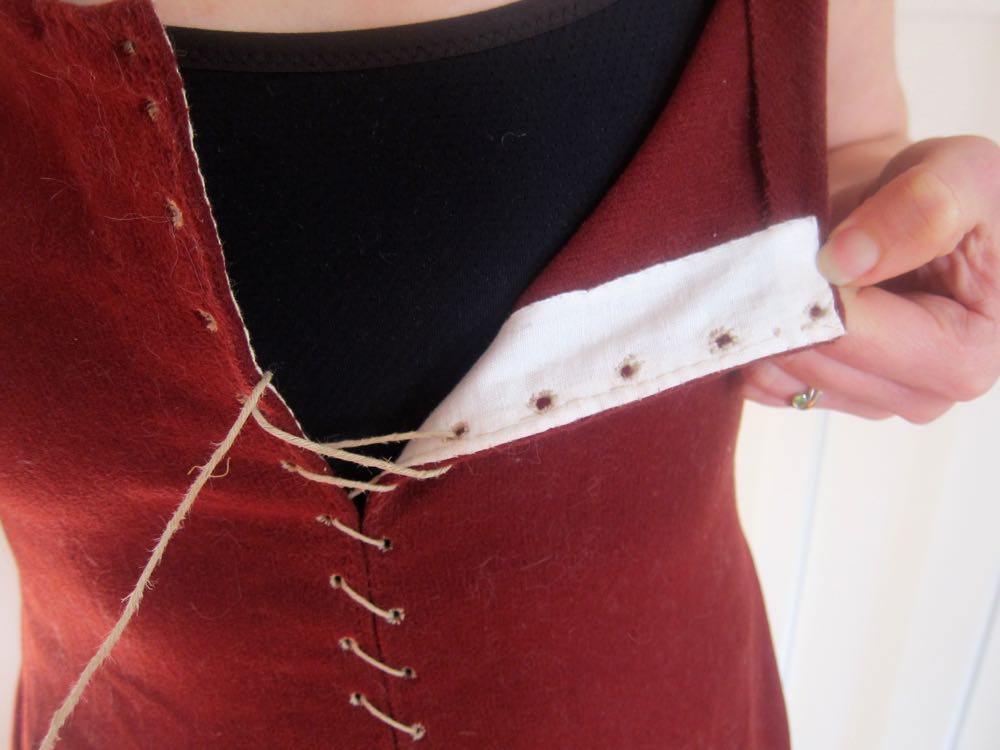
1350s-70s gown fitting & details thedreamstress.com08


Question to think about: was their a medieval etiquette around which way lacing slants…?

To lace my gown, I’m using a linen cord for now, until I find/make something better.

To make lacing it easier, I use a bodkin.
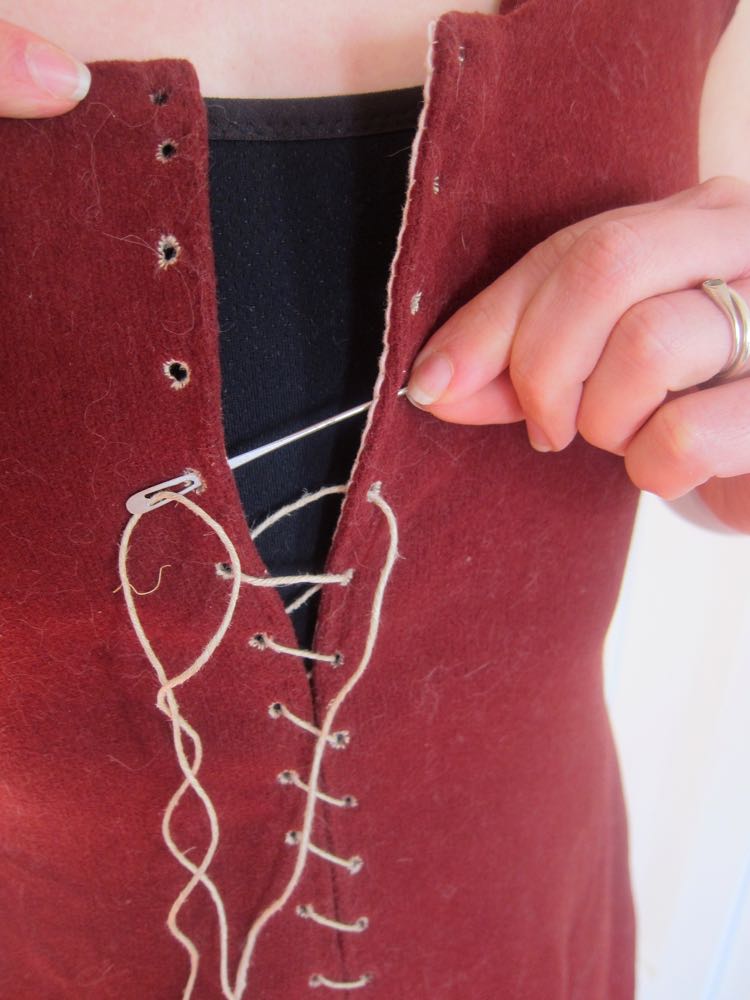
1350s-70s gown fitting & details thedreamstress.com10


There is a lot of evidence that bodkins were in use by the 14th century, and they certainly help with the lacing!  I’m particularly pleased with this one, as it looks more like earlier bodkins.  Maybe I should engrave it!
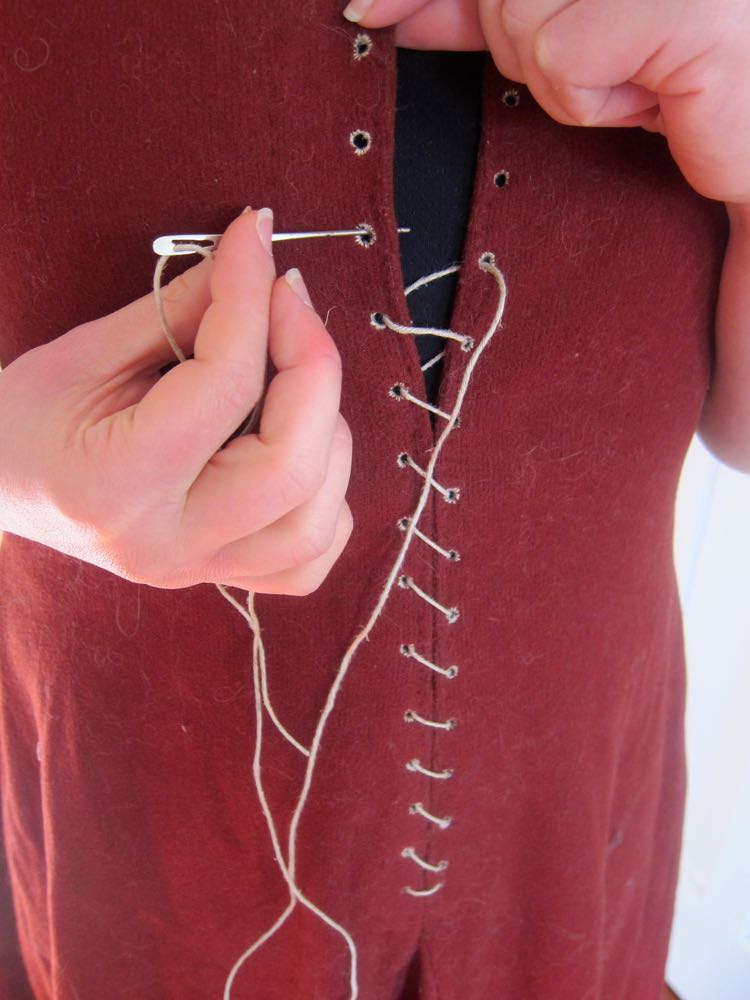
1350s-70s gown fitting & details thedreamstress.com09

Still to do: finish the neckline; let out the side seams the tiniest bit, as the lacing is struggling slightly across the bust; pattern, sew, and set in the sleeves, work endless amounts of sleeve buttonholes, sew on the buttons, and hem.  And press, press, press!

Oh,  and remove a couple of kilos of Felicity hair, because it attracts it like a magnet!

1350s-70s gown fitting & details thedreamstress.com06


Plus  I actually have something to wear this too?  Yes!  A historical evening near the end of August!  Exciting!

But that does mean I have to get it done by a certain date, and have a headdress to wear it with (though it this case, I think the most glamourous & high status circlet-&-fancy braided hairdo (and maybe even, gasp, a silk veil (or, you know, just appropriating the not-historical silk fichu I use for 18th century)) will be more appropriate than the period accurate linen veils I’ll be making later.)! 😉

The HSF/M 2015: Challenge #9: Brown

The theme for the Historical Sew Monthly Challenge #9 is Brown: make something in any shade of brown.

Brown is not generally my favourite colour, but I’m getting quite ambitious about this challenge, and have actually gotten very excited as I’ve researched it, so I may come around to brown yet!  And I’ve found so many beautiful things in finding pieces for the inspiration post!

Brown should be an easy one for everyone to do, because brown has been such a popular colour throughout history: there is almost no period, no people, no rank or station that hasn’t worn brown.  Hopefully  there will be entries to represent all sorts of periods, places, levels of stations, and all shades of brown!

And now, for some inspiration…

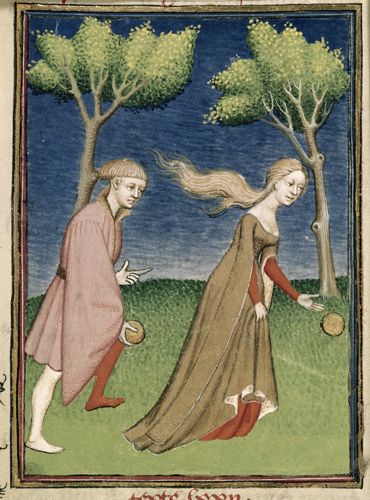
True browns are less common in Medieval illustrations than they were in Medieval clothing, simply because the illustrators went for bright shades for visual effect, and coloured illuminations are more likely to depict the upper classes, where brighter colours were a status symbol.  Plus, some colours  have faded to brown over time.  But I’m pretty sure Atalante’s frock was always brown, and isn’t it beautiful with her red under-gown!

Queen's Book, fol. 128. Hippomenes and Atalante.

Queen’s Book, fol. 128. Hippomenes and Atalante.

For another high-status brown, here is Jan Janz Mostaert’s beautiful Portrait of a Lady.  I love the way the rich brown brocade of her over-dress mirrors the rich brown of the fur lining, and complements the pinks of her under-dress.  Delicious!

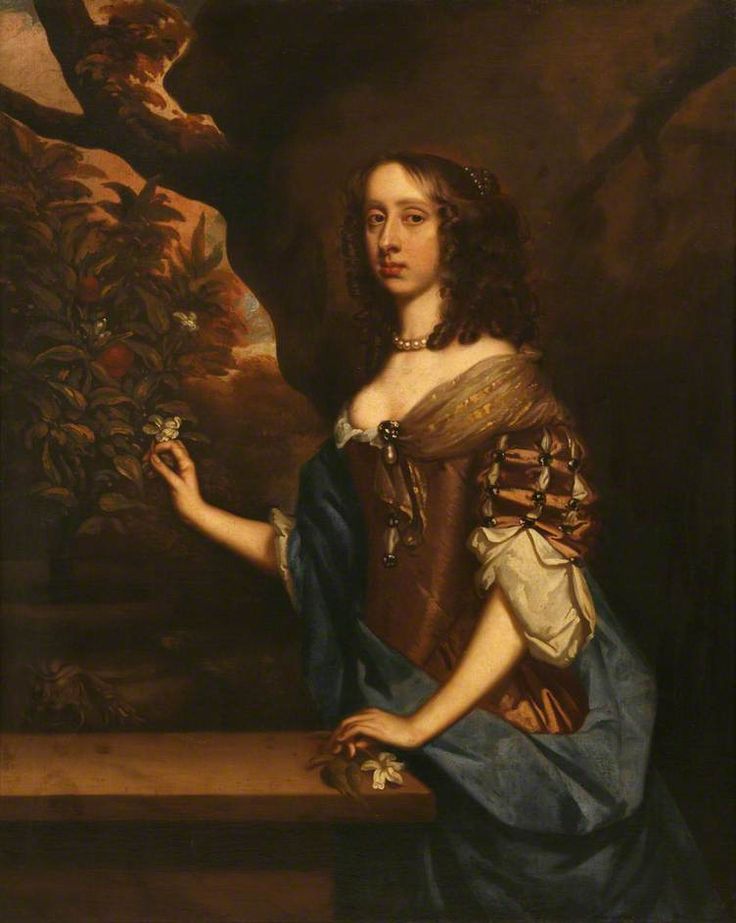
Fawn and copper were both very popular colours in the mid 17th century, as these two Lely portraits show admirably:

Elizabeth Wriothesley, Countess of Northumberland, later Countess of Montagu (1646-90), by Peter Lely, c. 1668

Elizabeth Wriothesley, Countess of Northumberland, later Countess of Montagu (1646-90), by Peter Lely, c. 1668

Jemima, 1st Countess of Sandwich, studio of Peter Lely, ca. 1660; (c) Mount Edgcumbe House; Supplied by The Public Catalogue Foundation

Jemima, 1st Countess of Sandwich, studio of Peter Lely, ca. 1660; (c) Mount Edgcumbe House; Supplied by The Public Catalogue Foundation

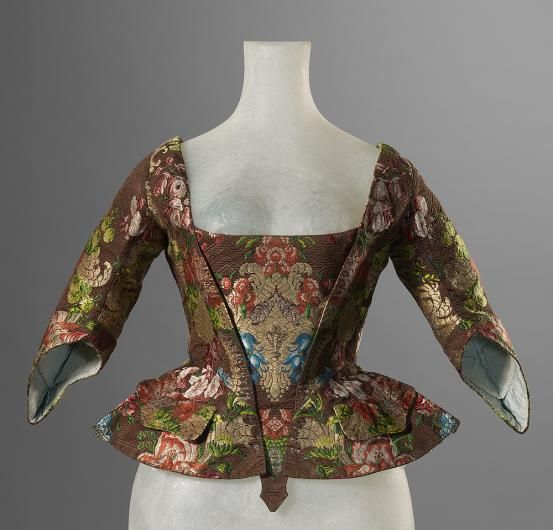
I absolutely adore this early 18th century jacket, the  beautiful bizarre silk it is made from, and the masterful use of the fabrics pattern in its design:

I’m still obsessed with 18th century chine a la branche silks, and I’ve noticed that they all come in shades of palest tan and the most classic 18th century shade of all, the pink-brown  known as puce.

Robe à la Francaise (detail), French, 1760s, chine silk, LACMA

Robe à la Francaise (detail), French, 1760s, chine silk, LACMA

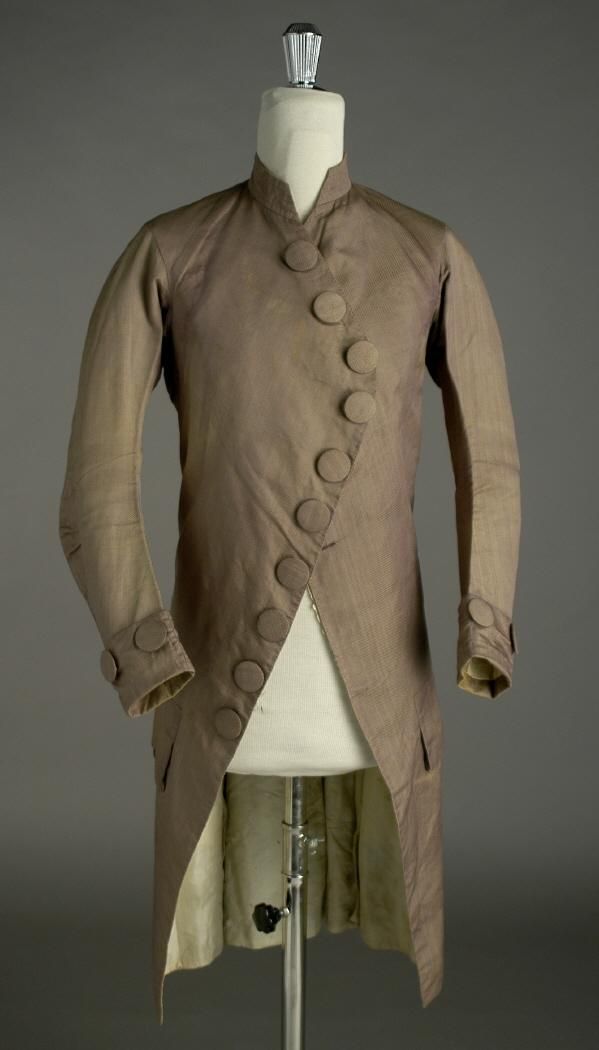
18th century menswear can be a bit over the top, but this jacket  is both severe and fabulous.

Lovely!

Brown was, of course, a common colour for stays and other under-things in the 18th century, and the working classes made all manner of garments, including shifts, from unbleached  brown linen.

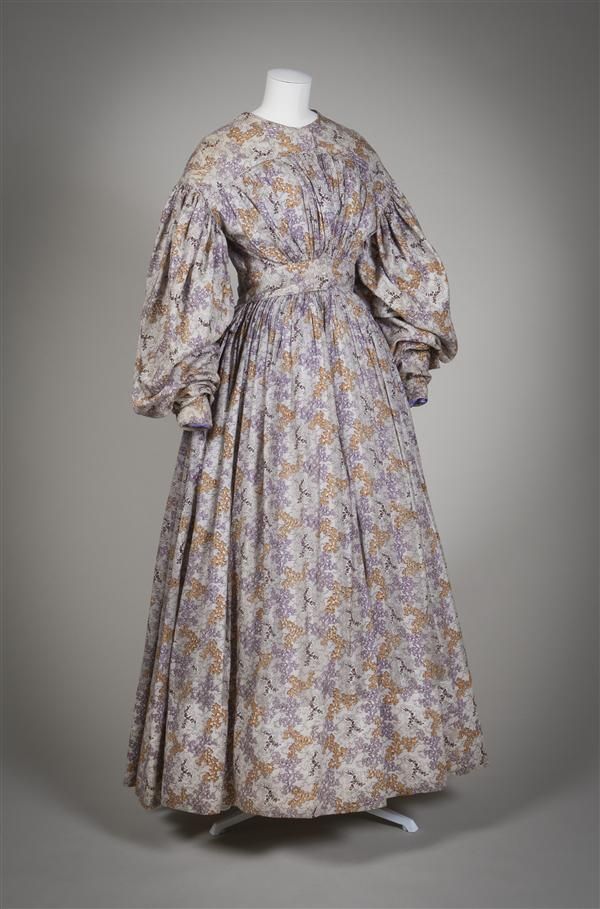
As with all colour challenges, the item doesn’t have to be exclusively brown, as long as the brown component is a significant part of it. This dress may be predominantly lilac, but  the beige flowers give it interest and visual impact, and even the briefest description is likely to say that it is lilac and light brown.

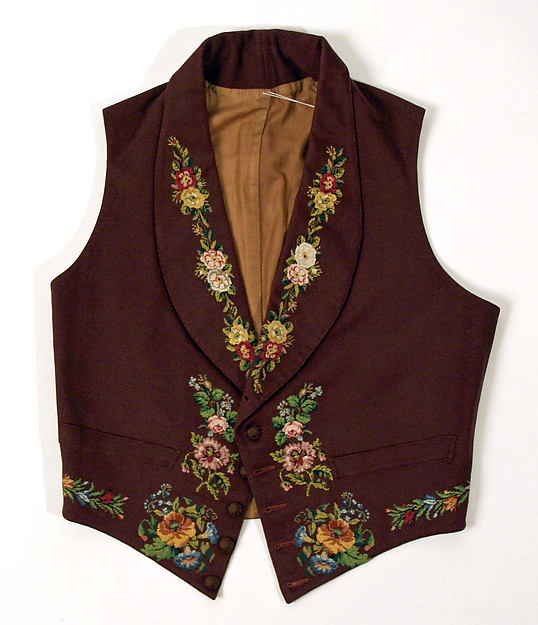
And because gorgeous mid-19th century flowers aren’t just for women….

Waistcoat, mid-1840s, British, wool, silk, Metropolitan Museum of Art, 24.160.3_F

Waistcoat, mid-1840s, British, wool, silk, Metropolitan Museum of Art, 24.160.3_F

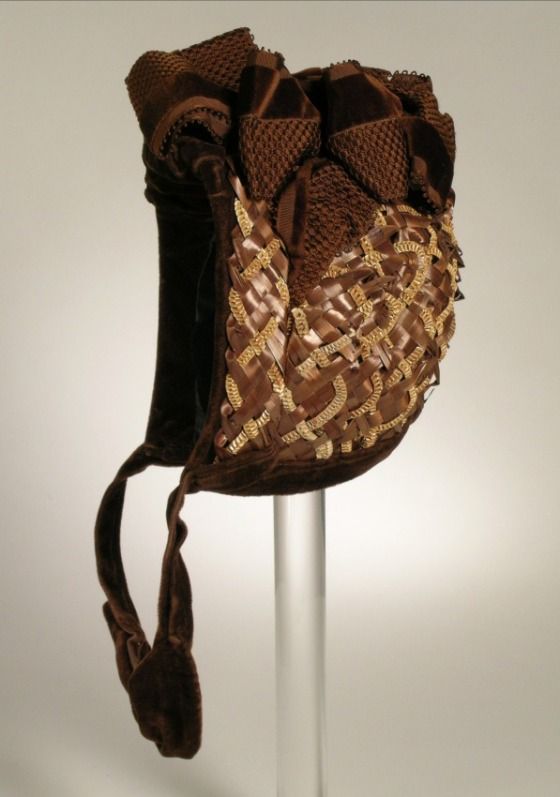
Accessories are a great way to bring brown into an outfit if a whole brown garment is too much.  I love this little bonnet:

Woman's Bonnet E. Dreyer (United States, Pennsylvania, Pittsburgh, active 19th century) Constructed in France for the United States market; materials from Switzerland or Japan, circa 1890 Costumes; Accessories Barley straw and synthetic celluloid, silk velvet, Los Angeles County Museum of Art, M.60.22.4

Woman’s Bonnet
E. Dreyer (United States, Pennsylvania, Pittsburgh, active 19th century)
Constructed in France for the United States market; materials from Switzerland or Japan, circa 1890
Costumes; Accessories
Barley straw and synthetic celluloid, silk velvet, Los Angeles County Museum of Art, M.60.22.4

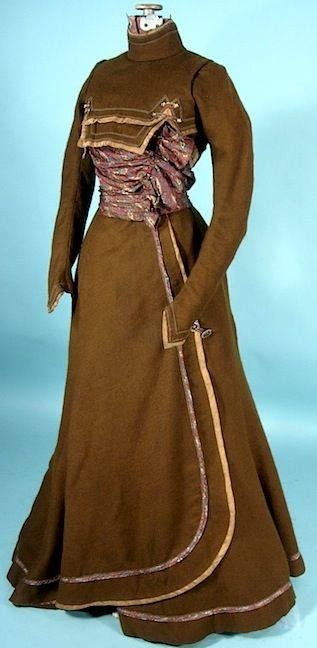
This ensemble got rather ravaged in Rate the Dress, but I still think it’s fascinating, and has distinct possibilities:

Ensemble (dress in two parts) in brown wool and paisley silk, ca. 1900, sold via Antique Dress.com

Ensemble (dress in two parts) in brown wool and paisley silk, ca. 1900, sold via Antique Dress.com

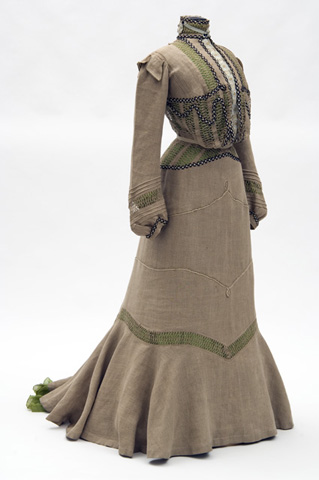
For an  example of brown linen, not the 18th century kind, this brown linen summer ensemble:

Day dress of unbleached linen with green silk underslip, 1901-2, Misses Leonard, St. Paul, US, Minnesota Historical Society

Day dress of unbleached linen with green silk underslip, 1901-2, Misses Leonard, St. Paul, US, Minnesota Historical Society

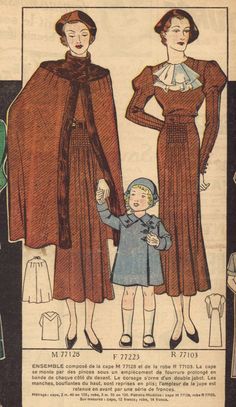
In more recent decades, brown has become a popular autumn colour, and is seen a lot in coats and tweeds, as in this chic 1935 number with matching cape:

1935, Petit Echo de la Mode

1935, Petit Echo de la Mode

Gorgeous!  Happy sewing!