Latest Posts

Not at all Slevils: Adventures in Medieval Sleeve Fitting

With surprisingly little faffing and no angst at all, my 1360s-70s gown now has sleeves!

Medieval sleeves have a reputation for being hard (I’ve heard them called slevils more than once) but sleeves are one of the things I’m really good at, so I wasn’t too worried about them.*  I think it’s because I’d sewn in a dozen sleeves and drafted at least two before I heard that sleeves are supposed to be awful.  I never had time to be scared!

But I’m a good little bloggy scholar, and I want my dress to help me get to historical accuracy, so I read pretty much all the medieval sleeve drafting posts on the internet, and got myself all psyched up to sew 14th century sleeves.

I started with the sleeve drafting tutorial at the Completely Dressed Anachronist.  Nice and clear, and I like the way she discusses the pitfalls of drafting methods.

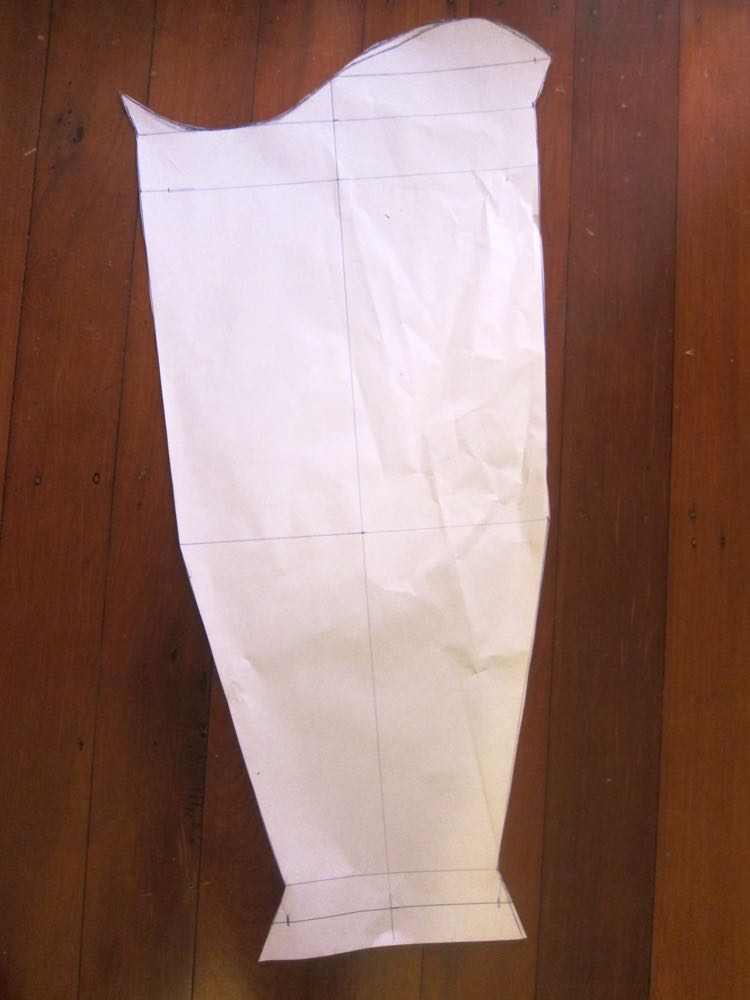
By following it, I got this:
Fitting medieval sleeves 2 thedreamstress.com3

I cut it out in toile fabric, sewed it up, and it DID NOT WORK.  It was way too long, particularly in the upper half, and the armscye was ridiculously not-right.   Half of that I will cop as totally my fault, because I did the measurements on myself, and I’m pretty sure I did a really crappy job on them.  The other half is the limitations of any drafting system for a garment with a very fitted  armscye – the shape is just going to be so specific to the individual and the garment that it’s almost impossible to develop a formula for it.

But I didn’t loose heart!  Oh no!  I shortened the upper sleeve 2″, peered at the armscye while tugging and moving my arm, and drew a new armscye shape with a shallower top curve, and a narrower underarm dip:
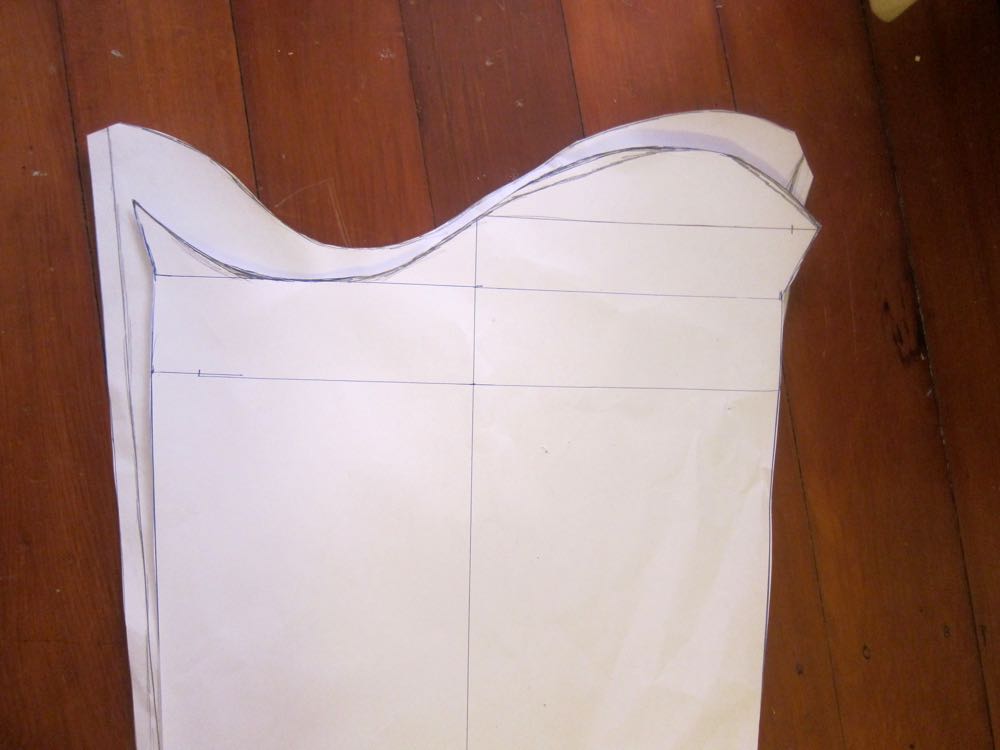
Fitting medieval sleeves 2 thedreamstress.com5

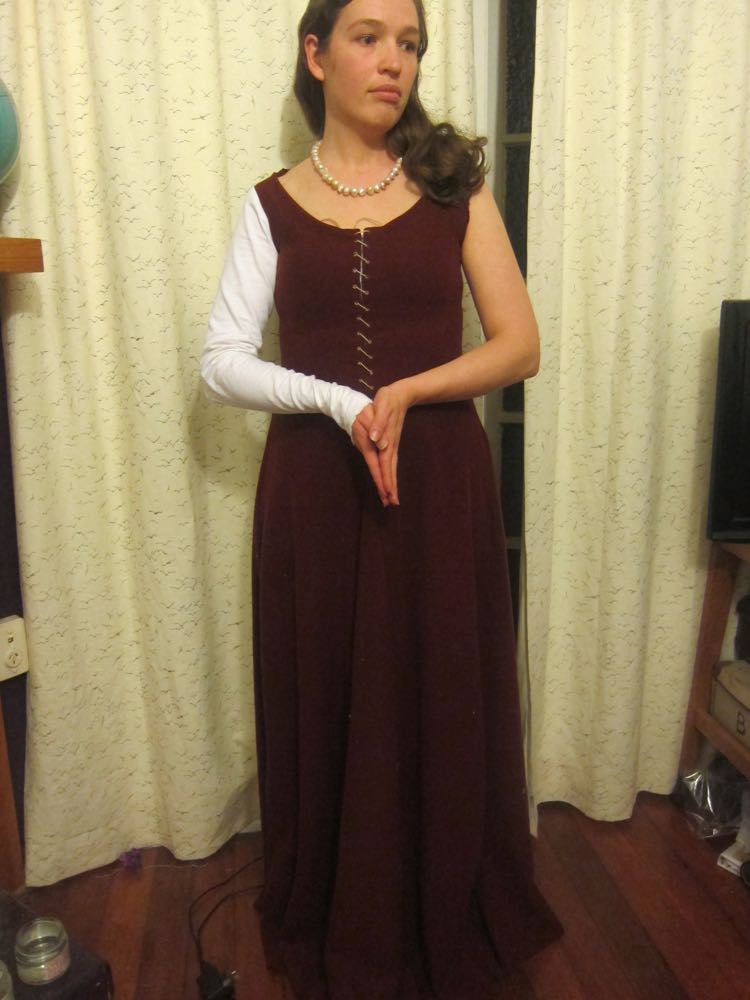
I tried that as a toile, made a few tweaks to it, made another toile, the fit was perfect, so I re-drew my arm seam  on it based on the extremely helpful diagrams at By My Measure, and made a fourth toile.

I could bend my elbow:
Fitting medieval sleeves thedreamstress.com1

I could bend my elbow a  lot:

Fitting medieval sleeves thedreamstress.com2

(side note: I’ve moved the skirt gores back down again, versus their position in the last post, and look how much better than hang of the dress and the line over my hips is)

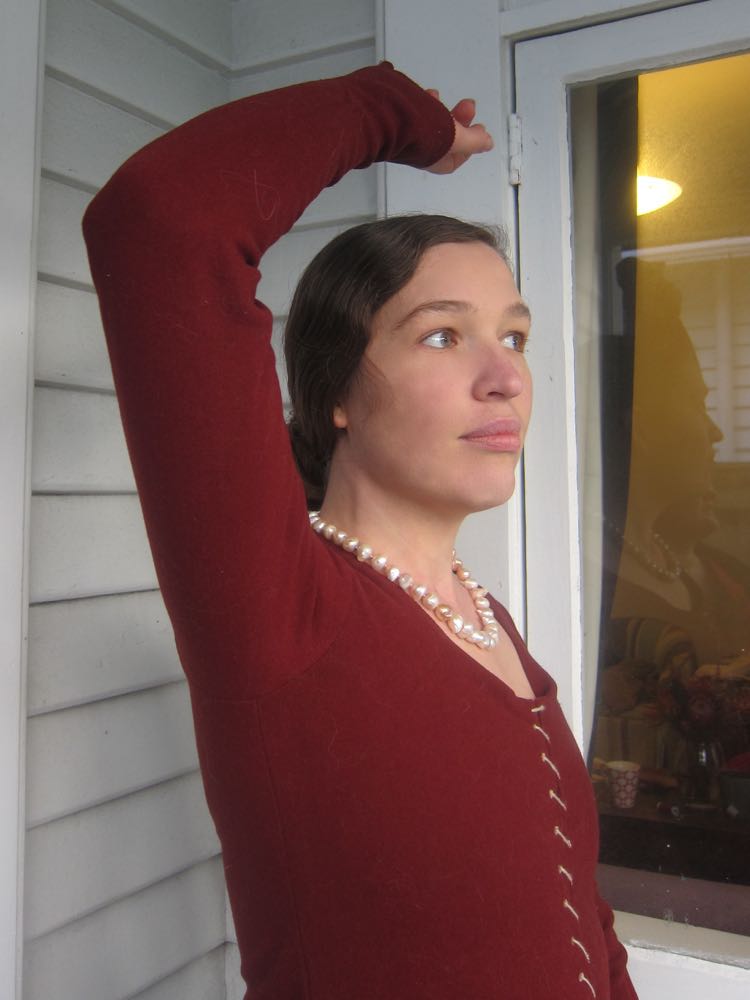
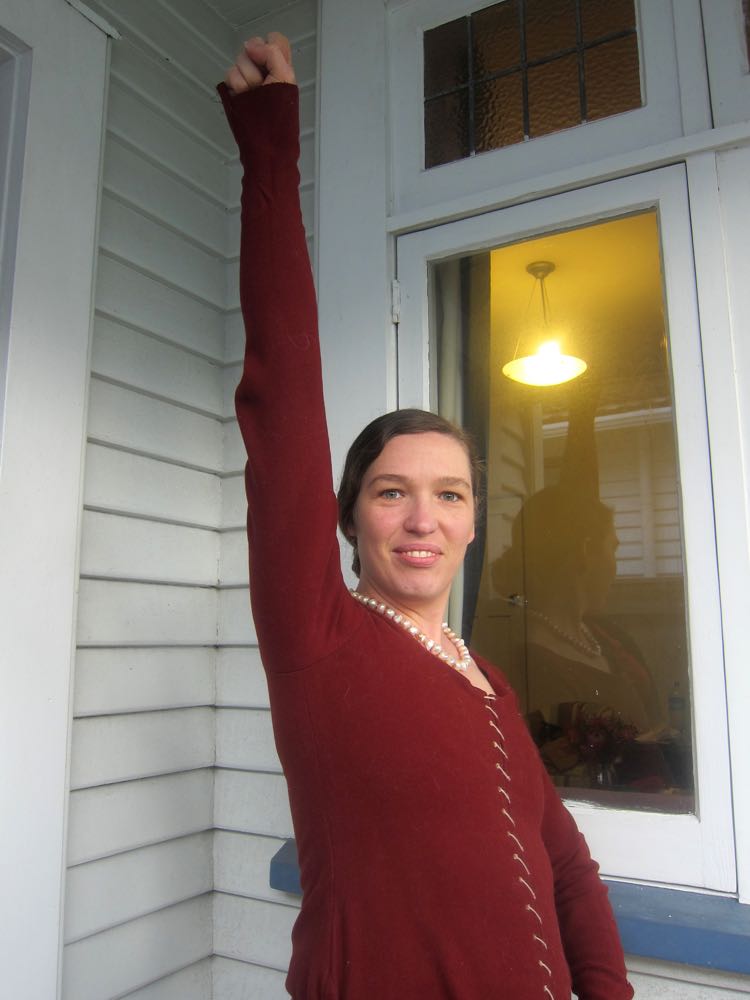
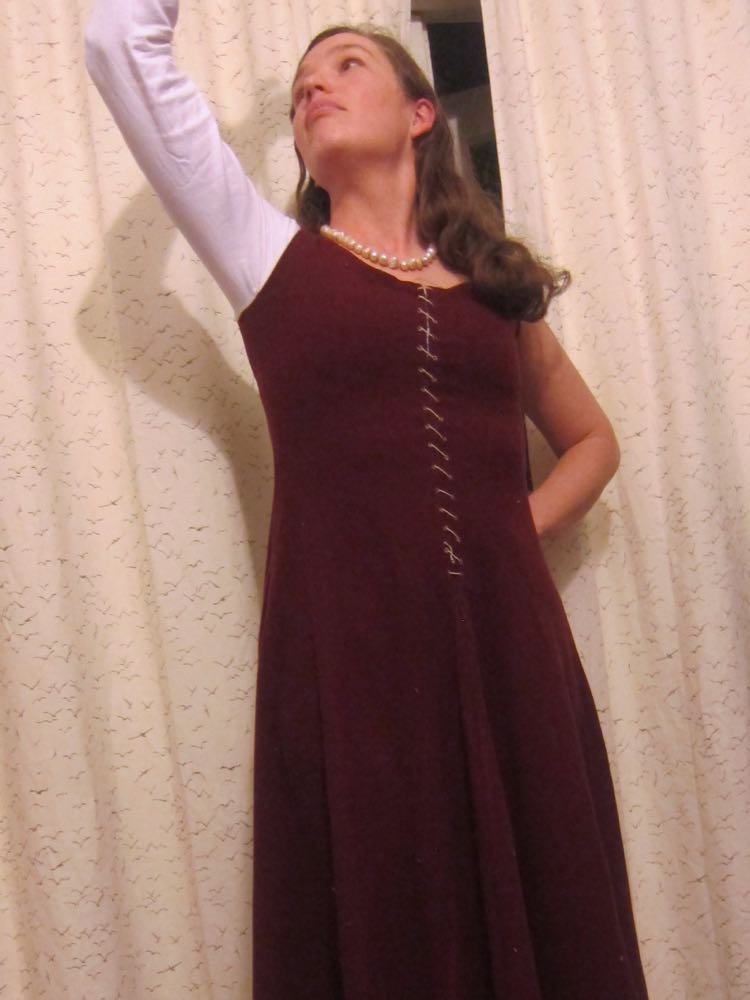
I could raise my arm:
Fitting medieval sleeves thedreamstress.com3

I was ready to cut sleeves!

For reference, here is my original drafted pattern on the left, and my final version with an altered line so the seam runs on the side of my arm so I can have sleeve buttons on the right (the final version has seam allowance added).  The final version looks a little weird, but that’s because arms and shoulders are weird.  They aren’t nice straight symmetrical tubes.
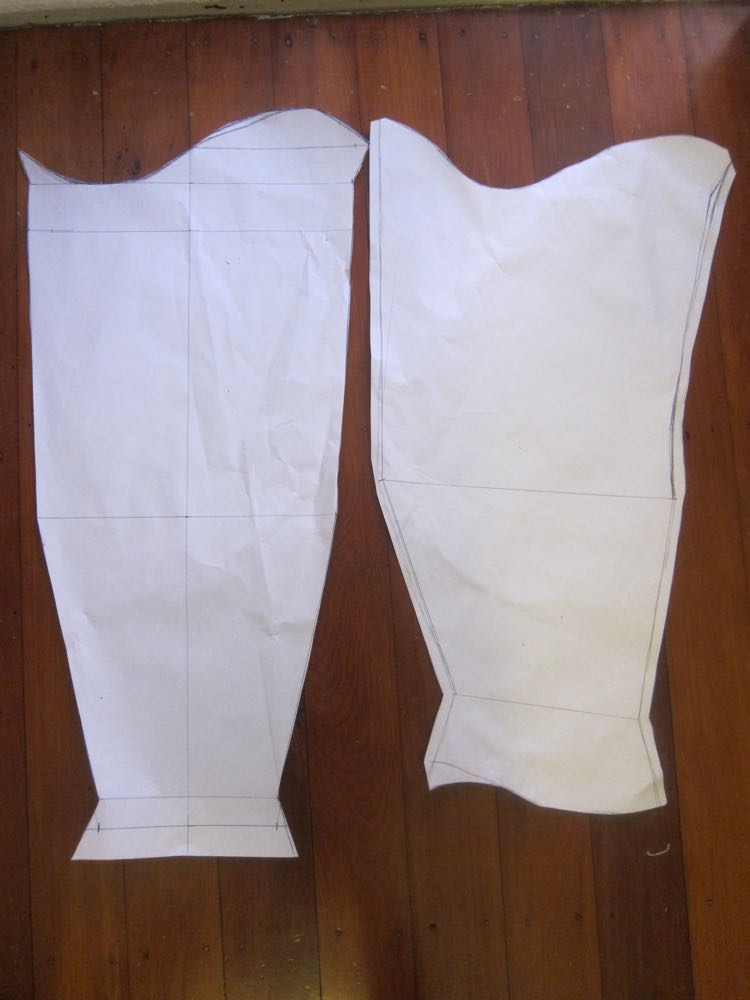
Fitting medieval sleeves 2 thedreamstress.com4

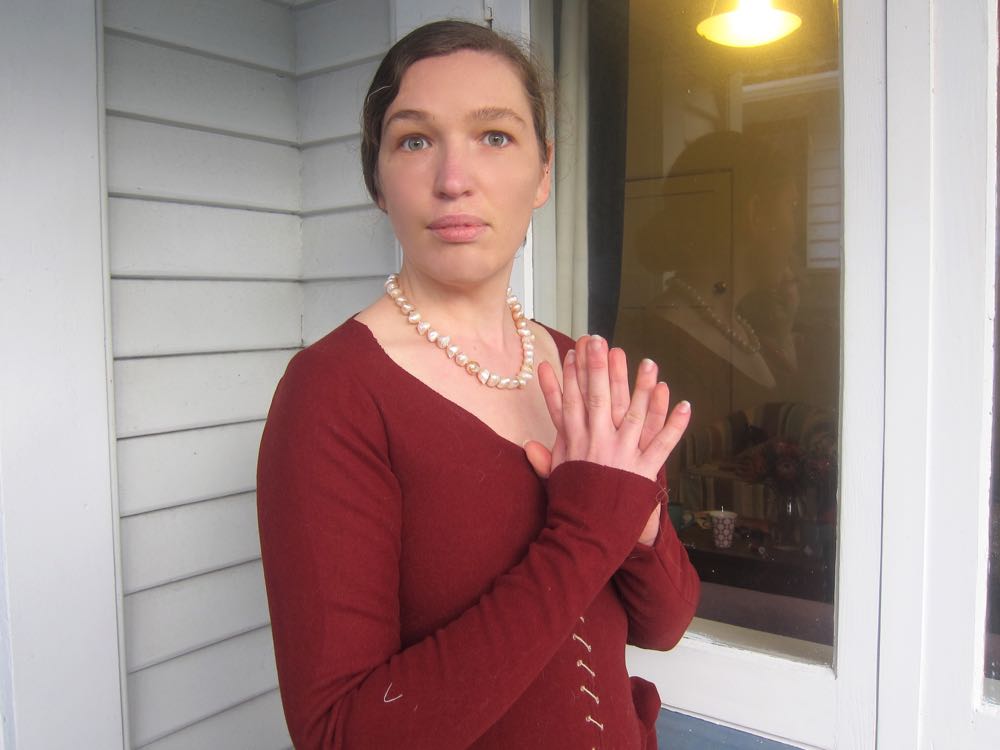
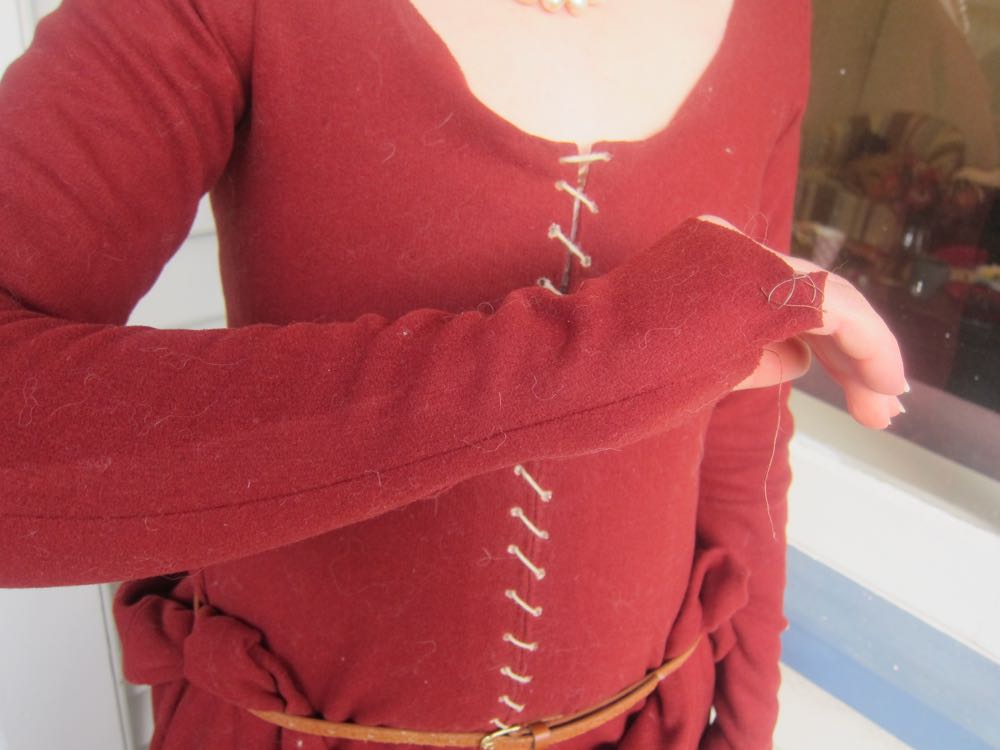
And here are my sewn-in  sleeves:

Fitting medieval sleeves thedreamstress.com6

Fitting medieval sleeves thedreamstress.com8

Fitting medieval sleeves thedreamstress.com5

Success!

Fitting medieval sleeves thedreamstress.com7

I’m pretty pleased, though I may keep fussing with the pattern, as I think I could get it just a bit more perfect for my next version, but overall it does everything it should, and  Felicity likes the pattern, so it must be good:
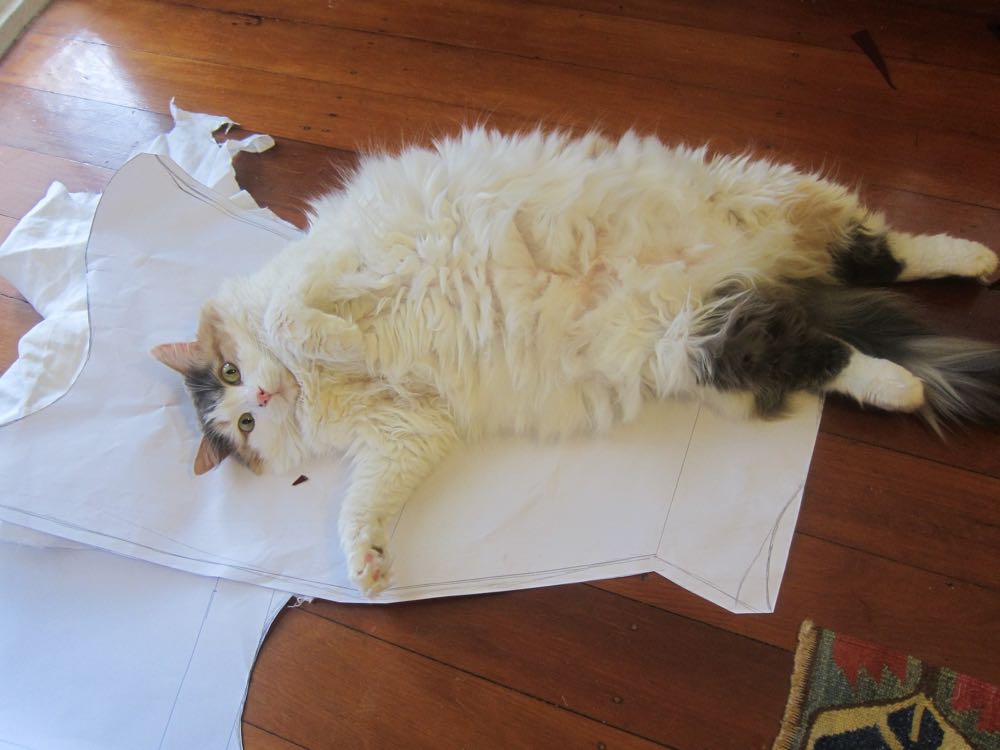
Fitting medieval sleeves 2 thedreamstress.com2

Some final thoughts on sleeve fitting:

  • Toiles.  Lots of em.  Suck it up and just keep doing them, because that’s how you get things right.
  • Just keep looking at your toiles, analysing where there is pulling (too little fabric) or bagging (too much fabric) and adding or taking away until you get it just right.
  • Sleeve fitting is an art, not a science.
  • Arms and shoulders are not symmetrical, and not straight.  It’s better to have a funny looking pattern that fits right, than a tidy looking one that doesn’t.

* Don’t worry, there are plenty of sewing and other things I’m not remotely good at, so balance is achieved across the universe!
Rate the Dress: Evening shades for ca. 1910

I’m always surprised by what does and what doesn’t come under criticism with a Rate the Dress. I knew the print and non-symetrical matching of last week’s credited-as-1860s-almost-certainly-early-1850s-instead frock wouldn’t be everyone’s favourite, but it didn’t occur to me that quite a few of you would castigate it for the anatomy it was meant to fit over.  The lady who wore it couldn’t help her very long torsos and slope-y shoulders (and the shoulders, at least, were very fashionable at the time)!  Many of you did, however, appreciated the pairing of a very busy fabric with a very simple design, which helped to give the dress a modest but respectable 7 out of 10.

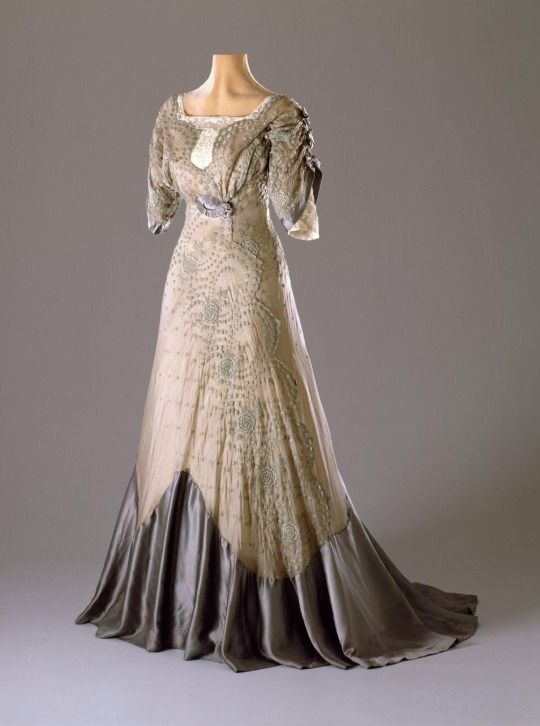
This frock, from the Hillwood Estate Museum, features very muted fabrics, and the transitional silhouette of 1909ish, as fashions moved from the sweeping skirts and drooping bodices of the first decade of the 20th century, to the raised waists and slim columnar shape of the second.

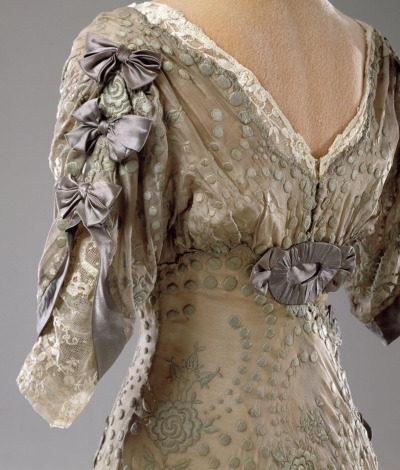
This evening dress still features the sweeping skirts, but they are considerably restrained.  The colours are the fashionable pastels of the 1900s, given a slightly off-tone twist that anticipates the wilder colours of the 1910s.  A slight hint of blousing in the bodice remains, but the waist is raised, and the sleeves hint at the newly fashionable kimono or dolman sleeves, albeit with a very uber-feminine Edwardian touch of bows.

How do you feel about the mix of styles? Is it the best of both eras?

Rate the Dress on a Scale of 1 to 10

Fittings, lacings, and gores: progress on the medieval gown

There has been a bit of blog silence on it for the last few months, but I have been plugging away on the 1370ish dress, but there has been an awful lot of effort on it that doesn’t look like anything, because it was just unpicking and re-doing.

I got it all sewn together, did an initial fit, and it just didn’t feel quite right, which prompted a LOT more research.  Based on the research, I decided that lining 14th century gowns with linen is almost certainly not accurate, and gives a fit that doesn’t match the fits shown on effigies of the period.

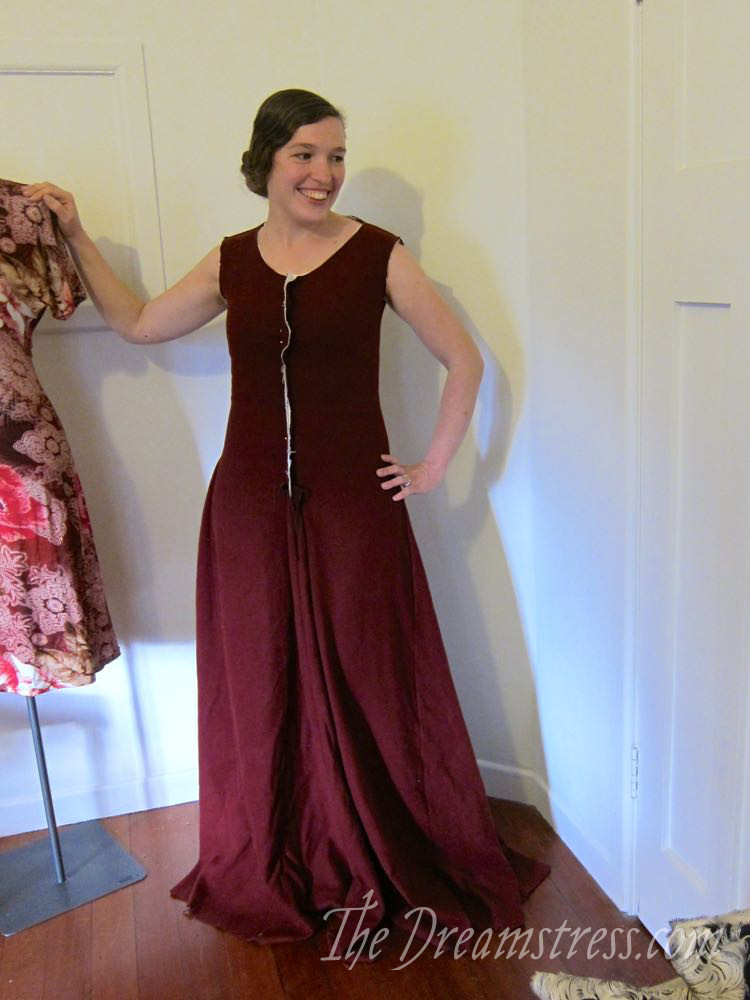
This is what the dress looked like with a linen lining:

Fitting a medieval gown thedreamstress.com11

It looks really good, but it’s very constricting.  It just didn’t feel right.

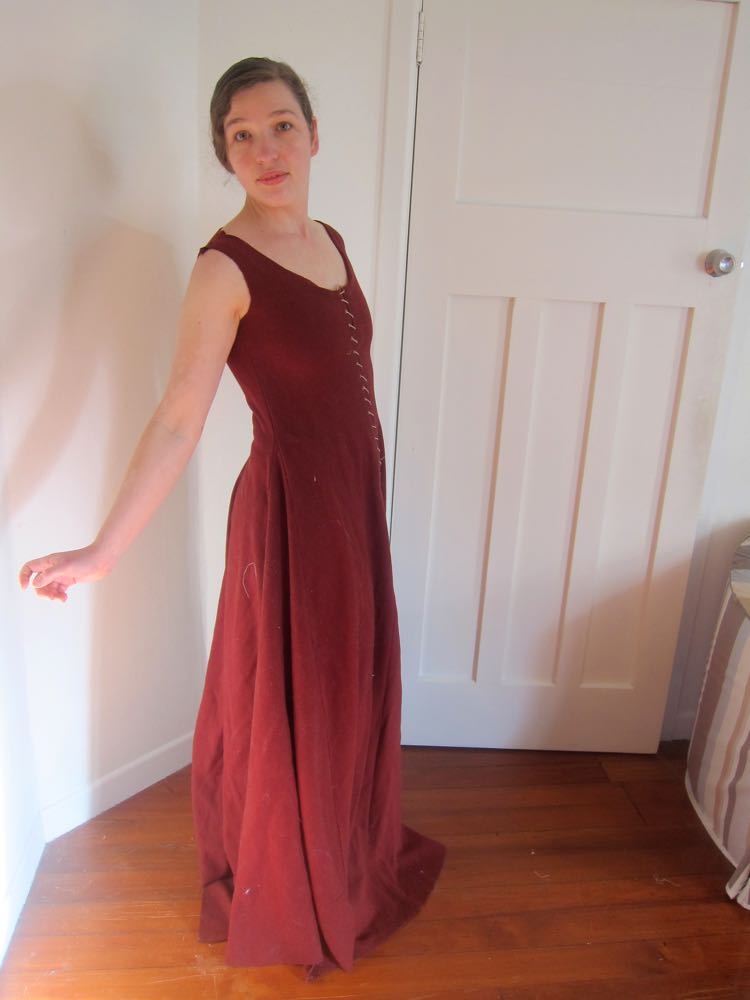
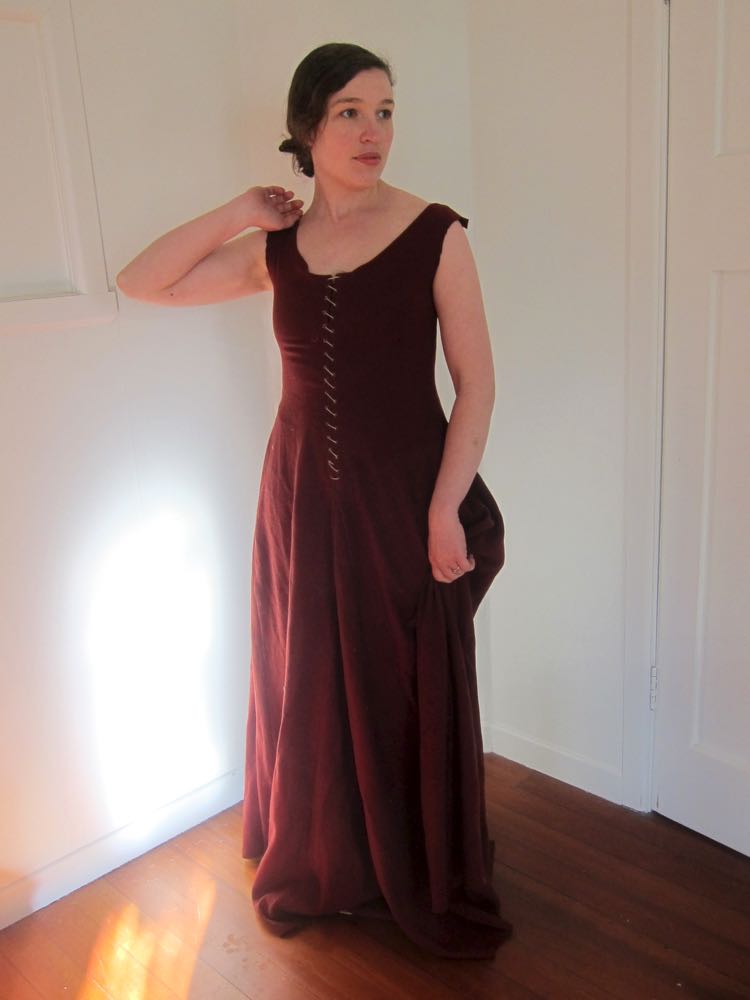
So I sucked it up and unpicked the lining.  And all my gores.  And then I re-sewed the entire gown without a lining, and with the gores placed almost at my waist.

1350s-70s gown fitting & details thedreamstress.com05

As soon as I tried on gown 2.0 I knew two things.

First, the fit is SO much better without a lining.  It feels much more correct.  The gown is much easier to wear, much easier to move in, and provides support without constriction.  I can move and pose in exactly the stances shown in illuminations and effigy, and it feels comfortable, whereas it felt awkward and as if I was fighting the dress when it had a lining.

It’s not just that I’m small busted.  Even a MUCH bustier friend who tried on the dress was impressed by how much support the dress supplied with a snug fit and slight give from the wool.

Even though it was extra work, I’m very glad I tried the lining, because I was able to compare it to a dress without the lining and really understand the difference in fit.

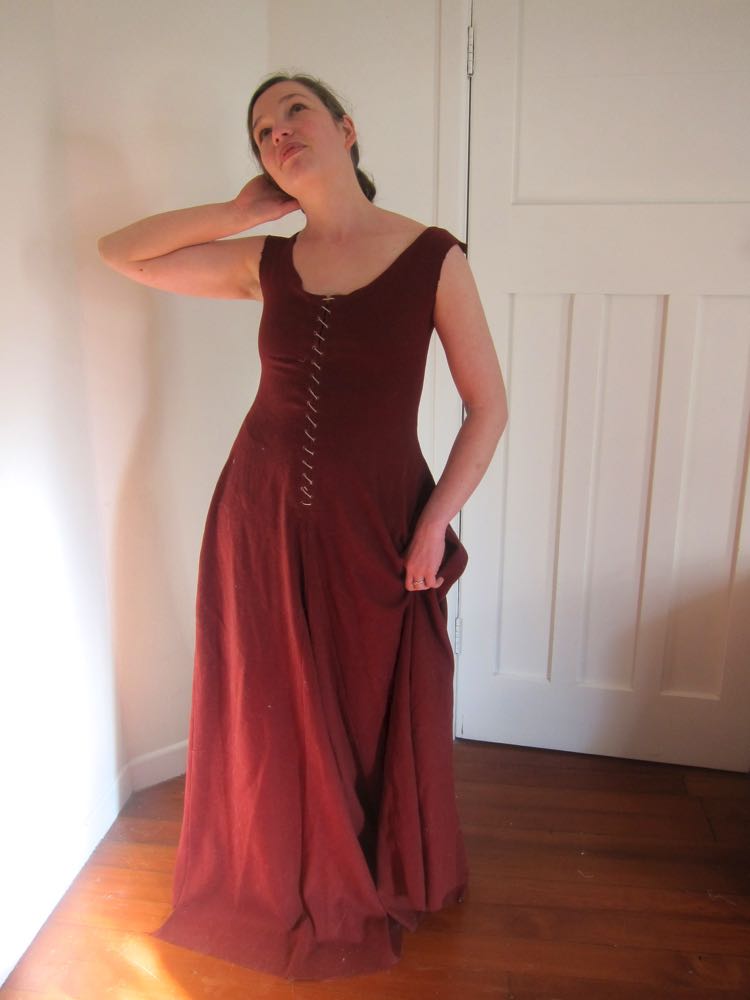
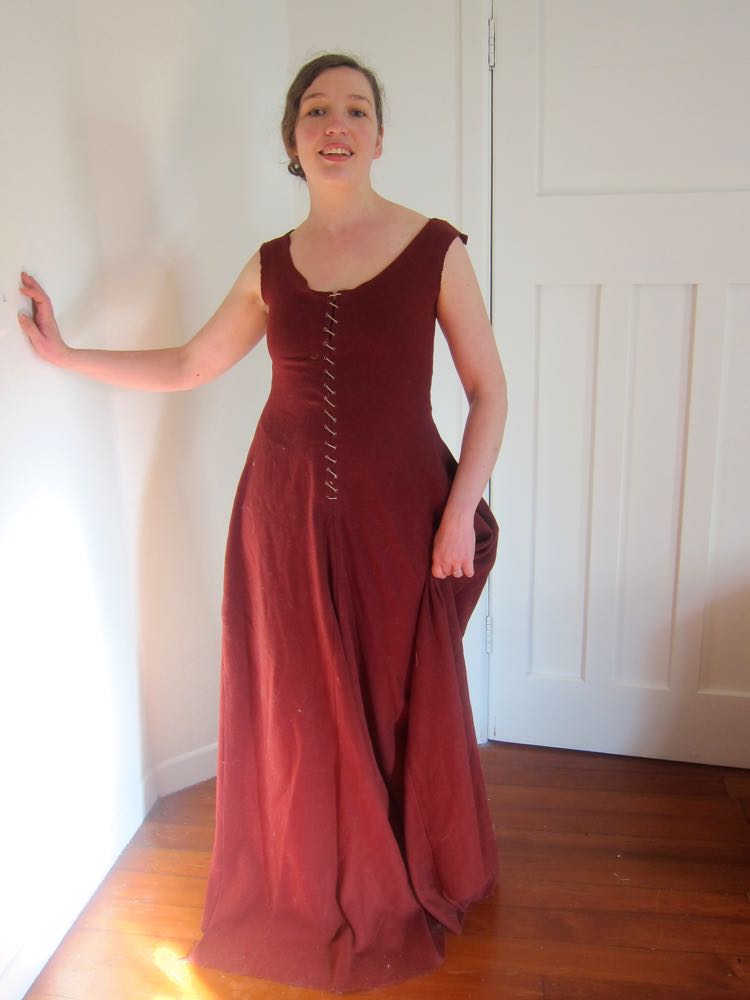
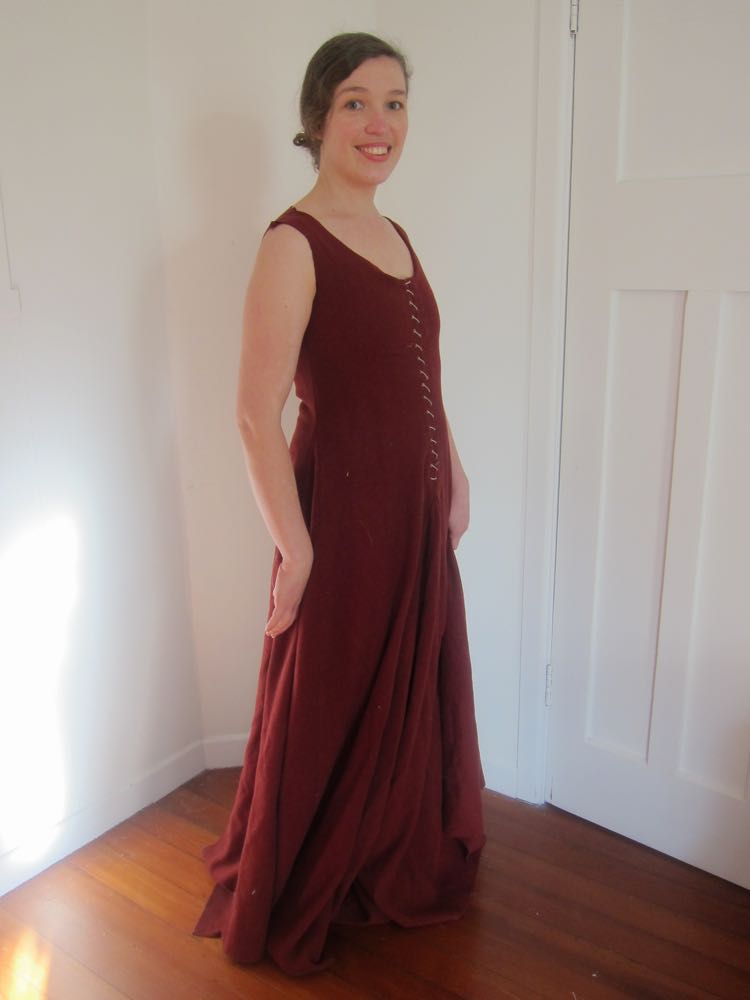
The second thing I found from version 2.0 isn’t so good.  I DO NOT like the higher gores.  They ‘poof’ out way too much over my hips, and rub against the top of my hipbone, and basically don’t match the more androgynous 1360s-70s silhouette I am going for.

1350s-70s gown fitting & details thedreamstress.com03

They haven’t, of course, had time to really hang into place, and they would benefit from a really good pressing, both of which would would help.  If I were doing 1390s the silhouette would be more appropriate, but as they are I don’t like them.

1350s-70s gown fitting & details thedreamstress.com01

So….more unpicking.

Yay.

(yes, I know I like unpicking, or at least don’t dislike it, but not heavy cotton thread (yes, inaccurate but this was always a test dress) on fulled wool in the middle of winter when the pressure of the quick-unpick on my finger gives me a big chillblain lump where it rubs as I hold it is not fun!).

I’ve got one other tiny thing I wish I could change, but can’t.  I’m not in love with the neckline.  I lowered it a couple of cm from the first fitting, and widened it quite a lot, and I wish I’d only widened it – it’s a little lower than I would like.

1350s-70s gown fitting & details thedreamstress.com02

I’ve ended up with lady in blue instead of lady in red after all:

Guillaume de Machaut epiant les amoureux deçus. - Le Jugement dou roi de Navarre.Maître du Policratique. Enlumineur de l'œuvre reproduite Date d'edition - 1380-1395

Guillaume de Machaut watching the disappointed lover. – The Judgement of the King of Navarre. Maître Policratique . 1380-1395

I may try to widen the neckline as much more as I possibly can.  The good thing about a low, wide, neckline, is that I can wear every possible layer over it, and their necklines will fit, so that’s a bonus!

In addition to tons of unpicking and re-sewing, I finished and faced the front edge:

1350s-70s gown fitting & details thedreamstress.com11

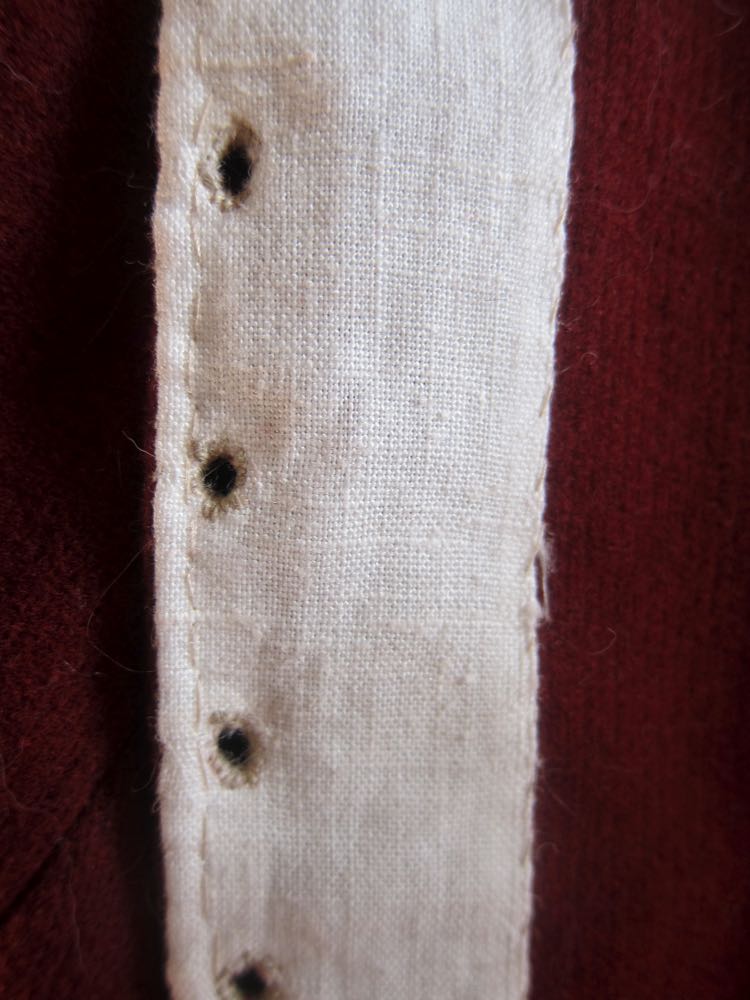
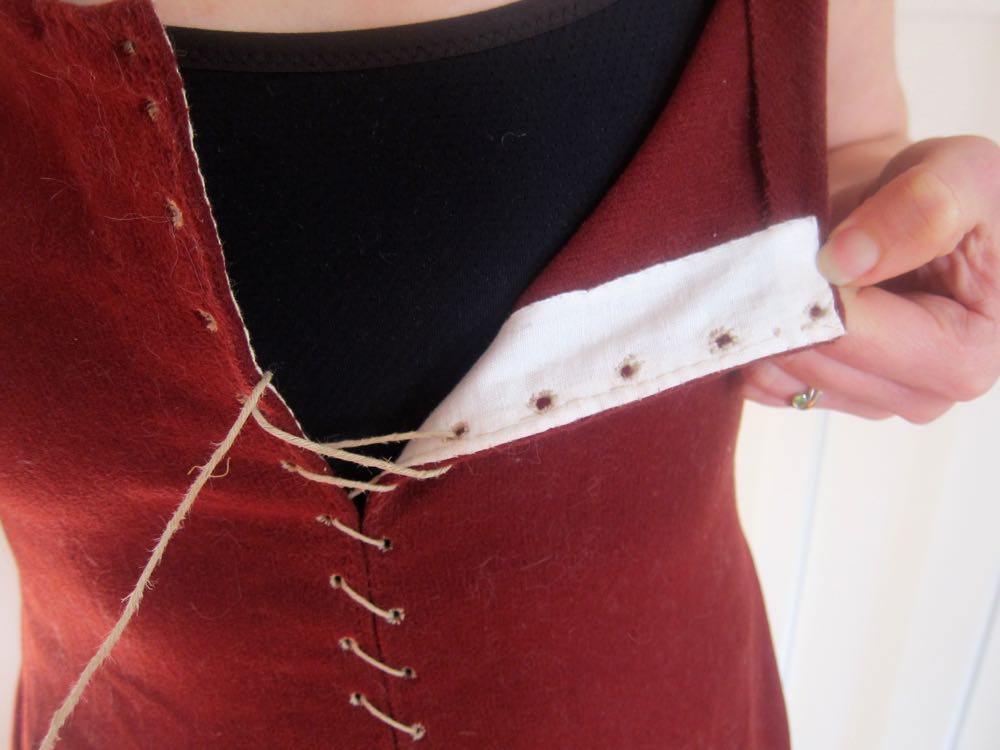
The sewing is done with a combination of silk and linen thread, and all of the lacing holes are worked in linen thread.

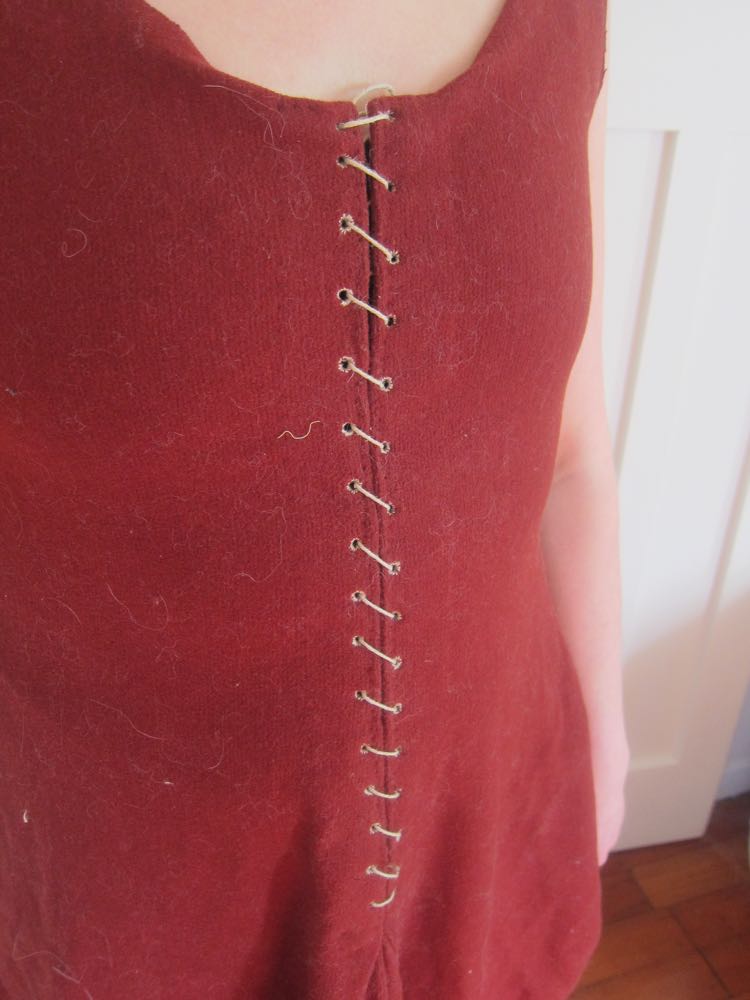
There are 32 hand-worked lacing holes going down my front, placed one inch apart, and offset so that the dress laces in a spiral.

1350s-70s gown fitting & details thedreamstress.com06


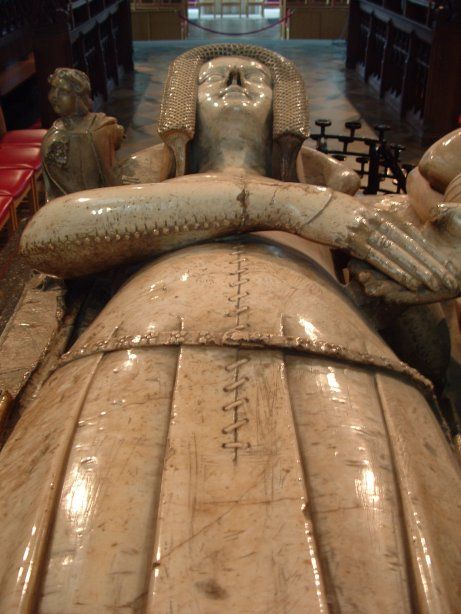
Look how beautifully they match Katherine’s lacing:

Effigy of Katherine, Countess of Warwick, died 1369

Effigy of Katherine, Countess of Warwick, died 1369

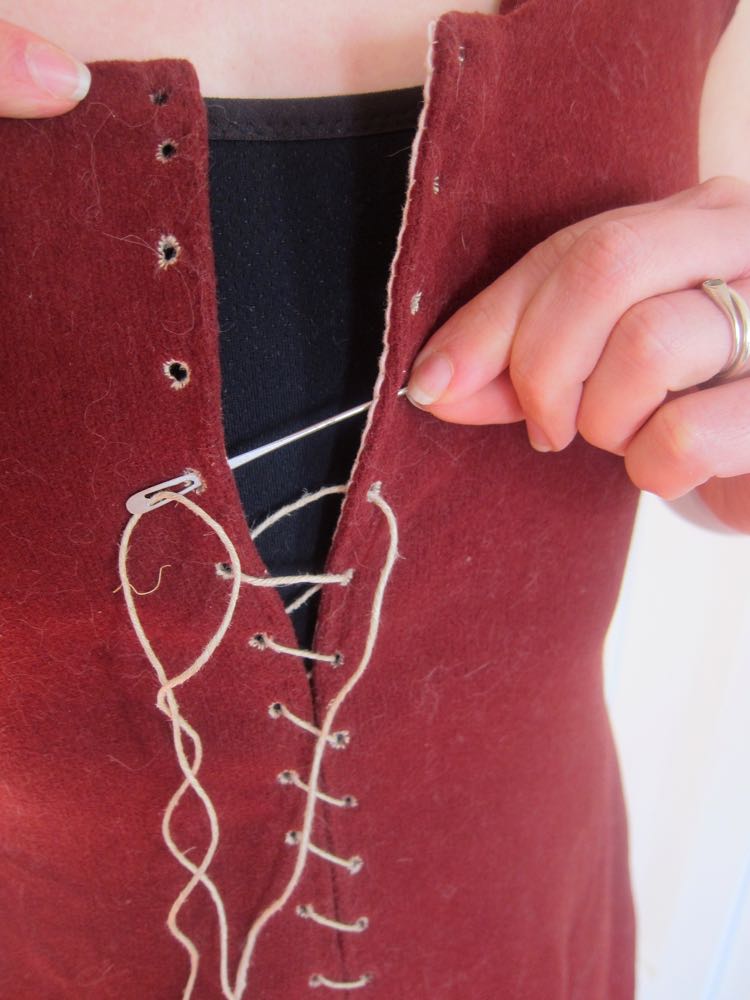
Only mine slant the other way!  I hope that isn’t bad or not-period-accurate.  I didn’t even think about it when I started the lacing holes, just picked one side, started, and assumed the other could  be offset!

1350s-70s gown fitting & details thedreamstress.com08


Question to think about: was their a medieval etiquette around which way lacing slants…?

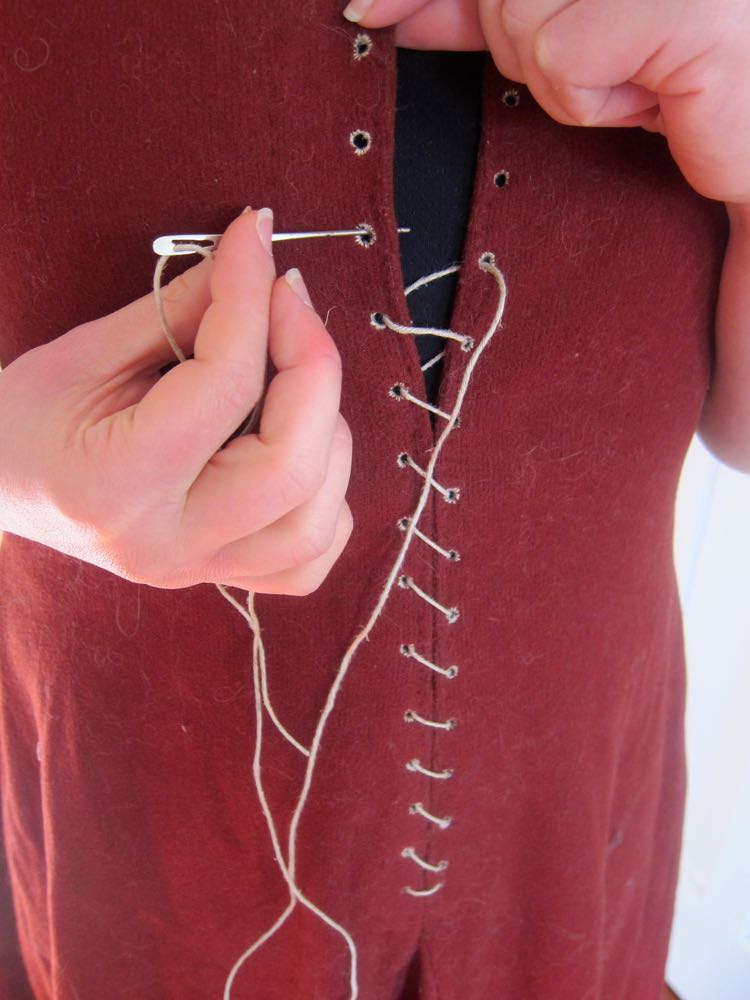
To lace my gown, I’m using a linen cord for now, until I find/make something better.

To make lacing it easier, I use a bodkin.

1350s-70s gown fitting & details thedreamstress.com10


There is a lot of evidence that bodkins were in use by the 14th century, and they certainly help with the lacing!  I’m particularly pleased with this one, as it looks more like earlier bodkins.  Maybe I should engrave it!

1350s-70s gown fitting & details thedreamstress.com09

Still to do: finish the neckline; let out the side seams the tiniest bit, as the lacing is struggling slightly across the bust; pattern, sew, and set in the sleeves, work endless amounts of sleeve buttonholes, sew on the buttons, and hem.  And press, press, press!

Oh,  and remove a couple of kilos of Felicity hair, because it attracts it like a magnet!

1350s-70s gown fitting & details thedreamstress.com06


Plus  I actually have something to wear this too?  Yes!  A historical evening near the end of August!  Exciting!

But that does mean I have to get it done by a certain date, and have a headdress to wear it with (though it this case, I think the most glamourous & high status circlet-&-fancy braided hairdo (and maybe even, gasp, a silk veil (or, you know, just appropriating the not-historical silk fichu I use for 18th century)) will be more appropriate than the period accurate linen veils I’ll be making later.)! 😉