Latest Posts

HSF Challenge 2: UFO – three ways to interpret it

The first proper Historical Sew Fortnightly challenge is done – some amazing things were created, it’s so exciting!  Mine is done but not quite photographed, so I’ll do that tomorrow and post about it Wednesday after the Rate the Dress.

And then it’s time to work on the next one…

The next challenge is UFO – Un-Finished Object.  Use this opportunity to finish off something that’s never quite gotten done, or stalled halfway through.

I’m finishing the Luna Moth frock:
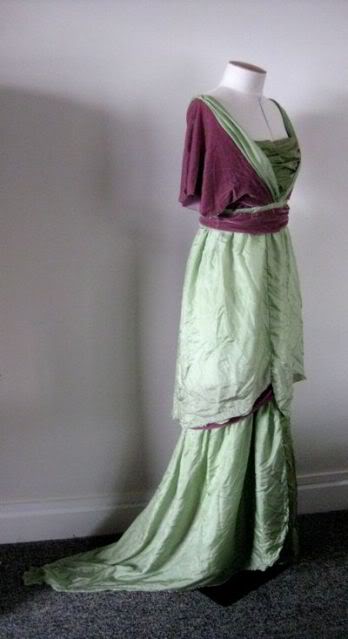
I’m finishing my Luna Moth frock

I thought this would be super easy, because I have so, so many UFOs to tackle.  I assumed everyone else would have the same problem.  I didn’t count on two things.

  1. To my absolute delight, there are a lot of seamstresses doing the HSF as their first introduction to historical sewing, so they don’t have any historical UFOs, and;
  2. Some of you are ridiculously organised and have no UFOs.  I am so envious!

If you fall into one of these two categories, fear not, I have a solution.  There are three ways to interpret this challenge so that everyone can participate.

  1. First, the obvious way is if you have an outstanding UFO (or 6, or 26) pick one of them and finish it.  I’m finishing my Luna Moth frock for three reasons – 1) it’s the closest to being done, 2) it’s the UFO that I get the most requests to finish, and 3) all my other UFO’s would be perfect for other challenges.
  2. If you don’t have an outstanding UFO, what about a UFI?  Un-Finished Idea.  Do you have a project you have always wanted to tackle, something you have always wanted to create, or an accessory an outfit has always needed an accessory?
  3. Finally, as a last resort, if neither of the previous two applies, create a UFO.  Really  (I know, I feel like I’m encouraging an addiction).  Not a long term UFO, but a chance to look ahead at the other challenges, and pick one that you really want to do something spectacular for but couldn’t get done in a 2 week period.  Use this challenge to get a start on your project and then finish it for that challenge.  If you do pick this option, try to get a set amount done – the bodice, or the main construction with finishing and trimming to be done later.

Obviously if you do have any actual UFO’s I really, really recommend you go that path and get something off the pile!

I can’t wait to see what you do!
1813 Kashmiri dress: Progress and a mostly done photoshoot

I’ve been sewing like mad on the 1813 Kashmiri dress that I am making for the Historical Sew Fortnightly  Bi/Tri/Quadri/Quin/Sex/Septi/Octo/Nona/Centennial  Challenge.

I’ve based my pattern on the 1805-9 dress in Janet Arnold with reference to patterns from other slightly later extent garments, and my inspiration fashion plate and extent garment, to bring it up to date for a dress that would be the latest fashion in January 1813.

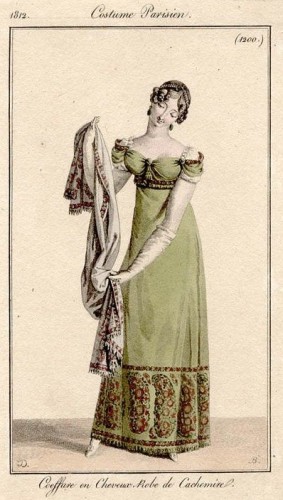
Fashion plate featuring a dress made of Kashmiri shawls, 1812

Fashion plate featuring a dress made of Kashmiri shawls, 1812

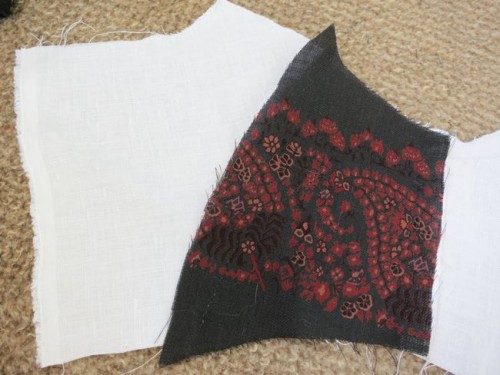
The bodice will be fully lined with white linen, so I started with that, sewing the linen together, and then sewing the wool pieces to the support lining, using careful little 14 stitches to the inch (OK, sometimes it was only 12 or 13).

Linen bodice assembled, sewing down the first piece of the wool

Linen bodice assembled, sewing down the first piece of the wool

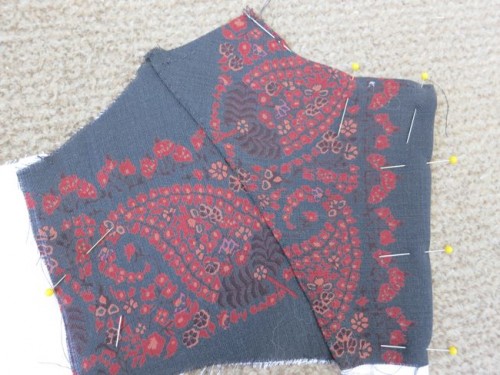
The side-back panels went first, followed by the back panels:

Pinning and sewing the centre back panel

Pinning and sewing the centre back panel

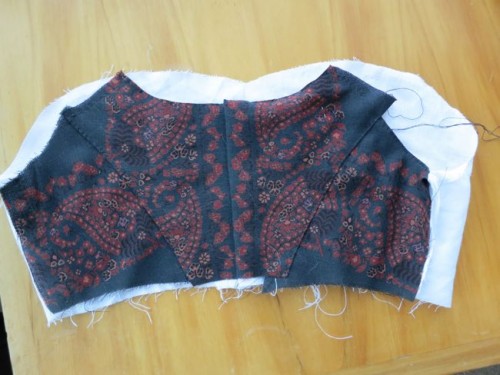
There was no ideal layout for the paisley border print, so I just did my best.  I quite like the way the pattern meets at the centre back.

The centre back of 1813 Kashmiri dress

The centre back of 1813 Kashmiri dress

I originally considered having the centre back fasten with buttons like the 1805-9 dress in JA, but I didn’t have any suitable buttons in stash, and decided that hooks and loops would work better with the fabric, and be easier.  The wool is too heavy for the tie fastenings used in this dress to be an option:

Dress with a paisley border, ca. 1810, Musee Historique de Tissu de Lyon

Dress with a paisley border, ca. 1810, Musee Historique de Tissu de Lyon

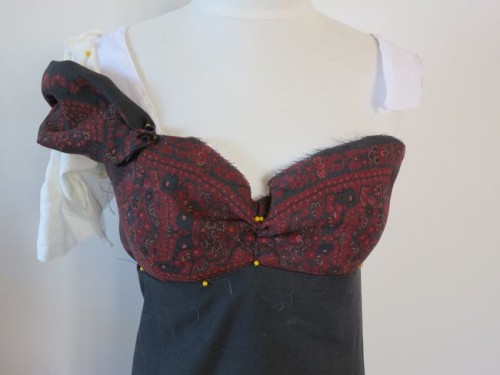
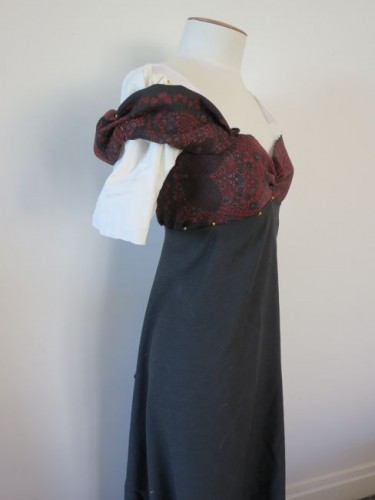
With the back all constructed, I put the bodice on Isabelle and pinned on the skirt to play with sleeve and bodice front options.

Bodice options

Bodice options

I love the white under-sleeves in so many of the inspiration images, and the sleeve-swags in my main inspiration image  – there is a lovely tension between the pure white sleeves rising above the dress, and the slight suggestion that the dress is about to slide right off the wearer.

Playing with sleeve options

Playing with sleeve options

However, as so often happens, what looks good on the mannequin doesn’t work on the body, so when I actually sewed the dress together, what happened was a little different:

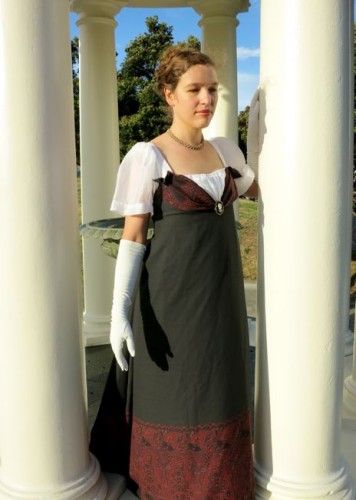
The mostly-finished 1813 Kashmiri dress

The mostly-finished 1813 Kashmiri dress

I’m afraid I have no real source to authenticate what I have done with my bodice, but it does echo what you see going on in paintings of Kashmiri dresses such as this one, and it actually worked with my fabric, and my body:

Salome Louise Coulmann, Comtesse Walther by Robert Lefevre, 1811 Salome Louise Coulmann, comtesse Walther by Robert Lefevre, 1811, Versailles

Salome Louise Coulmann, comtesse Walther by Robert Lefevre, 1811, Versailles

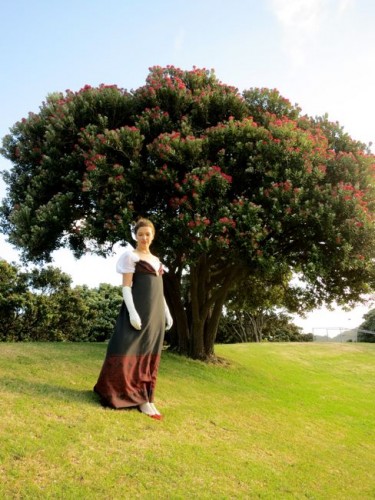
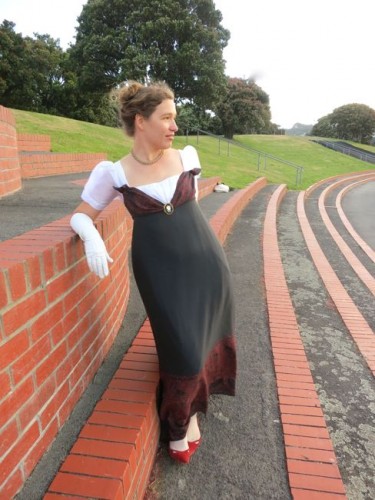
These photos were taken at the Basin Reserve with the last of the sunshine on a very windy Saturday.  It was supposed to be a photoshoot for the finished dress, but that didn’t quite happen.

1813 Kashmiri dress and pohutakawa tree

1813 Kashmiri dress and pohutakawa tree

Still, I’m not entirely sad the photoshoot didn’t work out – it’s great to give the dress a test run to figure out what is working and what isn’t, and now I have two days (well, one now) to get everything perfect before my deadline.

Unfinished 1813 Kashmiri dress at the Basin Reserve

Unfinished 1813 Kashmiri dress at the Basin Reserve

So what needs to be done?  This:

  • Re-do skirt pleating at centre back, pleating in a different way and bringing the pleats out from the CB slightly more.  While I do this I may get rid of the demi-train, because fetching as it is, it’s not accurate for a dress made of Kashmiri shawls.
  • Give the sleeves an organza underlining, re-sew them on, and gather them at the bottom.
  • Sew on the sleeve swags (you can see the little pieces that they will be attached to in the pictures)
  • Sew hooks and loops to the bodice-skirt meeting, and possibly the skirt opening
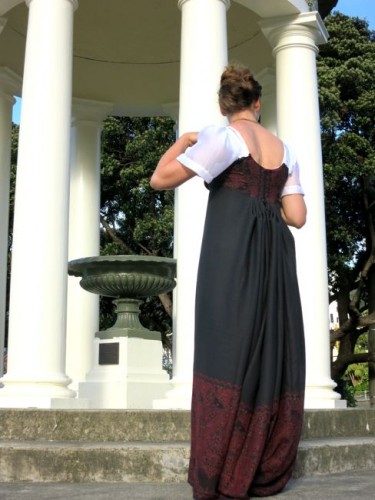
  • Figure out why the heck the back of the bodice turned out so low, and fix it if possible (I mean, I wanted it to be low – the orange dress above has a low back, but this is ridiculous):
Way too much back!

Way too much back!

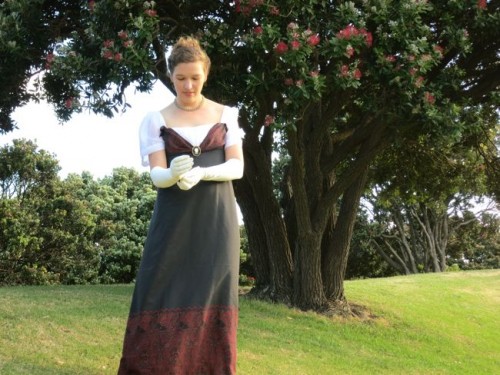
Still, the dress generally looks quite good, especially paired with the last of the pohutakwa blossoms:

1813 Kashmiri dress and pohutakawa blossoms

1813 Kashmiri dress and pohutakawa blossoms