Latest Posts

The Seven Year Stitch apron

Mr Dreamy & I will be celebrating our 7th anniversary in just a few days.  I can’t believe it’s been that long!

We got married in Hawaii, just down the road from my parent’s farm.  I was a very practical bride: we didn’t want our wedding to be a fantasy or a fairytale, we wanted it to be the best reflection of what we could really be as people.

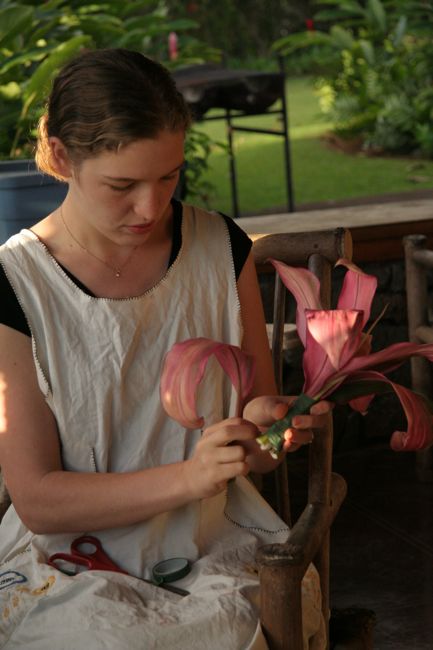
As a practical bride, I did all sorts of things on the day.  I got up early and made my own bouquet, and the bridesmaid’s bouquets.  With a lot of help from aunts and anyone with strong arms I made chocolate mousse for 80 people without any egg beaters (the fully equipped kitchen of the venue, wasn’t).  I set tables and arranged flowers, and, to the horror of the aunts, I got down on my knees and scrubbed the dancefloor.

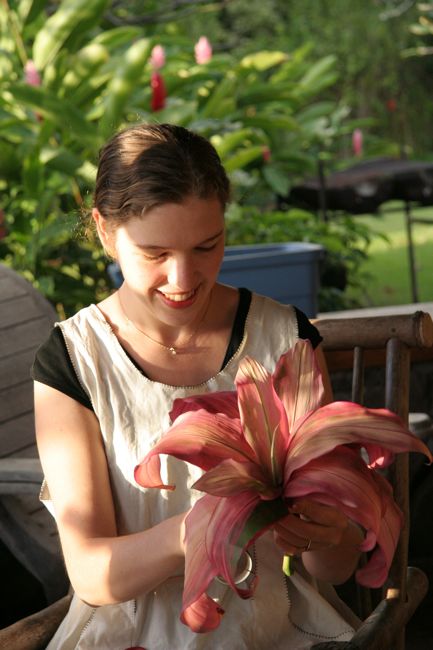
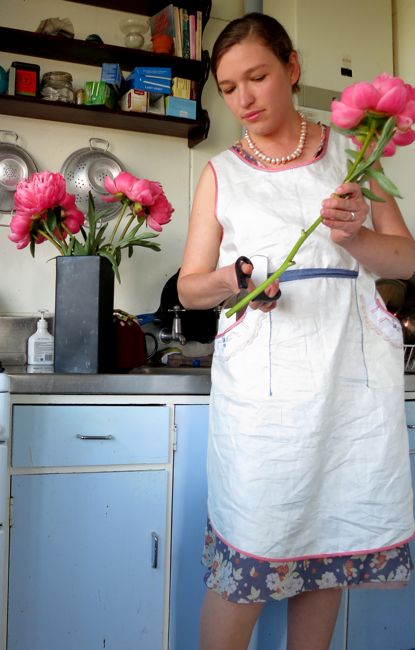
Now, any practical bride who is going to scrub floors on her wedding day needs a good apron, and I had a stunner: an embroidered early 30s number that covered me from knee to neck, and wrapped all the way around to my back.  It was given to me by an aunt on the condition that I would actually use it, not just store it as a vintage textile.

I’m pretty sure wearing it to scrub floors on your wedding day is the best possible use you could put it to!

Unfortunately there are no photos of me scrubbing the floor (to my everlasting regret), but there are a beautiful series of me in the apron, making my bouquet:

 

I’ve always wanted to make a replica of the apron, because I do feel a bit bad using it, and it has a rip under one arm (it was there when I received it).  So when the Sew Weekly Apron challenge came up, I decided it was time – and a perfect time too, with our anniversary so close.

I didn’t have time for the embroidery that was on the original apron, so I repurposed a stained vintage doily that I’ve been holding on to for just this type of project.
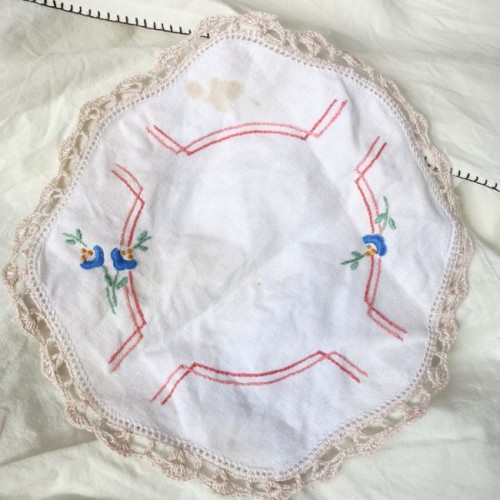
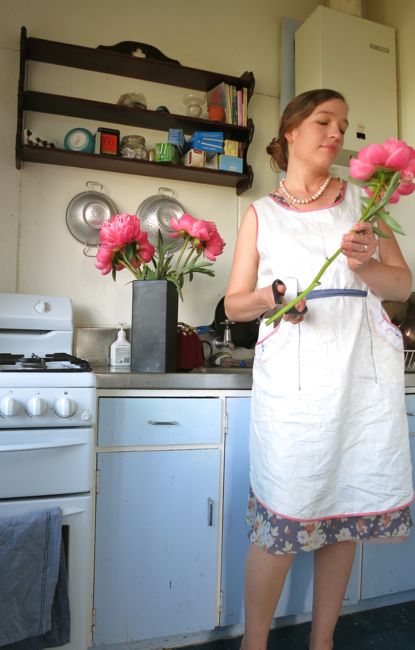
The rest of the apron’s decoration scheme was decided by the doily.  I trimmed the pockets in blue ric-rak and rosy pink binding, and used the pink binding to bind all the apron edges.  I added more blue-ric-rac around the apron neck, and sewed together a few lengths of checked bias-tape (the same stuff I used on Aline’s bonnet) for a sash.

Then I sucked it up, and posed in the kitchen, trimming the stems of my peonies (my springtime indulgence, and yes I actually cut them) and in the bathroom, pretending to dust while Felicity was mesmerized by the blinking camera timer.  I hate both rooms – they are dark and pokey and impossible to keep clean.  I can’t wait until we buy a house and I can have proper versions of them!

At least my apron is cute though!  In a very 1930s way – charmingly shapeless and frumpy.  😉
 

Pssst…since I mentioned it, want to see some wedding pictures?  There are a few here.
The 18th century man’s suit at the Honolulu Museum of Art

One of the most glorious pieces I got to see at the Honolulu Museum of Art  was a formal 18th century man’s suit, complete with breeches, waistcoat and coat.  I suspect the outfit is French, and dates from about 1760, but menswear isn’t my area of expertise, so if you have a better idea, please let me know!

The coat is of a three-dimensional pile fabric, probably a type of cisele velvet, with wine coloured velvet areas surrounding indented corded rectangles in muted gold.  This type of fabric seems to have been very common in mid-late 18th century menswear.  There is a similar but slightly later jacket here, an earlier jacket and waistcoat at the LACMA,  another full suit at LAD, and a suit with a slightly confused dating was sold by Augusta Auctions in 2011.

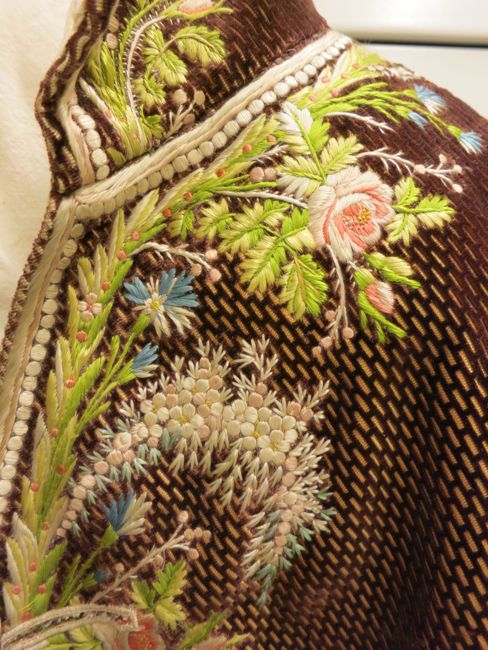
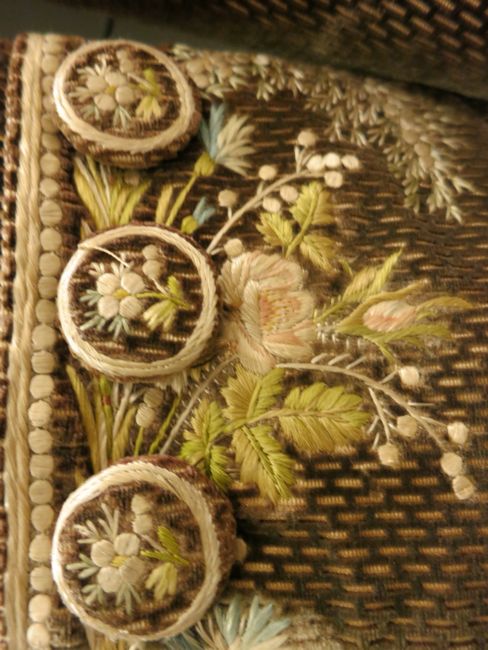
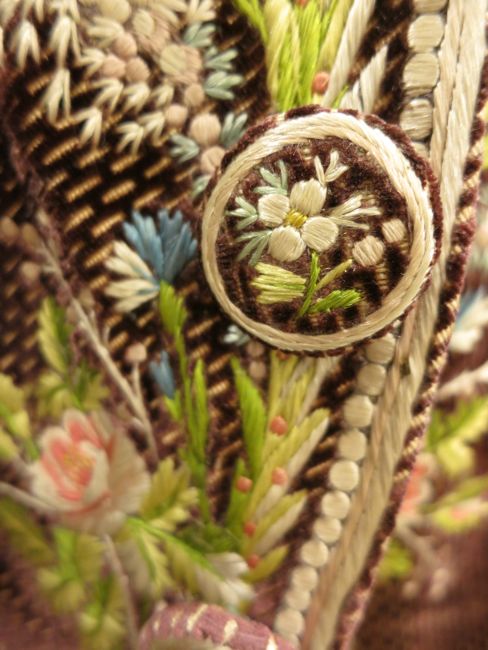
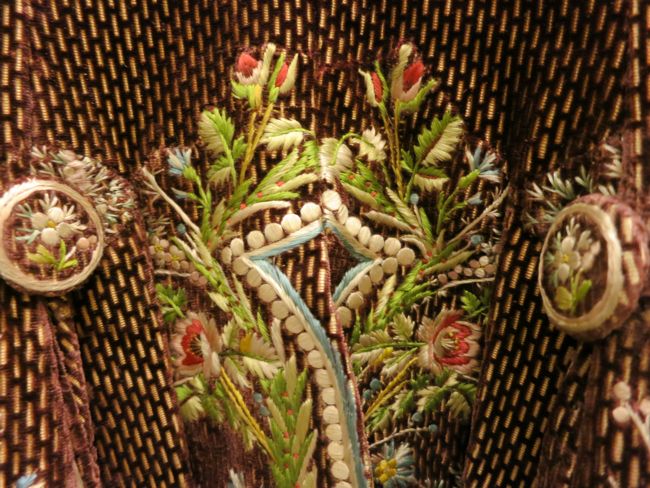
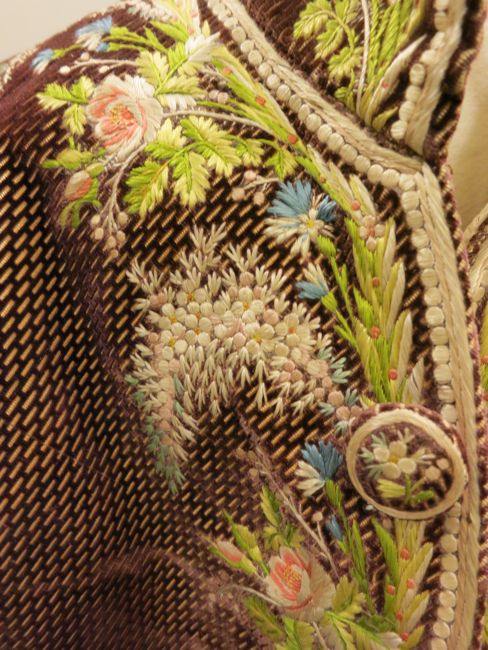
The embroidery is worked mainly in satin stitch with highlights in stem stitch and french knots.  The silk embroidery threads are in shades of pale green, pale peach pink, sky blue, cream, aqua & yellow.  It features roses, cornflowers, and sprays of white flowers that I haven’t identified.

Embroidery on the coat

Sprays of flowers & a leaf garland

Embroidered buttons on the coat

Pink roses

Embroidery around the shoulder and collar

An embroidered button

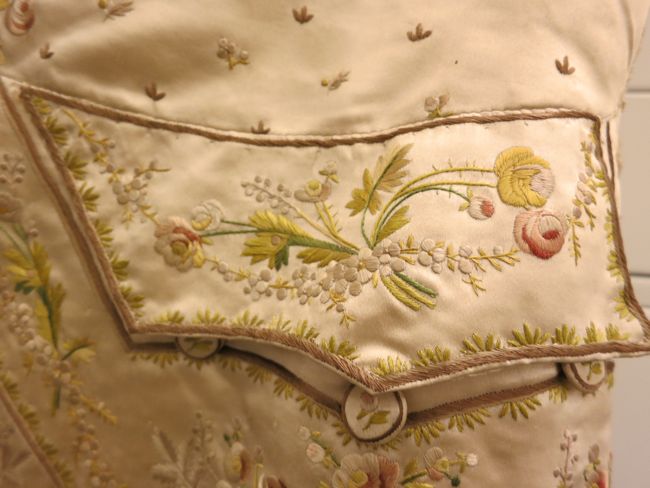
The embroidered pocket flaps and peek of buttons

Embroidery around the pleated back panels of the coat skirt

The embroidery at the top of the pleated coat skirt panels

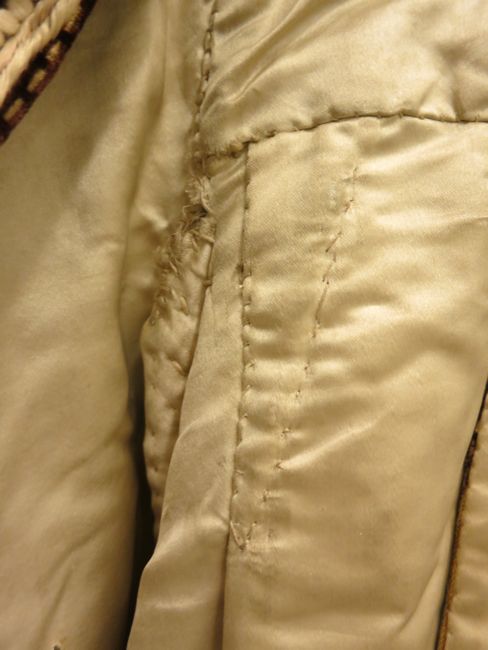
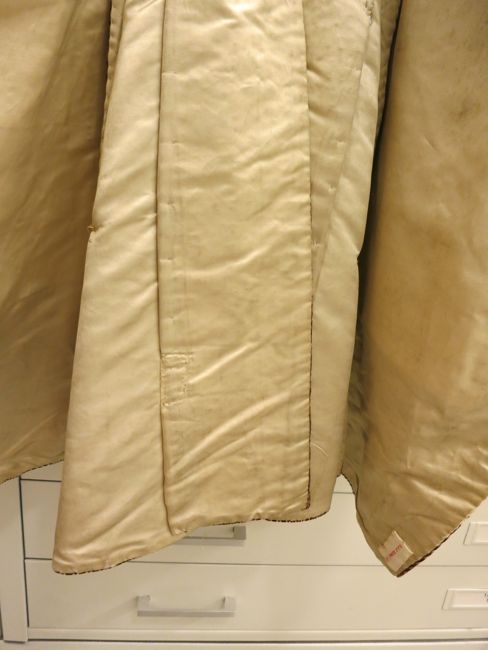
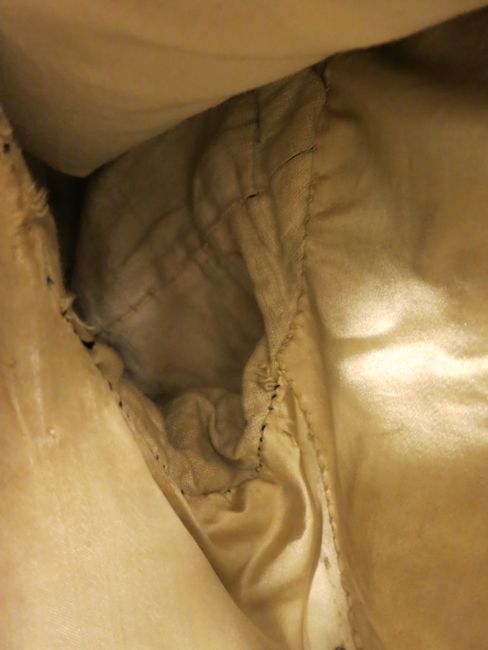
The inside of the coat is lined in a combination of ivory silk-satin (the same fabric as the waistcoat), and a mix of linen fabrics.  Some of the interior stitching is rather rough: the focus was clearly on making the outside of the coat look beautiful – the inside would never be seen.

Rough stitching holding down the back pleats of the coat skirt

The stitched down pleats of the coat skirt

The join of the silk lined coat body, and linen-lined sleeves

The breeches are made of the same fabric as the coat.  They feature a flap-front closure – usually the sign of an earlier garment, or one made for an older, more conservative man.  After 1775 single placket breeches with a closure similar to modern button-front pants became more common.

The flap-fronted breeches

The button-front flap opening

The cuffs of the breeches are decorated with a simple form of the coat embroidery.

The embroidered cuffs of the breeches

The buttons that fasten the cuffs of the breeches

A glimpse of the velvet selvedge in the cuffs of the breeches

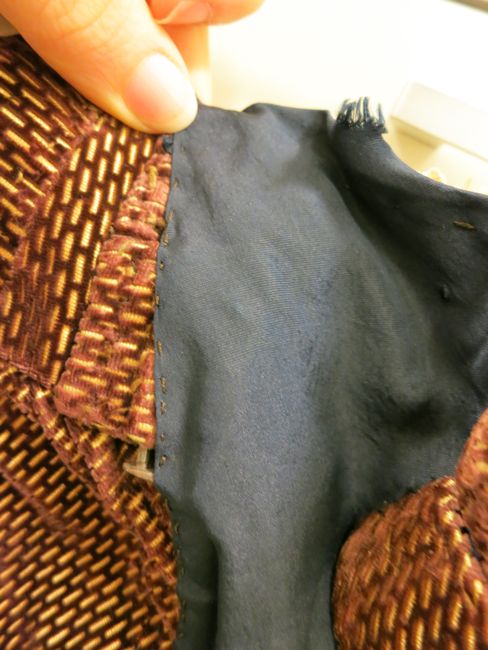
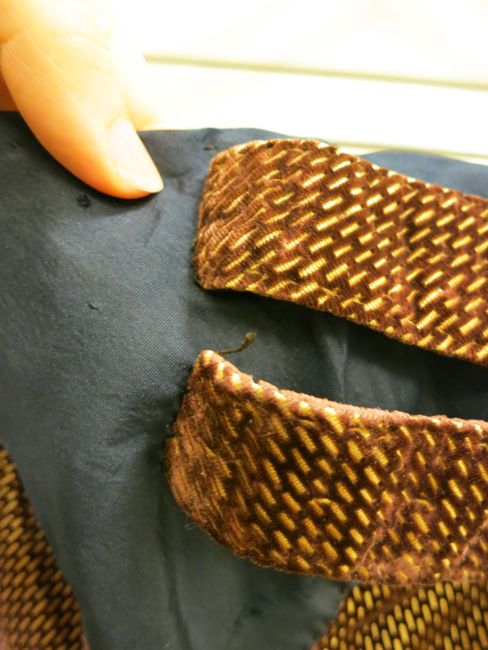
The breeches are the only part of the outfit that show obvious signs of later alterations.  A triangle of heavy silk has been added to the centre back of the breeches, making the breeches larger and covering the earlier fastenings which would have closed the back of the breeches.  The addition is quite roughly done.  Silver buttons, probably to fasten to suspenders, have also been added to the breeches.

The back of the breeches with the triangular gore

The fabric used, and the techniques used to make the alteration, both point to a late Victorian alteration.  The breeches were probably adapted either for fancy dress wear, or for theatre use.  A number of items in the Honolulu Museum of Art were given by local theatre groups.

The gore sewn over the back of the breech fastening

The original tabs of the breeches, and the black silk sewn over the metal clasps the tabs would have attached to.

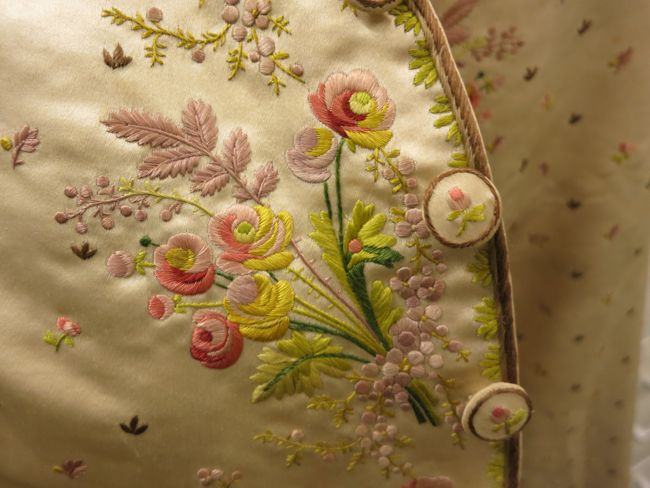
The waistcoat of the suit is made of ivory silk satin – lighter, softer & more supple than a modern duchesse satin, but much heavier than a silk charmeuse.  It’s a very similar weight to most of my silk obi, or to the ivory satin I used for my tea gown.

The waistcoat

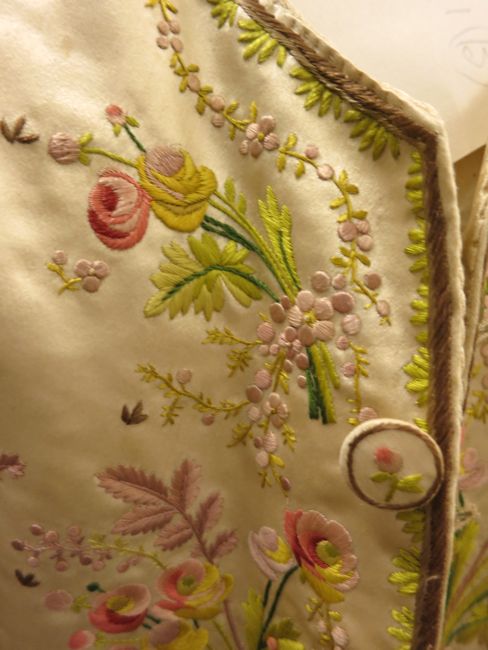
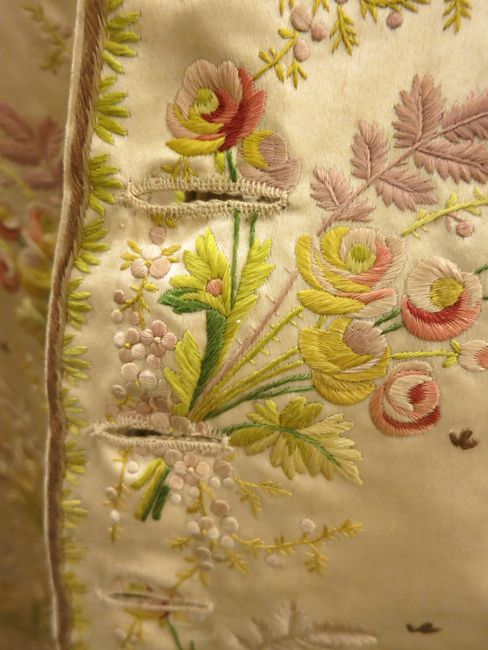
The embroidery on the waistcoat coordinates with that on the jacket and breeches, but it isn’t the same embroidery.  The shades of green and pink anre similar, but there are more shades of pink, additional touches of brown, there is no blue, and the flowers are much more stylized.  The rounded, controlled roses provide a nice counterpoint to the more flowing, naturalistic embroidery on the coat.

The embroidery on the waistcoat

The embroidery on the waistcoat pockets

Embroidered flower sprays and buttons

The hand-worked buttonholes, done after the embroidery was finished

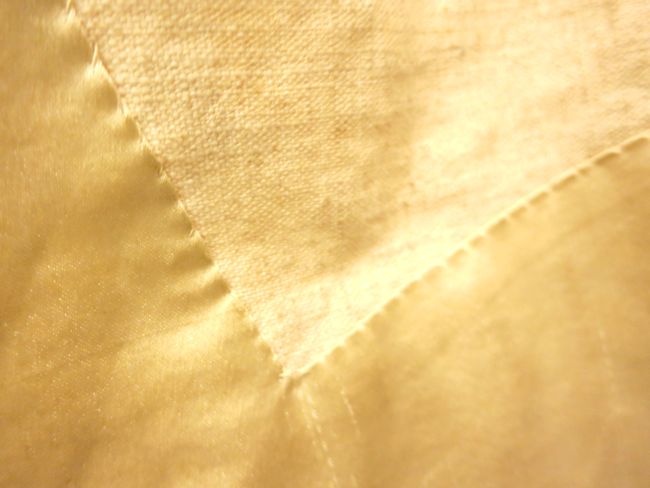
Like the coat, the waistcoat is a mix of silk and linen.

Silk meets linen in the interior of the waistcoat

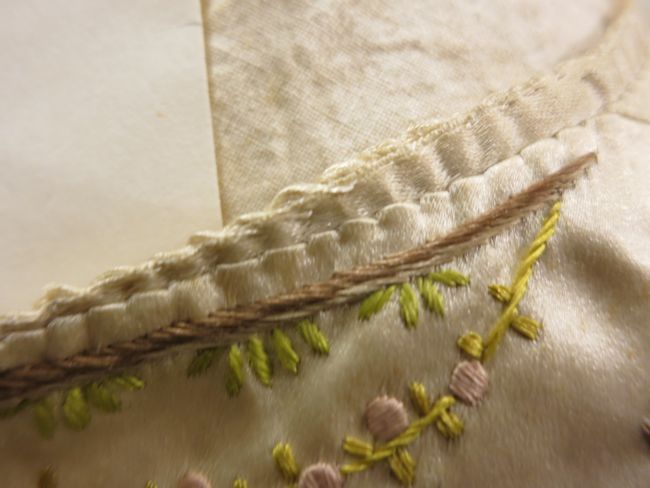
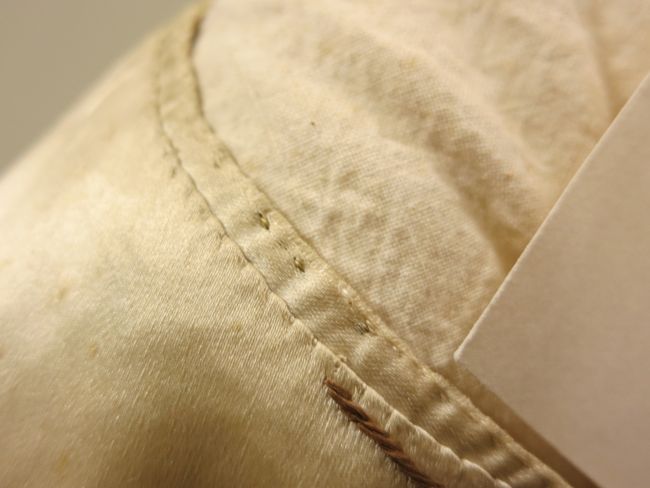
I took some images of the hand-stitching for reference in my own sewing.

Whip stitching around the collar

Whip stitching and running or back-stitch around the collar

Whip stitching and running or back-stitch around the collar

Witches Britches


Back in October when I did the talk on Steampunk fashions for Aethercon I really wanted to make something to illustrate the introduction of aniline dyes in the late 1850s.

It’s one of the things that has always confused me about Steampunk fashion.  Why do you see so few chemical brights in Steampunk attire, when the discovery of aniline dyes was THE big textile innovation of the Victorian era?

The problem with talking about aniline dyes is well…me.  Or, more precisely, my stash.

I don’t know if you have noticed, but it tends to be on the muted/colours you can achieve with natural dyes side.  The only aniline-accurate colour that I have in any quantity is black, which isn’t very exciting.

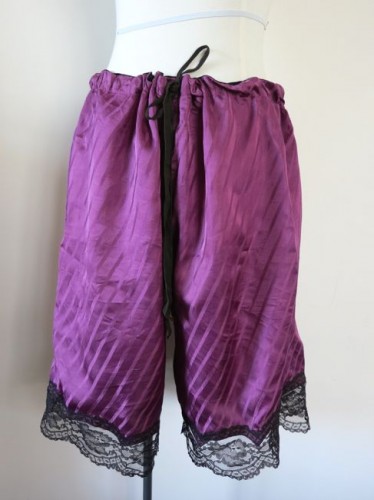
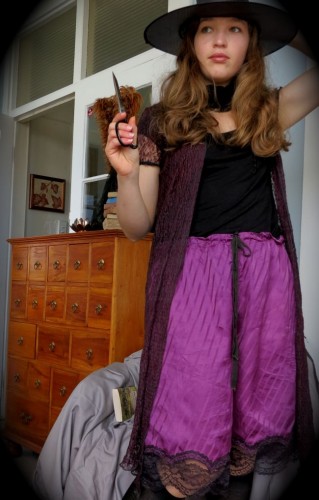
So I had a massive search through my ENTIRE stash (this is quite an undertaking), and found the single other piece of fabric in an aniline hue that I own – a 3/4 length kimono jacket in self-striped mauvine-ish satin.

Since I only had a 3/4 length jacket to work with, I was really limited in what I could make.  In a nice way though, it gave me a good excuse to not stress and make something I always need more of: drawers.

I was inspired by later 1890s drawers.  It’s a nice period in drawers: the shape is much more modern, there are some examples of silk drawers and coloured drawers from this period, and aniline purple had a slight resurgence.

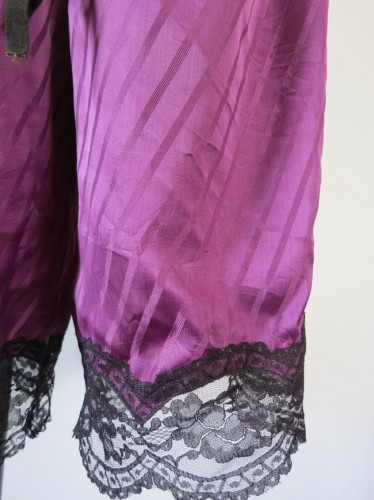
The drawers were a breeze to sew up.  I carefully matched the alternating diagonal stripes all along the side seams, and even got a match over the CF seam.  I went to all this effort even though the seams in the original kimono don’t even remotely try to match the stripes, and I had to use some the original seams  in my drawers.

My side-seams are sewn selvedge to selvedge, and my rise seams are flat felled, for maximum strength in vintage satin.


I trimmed the drawers with some gorgeous lace I inherited from Nana.  It’s nylon, and not remotely historically accurate, but the drawers weren’t ever going to be more than an exercise in historical plausibility, and the lace is so pretty!

Madame O wore the drawers with the 1890s corded corset (now hers) for my talk at Aethercon, and looked lovely.

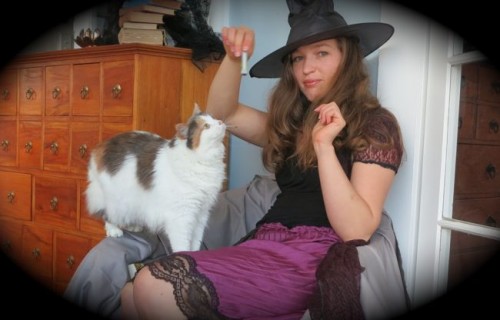
Afterwards, the drawers served double-costume duty.  Historical they may be, but they made perfect Halloween witches britches for a little ‘lounge around and eat Halloween candy while reading my favourite witchy novel’ photoshoot. It was the closest I got to dressing up for Halloween.

It’s really hard to make my house look gloomy and witchy.  I did manage to get my familiar to pose with me with the help of my wand though.  She’ll do anything for that wand!

So what kind of witch would wear these britches?  What to wear under your dresses is obviously an important question if you are a witch.  After all, you need to be able to maintain your dignity and modesty as the wind whips around your broomstick as you fly off to your coven meeting.

Not  Granny Weatherwax  – she’d recommend thick woolen numbers with padded bottoms (broom handles don’t provide a lot of perching surface) and the ability to repel any attempt at her ankle, much less anything higher up.  Nanny Ogg probably went without and took every effort NOT to maintain her dignity and modest in her youth. These would be the type of britches that Magrat longed for.  Or perhaps they would be more Perdita’s style, though I’m sure Agnes never agreed!

And, since it is Thursday, how about a bit of bonus terminology?

Witches britches are actually a thing.  They were a peculiar Antipodean  fad of the 1960s — tight mid-thigh knit knickers with lace trimmed hems (think bike shorts with rows of ruffles or lace at the bottom) meant to be worn under miniskirts and seen when you bent over.  They were apparently part of the historical revivalism in fashion at the time, and were inspired by turn-of-the-century drawers.

You can see a picture and read a bit more about them (the ‘school approved colours’ part is hilarious) here.