When I posted the Rodeo & Wrangle & Ramble in Style outfit last week, I promised to post instructions on my ‘hack’ of Steph’s Blank Canvas Tee pattern.
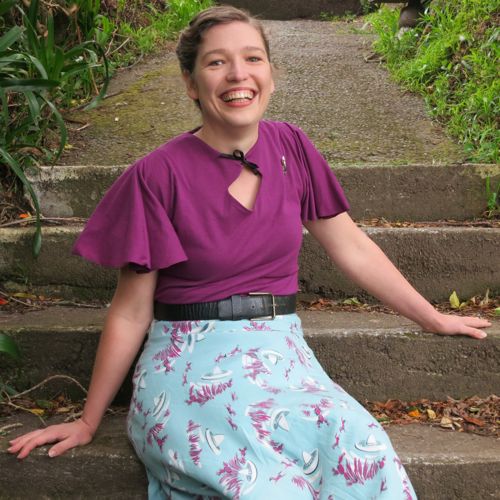
The ‘Rodeo & Wrangle’ Tee
This is Part II — construction. Go here for information on drafting the pattern.
Please note that knits are not my forte (I’m a historical seamstress after all), so this is not necessarily the correct or best way to sew this — it’s just what I did, and it worked. (though writing this tutorial I realise how much I do know, and how much is coming back from sewing knit dance gear for a costume shop 10 years ago).
Unless otherwise stated, use a lightning stitch and a 1/2″ seam allowance.
Step 1: Stabilizing the shoulder seams
Cut a strip of interfacing 1.5cm wide and as long as your shoulder seam. Interface your shoulder seam to stablise it and keep it from wrinkling and warping. DO NOT interface past the turn of the shoulder seam, as this will affect the hang of your sleeve.

Interfacing to stabilize the shoulder seam
Step 2: Finishing the back neckline
Cut a strip 3cm wide and just shorter than the back neckline. Right sides together, using a 1/2″ seam allowance and stretching slightly as you sew it, sew this to the back neckline. Turn and press it over, turning the raw end under to cover it, and sew it down with a double needle.
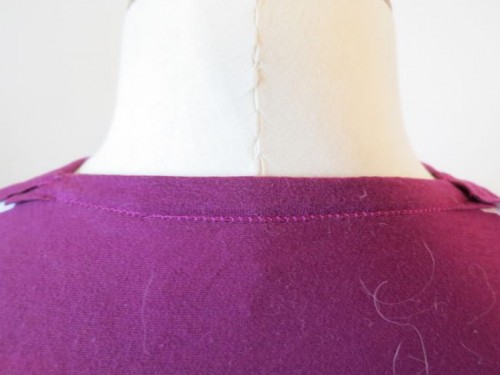
The interior back neckline finish
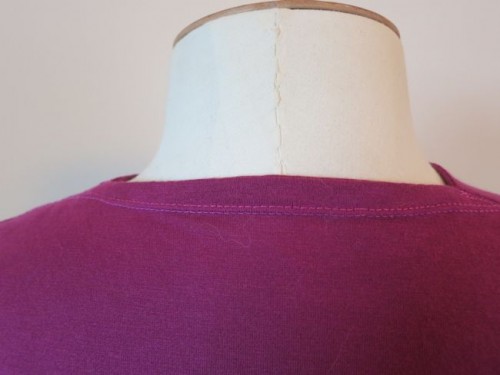
The exterior back neckline finish
Step 3: Stabilizing the front yoke
You’ll need to interface your front yoke to stabilize it. It’s really important to use a woven or knit interfacing to stabilize knits – not a non-woven interfacing. The interfacing I used is a little too heavy for my fabric (I didn’t realise I was out of my light stuff, and didn’t want to make a trip to the shop), so it’s making the yoke curl a little.

My front yoke
Once the front yoke is stabilized, you can finish the round outside edge in any manner you wish (it will be fine if you leave it unfinished too).
Step 4: Sewing the front yoke
With right sides together, place the front yoke over the front of the T. Using a lightening stitch and the absolute minimal seam allowance (this will vary depending on your fabric, but I managed just over 1/8″), and starting exactly at the centre point of the keyhole cutout, sew up to the shoulder. Do not backstitch when you start, and make sure you leave enough thread to pull the thread through to one side and tie it off. Backstitching will create extra bulk and make it hard to turn the keyhole perfectly. Stitch the other side in the same way. Stitching symmetrically will keep the keyhole symmetrical.
With the yoke sew, turn and press it. You may need to clip into the corners. Topstitch through the yoke & seam allowances on only the lower portions of the keyhole cut out to keep it neatly held back.
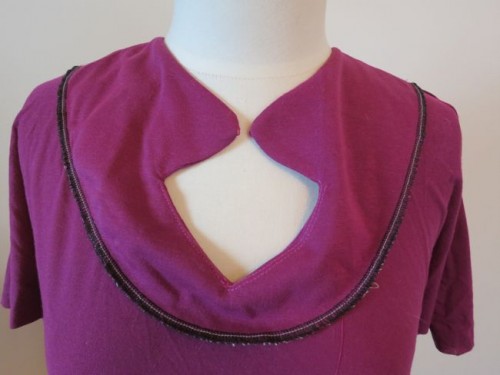
The turned and pressed yoke
Step 5: The shoulder seams
Without sewing through the yoke, carefully match the finished back neck edges to the seam at the turn of the yoke, and sew the back piece to the front piece at the shoulder/sleeve seam. Press the seam back, fold the yoke edge over it, and topstitch right along the shoulder seam using a double needle to hole the yoke down on the inside.
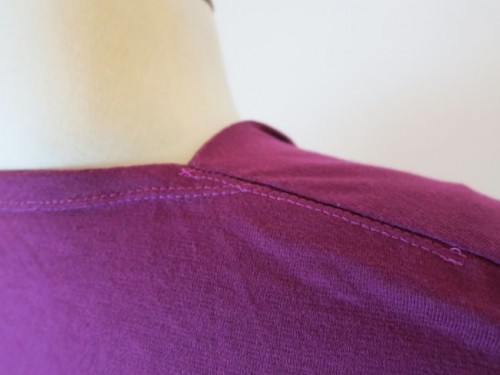
The finished back neck edge meeting the front piece, and the double-stitching holding down the yoke
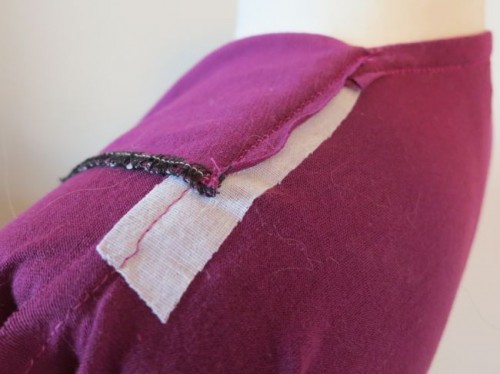
The stitched down yoke at the shoulder seam

The sewn sleeve/shoulder seam
Step 6: Your side seams.
Sew your side seams from underarm to hem. Try on your shirt, and make any adjustments in sizing. I ended up using a french curve to create a curved size seam to eliminate bulk at my waist.
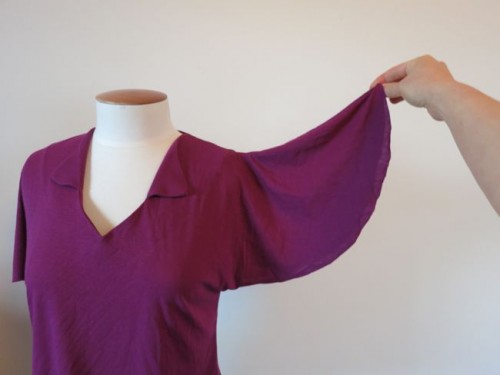
The sleeves and side shaping
Step 7: hemming
Hem the shirt. I used a double-turn and a double needle.
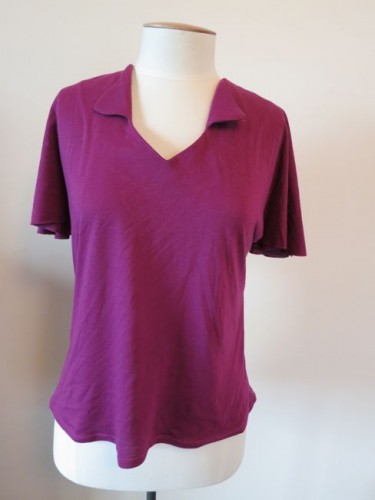
The hemmed and almost-done shirt
Step 8: The keyhole loops.
Using a buttonhole stitch, hand-work loops at the widest points of your keyhole neckline to slip a ribbon through to hold it closed. The shirt can also be worn with the flaps open as a faux-collar.
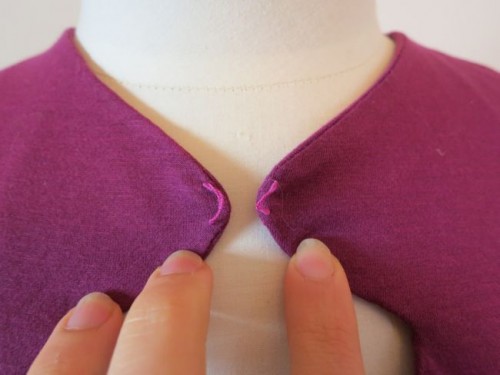
The little loops on the keyhole cutout
Ta da! It’s done! Feel free to make your own, adapt, improve.
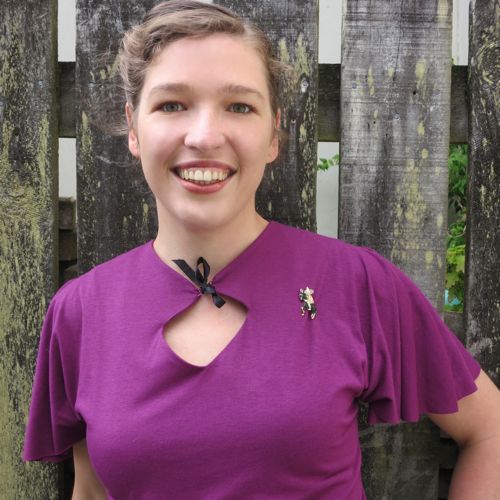
The ‘Rodeo & Wrangle’ tee