Latest Posts

May detail, Cycle of frescos of the twelve labors of the months, Trento (Italy), Castello del Buonconsiglio (Bishops Castle), Torre del'Aquila (Tower of the eagle), otherwise unknown Master Wenceslas of Bohemia, after 1397

The Historical Sew Monthly 2018: Inspiration for Challenge #5: Specific to a Time of Day or Year

The Historical Sew Monthly 2018 is well underway now, and it’s my duty and honour to write the inspiration post for our fifth challenge of the year: Specific to a Time (of Day or Year).

I was slightly panicked when I realised this theme would fall to me.  I’m not at all an expert at pre-1700s fashions, and this is a challenge that’s particularly tricky before the 19th century (ish), when specific garments for different times of day became common.  But with help from my awesome co-moderators, I’ve found examples from a range of eras – enjoy!

In chronological order:

This ca. 1400 cycle of frescos of the months from the Castello del Buonconsiglio in Trento, Italy, provides a wonderful look at late Medieval fashions by season, with warm layers for winter snowfights:
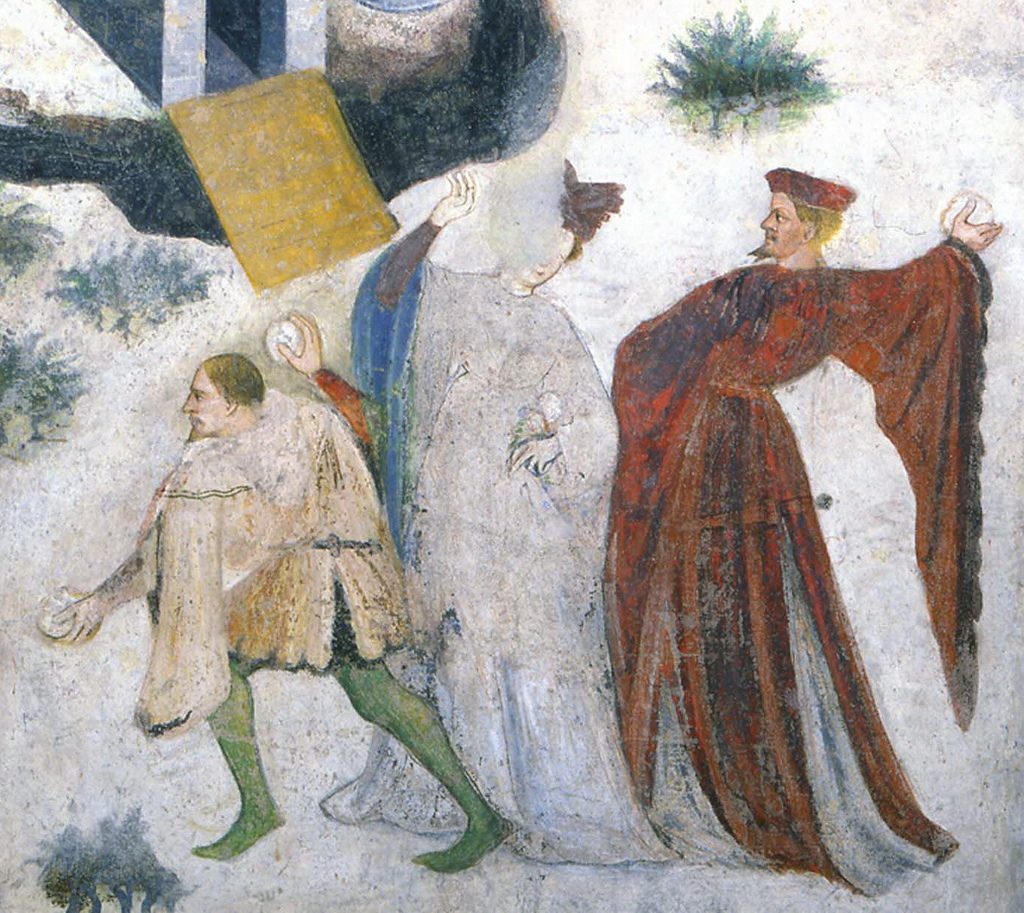
January detail, Cycle of frescos of the twelve labors of the months, Trento (Italy), Castello del Buonconsiglio (Bishops Castle), Torre del'Aquila (Tower of the eagle), otherwise unknown Master Wenceslas of Bohemia, after 1397

January detail, Cycle of frescos of the twelve labors of the months, Trento (Italy), Castello del Buonconsiglio (Bishops Castle), Torre del’Aquila (Tower of the eagle), otherwise unknown Master Wenceslas of Bohemia, after 1397

Flowing garments for spring romance (note the love-knots on the gentleman’s tunic):

May detail, Cycle of frescos of the twelve labors of the months, Trento (Italy), Castello del Buonconsiglio (Bishops Castle), Torre del’Aquila (Tower of the eagle), otherwise unknown Master Wenceslas of Bohemia, after 1397

And sunhats and light shirts (and sandals!) for harvest labours.  The sunhats do double duty for this challenge, being both daytime, and summer, specific:
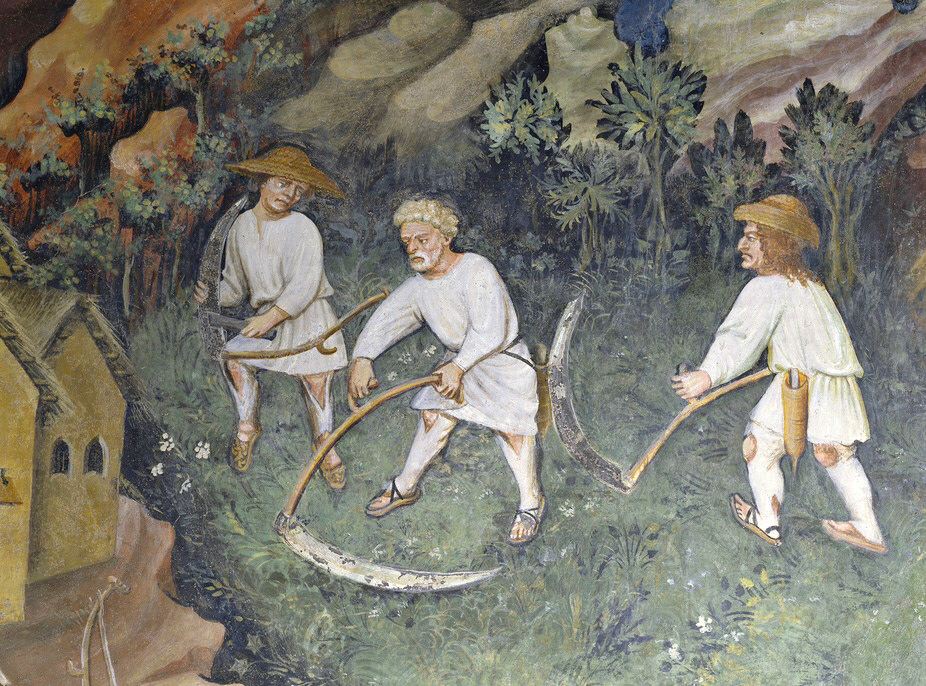
May detail, Cycle of frescos of the twelve labors of the months, Trento (Italy), Castello del Buonconsiglio (Bishops Castle), Torre del'Aquila (Tower of the eagle), otherwise unknown Master Wenceslas of Bohemia, after 1397

May detail, Cycle of frescos of the twelve labors of the months, Trento (Italy), Castello del Buonconsiglio (Bishops Castle), Torre del’Aquila (Tower of the eagle), otherwise unknown Master Wenceslas of Bohemia, after 1397

Elizabethan costume plates also show wonderful examples of sunhats, like this charming bowl-shaped number.

Portraits are so formal it’s tricky to identify seasonal and time changes, but I’ll guess that heavy fur lined cloaks like the one sported by the Earl of Pembroke were far more popular in winter than summer:

Henry Herbert (1538—1601), 2nd Earl of Pembroke

And, while fans are a popular accessory for ladies in late 16th and early 17th century portraits, I can’t help but to suspect that they were even more common in the warmer months than at other times of years:

Elizabeth Stuart, Princess Royal (later, Queen of Bohemia), Robert Peake (1551-1626)

Elizabeth Stuart, Princess Royal (later, Queen of Bohemia), Robert Peake (1551-1626), 1603
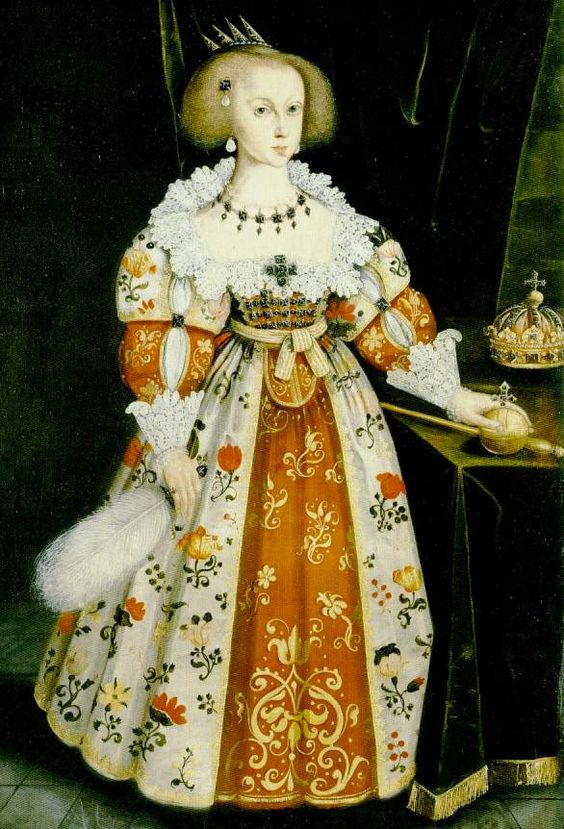
Queen Christina of Sweden by Jacob Heinrich Elbfas, 1634

Queen Christina of Sweden by Jacob Heinrich Elbfas, 1634

Going back to winter, we have the wonderful fur-lined jackets that appear in many Dutch interior scenes of the mid-17th century.  This one gives the central figure a place to warm her hands, while also refusing to take the gentleman’s missive.
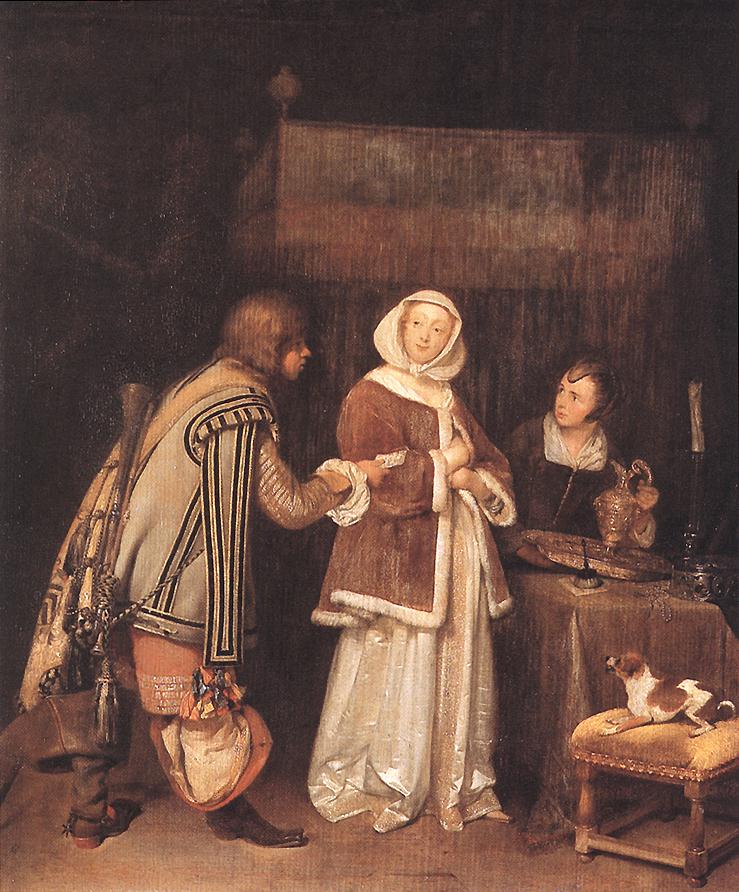
Gerard ter Borch II, The Letter, 1655

The advent of fashion plates in the late 17th century makes identifying seasonal specific fashions much easier.  This elegant lady’s soft quilted hood, cozy quilted petticoat, and warm muff all seem perfect for winter, but the caption leaves no doubt at all about the seasonal-appropriateness of her dress:

‘Femme de qualite en habit d’hyver’ Nicolas Arnoult (France, circa 1671-1700) France, Paris, 1687 Prints Hand-colored engraving on paper, LACMA, M.2002.57.64

Her informal summertime counterpart, on the other hand, wears much lighter dress, and carries a fan.  Although they are half a century later, the frequency in which fans appear in 17th century summer-themed fashion plates, and their infrequency in winter plates, makes it likely that the same seasonal shift appeared (or was at least starting to appear) earlier in the century.

Recueil des modes de la cour de France, 'Femme de Qualite en Deshabille d'Este' Jean LeBlond (France, active circa 1635-1709) France, Paris, 1682 Prints Hand-colored engraving on paper, LACMA M.2002.57.65

Recueil des modes de la cour de France, ‘Femme de Qualite en Deshabille d’Este’ Jean LeBlond (France, active circa 1635-1709) France, Paris, 1682 Prints Hand-colored engraving on paper, LACMA M.2002.57.65

If the 18th century is your thing, you could make a bergere, suitable for summer, daytime wear from the 1750s onwards:

Bergere hat, English c1750, Royal Albert Memorial Museum

Princesse de Lamballe, 1782, Elisabeth Vigee-Lebrun

Princesse de Lamballe, 1782, Elisabeth Vigee-Lebrun

(pictorial evidence suggests that chemise a la reine were primarily daytime wear, but I’ve found a few images that suggest they were also worn to nighttime events, so you’d need to make an argument for them being specific to a time of day if you wanted to make one for this challenge).

While chemise a la reine aren’t clearly for one time of day or other, and dresses like this could be worn to formal events at any time of day or year, masked balls were, as much as I can determine, purely nighttime events, so a masque would be a suitable item:
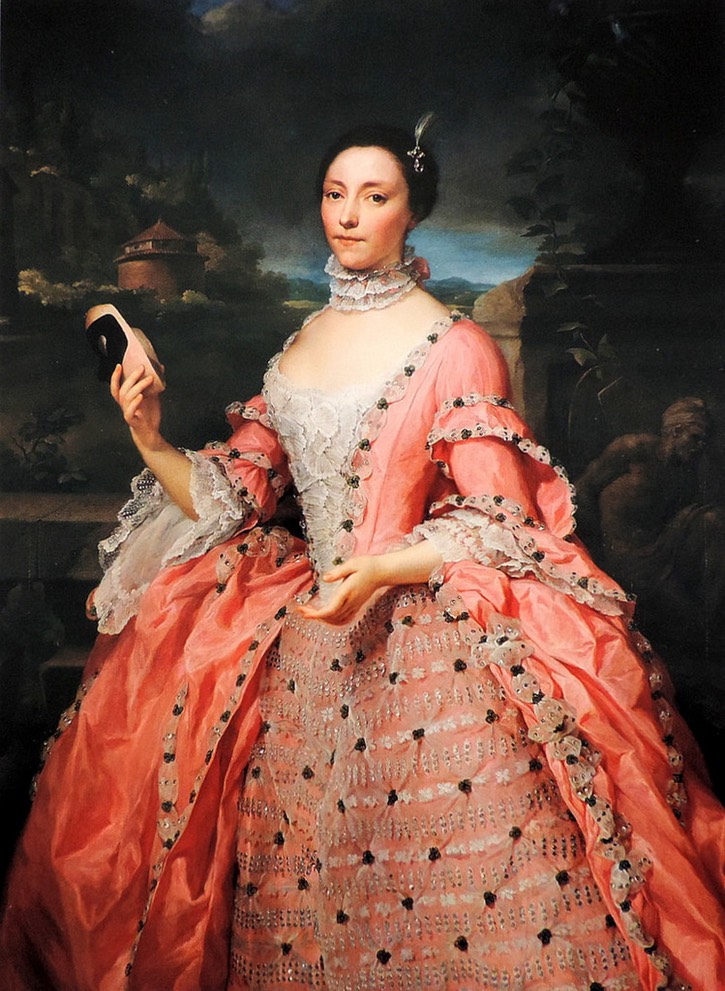
Anton Raphaël Mengs, Arabella Astley Swimmer, Lady Vincent of Stoke D'Abernon, 1753

Anton Raphaël Mengs, Arabella Astley Swimmer, Lady Vincent of Stoke D’Abernon, 1753

Masquerade mask. 1780s © Museum of London via BBC Radio 4

Riding habits were daytime dress:

Collett, “Officer in the Light Infantry,” 1770

And fur line cloaks, and muffs of all description, were clearly cold-season accessories:

Elizabeth Farren (born about 1759, died 1829), Later Countess of Derby by Sir Thomas Lawrence (British, Bristol 1769—1830 London), 1790

Muff English, 1785—1800 England, MFABoston

As were quilted petticoats:
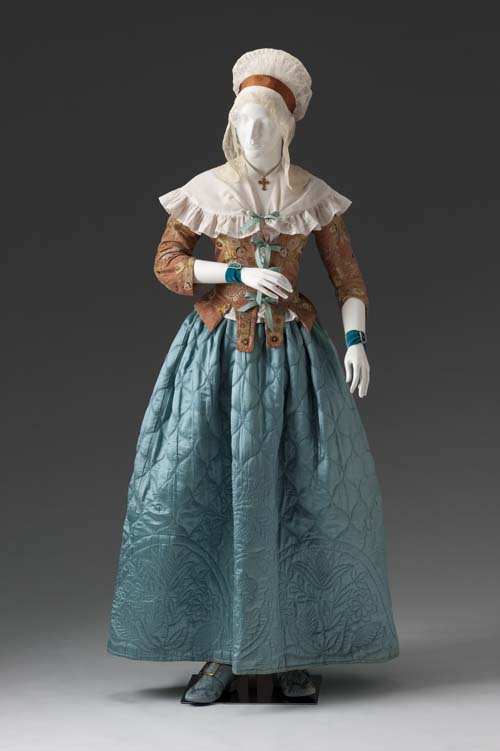
Caraco circa 1780, quilted Petticoat circa 1770-1780, Mint Museum

Leaving the 18th century behind, and moving into the 19th, the distinction between daytime and nighttime dress, and thus things that qualify for this challenge, becomes much clearer.

Short sleeved dresses were primarily evening appropriate in the early 19th century:

Full evening dress, June 1809, La Belle Assemblee

And long sleeves were daywear, as were, generally speaking, chemisettes and other neck fillers:

Portrait of a Lady (possibly Caroline Bonaparte-Murat, Queen of Naples) by Robert Lefèvre, 1813

While top hats were worn year round for men, there are some summer-specific versions in straw:
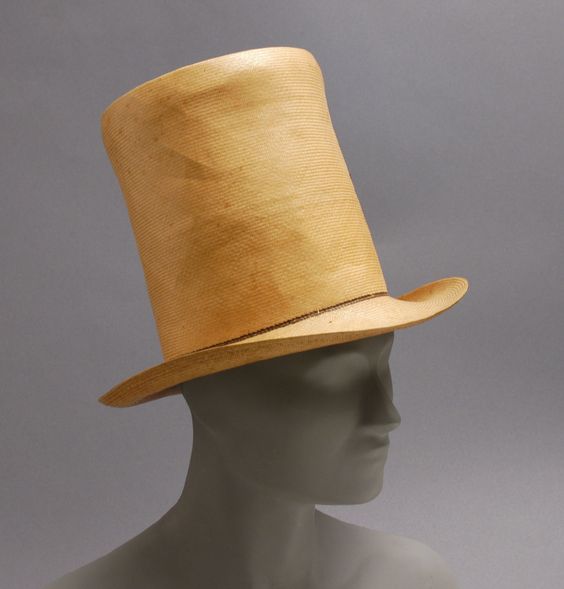
Straw as a summer specific material is a common thread throughout this theme, from the medieval examples we started with, all the way through the 19th, and into the 20th century.
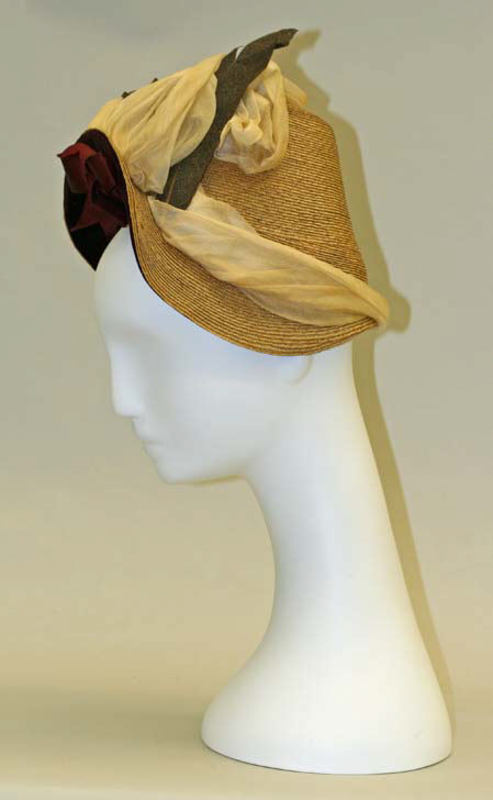
Straw bonnet, ca 1880, Metropolitan Museum of Art

Winter hats, in contrast, came in dark colours, and furs and fabric:

Hat Mme. Mantel (French) Date- ca. 1885 Culture- French Medium- fur, wool, silk, Metropolitan Museum of Art

While the 18th century primarily had formal or informal clothes, rather than day and evening clothes, as the 19th century progressed the break between the two became quite rigid, though some robe a transformation dresses came with both low-cut, sleeveless evening bodices, and long sleeved, high necked, daytime bodices:
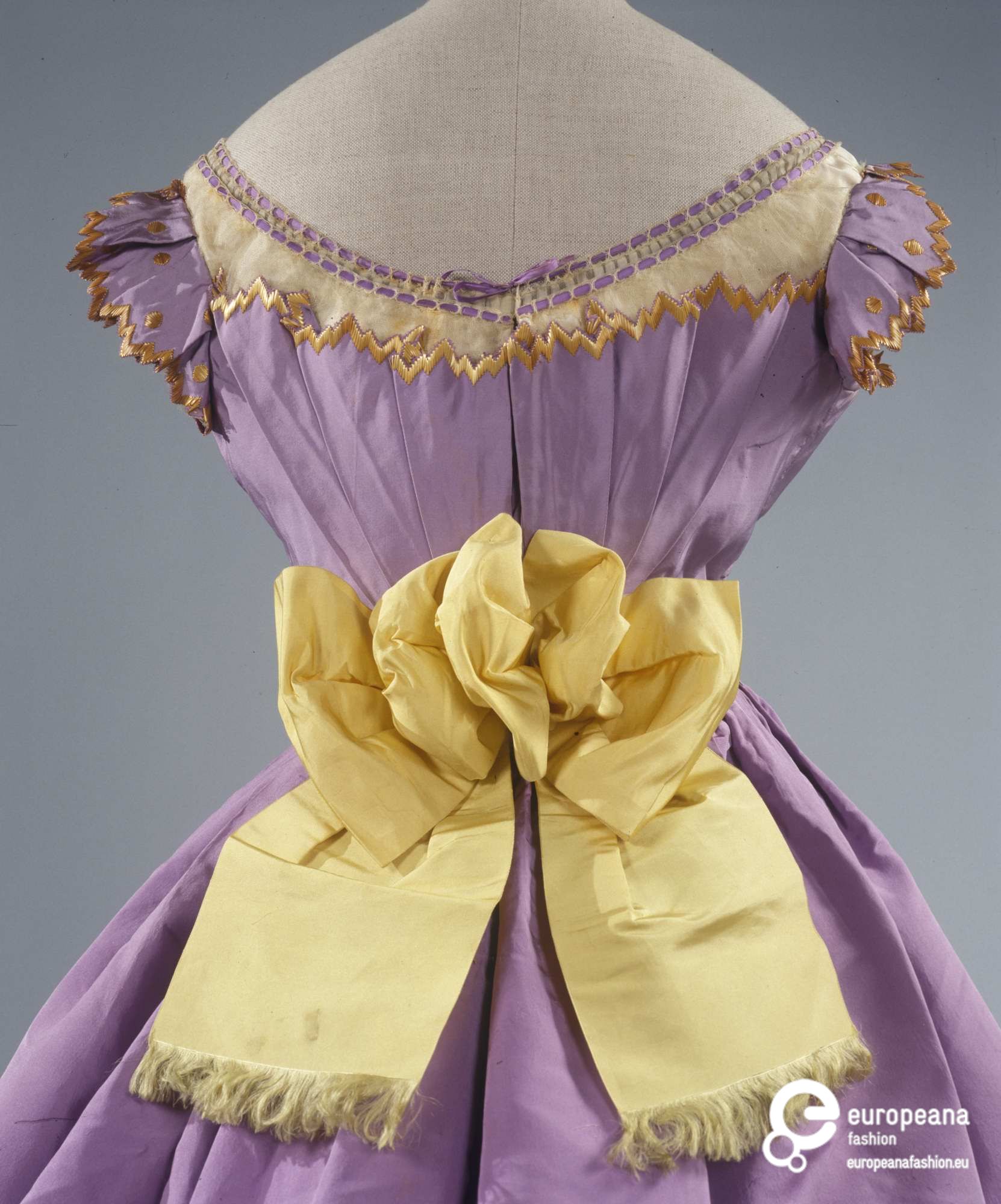
Dress in three parts, Italian, silk taffeta with straw embroidery, 1867, Galleria del Costume di Palazzo Pitti, 00000101, via EuropeanaFashion.eu

Dress in three parts, Italian, silk taffeta with straw embroidery, 1867, Galleria del Costume di Palazzo Pitti, 00000101, via EuropeanaFashion.eu

Dress in three parts, Italian, silk taffeta with straw embroidery, 1867, Galleria del Costume di Palazzo Pitti, 00000101, via EuropeanaFashion.eu

The growing power of the Industrial Revolution also made seasonal clothing distinctions even clearer.  No longer was seasonality just about fabrics that were warm vs. fabrics that were cool, it also took in colours.

Coal powered machinery made industrial cities very dirty, and light clothes impractical.  The advent of rail travel made getting away from cities easy – especially for the well off.  They signalled their summer escape from hot, dirty cities by donning white clothes, and then put back on dark ones when they returned in the autumn, leading to sayings like ‘no white after labour day’.

Suit, 1875—90, British, linen, Metropolitan Museum of Art, 2009.300.487a—c
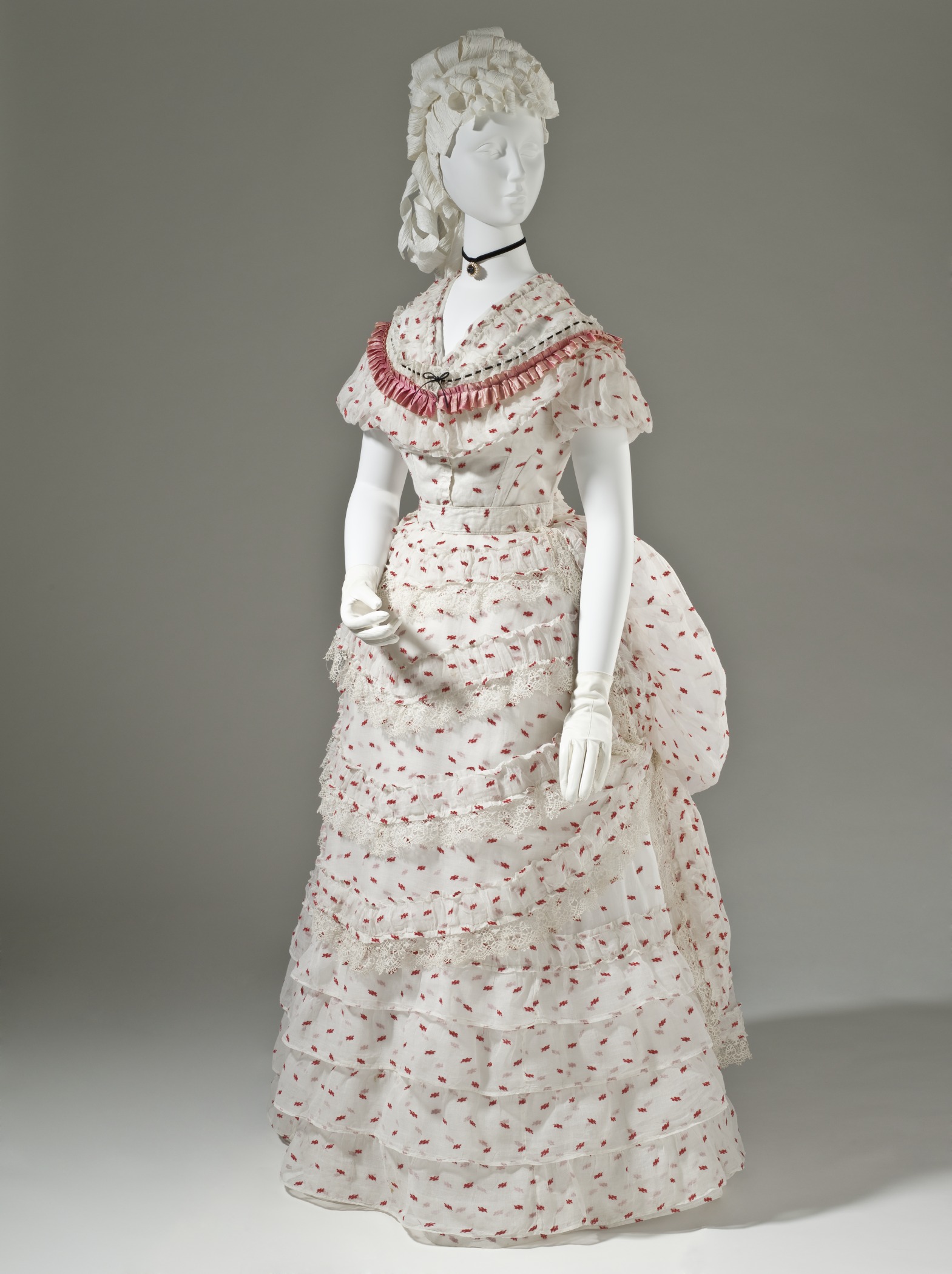
Woman’s Polonaise Dress, England, circa 1875, Cotton plain weave with wool of discontinuous supplemental weft, silk satin ribbon, and machine lace, LACMA, M.2007.211.777a-f

Woman’s dress, American, 1905—10, Embroidered cotton with lace inserts, MFA Boston 2007.523

One of my favourite time/seasonal distinctions is when the same garment (by name) would be specific to  very different times of day or season, depending on the design, and what it was made of.

So, for pyjamas, we have beach pyjamas (daytime, summer)
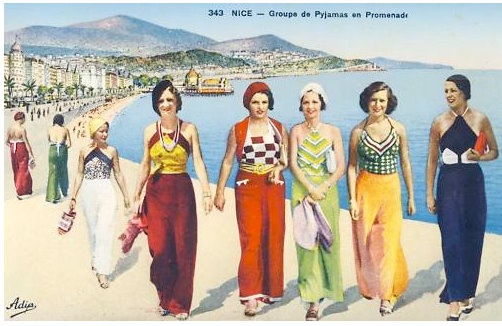
Beach pyjamas on the Cote D’Azure, colourized postcard, 1930s

Evening pyjamas (nighttime, summer or winter):
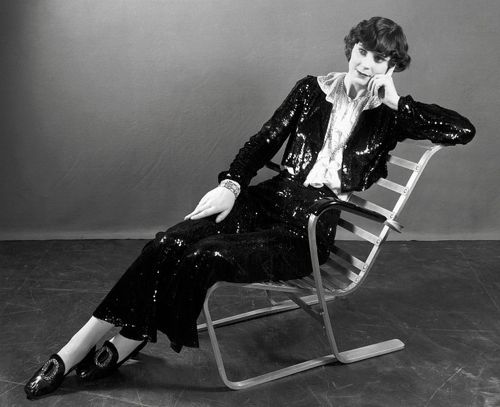
Evening suit and blouse (or evening pyjamas), Chanel, 1937-38, collection of the V&A

And lounging pyjamas (day to evening, usually winter), and pyjama pyjamas (nighttime, sleeping):
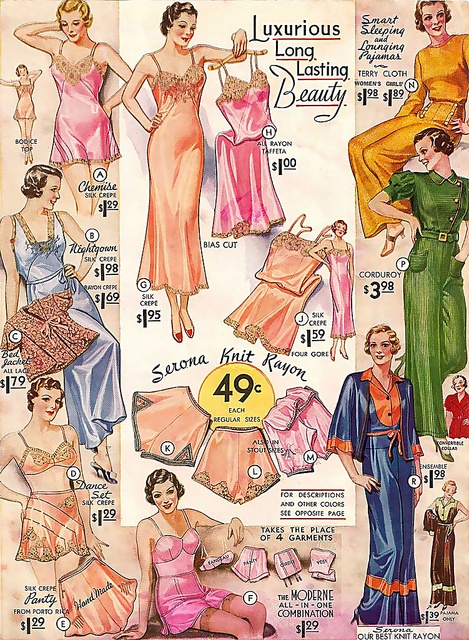
Pyjamas and lingere in rayon, 1934

Can’t wait to see what you make this is  Specific to a Time!

SaveSaveSaveSave

SaveSave

Ball gown, Emile Pingat (French active-1860—96) ca. 1864, French, silk, Metropolitan Museum of Art C.I.69.33.12a—c

Rate the Dress: An enormous Pingat ballgown

I enjoyed looking for examples of Pingat creations so much while writing my review of ‘My Official Wife’ that I had to choose one for today’s Rate the Dress.  To give a contrast to the ca. 1890s fashion of Savage’s novel, and the almost-modern dress Adrian dress from last week, I went with an 1860s ballgown big enough to smuggle an entire aviaries worth of budgerigars underneath.

Last week:  A cubist inspired Gilbert Adrian evening ensemble

An interesting, but not surprising, mix of reactions to the Adrian dress.  I say not surprising, because I had a little spare time (for once!) when I wrote the rate the dress, and a made a list of predictions of what would be said – and you hit every one of them, from muddy colour complaints to notes of wrinkles (sans a comparison to mushrooms 😉 ).  And added the bit about it reminding you of Neapolitan ice cream.

I’m glad I wasn’t quite alone in thinking that a bit of mint makes Neapolitan so much better.

The Total: 7 out of 10

And that’s what happens when a bunch of people give threes and even more people give 10s!

This week: A Ballgown by Pingat

This Pingat ballgown is shown with two different under-structures in the Met’s photographs of it, a very, very large hoop, and then a slightly more moderate one:

The black and cream colour scheme combines to popular trends in ca. 1860s fashion: pale colours for evening wear, so they showed up well in poor lighting, and high contrast trim.

The combination of textures is another highly fashionable touch, with delicate gauzes contrasting with rich taffeta.  Lace in black and warm cream, ribbons, ball-end fringe, and tiny gold beads add further visual texture, sparkle, and movement.

Note the way the berthe wraps across the back bodice, hiding much of the bodice lacing.

Note also the double lines of piping finishing the bottom edge of the bodice.  Double piping is sometimes cited as a Charles Frederick Worth innovation, or at least a specific mark of the House of Worth, but it’s seen on many high end mid-19th century garments including ones that predate Worth.

What do you think?  One for the record book, or forgettable?

Rate the Dress on a Scale of 1 to 10

A reminder about rating — feel free to be critical if you don’t like a thing, but make sure that your comments aren’t actually insulting to those who do like a garment.  Our different tastes are what make Rate the Dress so interesting, but it’s no fun when a comment implies that anyone who doesn’t agree with it, or who would wear a garment, is crazy/totally lacking in taste.

(as usual, nothing more complicated than a .5.  I also hugely appreciate it if you only do one rating, and set it on a line at the very end of your comment, so I can find it!  Thanks in advance!)

SaveSave

SaveSave

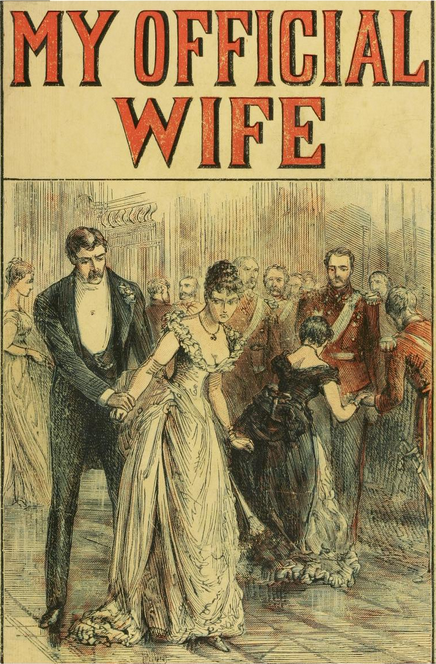
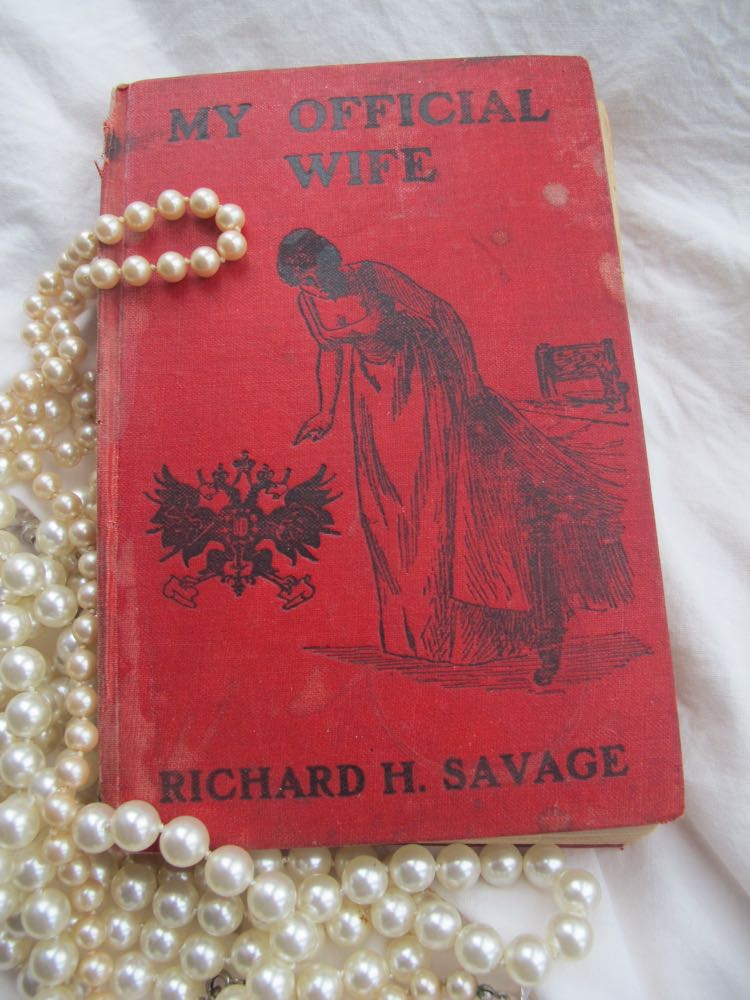
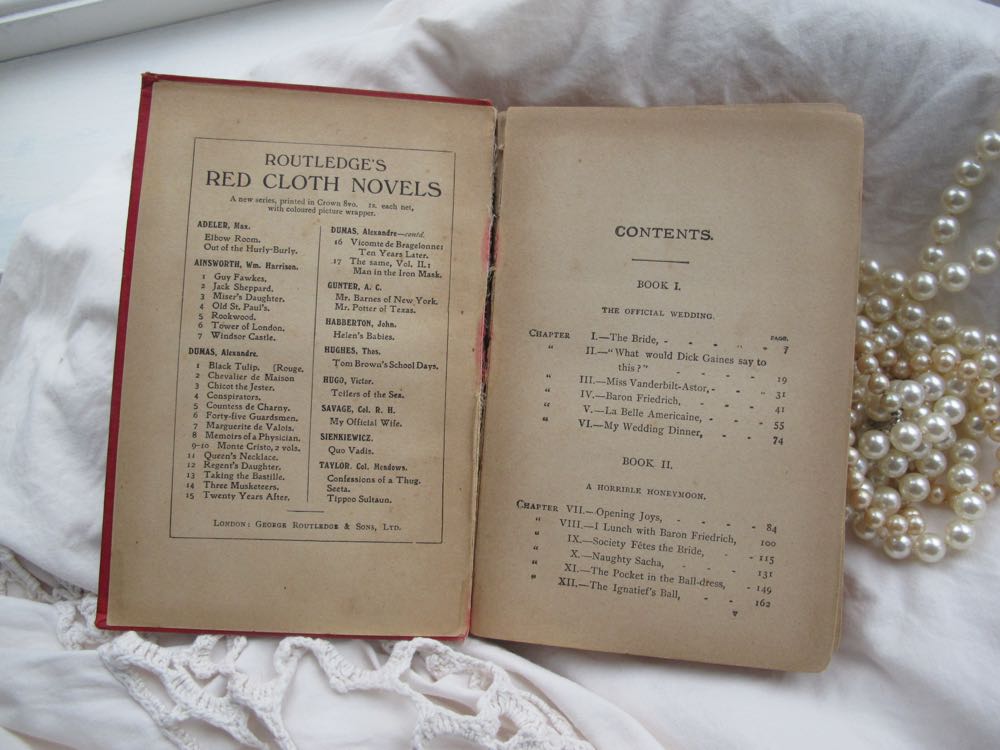
Friday Reads: My Official Wife

When you find an old book with a title like ‘My Official Wife‘ for 50 cents at an op shop, how could you possibly pass it up?  Even if it’s terribly battered and slightly falling apart?  With that name, you just have to know what’s inside!

My Official Wife, book review thedreamstress.com

Little did I realise when I bought it that My Official Wife was once well known.  It was a bestseller when it was published in 1891, and made Savage a household name.

It’s also hilariously, awesomely, terrible.

My Official Wife was Richard Henry Savage’s first novel, and it draws heavily on his life.  Like Savage, the ‘hero’ (more on those quote marks later), Colonel Arthur Lenox, is a retired army man.  Both men had experience serving in forces all over the world, from their native US, to Egypt.  Savage & Lenox both had a single child, a daughter, who married a Russian noble & government official.

Colonel Lenox’s first visit to Russia to see his now-married daughter, and meet his extended family of highly-placed in-laws, precipitates the book’s action.  Mrs Lenox elects to remain in Paris, so Colonel Lenox travels alone on the passport that lists both himself, and his wife.  At the border an enchanting young lady who claims to be American (Miss Vanderbilt-Astor no less!), and to have misplaced her passport, convinces him to let her cross the border on his, as Mrs Lenox.  This subsequently turns out to be a huge problem for the Colonel, because passport fraud in Savage’s Russia is a quick ticket to Siberia.

My Official Wife, book review thedreamstress.com

The Colonel doesn’t worry about this at first, because he’s too busy being dazzled by his superlative new bride.  The new Mrs Lenox has, as an arsenal, every feminine wile the author could think of, actual brains, and the most spectacularly envy-inducing wardrobe of early 1890s couture.  Her trunks literally spill Pingat & Worth garments, from tea gowns to ball gowns.  The garments are described in rather nice detail, making for fun mental images for the historically costume inclined.

I could well imagine her ball dress, for the pivotal ball, looking much like this one (with the addition of a large and important pocket):

Evening Dress, House of Worth (French, 1858—1956), ca. 1890, 2009.300.635, Met

Lenox is easily taken in by the tea gowns and beguiling smiles.  He soon finds himself entirely out-maneuvred on every front by his newly acquired spouse, who has her own reasons for wanting to remain Mrs Lenox – at least officially.   Once he finally realises that the incredibly obvious is true, everything his new ‘wife’ has told him is a lie (she’s wasn’t even Miss Vanderbilt-Astor, gasp!), it’s too late.

As I read the book I tried to convince myself that Colonel Lenox must have been a satire of himself written by a clever and self-aware Savage.  Surely no-one would write a story where the hero is so clearly an author surrogate, and also so clearly pompous, vain, terribly chauvanistic (even by the standards of the late Victorian era) and hopelessly dumb, unless they intended it to be tongue-in-cheek?

The further I read, the more I realised, with mounting horror, that Savage the author clearly thought that Lenox-the-author-stand-in was smart and brave and quick witted.  In short, a hero the reader would identify with, admire, and cheer for.  When he wrote “I might have been surprised at her sudden change in manner had I not been accustomed to the peculiar freaks and emotions of womanhood, having made the fair sex my study – perhaps, I may say, my plaything”, he meant it, despite also having written a character who was easily deceived, even in the face of multiple obvious clues to the contrary, by a pretty face.

Savage’s hero could only be as clever as his author (and the plot holes suggest that Savage really wasn’t that clever), but he could have at least written a hero with an admirable character – and Lenox is not.  Lenox, upon finding that he’s brought a cuckoo into the diamond-lined nest of the Russian nobility, decides that if she’s going to pretend to be his wife, he’s going to take his full rights as husband (to use a really awful euphemism).  Not-Miss-V-A only manages to fight him off by saying that if he is a ‘man’ he won’t take advantage of a defenceless woman, and if he’s a coward he will.  He retreats, frustrated and angry, refusing to be a coward (because apparently that’s worse than a rapist?).  The part where he would have been cheating on his very-alive real wife doesn’t even cross his mind – thought what the real Mrs Lenox would think, knowing that she’s being represented by an imposter, is mentioned with much hand-wringing every time his Official Wife presents herself as ‘Mrs Lenox’.

Though My Official Wife was reasonably well reviewed in it’s own time, critics did note that it was improbable, and the writing more verbose than polished.  Savage’s numerous subsequent books were almost universally savaged.  His heroes and spy systems were “incredibly idiotic and futile“, and his writing so notoriously sensationalist that reviewers mocked it at length (this one is particularly funny)

Despite the florid writing, unpalatable hero, and the tone-deaf author, the book is a fascinating look at Russian politics during the last two decades of the 19th century.  It provides an interesting (if probably sensationalised)  depiction of how reactionary and restrictive Russia was under the extremely conservative Alexander III.  The Tzar spent most of his reign attempting to reverse all of the liberal reforms of his father, who had been assasinated.  The plot revolves around  lasting effects of Nihilism and the White Terror and the longer-term repercussions of Russian subjugation of Jews and reprisals in Poland & Lithuania in response to the January Uprising.   Savage’s writing hardly does the heftier topics justice, nor are his sympathies and moralities likely to appeal to modern audiences, but as a glimpse into how the topics were presented in a pop-culture format in the Victorian era, it’s worth a read.

And the clothes descriptions are amazing!

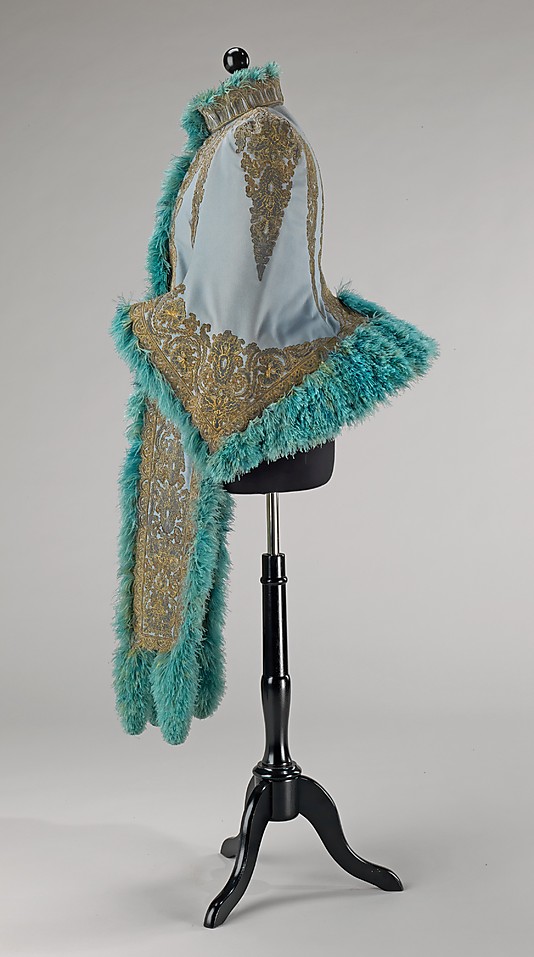
Emile Pingat, mantle, 1891, Metropolitan Museum of Art   2009.300.337

SaveSave